Author: Frank, PANews
At most technology conferences, the most common question is "who released what." But at the mu Shanghai AI WEEK in May 2026, the frequent question PANews heard was more practical: As AI makes it increasingly easy to build product prototypes, what has truly become the hardest part of entrepreneurship?
What made this event special was that it didn't feel like a standard conference, but more like a temporarily constructed developer space. There were few booths, few corporate pitches, and no fixed topics. A large number of overseas developers flew to Shanghai from Argentina, Silicon Valley, Japan, or Southeast Asia, just to connect with Chinese developers, model companies, investors, and the local ecosystem over the course of a month.
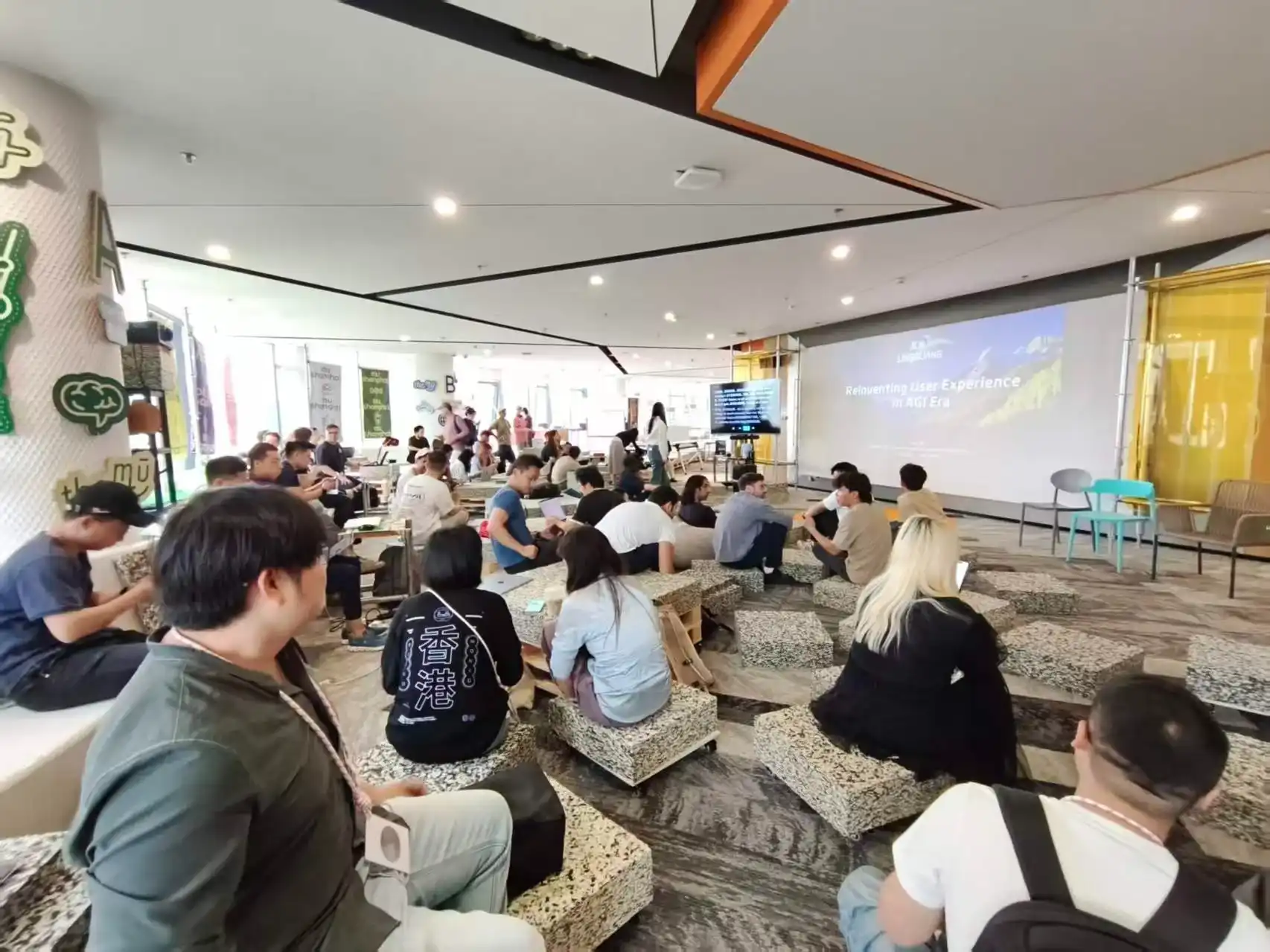
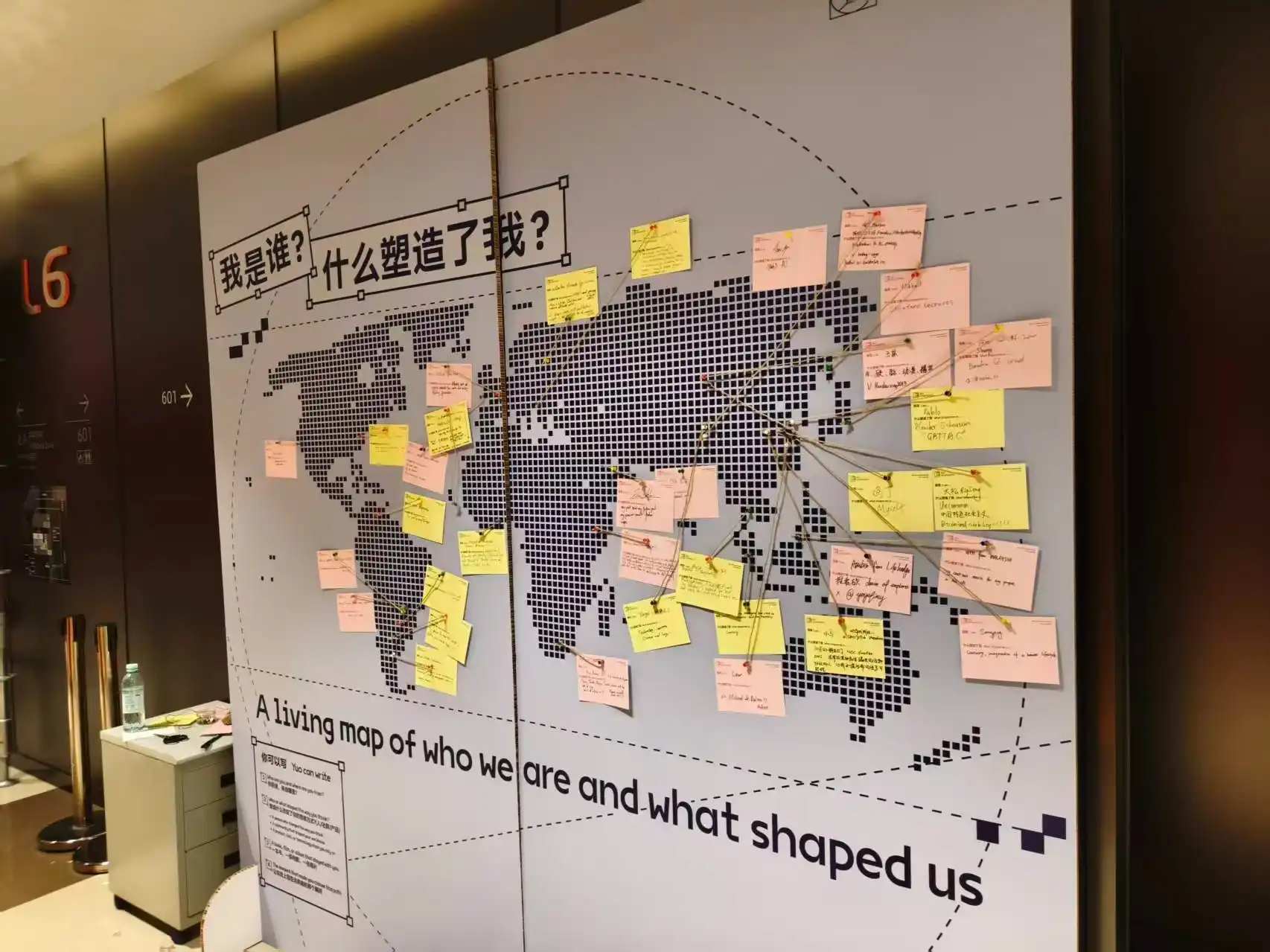
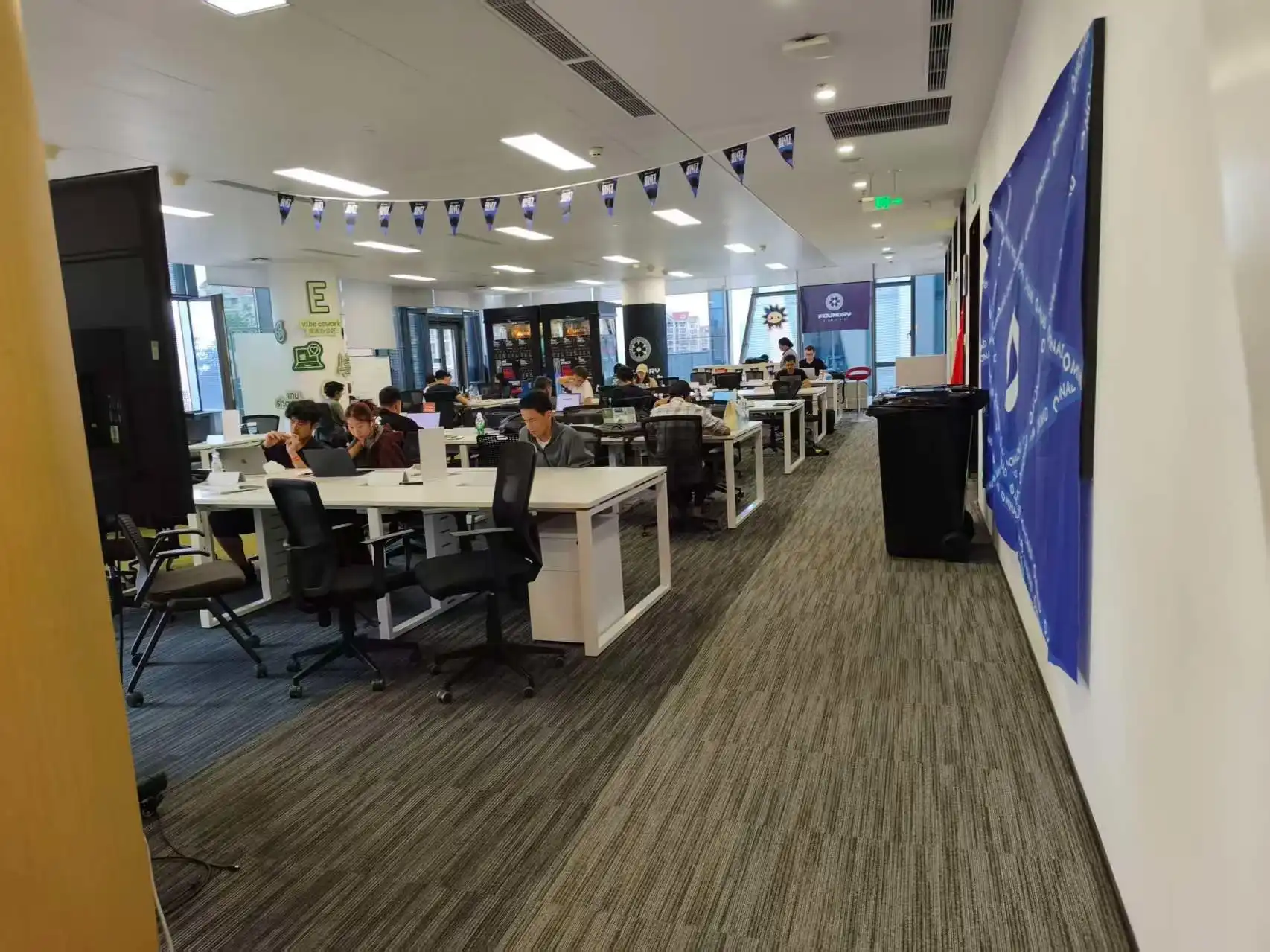
The venue wasn't set up as a traditional hotel conference hall, but as a hybrid space of open-plan work areas, stepped seating pads, bean bags, and temporary projectors. Some people sat at workstations typing code, others gathered on rugs and square cushions listening to talks, while some leaned in corners continuing to work on their products. Colorful mu Shanghai flags hung on the walls. A world map with the question "Who am I? What shaped me?" was covered with sticky notes and connecting lines, resembling an identity network being collectively filled in by participants.
Through conversations at the scene with multiple organizers, project teams, investors, and model company representatives, PANews found that AI entrepreneurship is entering a new phase. If "who can access models faster and build products" was the first phase of AI entrepreneurship; then the second phase is "who can find real-world scenarios, acquire users, build communities, and survive long enough." If models are the utilities (water, electricity, gas), then what is truly scarce now is no longer just the ability to connect the pipes, but who can find the people who most need the water.
A Deep Social Experiment with Global Developers
The most unusual aspect of mu Shanghai was first reflected in its organizational form. Founder Sun mentioned in an interview with PANews that mu didn't start in China initially, but spread in forms like pop-up cities and startup communities in places like Thailand, Argentina, Africa, and Japan. Compared to traditional two- or three-day conferences, it emphasizes a group of people entering the same city for about a month to co-create, exchange, live, and build relationships.
This format naturally gives the event a strong community attribute. According to Sun, about 2000 people registered for this mu Shanghai, with over 800 ultimately selected. The participant composition was also quite diverse: Chinese participants accounted for about 20%, other Asian regions like Japan, Korea, India about 18%, Southeast Asia about 16%, Latin America, the US, and Europe about 10%, 10%, and 11% respectively, and Africa about 6%. By industry background, AI practitioners accounted for about 40%, Web3-related practitioners about 20% to 30%, with additional groups from hardware, biotech, investment, etc.
Sun explained the appeal of this event format in the interview: "After leaving university, people rarely have that kind of deep relationship again. It's also hard to form such connections in work and big cities, so I think it's very valuable." In his view, what mu attempts to replicate is not the fleeting traffic of traditional conferences, but a relationship density closer to university, community, and shared living.
The scene indeed felt closer to this state. The main stage wasn't always the center of the space; subtitles next to projection screens, temporary display racks, and computers scattered everywhere together formed the daily backdrop of the event. During a sharing session on user experience, the audience wasn't neatly seated on chairs but dispersed among low cushions, the floor, and open workstations. The speaker shared at the front, while people below listened while taking notes, replying to messages, or continuing to work on their projects. This slightly loose state was closer to the real way developer communities operate.
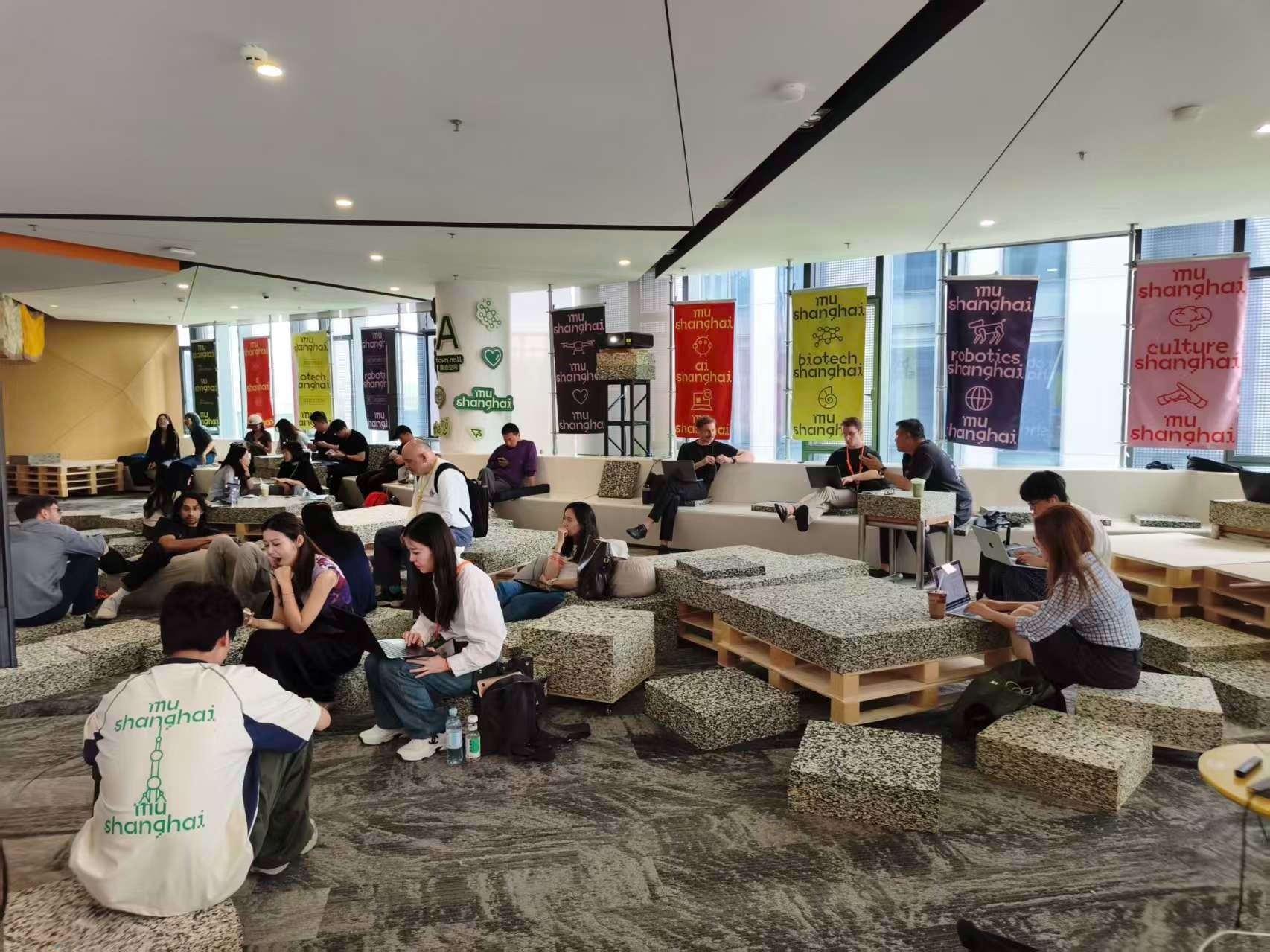
The significance of these numbers lies not in the event scale itself, but in showcasing an organizational logic different from traditional exhibitions. Traditional conferences often connect brands and users, companies and clients; mu Shanghai felt more like connecting Chinese and foreign developer cultures. There were large model roundtables, hackathons, co-creation activities, language learning, community sharing, and impromptu discussions. Feng Wen, Product Lead at MiniMax, mentioned in an on-site exchange that the atmosphere here wasn't just about "taking the stage to share about AI," but also included cultural exchange, developer co-creation, and community participation.
The presence of a large number of Web3 practitioners also made this connection more complex. What the Web3 industry has accumulated over the past few years isn't just on-chain assets and speculative narratives, but also a set of methods for community mobilization, global collaboration, social media dissemination, and developer organization. As AI entrepreneurship shifts from competing on model access to competing on user reach, this set of methods regains value.
From 'How to Build' to 'Who to Sell To': AI Entrepreneurship Enters Deep Waters
The most obvious feeling PANews had at the scene was that AI entrepreneurs are no longer excited for long about "whether they can build a product." Multimodal models, code generation tools, Agent frameworks, and automated workflows are rapidly lowering the barrier for product prototyping. A small tool that previously required designers, engineers, and operations to complete might now have an initial version built by a few people in a few nights using AI coding tools.
Newer data better illustrates this change in threshold. The AI Pulse survey conducted by JetBrains in January 2026 showed that 90% of professional developers already routinely use at least one AI tool at work, and 74% have adopted specialized AI tools for developers. For entrepreneurs, "being able to build" is becoming a more common capability, no longer a natural barrier.
However, once the product is built, the real problems begin. A founder named Nathan told PANews he is working on a product to help AI entrepreneurs find startup directions. The logic is that AI can already expand information collection range, solidify the judgment and taste of serial entrepreneurs into a set of rules, and then let AI discover signals of business opportunities. But this product itself reveals a larger reality: as building products becomes easier, "what exactly to build" becomes the scarcer question.
Nathan told PANews: "With AI coding tools, making something new is already fast. The real key is whether this direction is worth pursuing." The product he is making essentially productizes the act of "finding direction." This case is small but reflects a new change in AI entrepreneurship: when execution is amplified by AI, judgment becomes the scarce asset.
In the roundtable "Innovative Practices and Path Exploration in the AI Consumer Ecosystem" hosted by PANews, multiple guests expressed similar views: AI indeed makes rapid prototyping, demo samples, and initial launch easier, but the truly difficult parts of entrepreneurship haven't disappeared. User acquisition, commercialization, community stickiness, user education, and human-to-human connections still require teams to have more composite capabilities.
In other words, AI lowers the development threshold, not the entrepreneurship threshold. In the past, the first hurdle in product competition was "can it be built?" Now that this hurdle is significantly lowered, the real filtering starts moving later to distribution, scenarios, and commercialization. An on-site intervieee summarized it as: making tools isn't hard now; what's hard is getting the product, IP, and value seen by more people.
This is also a common dilemma faced by many AI tools. The more tools there are, the harder it is for users to choose; the stronger the models, the easier it is for single-point functions to be swallowed by the next model update. For entrepreneurs, a product that seems viable today might lose its raison d'être in 6 months because underlying model capabilities improve. Therefore, the real question isn't "whether to do AI," but whether one can find a specific scenario that the model cannot completely erase in the short term.
AI usage is rapidly spreading, but between tool usage and stable value, there still lies scenarios, processes, governance, and organizational capabilities.
Web3 People Flooding into AI, Not Just Chasing Hype
If viewed only from a narrative perspective, Web3 people flooding into AI might seem like just another hype migration. But at mu Shanghai, there were more practical reasons behind this migration.
On one hand, the wealth effects, capital dividends, and technological dividends of the crypto industry are waning, and many practitioners are looking for new tech directions; on the other hand, AI applications恰好 need the capabilities Web3 is most familiar with: community, globalized communication, developer relations, and social media distribution.
A senior Web3 practitioner said bluntly on-site that the crypto industry has been around for 10 years, and most of the capital and knowledge arbitrage opportunities are over; now it's better to move towards new tech directions. He advised entrepreneurs to gradually shift their careers, personal brands, and asset allocation towards AI, rather than continuing to heavily bet on cryptocurrencies. This assessment may not represent all Web3 practitioners, but it did reflect the real mindset of some people present.
He expressed it directly: "I think AI is worth long-term investment. By investment, I don't just mean using tools, but gradually shifting one's career, personal brand, and asset allocation towards AI." His personal choice was to transition into an AI-focused blogger, holding a sports camera to film Vlogs of teams building AI products at the event.
Such judgments may not represent all Web3 practitioners, but they were enough to illustrate the on-site atmosphere: AI is no longer just an optional track, but is becoming a direction for some Web3 practitioners to reconfigure their time, assets, and professional identities.
The AI-driven social media assistant XerpaAI had a booth at the event. Their staff said in an interview, "We are a pure AI project, technically not much related to Web3. But from the user side, we will definitely reach Web3 users. For example, the X AI Assistant will serve some Web3 users with operational needs." This statement well represents the ambiguous relationship between current AI applications and the Web3 community: the product doesn't have to be Web3, but users, dissemination, and early needs often cannot avoid Web3.
In on-site exchanges, model company representatives also mentioned that the user groups of AI and Web3 are increasingly difficult to completely separate; many heavy users of AI tools originally come from Web3 backgrounds. Especially in scenarios like Hong Kong and Shanghai, AI and Web3 often share the same group of high-frequency event attendees, early users, and community dissemination nodes. For them, they don't reject whether community members are Web3 users; as long as the theme is AI, everyone's goals are aligned.
From this perspective, Web3 entering AI isn't just a "change of scene." What Web3 brings isn't the on-chain technology itself, but a set of methods on how to gather global developers around a project, sustain discussions, and contribute attention. For current AI applications, this capability might be harder to replicate than a short-term feature.
Hardware, Supply Chain, and the Chinese Foundation
Compared to the anxiety over "whether AI software apps will be eaten by models," discussions on AI hardware, embodied intelligence, and the Chinese supply chain at the scene felt more certain. Multiple interviewees mentioned that as AI enters the real world in the future, hardware, robotics, embodied intelligence, and multi-sensory interaction will see greater opportunities. In the consumer-grade AI roundtable hosted by PANews, Feng Wen, Open Platform Product Lead at MiniMax, also predicted that smart hardware, robotics, and embodied intelligence will reach an important inflection point in the next three to five years; AI will no longer exist only in software interfaces but also enter the real physical world.
Outside the venue, the robotics track is also becoming a focus. A human vs. robot parcel sorting competition hosted by overseas robotics company Figur on May 18 sparked widespread online discussion. Even though humans won by a narrow margin within 10 hours, it's clear that over longer timeframes, robots have become the winners. The Stanford HAI "2026 AI Index" also shows that AI agents' accuracy in real-world computer task tests like OSWorld improved from about 12% to 66.3%, autonomous driving has begun to see scaled deployment, and China's Apollo Go completed 11 million fully driverless trips cumulatively.
AI entering the real world through hardware, robotics, and on-device deployment is no longer just a distant narrative.
This is precisely the special advantage of the Chinese ecosystem. Sun repeatedly mentioned in the interview that China possesses almost the entire supply chain from hardware, AI, life tech to infrastructure. For overseas entrepreneurs, if they want to do AI hardware, whether it's raw materials, factories, engineers, or rapid prototyping capabilities, it's ultimately hard to avoid China. He also revealed that for many entrepreneurs coming from overseas to China for this event, the goal was to experience and closely observe China's complete industrial chain.
Sun stated: "As long as you're doing hardware, overseas teams will eventually return to China to find supply chains, raw materials, engineers, and prototyping capabilities." He believes that in the next five to ten years, more international talent will come to China to find supply chains, raw materials, talent, and capital. For overseas entrepreneurs, China is not just a market, but a set of infrastructure for product realization.
A venture capital professional told PANews on-site that their main goal for participating was to see if there were more hard tech, embodied intelligence, and world model projects, rather than purely consumer applications. Their logic was that if the replication cost of software AI is decreasing, then hardware, supply chain, and real-world interaction might instead become barriers harder to be directly erased by model updates.
However, the attractiveness of the Chinese AI ecosystem to overseas developers doesn't come only from the supply chain. The emergence of domestic models like DeepSeek, Kimi, MiniMax, Zhipu, and Qwen has made overseas developers start to reconsider Chinese model capabilities. But Chinese models going overseas still face trust and deployment challenges. Feng Wen, Open Platform Product Lead at MiniMax, mentioned that Chinese models mainly gain attention and brand influence overseas through open source, but many overseas developers still worry about data, compliance, and trust issues. Even if models are open source, most people may not have enough computing power to deploy them themselves, leading to the emergence of an intermediary layer where US companies deploy Chinese open-source models and then provide them to overseas clients.
For overseas developers, the attractiveness of the Chinese AI ecosystem no longer comes only from cost or market size, but also from continuously expanding model supply, engineering capabilities, and industrial conversion capabilities.
This means the opportunity for the Chinese AI ecosystem isn't a single line. Model capabilities, hardware supply chain, government execution, and developer communities need to operate together to truly bring overseas entrepreneurs in. The role mu Shanghai plays in this process is more like a connector bringing overseas developers into China.
Large Model Companies Begin Competing for Developer Communities
If the competition among large model companies in the past year was mainly reflected in parameters, leaderboards, and prices, then at mu Shanghai, the importance of developer communities was pushed to the forefront. Domestic large model companies don't just need more API calls; they need developers to know about them, trust them, and be willing to build applications around their models.
Feng Wen mentioned in on-site exchanges that they do a lot of developer-related work. Developer experience, event screening, guest participation, hackathons, judging, token sponsorship, etc., all need to be incorporated into the ecosystem work of model companies.
"Developers are our users, so we value developer experience highly and also hope more developers understand what we are doing," Feng Wen stated. This sentence can almost be seen as a footnote to the ecosystem strategy of domestic large model companies: models are no longer just placed on a platform waiting to be called, but must actively enter spaces where developers gather.
This isn't a choice unique to MiniMax. On-site participants revealed that Zhipu has "Origin Academy" in Beijing, with activities almost every week, and close ties to university resources like Tsinghua and Peking University; AIGC and AGI communities also continuously gather talent through fixed spaces, hackathons, hotpot gatherings, and developer nights. These spaces are becoming offline versions of developer portals.
Behind this is a larger change: model companies are no longer satisfied with "releasing the model." They need documentation, trial platforms, case studies, video tutorials, and also communities, hackathons, and developer events to help users cross the initial threshold. As Agent capabilities improve, user education itself is being reshaped. In the past, developers needed to read documentation, check error codes, and understand parameters themselves; now, Agents can help users read documentation, search for solutions, select models, and automatically correct paths.
For model companies, the real competition isn't just model call prices, but who can enter developers' daily workflows earlier. For application entrepreneurs, the real opportunity isn't just which model to connect to, but whether they can find a group of early users willing to continuously use, provide feedback, and even actively spread the word.
Being Needed, Understood, and Kept
mu Shanghai didn't provide a unified answer for AI entrepreneurship. Some are bullish on hardware, some are making social media growth assistants, some are discovering entrepreneurial opportunities, some discussed cultural出海 and spiritual consumption, while others treated it as an entry point to meet overseas developers and local partners.
But these seemingly scattered clues precisely constitute the most real current state of AI entrepreneurship. Model capabilities continue to advance, but application forms are still searching for stable scenarios; development thresholds are lowered, but distribution and commercialization become more critical; Web3 hype cools, but the community methods it left behind are being absorbed by AI; Chinese supply chain and model capabilities become important, but overseas developers still need a trusted entry point to understand China.
Sun mentioned in the interview that mu Shanghai's long-term goal isn't just to host an event, but to form a continuous space where overseas and domestic people can meet, collaborate, and create new things in the same place. In fact, mu has very few formal employees; much of the work is driven by contributors and partners. This organizational method itself resembles Web3 and open-source communities: low centralization, emphasis on contribution and relationship networks, and thus more attractive to people familiar with this culture.
Of course, this model still has many uncertainties. Whether the event can transform into a long-term space, whether community enthusiasm can solidify into real projects, whether overseas developers will stay long-term in the Chinese ecosystem, whether large model companies can convert developer activities into stable call volumes, all remain to be seen. Communities can create encounters but cannot replace business closure; cities can provide scenarios but cannot guarantee product success.
However, mu Shanghai at least made one trend clear: AI entrepreneurship is moving from "model worship" to "scenario competition," from "making tools" to "being seen by users," from single-point products to comprehensive competition involving communities, supply chains, and cross-national collaboration. For ordinary entrepreneurs, the opportunity brought by AI isn't making everyone a winner easily, but exposing more people earlier to the same, more intense screening process.
When products become increasingly easy to produce, what is truly scarce becomes the ability to understand users, enter scenarios, build trust, and continuously connect people. AI will continue to lower the production cost of tools, but it won't automatically answer "why you?" In this sense, building the product is only the first step; being needed, understood, and kept is the harder second half of AI entrepreneurship.





















