Every Ethereum Whale Cohort Now Underwater: ETH Capitulation Marking The Final Bottom?

bitcoinistPublished on 2026-02-21Last updated on 2026-02-21

Abstract

Ethereum is struggling below the $2,000 mark amid persistent selling pressure and weak market sentiment. Analysis shows all major whale cohorts are now holding ETH at an unrealized loss, with profit ratios turning negative. This increases the risk of capitulation, which could deepen short-term volatility. However, ETH has so far held above recent local support levels, suggesting large-scale selling hasn't yet occurred. Historically, such stress among large holders has sometimes marked medium-term bottoms. Technically, ETH remains fragile, trading below key moving averages with resistance near $2,200–$2,600. A sustained recovery would require improved liquidity, stronger demand, and supportive macro conditions.

Ethereum continues to struggle below the $2,000 level as persistent selling pressure and elevated uncertainty weigh on broader crypto market sentiment. Despite occasional rebound attempts, price action remains fragile, with volatility still elevated after months of corrective momentum. The inability to decisively reclaim this psychological threshold has reinforced caution among traders, particularly as liquidity conditions tighten and macro uncertainty continues to influence risk appetite across digital assets.

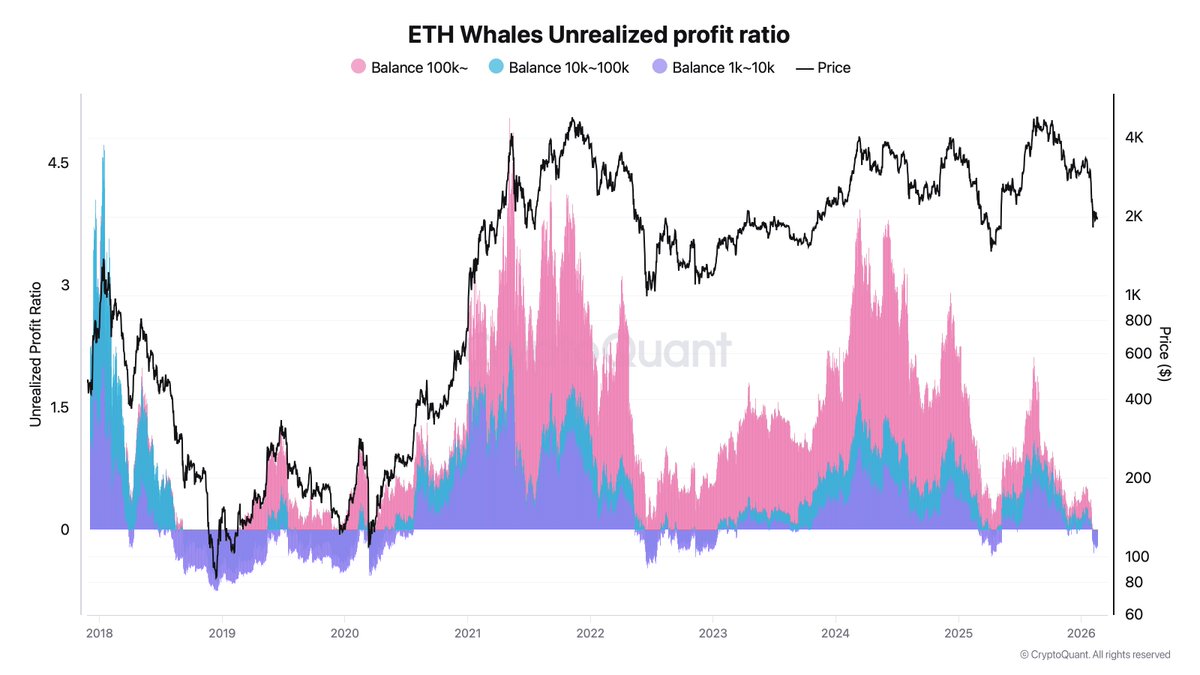
Recent analysis from Darkfost adds further context to the current market structure. According to the data, the ongoing correction is now affecting all investor cohorts, including Ethereum’s largest holders. Notably, the unrealized profit ratio for whale groups has shifted into negative territory across the board. Wallets holding between 1,000 and 10,000 ETH show an unrealized profit ratio of approximately -0.21, while those with 10,000 to 100,000 ETH stand near -0.18. Even the largest cohort — addresses holding more than 100,000 ETH — has slipped into negative territory around -0.08.

Ethereum Whales Unrealized profit ratio | Source: CryptoQuant

This development is notable because Ethereum has not yet revisited its April lows, suggesting the depth of unrealized losses is expanding earlier than in some previous corrective phases. Such conditions can increase market sensitivity, as even traditionally resilient holders may reassess positioning amid prolonged volatility.

Whale Stress Raises Capitulation Risk While Bottom Formation Signals Emerge

Darkfost further notes that if Ethereum extends its decline, large holders could face increasing financial pressure. Sustained downside would deepen unrealized losses across whale cohorts, potentially forcing some participants to reduce exposure or liquidate portions of their holdings. Historically, such capitulation events among large investors tend to amplify short-term volatility, particularly when liquidity conditions are already fragile.

However, despite the negative profit ratios now visible across whale groups, Ethereum has so far managed to stabilize above recent local support zones. This relative resilience suggests that, while sentiment remains cautious, immediate large-scale distribution from whales has not yet materialized. The distinction is important because unrealized losses alone do not necessarily trigger selling unless accompanied by liquidity stress, leverage pressure, or broader market shocks.

Periods in which major holders experience stress have often coincided with medium-term bottom formation phases in previous cycles. As weaker hands exit and leverage unwinds, markets sometimes transition into accumulation regimes characterized by lower volatility and gradual stabilization.

Still, this interpretation should be approached cautiously. Whale positioning is only one element of market structure, and confirmation typically requires improving liquidity, stronger spot demand, and supportive macro conditions before a sustained recovery can take hold.

Ethereum Price Structure Remains Fragile Below Key Averages

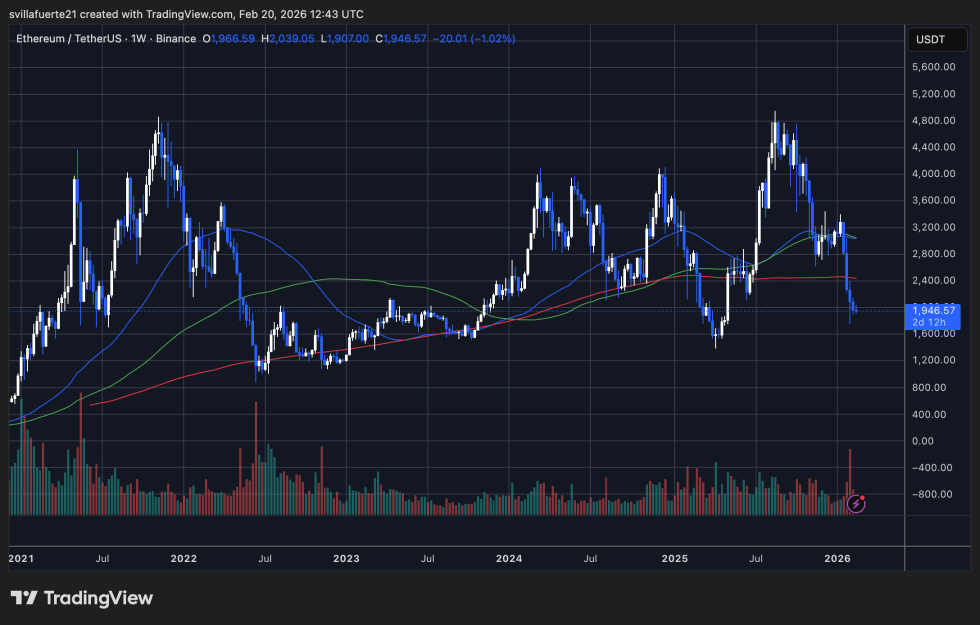
Ethereum continues to trade under clear technical pressure, with the weekly chart showing a sustained inability to reclaim the $2,000 region decisively. Following the sharp rejection from the 2025 highs near the $4,800 zone, price action has transitioned into a sequence of lower highs and weakening rebounds, typically associated with corrective market phases rather than accumulation-led recoveries.

ETH testing critical demand level | Source: ETHUSDT chart on TradingView

Technically, ETH is currently positioned below several major moving averages that previously acted as dynamic support. These levels now function as resistance, limiting upside attempts unless a strong reclaim occurs with expanding volume. The recent decline toward the $1,900 area reflects persistent selling pressure, while repeated failures near the mid-$2,000 range reinforce cautious market sentiment.

Volume activity has moderated compared with the impulsive rally phase, suggesting reduced speculative participation. While declining volume during corrections can sometimes signal seller exhaustion, confirmation of stabilization usually requires sustained buying interest rather than temporary rebounds.

From a structural perspective, immediate support appears concentrated near the recent local lows around the $1,800 region, while resistance remains clustered between roughly $2,200 and $2,600. Until Ethereum reclaims these levels convincingly, the broader technical outlook remains vulnerable, with consolidation or further downside still plausible.

Featured image from ChatGPT, chart from TradingView.com

Related Questions

QWhat is the current unrealized profit ratio for Ethereum whale cohorts holding between 1,000 and 10,000 ETH?

AThe unrealized profit ratio for wallets holding between 1,000 and 10,000 ETH is approximately -0.21.

QAccording to the article, what key psychological price level is Ethereum struggling to reclaim?

AEthereum is struggling to decisively reclaim the $2,000 psychological threshold.

QWhat potential risk arises if Ethereum extends its decline, according to Darkfost's analysis?

AIf Ethereum extends its decline, large holders could face increasing financial pressure, potentially forcing some to reduce exposure or liquidate portions of their holdings, which would amplify short-term volatility.

QWhat technical pattern is Ethereum's price action showing on the weekly chart after the rejection from 2025 highs?

AFollowing the rejection from the 2025 highs near $4,800, Ethereum's price action has transitioned into a sequence of lower highs and weakening rebounds, typical of corrective market phases.

QWhat does the article suggest periods of whale stress have often coincided with in previous market cycles?

APeriods in which major holders experience stress have often coincided with medium-term bottom formation phases in previous cycles, as weaker hands exit and leverage unwinds.

Related Reads

China's First Embodied Data Compliance Outbound: How Does Paxini Become a Game-Changer for Industry Development?

"Embodied Intelligence Data Compliance Goes Global: A Breakthrough Moment. At the 2026 World Intelligent Industry Expo, Paxini, the sole Chinese company authorized for cross-border embodied data transfer, launched a pioneering project in Tianjin. This marks the first officially approved case of its kind in China, resolving a major industry bottleneck for compliant international data flow. As the ultimate direction of AI evolution, embodied intelligence relies on vast, multi-modal physical world interaction data. Despite booming global demand, stringent compliance had previously trapped the domestic industry. Paxini's breakthrough establishes a formal compliance framework, setting a benchmark for standardized development. The core of Paxini's success lies in its industry-leading data infrastructure and compliant security architecture, aligning with national data strategy. It operates a large-scale 'data collection factory' for high-quality, multi-modal data and has established a full-chain compliant pathway from 'collection-processing-certification-outbound transfer'. This dual advantage in data scale/quality and compliance secures its leadership. Beyond immediate commercial impact, the project signifies long-term strategic value: international market validation from top-tier financial institutions and the compounding benefits of ecosystem building. High-quality physical world data possesses enduring value. By solving fundamental infrastructure and compliance challenges, Paxini not only contributes a 'Chinese model' to the global embodied intelligence industry but also solidifies a key competitive moat for the long haul. This enables safe, efficient global flow of China's quality embodied data, amplifying its influence in the intelligent manufacturing landscape."

marsbit3m ago

China's First Embodied Data Compliance Outbound: How Does Paxini Become a Game-Changer for Industry Development?

marsbit3m ago

Macroeconomic Origins of the African Payments Market Structure

Africa’s payment landscape exhibits the world’s highest mobile money penetration and fastest cryptocurrency adoption. This is not a market anomaly but a macroeconomic inevitability driven by deep structural factors: a vast, young population, heavy reliance on commodity exports and remittances generating massive cross‑border payment needs, and a chronically underdeveloped formal banking system plagued by de‑risking, high inflation, and currency instability. This vacuum has allowed mobile money (e.g., M‑Pesa) to become the primary payment channel domestically, while cryptocurrencies—particularly stablecoins—serve as a store of value against local‑currency depreciation and a lower‑cost cross‑border medium. The key divide is the Sahara: North Africa integrates with the MENA oil‑centric financial system, while Sub‑Saharan Africa, facing acute dollar shortages and fragmented currencies, is the epicenter of this fintech surge. Structural reliance on dollars, driven by trade deficits and weak local currency credibility, creates persistent dollar scarcity, which crypto and mobile payments effectively address. Efforts like the Pan‑African Payment and Settlement System (PAPSS) aim at de‑dollarization, but these alternatives will remain essential as long as underlying economic constraints—commodity dependence, limited industrialization, and financial exclusion—persist.

marsbit15m ago

Macroeconomic Origins of the African Payments Market Structure

marsbit15m ago

AAOI Defies Trend with Over 10% Surge, 'New Stock God' Serenity Predicts Potential to Double Again

On June 4th, despite a significant sell-off in the broader AI and semiconductor sector triggered by Broadcom's disappointing guidance, Applied Optoelectronics (AAOI) surged over 11%, showcasing a sharp divergence in market sentiment. Broadcom's warning about potential supply chain diversification by key customer Google and a weaker-than-expected outlook punctured the high-flying AI valuation narrative. This led to heavy selling in names like Broadcom (-12.6%) and Micron (-7%), with funds rotating into traditional industrial stocks. AAOI defied this trend. The stock has experienced high volatility recently, driven by bullish analyst coverage, notably from Rosenblatt which raised its price target to $220. Key catalysts include initial 800G optical module revenue from Amazon, potential certification from Oracle, and strong demand across its product portfolio. The company has reported cumulative orders for 800G/1.6T modules exceeding $324 million and is aggressively expanding manufacturing capacity in Texas, targeting an annualized run-rate of $1.4 billion for its module business by Q3 2027. However, AAOI's fundamentals present a mixed picture. Its Q1 2026 results missed expectations, showing a GAAP net loss, and Q2 guidance points to merely breakeven adjusted EPS. Risks include a delayed 800G production ramp to the second half of the year and high dependence on a few key cloud customers. Recent stock sales by company executives near price highs also noted. The article suggests AAOI's rally reflects a market beginning to differentiate within the AI ecosystem. While Broadcom's issues prompted a reassessment of custom ASIC and customer concentration risks, funds flowing into AAOI indicate a belief that the "physical bottleneck" narrative for optical connectivity—where supply remains tight—remains intact and is somewhat decoupled from the current sector weakness. The sustainability of AAOI's premium valuation now hinges on the successful execution of its production plans and upcoming quarterly results.

marsbit21m ago

AAOI Defies Trend with Over 10% Surge, 'New Stock God' Serenity Predicts Potential to Double Again

marsbit21m ago

Trading

Spot
Futures

Hot Articles

Discussions

Welcome to the HTX Community. Here, you can stay informed about the latest platform developments and gain access to professional market insights. Users' opinions on the price of ETH (ETH) are presented below.

活动图片