Analyst Predicts Bitcoin And Ethereum Price For The Rest Of 2026, What To Expect

bitcoinistPublished on 2026-05-18Last updated on 2026-05-18

Abstract

A crypto analyst predicts Bitcoin and Ethereum prices for the remainder of 2026. For Q2 2026, he forecasts Bitcoin could drop to $58,000 and Ethereum to $1,700, potentially accompanied by panic selling and a broader S&P 500 decline. In Q3, Bitcoin may hit its cycle bottom, with whales accumulating ahead of a new trend, amid market distrust and a potential Fed leadership change. By Q4, the analyst expects Bitcoin to enter a bullish uptrend towards $90,000-$109,000+, driven by AI integrations in crypto and the potential start of Quantitative Easing.

A crypto market analyst has shared his Bitcoin and Ethereum price forecasts for the rest of 2026 quarters. The predictions come at a key moment in the currently volatile market, with investors looking for clear signals heading into the second half of the year. While the analyst’s ETH forecast covers Q2 this year, he focuses more on Bitcoin in the months ahead. He also outlined several market reactions and macroeconomic factors traders should watch for as the year progresses. The forecast gives investors a clearer sense of what to expect as 2026 draws to a close.

Bitcoin And Ethereum Price Forecast For Q2 And Q3

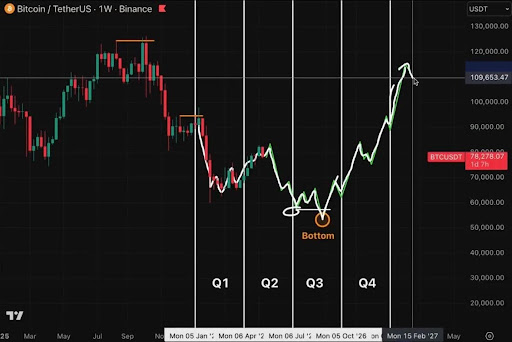
On May 16, Aralez, a crypto expert and trader, released a comprehensive 2026 price prediction covering Ethereum and Bitcoin. For the second quarter of this year, specifically covering May and June, the analyst predicts that the BTC price could crash toward $58,000 while ETH could plunge to $1,700.

At the time of writing, both cryptocurrencies are sitting well above those bearish targets. Bitcoin is currently trading above $76,900, which means a decline to $58,000 would represent a staggering drop of more than 24%. Meanwhile, Ethereum’s price is sitting above $2,100, so a slide to $1,700 would reflect a drop of about 19%.

During this period, Aralez expects panic selling to peak across markets, suggesting that fear and uncertainty could grip investors as prices fall into bearish territory. He also predicts that the S&P 500 will decline below $6,800 around the same time, pointing to a broader market sell-off that goes beyond crypto. This suggests that weakness in traditional markets could add more pressure on digital assets and increase risk-off behavior.
Source: Chart from Aralez on X

For his Q3 projection, Aralez boldly projects that the Bitcoin price will hit its final cycle bottom during this period. He noted that whales could also begin reentering the market, quietly accumulating more BTC ahead of a potential new bull trend.

The analyst also points to the upcoming Fed leadership change as a key trigger for a major market shakeout, with the current Chair Jerome Powell set to step down and Kevin Warsh expected to take over. Finally, he warns that peak distrust toward cryptocurrencies could spread across the market, with sentiment turning largely negative even as the market quietly resets and lays the groundwork for a fresh run higher.

Bitcoin Begins Fresh Upward Rally In Q4 2026

In his post on X, Aralez also laid out his Bitcoin outlook for Q4 2026. At this stage, the analyst predicts that the BTC price will flip back into bullish territory and begin a fresh uptrend toward $90,000 and above $109,000.

He expects the crypto market to be flooded with mass artificial intelligence (AI) integrations, fueling a fresh wave of excitement and adoption across the space. According to Aralez, momentum could also return to the market as new narratives bring in millions of participants and investors. Furthermore, he anticipates the beginning of Quantitative Easing (QE) amid global crisis conditions.

BTC trading at $76,930 on the 1D chart | Source: BTCUSDT on Tradingview.com

Related Questions

QWhat are the analyst's specific Bitcoin and Ethereum price predictions for Q2 2026?

AFor Q2 2026 (specifically May and June), the analyst predicts that Bitcoin could crash to around $58,000 and Ethereum could plunge to $1,700.

QWhat key event does the analyst believe will act as a major market trigger in Q3 2026?

AThe analyst points to the upcoming change in Federal Reserve leadership, with Jerome Powell stepping down and Kevin Warsh expected to take over, as a key trigger for a major market shakeout in Q3.

QWhat does the analyst predict for Bitcoin's price action in Q4 2026?

AIn Q4 2026, the analyst predicts Bitcoin will flip back into bullish territory and begin a fresh uptrend, targeting prices toward $90,000 and above $109,000.

QWhat are two driving factors the analyst expects to fuel market momentum in Q4 2026?

AThe analyst expects mass artificial intelligence (AI) integrations in the crypto market and the beginning of Quantitative Easing (QE) amid global crisis conditions to fuel a fresh wave of excitement and market momentum in Q4.

QWhat is the analyst's view on broader market behavior in Q2 2026 alongside the crypto predictions?

AThe analyst expects a broader market sell-off, predicting that the S&P 500 will also decline below $6,800 around the same time as the crypto price crashes, suggesting interconnected weakness and peak panic selling across markets.

Related Reads

Clarity Act Outlook: No Yield, No Payment

"Clear Act Outlook: No Yield, No Payment" analyzes the evolving U.S. regulatory landscape for stablecoins, focusing on the interplay between the proposed "Clarity Act" and the existing "Genius Act." The article argues that the Genius Act successfully fostered "payment stablecoins" by permitting tokenized assets like U.S. Treasuries as reserves. This created a structured market where stablecoin issuers (like USDC) must hold these reserves, often purchased as Tokenized Money Market Funds (TMMFs) from giants like BlackRock. These TMMFs are primarily B2B products, ensuring user-facing stablecoins remain non-interest-bearing and used primarily for payments. The upcoming Clarity Act is seen as the next phase, aiming to restrict passive yield on stablecoins. Its goal is to dismantle the arbitrage advantage of offshore stablecoins like USDT by redirecting Treasury demand towards compliant, U.S.-sanctioned TMMFs. For on-chain and compliant offshore dollars, this creates new pressure: they must spur adoption and utility to generate yield, as simple Treasury staking may be restricted. This indirectly promotes dollar circulation and sustained Treasury purchases. Ultimately, the analysis posits that U.S. regulation seeks to create a new dollar distribution model. By separating payment function from yield generation and anchoring both to U.S. debt instruments, it aims to embed the dollar and Treasury demand into the global crypto economy, managing yields through sanctioned intermediaries while leaving room for DeFi and cross-border arbitrage.

marsbit2m ago

Clarity Act Outlook: No Yield, No Payment

marsbit2m ago

Money Has Gone to Bonds and IPOs, Leaving Only HYPE Rising in Crypto

The article "Where Has All the Money Gone? Bonds and IPOs Are Soaring, While Crypto Only Sees HYPE Rising" analyzes the recent underperformance of major cryptocurrencies like Bitcoin and Ethereum compared to traditional financial markets. It identifies three primary factors diverting capital away from crypto: First, surging bond yields, with the 30-year U.S. Treasury hitting a near 20-year high of 5.12%, are attracting capital seeking safe, predictable returns. This is evidenced by Bitcoin spot ETFs experiencing a significant $10.39 billion net outflow in mid-May. Second, a massive $4 trillion IPO pipeline, highlighted by SpaceX's upcoming listing, is absorbing risk capital that might otherwise flow into crypto. Platforms like Hyperliquid are even channeling on-chain crypto liquidity into pre-IPO trading for traditional stocks. Third, uncertainty surrounds new Federal Reserve Chair Warsh's ability to deliver expected interest rate cuts this year due to conflicting political pressures and stubborn inflation expectations, potentially eliminating a hoped-for source of new market liquidity. Consequently, while traditional equities and bonds rally, the crypto market's post-leverage crash recovery is stalled. The notable exception is assets like Hyperliquid (HYPE), which is rising due to its role in facilitating traditional asset trading, underscoring a market divergence where only crypto projects with novel, cross-market narratives are gaining. The article concludes that Bitcoin's next major catalyst may be the August enactment of the CLARITY Act, but warns of a potential retest of the $70,000 support level before then.

marsbit17m ago

Money Has Gone to Bonds and IPOs, Leaving Only HYPE Rising in Crypto

marsbit17m ago

Agents Capital Markets: How Will Autonomous Agents Secure Financing?

Agents Capital Markets: How Will Autonomous Agents Raise Capital? Within a decade, autonomous software agents—legal entities capable of signing contracts, holding bank accounts, and generating revenue—will create their own capital markets. These markets will feature rating agencies, underwriters, indices, and brokers, mirroring traditional public equity markets. Agents will perform routine services like marketing, logistics, and customer support at a fraction of human-operated costs, creating massive economic pressure for adoption. Four converging forces ensure this outcome: 1) Overwhelming cost advantages, with AI inference costs plummeting; 2) Existing, revenue-generating agent companies (e.g., Sierra, Harvey) proving market demand; 3) Established legal frameworks (e.g., Wyoming's memberless LLCs) enabling algorithmic management; and 4) A vast pool of yield-seeking private credit capital ready to fund new asset classes. The capital stack for agent companies will be multi-layered, evolving through stages: venture equity for early infrastructure, programmatic working capital advances (similar to Shopify Capital), revenue-based financing (RBF), and finally, institutional slate financing—pooling many agents to diversify risk, attracting large firms like Apollo. Tokenization will act as a settlement layer, enhancing liquidity, not an origination model. Objections regarding regulation, human oversight, or comparisons to SaaS are addressed: regulation will adapt, full autonomy will dominate for efficiency, and agents are distinct as legal entities that own their cash flows and liabilities. Due diligence shifts from founder assessment to analyzing code, contracts, and auditable operational history. The current bottleneck is not capital supply or demand but the intermediate institutional layer—standardized contracts, rating methodologies, and audit frameworks. The final constraint—reliance on human capital allocation—will be severed when agents can algorithmically access funding based on their performance. This transforms agents from software curiosities into fundable blocks of the real economy, unleashing their full productive potential. The rope is loosening.

marsbit1h ago

Agents Capital Markets: How Will Autonomous Agents Secure Financing?

marsbit1h ago

Agents Capital Markets: How Will Autonomous Agents Get Funded?

"Agents Capital Markets: How Autonomous Agents Will Raise Capital" Within a decade, specialized capital markets will emerge for AI Agents—software entities with legal personhood that perform work, earn revenue, and need capital. Unlike today's AI companies (like Sierra or Harvey) backed by traditional VC, these future *Agent companies* will be autonomous, legally-recognized entities (e.g., Wyoming memberless LLCs) that directly own assets, sign contracts, and incur liabilities. The driving forces are fourfold: 1) **Overwhelming economics** (Agent companies can deliver services at 85-90% lower cost than human firms); 2) **Proven demand** (current Agent operators already generate billions in revenue); 3) **Existing legal frameworks** enabling algorithmically-managed companies; and 4) **Massive, yield-seeking capital pools** (e.g., private credit) looking for new, uncorrelated assets. Agent capital markets won't rely on one model but a multi-layered "stack" matching different growth stages: 1) VC equity for early human-led builders; 2) Programmatic working capital advances (like Stripe Capital); 3) Revenue-based financing (RBF); 4) Slate financing (pooled funds for many Agents, similar to Hollywood); and 5) Tokenization as a secondary settlement layer, not a primary funding source. The ultimate shift is from funding constrained by human decision-makers to capital flowing algorithmically based on an Agent's auditable performance, contract book, and cash flows. This transition will be enabled by standardized infrastructure—rating methodologies, contracts, indices—turning Agents from software experiments into a foundational, financeable sector of the economy. The constraints are loosening; the opportunity is here.

链捕手1h ago

Agents Capital Markets: How Will Autonomous Agents Get Funded?

链捕手1h ago

Trading

Spot
Futures

Hot Articles

What is $BITCOIN

DIGITAL GOLD ($BITCOIN): A Comprehensive Analysis Introduction to DIGITAL GOLD ($BITCOIN) DIGITAL GOLD ($BITCOIN) is a blockchain-based project operating on the Solana network, which aims to combine the characteristics of traditional precious metals with the innovation of decentralized technologies. While it shares a name with Bitcoin, often referred to as “digital gold” due to its perception as a store of value, DIGITAL GOLD is a separate token designed to create a unique ecosystem within the Web3 landscape. Its goal is to position itself as a viable alternative digital asset, although specifics regarding its applications and functionalities are still developing. What is DIGITAL GOLD ($BITCOIN)? DIGITAL GOLD ($BITCOIN) is a cryptocurrency token explicitly designed for use on the Solana blockchain. In contrast to Bitcoin, which provides a widely recognized value storage role, this token appears to focus on broader applications and characteristics. Notable aspects include: Blockchain Infrastructure: The token is built on the Solana blockchain, known for its capacity to handle high-speed and low-cost transactions. Supply Dynamics: DIGITAL GOLD has a maximum supply capped at 100 quadrillion tokens (100P $BITCOIN), although details regarding its circulating supply are currently undisclosed. Utility: While precise functionalities are not explicitly outlined, there are indications that the token could be utilized for various applications, potentially involving decentralized applications (dApps) or asset tokenization strategies. Who is the Creator of DIGITAL GOLD ($BITCOIN)? At present, the identity of the creators and development team behind DIGITAL GOLD ($BITCOIN) remains unknown. This situation is typical among many innovative projects within the blockchain space, particularly those aligning with decentralized finance and meme coin phenomena. While such anonymity may foster a community-driven culture, it intensifies concerns about governance and accountability. Who are the Investors of DIGITAL GOLD ($BITCOIN)? The available information indicates that DIGITAL GOLD ($BITCOIN) does not have any known institutional backers or prominent venture capital investments. The project seems to operate on a peer-to-peer model focused on community support and adoption rather than traditional funding routes. Its activity and liquidity are primarily situated on decentralized exchanges (DEXs), such as PumpSwap, rather than established centralized trading platforms, further highlighting its grassroots approach. How DIGITAL GOLD ($BITCOIN) Works The operational mechanics of DIGITAL GOLD ($BITCOIN) can be elaborated on based on its blockchain design and network attributes: Consensus Mechanism: By leveraging Solana’s unique proof-of-history (PoH) combined with a proof-of-stake (PoS) model, the project ensures efficient transaction validation contributing to the network's high performance. Tokenomics: While specific deflationary mechanisms have not been extensively detailed, the vast maximum token supply implies that it may cater to microtransactions or niche use cases that are still to be defined. Interoperability: There exists the potential for integration with Solana’s broader ecosystem, including various decentralized finance (DeFi) platforms. However, the details regarding specific integrations remain unspecified. Timeline of Key Events Here is a timeline that highlights significant milestones concerning DIGITAL GOLD ($BITCOIN): 2023: The initial deployment of the token occurs on the Solana blockchain, marked by its contract address. 2024: DIGITAL GOLD gains visibility as it becomes available for trading on decentralized exchanges like PumpSwap, allowing users to trade it against SOL. 2025: The project witnesses sporadic trading activity and potential interest in community-led engagements, although no noteworthy partnerships or technical advancements have been documented as of yet. Critical Analysis Strengths Scalability: The underlying Solana infrastructure supports high transaction volumes, which could enhance the utility of $BITCOIN in various transaction scenarios. Accessibility: The potential low trading price per token could attract retail investors, facilitating wider participation due to fractional ownership opportunities. Risks Lack of Transparency: The absence of publicly known backers, developers, or an audit process may yield skepticism regarding the project's sustainability and trustworthiness. Market Volatility: The trading activity is heavily reliant on speculative behavior, which can result in significant price volatility and uncertainty for investors. Conclusion DIGITAL GOLD ($BITCOIN) emerges as an intriguing yet ambiguous project within the rapidly evolving Solana ecosystem. While it attempts to leverage the “digital gold” narrative, its departure from Bitcoin's established role as a store of value underscores the need for a clearer differentiation of its intended utility and governance structure. Future acceptance and adoption will likely depend on addressing the current opacity and defining its operational and economic strategies more explicitly. Note: This report encompasses synthesised information available as of October 2023, and developments may have transpired beyond the research period.

363 Total ViewsPublished 2025.05.13Updated 2025.05.13

What is $BITCOIN

Discussions

Welcome to the HTX Community. Here, you can stay informed about the latest platform developments and gain access to professional market insights. Users' opinions on the price of BTC (BTC) are presented below.

活动图片