Note de la rédaction : Cet article traite du raid aérien mené par l'armée américaine contre des cibles près du détroit d'Hormuz, en Iran, tôt dans la matinée du 10 juin, heure de Pékin. Dean Blundell, dans un ton fortement ironique, critique les revirements politiques de l'administration Trump sur la question iranienne : un hélicoptère d'attaque américain AH-64 "Apache" s'est écrasé près du détroit d'Hormuz, les deux pilotes ont été secourus et les causes de l'incident restent controversées ; Trump a d'abord qualifié l'affaire de "pas grand-chose", avant de la présenter sur Truth Social comme le "tir" par l'Iran d'un hélicoptère américain, et d'utiliser cela comme prétexte pour mener des frappes contre des installations côtières iraniennes de défense aérienne, des radars et des centres de contrôle au sol.
La véritable critique de l'article ne porte pas seulement sur cette réponse militaire, mais sur la manière répétée dont l'administration Trump crée un écran de fumée médiatique autour d'un "accord imminent". D'un côté, elle affirme que les négociations sont dans leur "phase finale" et qu'un accord pourrait être signé "dans deux ou trois jours", de l'autre, elle intensifie les actions militaires et humilie publiquement l'Iran, faisant des pourparlers diplomatiques une performance politique au service du cycle médiatique. Parallèlement, la prétendue "réponse proportionnée" américaine a provoqué de nouvelles frappes de représailles iraniennes contre des bases américaines dans la région, le détroit d'Hormuz n'a toujours pas repris un cours normal, et la pression sur les prix du pétrole et les marchés persiste. L'auteur rappelle aux lecteurs que lorsque "très proche" remplace encore et encore un progrès réel, la réaction la plus rationnelle n'est peut-être pas d'y croire, mais de le noter et de supposer que la réalité est probablement exactement le contraire.
Voici l'article original :
Commençons par la chronologie, car cette chronologie elle-même est au cœur de toute cette supercherie.
Lundi soir, un hélicoptère d'attaque de l'armée américaine AH-64 "Apache" s'est abîmé en mer dans le détroit d'Hormuz, au large des côtes d'Oman. Les deux pilotes ont survécu et sont en bonne santé — ils ont été récupérés en moins de deux heures par un navire drone. Il faut reconnaître que c'est un équipement militaire assez impressionnant, et la seule partie de cette histoire qui ait vraiment fonctionné normalement.
Mais il y a un détail que Trump n'écrira pas dans ses messages en majuscules sur les réseaux sociaux : un responsable américain a déclaré à l'Associated Press que cet "Apache" s'était écrasé après être entré en collision avec un drone iranien, et qu'on ignorait encore si cette collision était intentionnelle. Trump lui-même avait dit au Wall Street Journal que toute l'affaire n'était "pas grand-chose" et que "les pilotes allaient bien".
Donc, retenez ceci : pas grand-chose. Les pilotes vont bien. L'enquête sur les causes est en cours. Peut-être juste un accident.
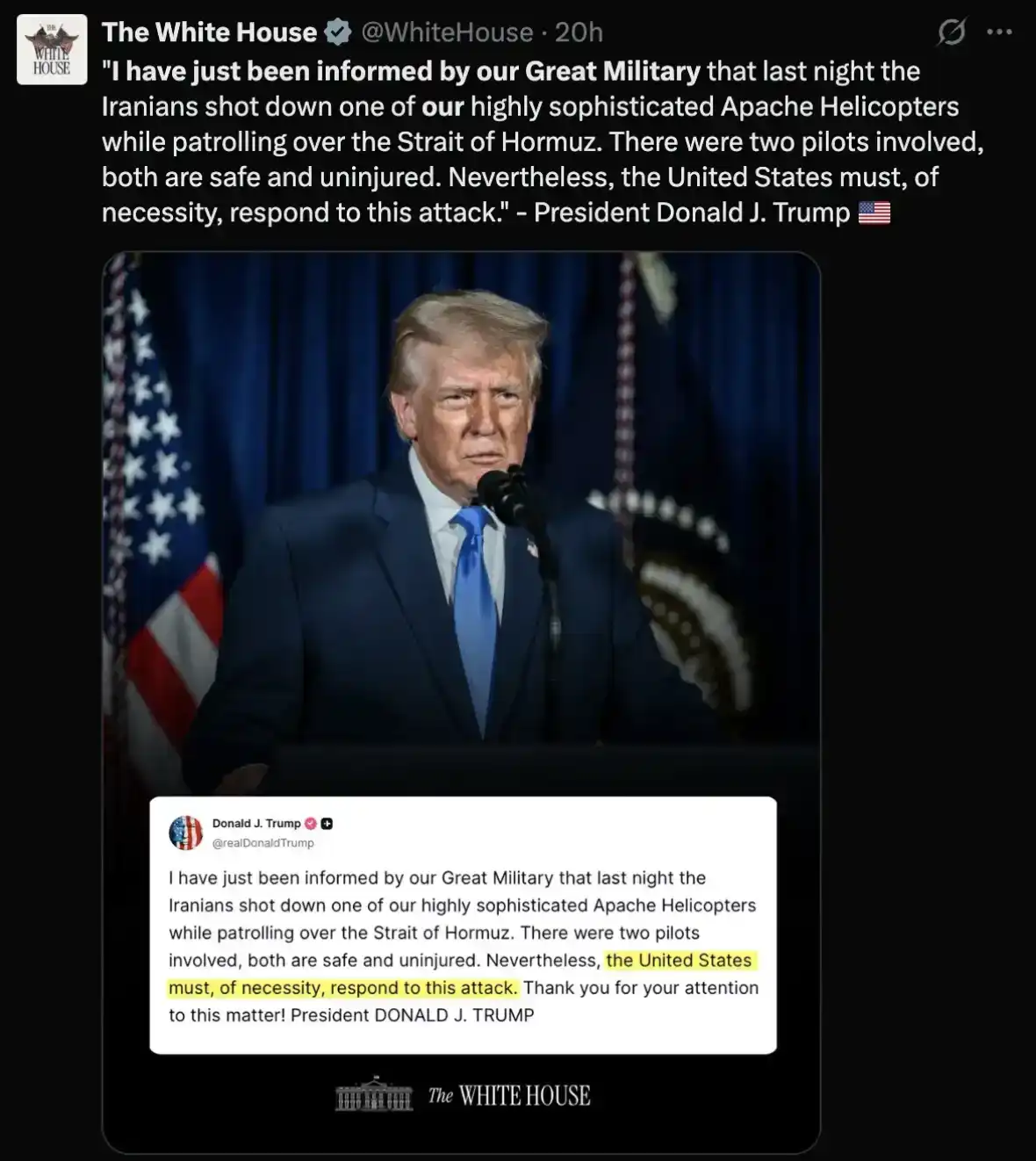
Mardi matin, la même personne, mais d'une humeur différente. Il est retourné sur Truth Social pour écrire : "Je viens de recevoir une notification de notre grande armée : hier soir, les Iraniens ont abattu l'un de nos hélicoptères Apache très avancé alors qu'il patrouillait au-dessus du détroit d'Hormuz... Il est nécessaire que les États-Unis répondent à cette attaque. Merci à tous pour votre attention !"
De "pas grand-chose" à "il est nécessaire de répondre", il n'y a eu qu'un cycle médiatique. Cette personne a contredit son propre récit en moins de 24 heures, et on s'attend apparemment à ce que nous acceptions cela en hochant la tête comme s'il s'agissait d'une forme d'art de la gouvernance.
Mardi soir à mercredi tôt dans la matinée, le Commandement central américain (CENTCOM) a commencé à mener des frappes contre des zones côtières iraniennes. L'opération a duré de mardi 22h00 GMT à mercredi vers 01h00 GMT, ciblant environ 20 sites, dont des systèmes de défense aérienne, des postes de contrôle au sol et des stations de surveillance radar, couvrant des localités comme l'île de Qeshm, Goruk, Bandar Abbas, Jask, Sirik et Minab, le long du détroit d'Hormuz et à l'intérieur de celui-ci. Le Pentagone a parlé de frappes "défensives", une réponse "proportionnée" à une "agression iranienne non provoquée".
Selon la télévision d'État iranienne, le résultat sur le terrain de cette prétendue "réponse proportionnée" est le suivant : deux réservoirs d'eau près de Sirik ont été touchés, privant d'eau potable environ 20 000 personnes dans la région de Bamani. La prochaine fois que vous entendrez l'expression "frappes chirurgicales", souvenez-vous de cette image.
La même nuit, l'Iran a riposté. Le Corps des gardiens de la révolution islamique (CGRI) a déclaré avoir mené 21 frappes contre des cibles américaines dans la région — des drones ont attaqué la Cinquième flotte américaine à Bahreïn et la base d'Ali Al Salem au Koweït, tandis que des missiles à longue portée ont visé la base aérienne d'Azraq en Jordanie ; ils affirment y avoir détruit un hangar abritant des F-35. La Jordanie a indiqué avoir abattu 5 missiles. Le ministre iranien des Affaires étrangères, Al Araghi, a utilisé un ton de dissuasion que Trump croit posséder : "Si vous voulez la sécurité, quittez notre région." Le président du Parlement iranien, Ghalibaf, a quant à lui déclaré : "Nous préférons utiliser le langage diplomatique, mais nous maîtrisons mieux d'autres langages."
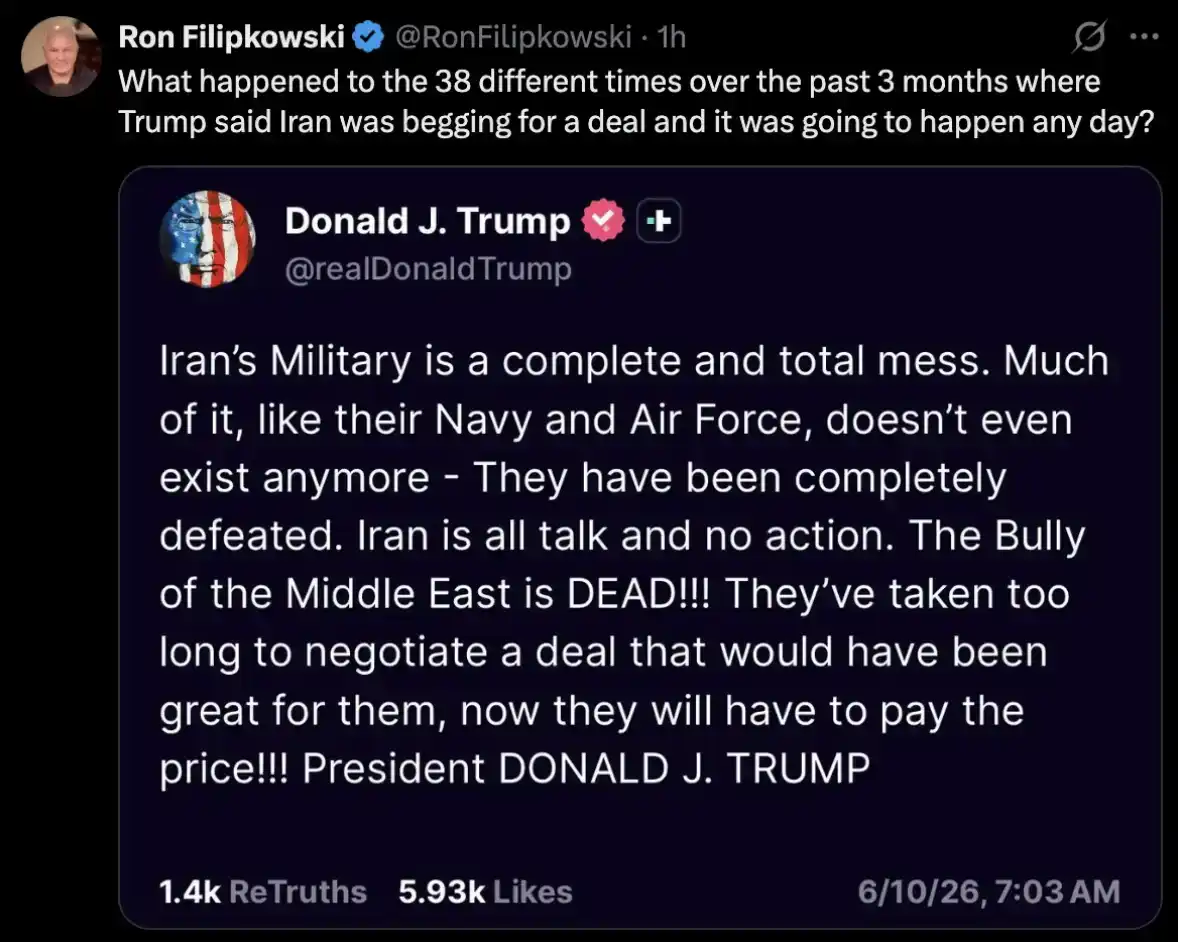
Mercredi matin. Et puis — c'est ici — que se produit le moment clé, le véritable tournant. Trump est revenu sur Truth Social, et ce "maître des transactions" a complètement enlevé son masque :
"L'armée iranienne est complètement en désarroi. La majeure partie de sa puissance, comme sa marine et son aviation, n'existe même plus — ils ont été complètement vaincus. L'Iran ne fait que parler, il ne fait rien. Le tyran du Moyen-Orient est mort !!! Ils ont mis trop de temps à négocier un accord qui leur était pourtant extrêmement favorable, maintenant ils doivent en payer le prix !!!"
"Ils ont mis trop de temps à négocier."
Trop de temps. Prononcé par la même personne qui, la veille au matin, affirmait que l'accord était dans sa "phase finale" et pourrait être signé "dans deux ou trois jours". La même personne qui, lundi soir en quittant la finale de la NBA, disait encore que les parties étaient dans la phase finale d'un "très, très bon accord", et qu'une fois signé, cet accord rouvrirait "immédiatement" le détroit d'Hormuz.
Le complexe industriel des "deux ou trois jours"
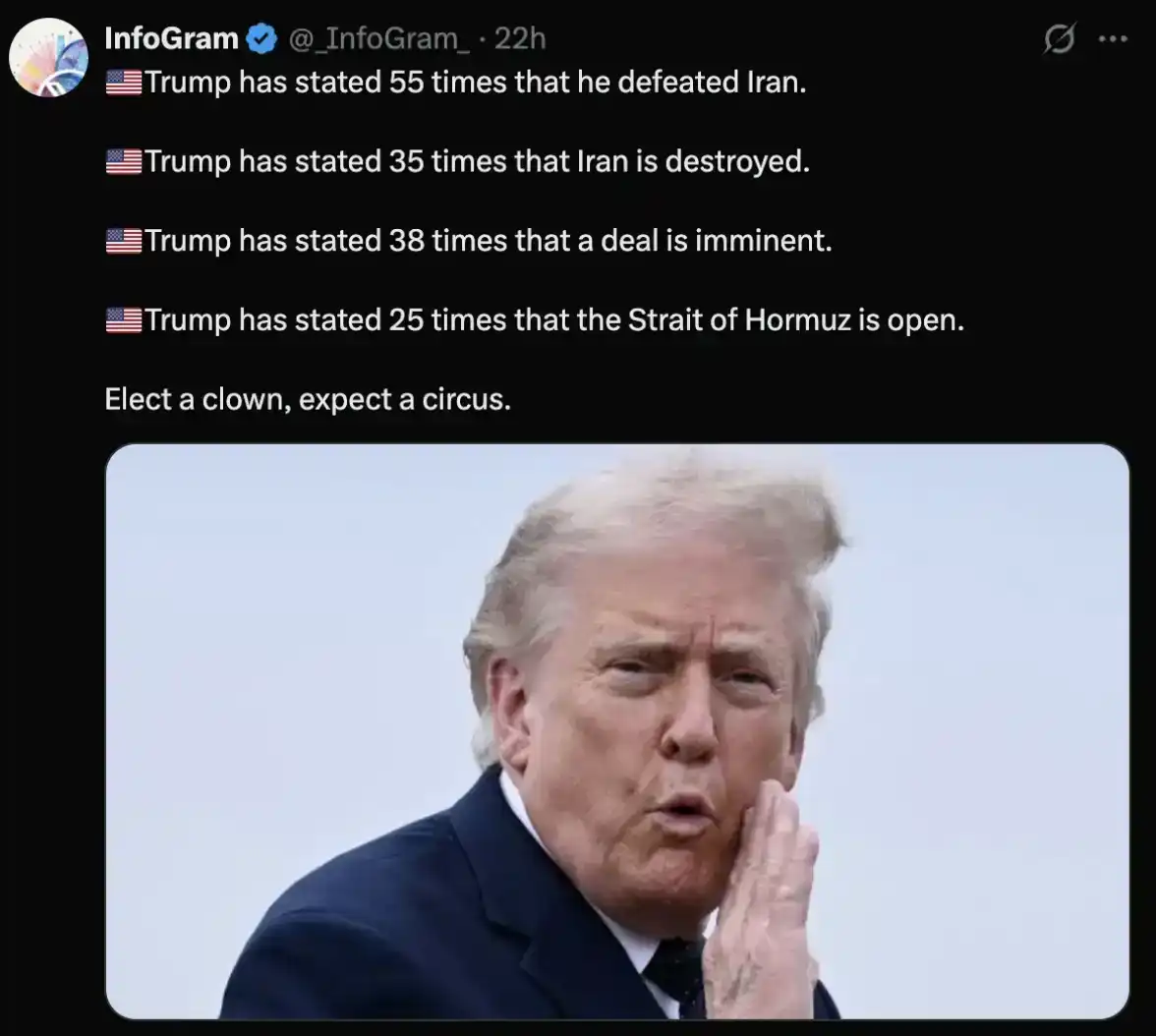
J'aimerais que vous réfléchissiez sérieusement à une chose. Pendant toute cette guerre, Trump n'a cessé de nous dire : l'accord arrive. Dimanche, cette guerre durait depuis plus de 100 jours. D'après mon décompte — oui, je les ai notés un par un, car quelqu'un doit bien le faire — depuis le début de ce conflit fin février, Trump a promis un accord imminent, brillant et à portée de main, plus de trente fois.
En voici quelques-uns piochés au hasard dans le "tiroir des reçus" :
23 mars : Annonce que les parties ont eu des "discussions très bonnes et productives" et reporte de cinq jours les frappes contre des centrales électriques qu'il avait menacé de mener. La réponse de l'Iran ? Ils ont simplement nié qu'aucune discussion n'ait eu lieu. Le prix du pétrole a d'abord baissé, puis rebondi après que Téhéran ait démenti ses affirmations.
Fin mars : Menace de "détruire" les centrales électriques iraniennes sous 48 heures si l'Iran n'ouvre pas le détroit. Ils n'ont pas ouvert. Il n'a pas agi.
Avril : Annonce une "pause de 10 jours dans la destruction des installations énergétiques". Un cessez-le-feu est déclaré. Des négociations ont ensuite lieu au Pakistan, principalement sous médiation d'Islamabad, et n'aboutissent à rien.
Cette semaine : "Phase finale." "Deux ou trois jours." "Ouverture immédiate après signature."
Mercredi : "Ils ont mis trop de temps. Doivent en payer le prix."
Ce ne sont pas des négociations. C'est une machine à sous qui ne produit que de l'exposition médiatique. À chaque fois qu'on tire sur le levier, les mêmes trois cerises apparaissent à l'écran : l'accord est sur le point d'aboutir, l'adversaire est faible, faites-moi confiance.
Et à chaque fois, JD Vance est là pour le soutenir — dimanche, il a déclaré à CBS que l'administration était "très proche" d'un accord. Très proche. Ces deux mots sont probablement les plus galvaudés de cette administration, juste derrière "appel parfait".
Enlevons le masque
Derrière ce "mec, fais-moi confiance", se cachent ces réalités.
Si vous contrôliez vraiment les négociations, vous n'auriez pas besoin de faire sauter des réservoirs d'eau pour prouver que vous êtes en train de gagner. Si vous contrôliez vraiment les négociations, l'autre partie ne tirerait pas 21 missiles sur trois de vos bases la même nuit. Si vous contrôliez vraiment les négociations, votre posture diplomatique ne changerait pas comme une bague à humeur, passant en 18 heures d'un "très, très bon accord" à "le tyran du Moyen-Orient est mort" — un changement dont la seule cause apparente semble être son humeur face aux reportages des chaînes câblées.
Le blocus dont il se vante tant — selon ses propres termes, "le blocus le plus réussi de l'histoire navale" — n'a pas empêché l'Iran de lancer des attaques dans toute la région, n'a pas permis la réouverture du détroit d'Hormuz et n'a abouti à aucun accord. Un commerçant de Téhéran a même dit cette semaine à CBS que les étagères de son magasin étaient toujours pleines. Mais bien sûr, on peut toujours l'appeler "le plus réussi de l'histoire". Il a même écrit "Alhamdulillah" (Louange à Dieu) — j'ai beaucoup de questions là-dessus, mais ce sera pour un autre article.
Le vrai signe révélateur est ici : le détroit est toujours fermé. Le seul objectif concret que cette guerre était censée concerner — rouvrir le passage par lequel transite un cinquième de l'approvisionnement mondial en pétrole — n'est toujours pas atteint après plus de 100 jours. Entre-temps, il y a eu des dizaines d'accords "imminents", un blocus naval et maintenant une nouvelle série de frappes. Le prix du pétrole a augmenté de près de 2%. Les marchés ont baissé. Et la personne au centre de tout cela publie encore des messages en majuscules pour affirmer qu'un "tyran" est mort.
Ce ne sont pas des jetons de négociation. C'est une personne qui a perdu le contrôle de son véhicule vers mars et qui a passé trois mois à insister sur le fait qu'elle avait l'intention de le faire déraper dans le rail de sécurité.
En conclusion
Que les deux pilotes soient sains et saufs est évidemment une bonne chose, et le seul résultat propre dans toute cette affaire. Mais ce soir, 20 000 personnes dans le sud de l'Iran n'ont pas d'eau potable, trois alliés américains ont été frappés par des missiles, un hangar abritant des F-35 en Jordanie est peut-être devenu une ruine fumante, et la personne responsable traite toute cette affaire comme une promo de catch.
Chaque "deux ou trois jours" est soit un mensonge, soit une illusion. Et à ce stade, la différence entre les deux n'a plus d'importance. Vous ne pouvez pas dire mardi que l'accord est dans sa "phase finale" et mercredi qu'"ils ont mis trop de temps", puis vous attendre à ce que quiconque ayant une mémoire normale continue de croire votre évaluation de la situation pour jeudi.
Donc, la prochaine fois que vous entendrez "nous sommes très proches", que ce soit Trump, Vance ou n'importe lequel d'entre eux qui le dise, faites la seule chose qui soit encore un peu rationnelle.
Comptez. Notez-le. Et présumez par défaut que la réalité est exactement le contraire.
Parce que "mec, fais-moi confiance" a cessé d'être une politique étrangère vers la douzième promesse d'accord. Aujourd'hui, nous en sommes à plus de trente.
Cela mérite clairement d'être rappelé.