Bitcoin decouples from stocks in second half of 2025

cointelegraphОпубликовано 2025-12-12Обновлено 2025-12-12

Введение

In the second half of 2025, Bitcoin decoupled from U.S. equities, falling nearly 18% while major stock indexes posted strong gains. Despite hitting new all-time highs and avoiding a "red September" for the third consecutive year, Bitcoin underperformed relative to historical trends. Key events included the GENIUS Act boosting crypto in July, Ether reaching an ATH after Powell’s dovish signals in August, and Bitcoin’s community divide over a network upgrade in September. October saw a historic $19 billion liquidation event triggered by Trump’s tariff threats, and November was Bitcoin’s worst month of the year, down 17.67%. By December, analysts like Standard Chartered revised year-end Bitcoin targets down to $100,000, delaying longer-term bullish forecasts.

The US Federal Reserve announced its third interest rate cut of the year on Wednesday, lifting US equities while Bitcoin (BTC) slipped before bouncing back.

That dynamic has defined the second half of 2025. Even as capital flows into Bitcoin are increasingly tied to traditional equity investors, the cryptocurrency has continued to diverge from the stock market.

Over the past six months, Bitcoin has fallen almost 18%. Meanwhile, the three major US stock indexes posted strong and consistent gains, with the Nasdaq Composite up 21%, the S&P 500 rising 14.35% and the Dow Jones Industrial Average climbing 12.11%.

Bitcoin has still recorded notable milestones this year, including setting new all-time highs and avoiding the typical “red September” for the third year in a row.

Here’s how Bitcoin’s divergence from stocks has widened through the second half of the year.
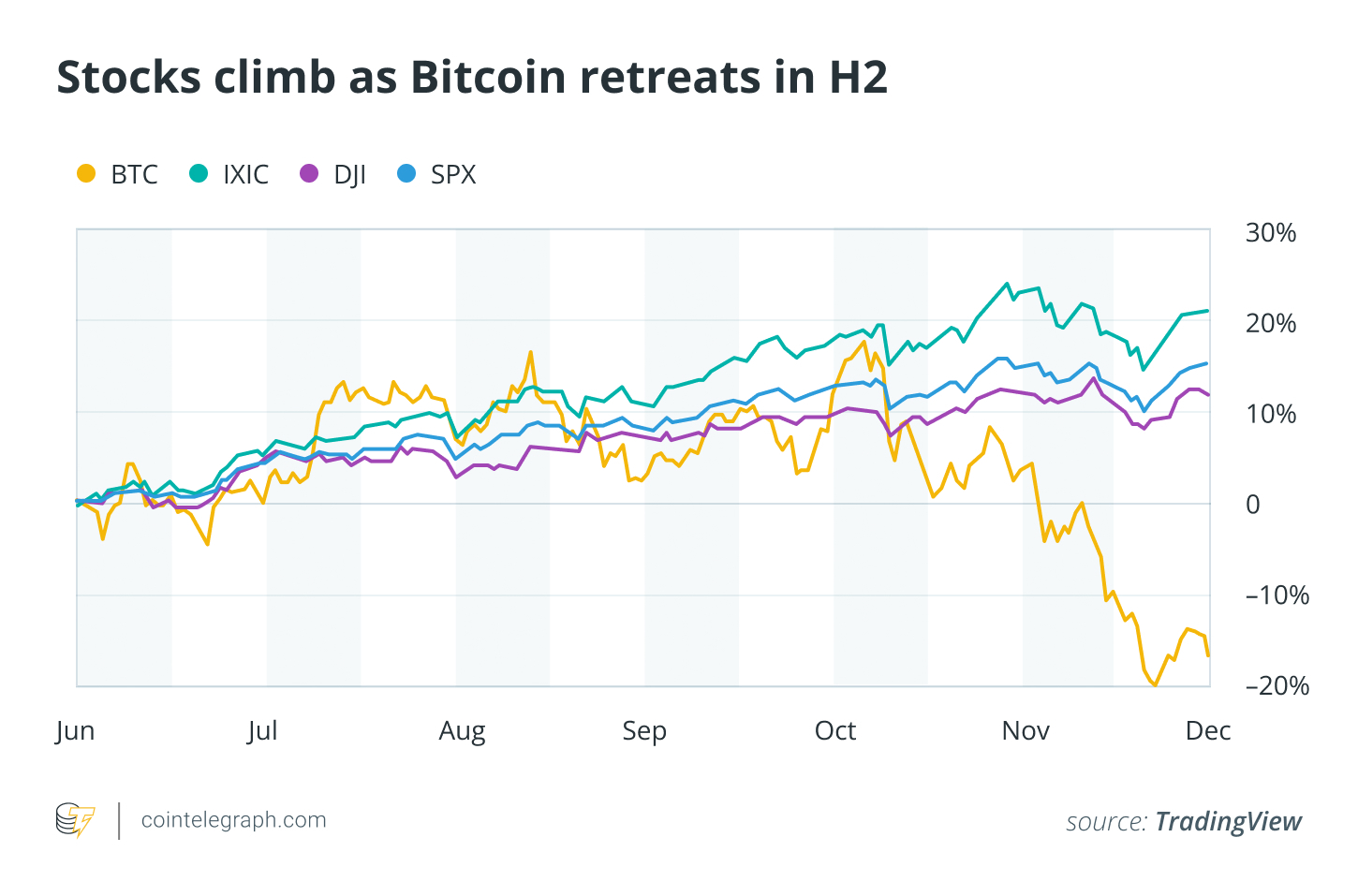
Bitcoin moved alongside the three major equity indexes in the third quarter but started to decouple in Q4.

July: GENIUS Act lifts crypto

July 2025 was defined by strong equity performance and a resilient risk appetite that persisted despite significant tariff announcements.

Early-July trade rhetoric caused brief turbulence, but markets quickly shifted their focus back to corporate earnings and underlying growth fundamentals.

Related: DATs bring crypto’s insider trading problem to TradFi: Shane Molidor

On July 9, AI chip giant Nvidia became the first company to reach a $4-trillion valuation. On the same day, equities shrugged off trade-related shocks as the S&P 500 and Nasdaq posted fresh record highs even after the US announced 50% tariffs on copper.

Bitcoin ended July up 8.13%, marking its strongest monthly performance in the second half of the year to date, including December. Crypto markets strengthened after US President Donald Trump signed the GENIUS Act into law, injecting fresh optimism into the sector, particularly for stablecoin-related businesses.
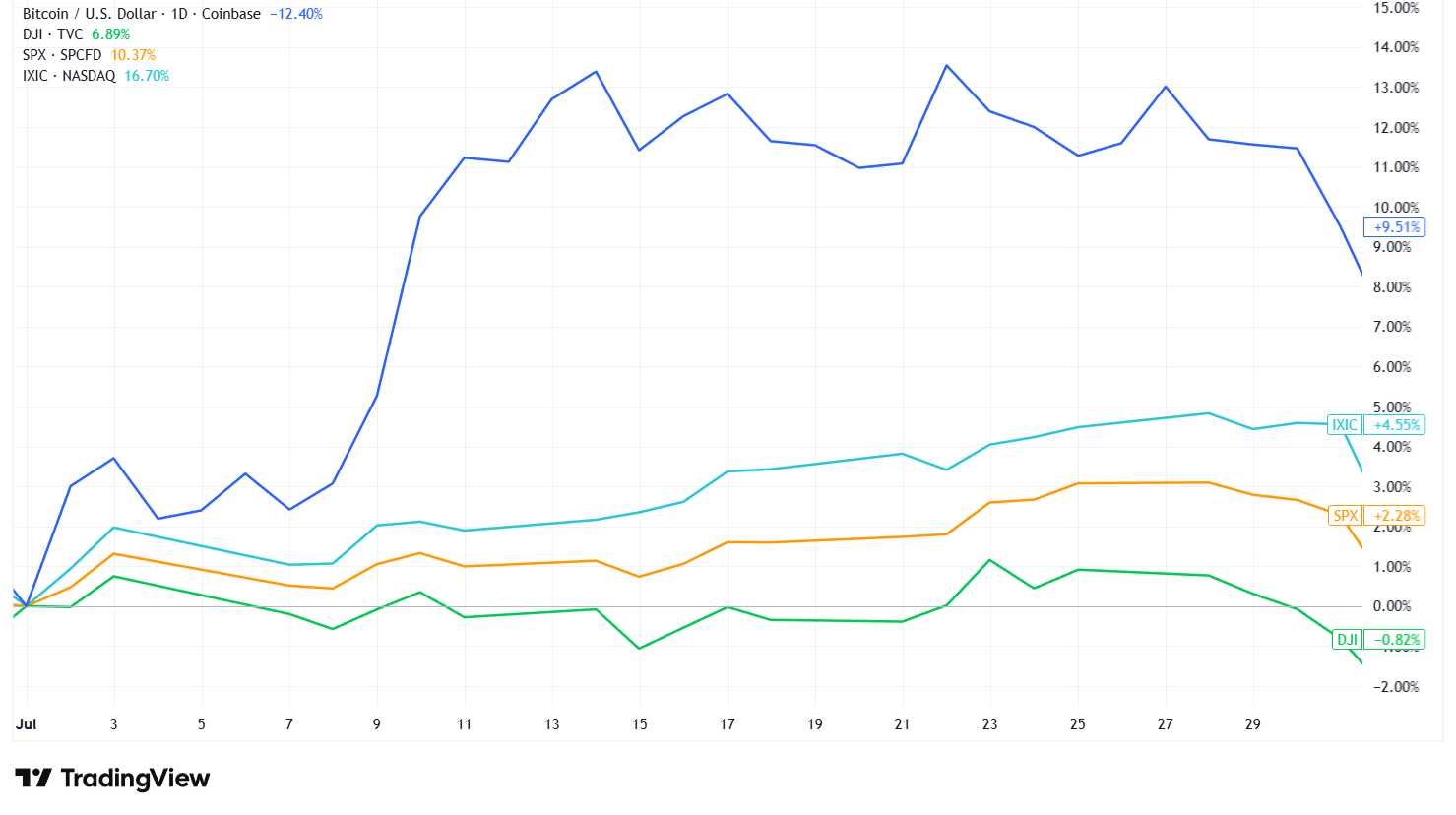
Equities crab walk, while Treasurys and stablecoins lift crypto. Source: TradingView

Corporate adoption also remained a key theme, with companies continuing to add Bitcoin to their balance sheets as part of digital asset treasury strategies. By July, interest in other major cryptocurrencies, including Ether (ETH) and Solana (SOL), also began to pick up.

August: Powell’s speech powers Ether’s ATH

August was driven by rising expectations that the Federal Reserve would soon cut interest rates. Those hopes fueled a broad rally across traditional markets, while crypto moved even faster. Bitcoin surged to a new all-time high of around $124,000 on Aug. 14 as the US dollar weakened amid rising trade tensions.

The Jackson Hole Economic Symposium then brought markets’ attention back to monetary policy. On Aug. 22, Fed Chair Jerome Powell delivered a dovish signal, suggesting that rate cuts were still possible later in the year, pushing Ether to a new all-time high.
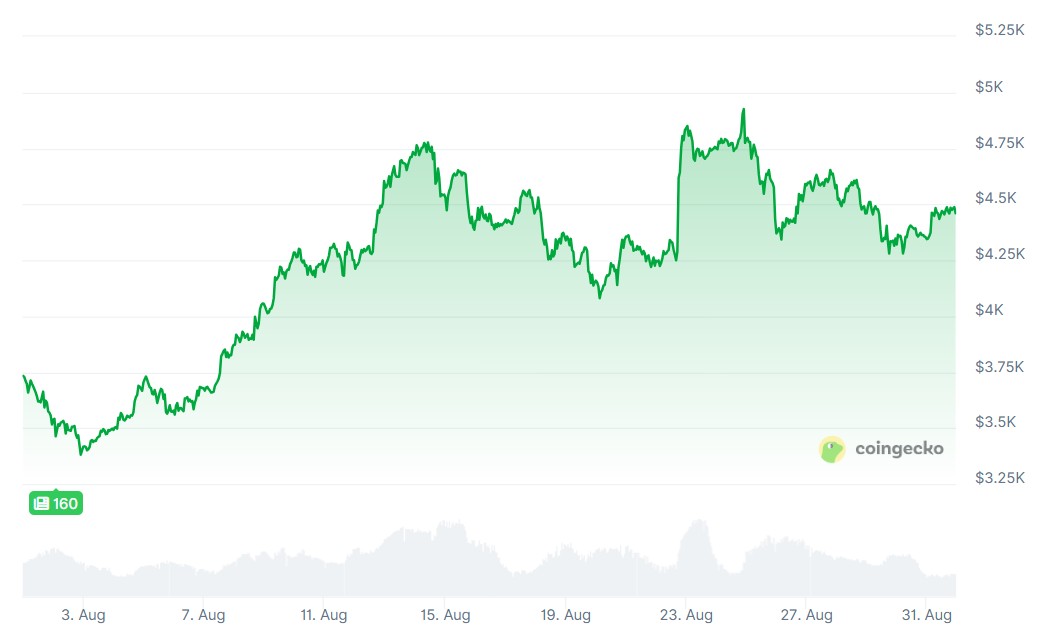
The Fed’s dovish signal sends Ether to new highs. Source: CoinGecko

Equities responded positively, but Bitcoin failed to sustain its momentum. The asset saw a sharp but brief uptick immediately after Powell’s speech before resuming its decline. By month’s end, Bitcoin’s post-ATH correction had clearly diverged from traditional markets. Bitcoin closed August down 6.49%.

September: First rate cut of 2025

September has historically been Bitcoin’s weakest month. Along with June, it is one of only two months that posts a negative average monthly return, earning it the nickname “red September.”

In 2025, however, Bitcoin defied that trend, recording its third consecutive positive September. The gain came as the Fed delivered its first rate cut of the year, a 25-basis-point reduction justified by signs of a cooling labor market. Bitcoin ended the month up 5.16%.

Related: Bitcoin set to beat ‘red September’ dip for third straight year

Equities also responded positively, extending their third-quarter rally as markets priced in the likelihood of additional monetary easing in October.

Bitcoin, however, faced a new internal challenge. The community became divided over a major network upgrade that would remove limits on how much arbitrary data can be embedded on the blockchain.

Bitcoin Core, the software implementation most widely used by miners and node operators, supported lifting the limit. Those who view non-financial data on Bitcoin as spam pushed back against the change, contributing to increased adoption of Bitcoin Knots as an alternative implementation.
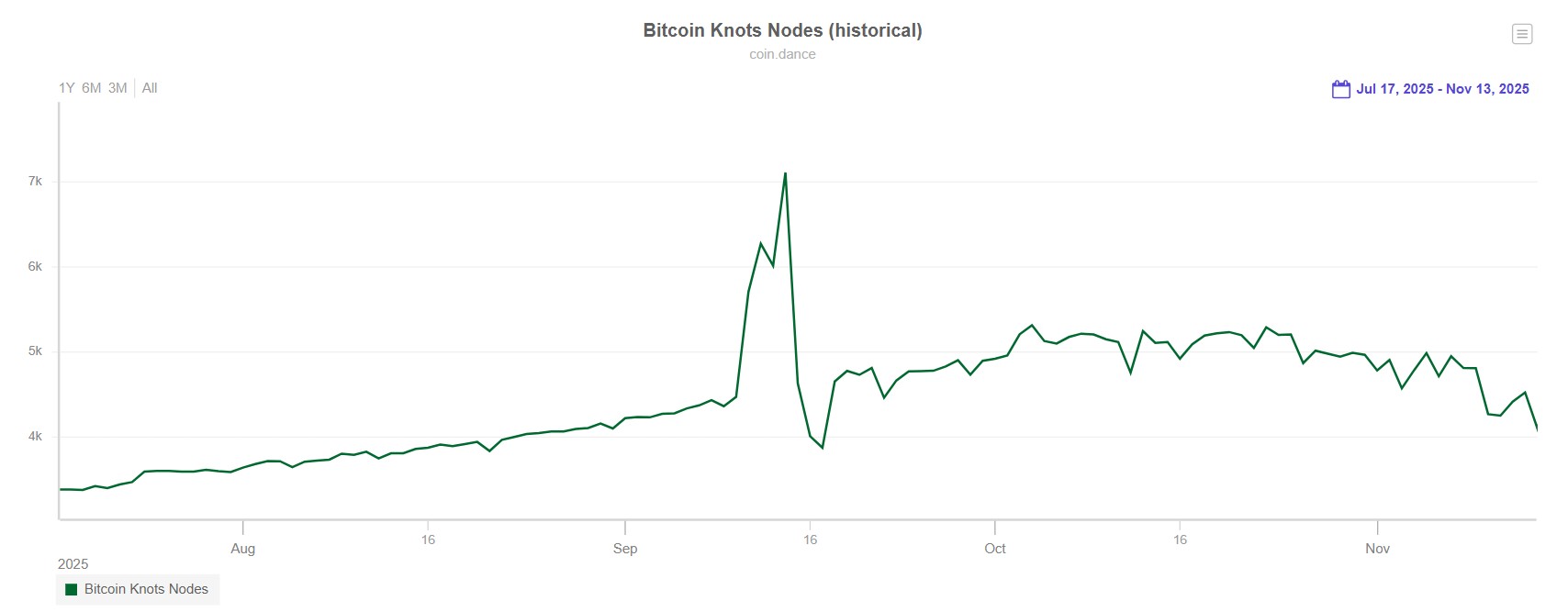
Bitcoin’s upgrade divides the community as Knots nodes rise as alternatives. Source: Coin Dance

October: Trump threatens 100% tariffs on China

Bitcoin hit another all-time high on Oct. 6, but the month was ultimately defined by the largest liquidation event in Bitcoin’s history, with roughly $19 billion in positions wiped out.

Several factors were identified as contributors to the liquidation cascade that sent Bitcoin plunging below $110,000. These included a price glitch on Binance and the industry’s heavy reliance on futures-based trading, which amplified forced liquidations as prices fell.

The immediate catalyst, however, was a social media post by President Trump threatening 100% tariffs on Chinese imports. The comment triggered a sharp sell-off across both crypto and equity markets.

Although October is often referred to as Uptober in the crypto community due to its historically strong performance, 2025 proved to be an exception. Bitcoin snapped a five-year streak of positive Octobers and ended the month down 3.69% even as major stock indexes recovered from the trade-related shock.
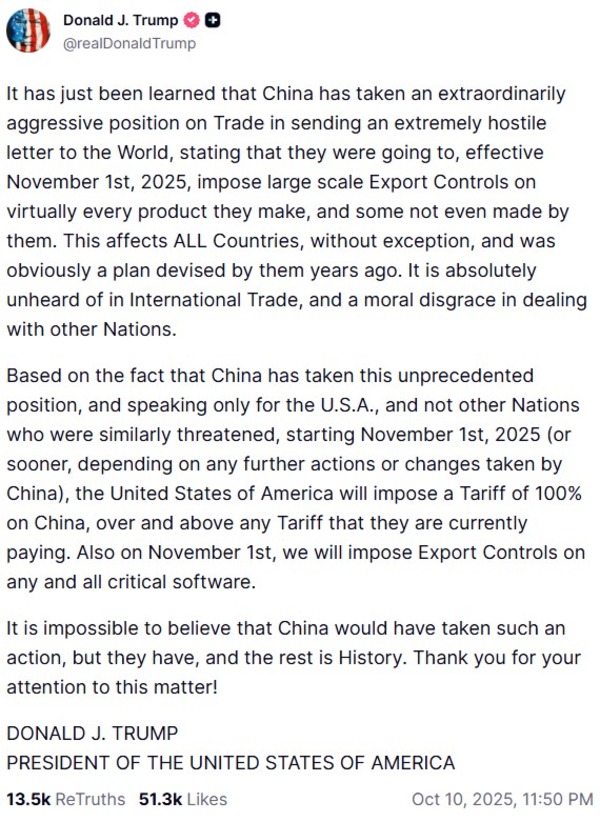
Trump’s social post sparks a crypto liquidation frenzy. Source: Donald Trump

By the end of the month, the Fed delivered its second consecutive rate cut, lowering the federal funds rate by another 25 basis points. Meanwhile, the US government remained shut throughout October, extending what became the longest government shutdown in history.

November: End of the US government shutdown

October may carry the nickname Uptober, but November has historically been Bitcoin’s strongest month, posting an average gain of 41.12% — more than double October’s average return of about 20%.

In 2025, November proved to be Bitcoin’s worst-performing month of the year, with the asset falling 17.67%. Selling pressure intensified throughout the month, pushing Bitcoin below the $100,000 mark by mid-November.
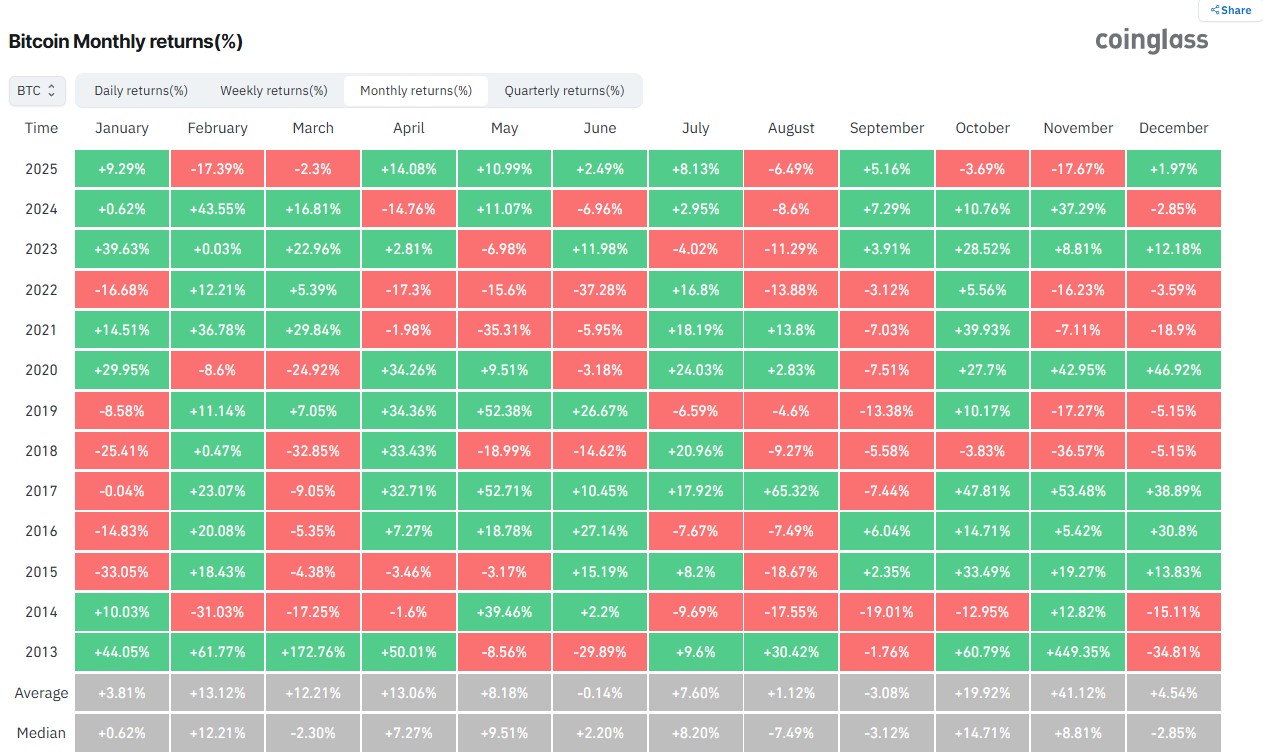
November is historically Bitcoin’s best month, but it was the worst month of 2025. Source: CoinGlass

The divergence from equities was pronounced. Stock markets traded largely sideways as the US government shutdown came to an end. Investors remained cautious amid concerns over a potential AI-driven bubble. Some of those fears were eased later in the month after Nvidia reported record earnings for the third quarter, helping stabilize sentiment across technology stocks.

Bitcoin’s year-end target slashed

So far, Bitcoin is up about 2% in December, with major equity indexes also posting moderate gains. Bitcoin’s average December return currently stands at 4.54% at the time of writing.

While the holiday season has been relatively quiet for Bitcoin in recent years, history suggests the crypto market does not necessarily slow down during the festivities.

In December 2020, for example, Bitcoin surged nearly 47%, even as market-shaking news emerged from the US Securities and Exchange Commission: the launch of a years-long lawsuit against Ripple Labs and its executives.

This year, much of the optimism surrounding Bitcoin’s potential year-end rally has faded. Several market watchers have lowered their price targets for the cryptocurrency, including Standard Chartered.

The bank had previously forecast a year-end price of $200,000 for Bitcoin, but on Monday, it revised that target down to $100,000. Standard Chartered has also delayed its longer-term forecast for Bitcoin reaching $500,000, pushing the target from 2028 to 2030.

Magazine: Big questions: Would Bitcoin survive a 10-year power outage?

Похожее

Chat with the Godfather of Crypto: $60k Bitcoin is Definitely Not the Bottom, the Real 'Capitulation Moment' is in October

**Summary: Interview with "Crypto Godfather" Michael Terpin on Bitcoin Outlook** Michael Terpin, founder of Transform Ventures and author of "Bitcoin Supercycle," discusses his market views in a podcast. He argues that Bitcoin's price around $60K is likely not the cycle bottom, with odds favoring a further decline to the $48K–$57K range, potentially bottoming in October. Key points include: * **Saylor & STRC:** He clarifies Michael Saylor's recent statement about potentially selling Bitcoin to pay dividends is driven by STRC's retail/ hybrid structure requiring an "escape valve," not a strategic shift. Saylor's large-scale OTC purchases create a floor for Bitcoin's price. * **October Bottom Thesis:** Terpin cites historical patterns (e.g., ~1-year bear markets, Coin Days Destroyed indicator, 23/35-month cycles) pointing to an October bottom. Current selling pressure is largely from leveraged retail liquidations, not whales. * **Cycle Dynamics:** He notes diminishing returns per cycle (e.g., 3000x, 100x, 30x, ~8x) and converging drawdowns. The long-term $1M Bitcoin target by 2033 remains. * **Risks & Narratives:** The real near-term "FTX moment" risk is an advanced AI model attacking a major Ethereum smart contract (e.g., Lido), not quantum computing breaking Bitcoin soon. AI tokens are expected to outperform Bitcoin in the next three years, with profits potentially flowing back into BTC. * **Market Mechanics:** He comments on reported systematic selling by firms like Jane Street and how Wall Street tactics (OTC buying, public market shorting) now influence Bitcoin. * **Supercycle & Design:** Terpin believes Satoshi intentionally aligned Bitcoin's 4-year halving cycle with US election years, influencing global liquidity cycles. He discusses Bitcoin's role in a potential new commodity supercycle driven by currency debasement.

marsbit10 мин. назад

Chat with the Godfather of Crypto: $60k Bitcoin is Definitely Not the Bottom, the Real 'Capitulation Moment' is in October

marsbit10 мин. назад

From Pizza to Unit of Account: A Prehistory of Bitcoin Price Discovery

From Pizza to Unit of Account: The Prehistory of Bitcoin Price Discovery This article traces Bitcoin's earliest price discovery mechanisms, focusing on its functional evolution as a unit of account rather than its price trajectory. The analysis centers on a nine-month period from October 2009 to July 2010, identifying three distinct, sequential layers of price formation. The narrative begins with the cost-of-production anchor established by NewLibertyStandard in October 2009, which calculated a unilateral USD/BTC exchange rate based on the electricity cost of mining. This constituted a posted rate, not a market-discovered price. The second layer emerged with peer-to-peer (P2P) discovery mechanisms starting in March 2010. This included Dustin Dollar's Bitcoin Market platform, which introduced a basic public order book, and forum-based实物 trades. The pivotal event in this phase was Laszlo Hanyecz's purchase of two pizzas for 10,000 BTC on May 22, 2010. Critically, the offer was made exclusively in BTC ("10,000 bitcoins for a couple of pizzas"), marking the first documented instance where Bitcoin functionally acted as a unit of account to price another good in a real transaction, 21 days before Hanyecz later provided a USD anchor (~$25). The third layer commenced in July 2010 with Jed McCaleb's launch of the Mt.Gox exchange. Its continuous order book, with last price, highs, lows, and volume, provided the first standardized, externally referenceable format for BTC/USD prices. The article argues this three-stage evolution—production cost anchor → P2P discovery → centralized continuous quotation—exhibits structural similarities to the historical price discovery paths of other asset classes, such as 17th-century VOC shares in Amsterdam and 19th-century grain futures on the Chicago Board of Trade. It posits that all markets follow a coarse-grained path from private bookkeeping to posted quotes to continuous matching, placing Bitcoin's early development within a centuries-long lineage of financial institutional evolution.

marsbit1 ч. назад

From Pizza to Unit of Account: A Prehistory of Bitcoin Price Discovery

marsbit1 ч. назад

Торговля

Спот
Фьючерсы

Популярные статьи

Тест по Bitcoin Биткоина

HTX Learn: Изучите Bitcoin halving и Заработаете Токены USDT

3.0k просмотров всегоОпубликовано 2024.04.16Обновлено 2024.04.16

Тест по Bitcoin  Биткоина

Что такое $BITCOIN

ЦИФРОВОЕ ЗОЛОТО ($BITCOIN): Комплексный анализ Введение в ЦИФРОВОЕ ЗОЛОТО ($BITCOIN) ЦИФРОВОЕ ЗОЛОТО ($BITCOIN) — это проект на основе блокчейна, работающий в сети Solana, который стремится объединить характеристики традиционных драгоценных металлов с инновациями децентрализованных технологий. Хотя он носит имя Биткойн, часто называемого “цифровым золотом” из-за его восприятия как средства хранения ценности, ЦИФРОВОЕ ЗОЛОТО является отдельным токеном, предназначенным для создания уникальной экосистемы в ландшафте Web3. Его цель — позиционировать себя как жизнеспособный альтернативный цифровой актив, хотя детали его применения и функциональности все еще развиваются. Что такое ЦИФРОВОЕ ЗОЛОТО ($BITCOIN)? ЦИФРОВОЕ ЗОЛОТО ($BITCOIN) — это токен криптовалюты, специально разработанный для использования в блокчейне Solana. В отличие от Биткойна, который выполняет широко признанную роль хранения ценности, этот токен, похоже, сосредоточен на более широких приложениях и характеристиках. Примечательные аспекты включают: Инфраструктура блокчейна: Токен построен на блокчейне Solana, известном своей способностью обрабатывать высокоскоростные и недорогие транзакции. Динамика предложения: ЦИФРОВОЕ ЗОЛОТО имеет максимальное предложение, ограниченное 100 квадриллионами токенов (100P $BITCOIN), хотя детали о его обращающемся предложении в настоящее время не раскрыты. Утилита: Хотя точные функциональные возможности не описаны, есть указания на то, что токен может быть использован для различных приложений, потенциально связанных с децентрализованными приложениями (dApps) или стратегиями токенизации активов. Кто создатель ЦИФРОВОГО ЗОЛОТА ($BITCOIN)? На данный момент личность создателей и команды разработчиков, стоящих за ЦИФРОВЫМ ЗОЛОТОМ ($BITCOIN), остается неизвестной. Эта ситуация типична для многих инновационных проектов в области блокчейна, особенно тех, которые связаны с децентрализованными финансами и феноменом мем-криптовалют. Хотя такая анонимность может способствовать культуре, ориентированной на сообщество, она усиливает опасения по поводу управления и ответственности. Кто инвесторы ЦИФРОВОГО ЗОЛОТА ($BITCOIN)? Доступная информация указывает на то, что у ЦИФРОВОГО ЗОЛОТА ($BITCOIN) нет известных институциональных спонсоров или значительных венчурных капиталовложений. Проект, похоже, функционирует по модели пирингового взаимодействия, сосредоточенной на поддержке и принятии сообществом, а не на традиционных путях финансирования. Его активность и ликвидность в основном сосредоточены на децентрализованных биржах (DEX), таких как PumpSwap, а не на устоявшихся централизованных торговых платформах, что еще больше подчеркивает его подход, ориентированный на grassroots. Как работает ЦИФРОВОЕ ЗОЛОТО ($BITCOIN) Операционные механизмы ЦИФРОВОГО ЗОЛОТА ($BITCOIN) можно подробно описать на основе его дизайна блокчейна и характеристик сети: Механизм консенсуса: Используя уникальный механизм доказательства истории (PoH) Solana в сочетании с моделью доказательства доли (PoS), проект обеспечивает эффективную валидацию транзакций, что способствует высокой производительности сети. Токеномика: Хотя конкретные дефляционные механизмы не были подробно описаны, большое максимальное предложение токенов подразумевает, что оно может быть предназначено для микротранзакций или нишевых случаев использования, которые еще предстоит определить. Интероперабельность: Существует потенциал для интеграции с более широкой экосистемой Solana, включая различные платформы децентрализованных финансов (DeFi). Однако детали относительно конкретных интеграций остаются неуточненными. Хронология ключевых событий Вот хронология, которая подчеркивает значимые вехи, касающиеся ЦИФРОВОГО ЗОЛОТА ($BITCOIN): 2023: Первоначальное развертывание токена происходит в блокчейне Solana, отмеченное его адресом контракта. 2024: ЦИФРОВОЕ ЗОЛОТО приобретает видимость, когда оно становится доступным для торговли на децентрализованных биржах, таких как PumpSwap, позволяя пользователям обменивать его на SOL. 2025: Проект наблюдает спорадическую торговую активность и потенциальный интерес к инициативам, возглавляемым сообществом, хотя на данный момент не зафиксировано никаких значительных партнерств или технических достижений. Критический анализ Сильные стороны Масштабируемость: Основная инфраструктура Solana поддерживает высокие объемы транзакций, что может повысить полезность $BITCOIN в различных сценариях транзакций. Доступность: Потенциально низкая цена торговли за токен может привлечь розничных инвесторов, способствуя более широкому участию благодаря возможностям дробного владения. Риски Отсутствие прозрачности: Отсутствие публично известных спонсоров, разработчиков или процесса аудита может вызвать скептицизм относительно устойчивости и надежности проекта. Волатильность рынка: Торговая активность сильно зависит от спекулятивного поведения, что может привести к значительной волатильности цен и неопределенности для инвесторов. Заключение ЦИФРОВОЕ ЗОЛОТО ($BITCOIN) является интригующим, но неоднозначным проектом в быстро развивающейся экосистеме Solana. Хотя он пытается использовать нарратив “цифрового золота”, его отход от установленной роли Биткойна как средства хранения ценности подчеркивает необходимость более четкого различения его предполагаемой утилиты и структуры управления. Будущее принятие и усвоение, вероятно, будут зависеть от решения текущей непрозрачности и более четкого определения его операционных и экономических стратегий. Примечание: Этот отчет охватывает синтезированную информацию, доступную на октябрь 2023 года, и с тех пор могут произойти события.

99 просмотров всегоОпубликовано 2025.05.13Обновлено 2025.05.13

Что такое $BITCOIN

Fractal Bitcoin: масштабирование Биткоина с помощью рекурсивной системы

Fractal Bitcoin — масштабное Layer-1-решнение, созданное на базе кода Биткоина, позволяющего достигать бесконечного масштабирования с помощью рекурсивного подхода.

2.3k просмотров всегоОпубликовано 2025.06.30Обновлено 2025.06.30

Fractal Bitcoin: масштабирование Биткоина с помощью рекурсивной системы

Обсуждения

Добро пожаловать в Сообщество HTX. Здесь вы сможете быть в курсе последних новостей о развитии платформы и получить доступ к профессиональной аналитической информации о рынке. Мнения пользователей о цене на BTC (BTC) представлены ниже.

活动图片