Another Corporate Bitcoin Treasury Strategy Ends: From High-Profile Entry to Liquidation at a Massive Loss in 11 Months

marsbitОпубликовано 2026-06-01Обновлено 2026-06-01

Введение

French semiconductor company Sequans Communications has sold off its bitcoin holdings and terminated its corporate bitcoin treasury strategy less than a year after launching it, sustaining heavy losses. Facing delisting from the New York Stock Exchange in mid-2025 due to low market capitalization, Sequans announced a plan to hold over 3,000 bitcoin as a long-term reserve asset. The strategy was executed with Swan Bitcoin and backed by a $384 million private financing round. At its peak in October 2025, the company held 3,234 bitcoin with an average cost of approximately $116,643 per coin. However, the plan quickly unraveled. With bitcoin's price falling, Sequans sold 970 bitcoin in late 2025 to repay debt, contradicting the core "hold" philosophy of such corporate strategies. The company has now sold more bitcoin to fully repay its convertible notes and announced the termination of its bitcoin reserve strategy. It plans to liquidate its remaining 658 bitcoin. The venture resulted in significant financial damage. The company reported an unrealized loss of $67.4 million on its bitcoin holdings in 2025, contributing to a total net loss of $109.3 million for the year. Sequans' stock (SQNS) has plummeted over 80% since the strategy's launch and is down 77% year-to-date. CEO Georges Karam, who previously championed bitcoin's long-term value, now states the company will refocus entirely on its core IoT semiconductor business. The failed experiment highlights the risks for compan...

Original Author: Protos

Original Translation: Chopper, Foresight News

Eleven months ago, French semiconductor company Sequans Communications launched a corporate bitcoin reserve plan to combat the risk of delisting from the New York Stock Exchange. Today, this trial has come to a quiet end.

The chipmaker confirmed that it has fully repaid its convertible bonds by selling its bitcoin holdings and also plans to gradually liquidate its remaining 658 bitcoins. The company's bitcoin holdings once peaked at 3,234 coins.

Sequans had previously declared its intention to accumulate and hold over 3,000 bitcoins as a long-term reserve asset. Yet this so-called "long-term" ultimately lasted less than a year.

The company's stock (ticker SQNS) has fallen 77% year-to-date, with a staggering 97% cumulative decline over the past five years.

Sequans' bitcoin reserve plan was launched on June 23, 2025, a time when Swan Bitcoin and its CEO Cory Klippsten were actively promoting the project (Note: Swan Bitcoin was the exclusive operator and advisor for Sequans' bitcoin reserve strategy). This launch came just 18 days after the NYSE issued a delisting warning to Sequans, stating the company's market capitalization and shareholder equity had both fallen below the exchange's $50 million minimum threshold.

Sequans' latest announcement confirms full repayment of its convertible bonds.

Klippsten stated at the time, "Sequans has the potential to become a leader in the corporate bitcoin treasury space." Back then, SQNS stock was trading at $23.40; today it opened at just $3.98.

Bitcoin Reserve Strategy Fails Shortly After Launch

Following the market bubble burst in early summer 2025, the stock prices of many public companies with digital asset treasury strategies collectively weakened, dashing the bright prospects Sequans had painted.

Sequans CEO Georges Karam had earlier expressed strong confidence, firmly believing bitcoin was a superior asset with extremely high long-term investment value.

The company had selected Swan Bitcoin as its execution partner and Coinbase Prime as the custodian. Simultaneously, Northland Capital Markets and B. Riley Securities acted as joint lead underwriters, assisting the company in completing a $384 million private placement.

Of this capital, only $195 million came from the sale of American Depositary Receipts at $1.40 per share; the remaining $189 million was in the form of secured convertible bonds using bitcoin as collateral. This means that from day one, the bitcoin Sequans held in reserve was essentially pledged to creditors.

As of October 3, 2025, Sequans held a total of 3,234 bitcoins, with an average acquisition cost of approximately $116,643 per coin. As of this writing, the bitcoin price has fallen to $73,000.

Just one month later, the company gained notoriety for a piece of negative news: to repay a portion of its debt, it sold 970 bitcoins.

This action completely violated the core principle of the corporate bitcoin accumulation model. Michael Saylor, a pioneer of this approach, famously stated, "Even if you are desperate, do not sell your bitcoin." But Sequans ultimately chose to sell its coins to pay debt.
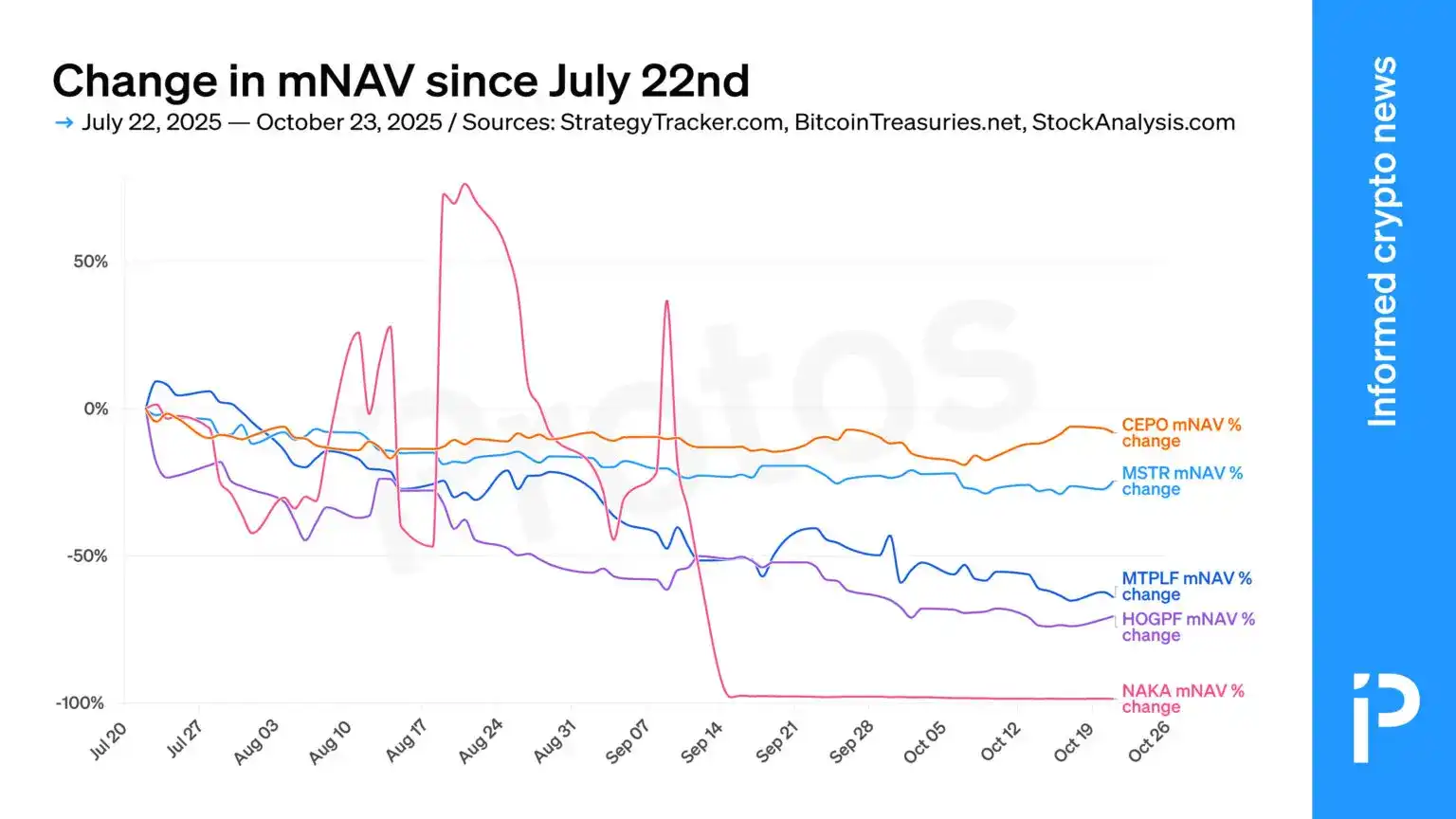
Percentage change in modified Net Asset Value per Share (mNAV) for several corporate bitcoin treasury companies since July 22, 2025.

"Bitcoin Reserve Strategy Officially Terminated"

Five more months passed, and Sequans completely halted the program. The company's announcement tersely stated: "The Bitcoin reserve strategy has been terminated."

Karam, the CEO who was once so bullish on bitcoin, now stated that this debt repayment is a significant turning point for the company, and Sequans will now fully focus on its core IoT semiconductor business to drive expansion.

All previous praise for bitcoin's value and promises to create long-term shareholder returns through crypto asset reserves have been abandoned. The current plan for the company is solely liquidation.

In fact, the exit signal was given three weeks earlier in the company's Q1 2026 earnings report. In the risk factors section, the company explicitly mentioned terminating its bitcoin reserve-related business. For that quarter, Sequans reported revenue of only $6.1 million and an operating loss of $50.5 million.

According to annual report data, Sequans posted a net loss of $109.3 million for the full year 2025. Within this, unrealized impairment losses on bitcoin assets alone amounted to $67.4 million, bringing the company's cumulative loss total to a staggering $145.1 million.

In summary, Sequans bought bitcoin high and sold low, ultimately generating tens of millions in losses.

The company had hoped to use its bitcoin reserves to strengthen its financial resilience and create long-term value for shareholders, but both goals have failed. Currently, SQNS stock is down over 80% from the day the bitcoin plan was launched and down 92% from its high over the past year.


Связанные с этим вопросы

QWhat was the main reason Sequans Communications started its corporate bitcoin reserve strategy?

ASequans Communications initiated its corporate bitcoin reserve strategy in June 2025 to counter the risk of delisting from the New York Stock Exchange after its market capitalization and shareholder equity fell below the exchange's minimum threshold.

QWho was the exclusive operator and advisor for Sequans' bitcoin reserve strategy?

ASwan Bitcoin, led by its CEO Cory Klippsten, was the exclusive operator and advisor for Sequans' bitcoin reserve strategy.

QHow many bitcoins did Sequans hold at its peak, and what was its average purchase cost per coin?

ASequans' bitcoin holdings peaked at 3,234 coins, with an average purchase cost of approximately $116,643 per bitcoin.

QWhat core tenet of the corporate bitcoin treasury strategy did Sequans violate when it sold part of its holdings?

ASequans violated the core tenet popularized by Michael Saylor: 'Don't sell your bitcoin, even if you're on the brink of disaster.' The company sold 970 bitcoins to repay part of its debt.

QWhat were the total net loss and the specific unrealized impairment loss related to bitcoin that Sequans reported for the year 2025?

AFor the year 2025, Sequans reported a total net loss of $109.3 million, which included an unrealized impairment loss on its bitcoin holdings of $67.4 million.

Похожее

a16z: Why Do Prediction Markets Matter?

Prediction markets, which allow users to trade on the outcome of future events, have gained significant traction, especially in the U.S. At their core, these markets function like any other market by aggregating information from all participants and translating it into a price signal—in this case, the perceived probability of a specific event occurring. Unlike polls or surveys that offer static snapshots, prediction markets provide dynamic, quantifiable probability estimates that update in real-time as new information and participants enter. A key advantage is the incentive structure: participants risk their own capital, which encourages serious research and trading based on genuine knowledge. This can surface information that traditional methods might miss. Furthermore, prediction markets can be created for a vast array of specialized questions—from geopolitical events to AI model performance—that aren't covered by traditional financial markets. However, several challenges remain. Infrastructure issues include reliably determining event outcomes and resolving disputes. Market design must ensure participation from well-informed individuals while preventing manipulation, such as insider trading or attempts to sway public perception by artificially moving prices. Addressing these concerns around rules, participation, and contract design is crucial. If these hurdles are overcome, prediction markets could evolve into a powerful, widely-used tool for forecasting and navigating uncertainty.

marsbit6 мин. назад

a16z: Why Do Prediction Markets Matter?

marsbit6 мин. назад

Interview with 7 Ordinary Professionals: After AI Arrived, How Are You Doing?

This article interviews seven professionals from diverse fields like Web3, bulk chemical trading, digital agriculture, and traditional wholesale to examine the impact of AI on their work. Key themes emerge from the discussions. AI has become integral to their workflows, primarily for increasing efficiency in tasks such as coding, content creation, research, and data analysis. Individuals across roles, from developers to managers, report that AI tools like ChatGPT and Claude have significantly reduced workloads and accelerated learning, creating opportunities for "super individuals" or one-person teams. However, this efficiency comes with a double-edged sword. It intensifies competition, pushing professionals to constantly learn new tools and adapt, leading to widespread anxiety about job security and a heightened pressure to keep pace. Interviewees anticipate significant job reductions in roles like administrative support, finance, HR, customer service, and some creative fields. A recurring view is that AI acts as a "great equalizer," amplifying the capabilities of those who use it effectively while leaving others behind, potentially deepening polarization. Despite AI's capabilities, interviewees identify enduring human strengths. AI struggles with tasks requiring deep contextual understanding, complex judgment in areas like risk assessment and system stability (especially in finance/Web3), nuanced human communication, and handling exceptions in logistics and manufacturing. These areas remain firmly in the human domain. Consequently, many professionals are refocusing their career strategies. They plan to evolve from task executors into "complex system owners," "super coordinators" managing AI agents, or specialists in high-level areas like business context, risk control, product design, and personal branding. In summary, the article portrays AI not as an optional tool but as a transformative force reshaping job demands. While it automates routine work, it also creates new forms of pressure and competition. The future, as seen by these professionals, belongs to those who can strategically integrate AI to augment uniquely human skills like judgment, responsibility, and strategic oversight.

marsbit22 мин. назад

Interview with 7 Ordinary Professionals: After AI Arrived, How Are You Doing?

marsbit22 мин. назад

Satoshi Nakamoto Sued? $83.7 Billion Worth of BTC Up for 'Legal Claim'

An anonymous individual known as Noah Doe, along with two Wyoming LLCs, has filed a lawsuit in the New York Supreme Court. They are attempting to use New York's "lost and found" laws to claim legal ownership of approximately 837 billion USD worth of Bitcoin held in 39,069 dormant addresses. Crucially, this list includes addresses believed to belong to Bitcoin's creator, Satoshi Nakamoto (holding around 837 billion USD), alongside other long-inactive addresses from Mt. Gox and early Bitcoin holders. The plaintiff's legal strategy hinges on classifying these public Bitcoin addresses as "lost property." They submitted a USB drive containing only the public addresses to the New York Police Department, sent OP_RETURN notifications on the Bitcoin blockchain, and issued press releases. Their argument is that after these efforts and a waiting period, they should be granted ownership. A key, and highly controversial, claim is an unnamed "independent expert" valuing each address at under 10 USD, allowing for a faster legal process. Analysts from Galaxy point out major flaws in the case. The plaintiff never physically possessed the Bitcoin or private keys. The "under 10 USD" valuation is considered unrealistic, and allowing anonymous companies to claim such vast assets is highly unusual. Even if the plaintiff wins, they would only receive a court declaration of ownership, not the actual private keys to move the Bitcoin. The real danger lies in this court document acting as a "cloud on title." If any of these Bitcoins are later transferred to a regulated exchange or custodian, the plaintiff could present the judgment to freeze the assets, forcing the true owner into lengthy and de-anonymizing litigation to prove ownership. The outcome is uncertain, but the case highlights potential legal risks for dormant cryptocurrency holdings.

marsbit27 мин. назад

Satoshi Nakamoto Sued? $83.7 Billion Worth of BTC Up for 'Legal Claim'

marsbit27 мин. назад

Is Satoshi in Legal Trouble? $83.7 Billion Worth of BTC Might Be 'Legally Claimed'

An anonymous plaintiff, “Noah Doe,” and two shell companies have filed a lawsuit in New York Supreme Court, seeking a declaratory judgment granting them ownership of 39,069 dormant Bitcoin addresses containing approximately 3.8 million BTC (worth ~$293.5 billion). Their claim is based on New York’s lost property law, arguing these addresses are abandoned assets. The plaintiff “found” the addresses, stored them on a USB drive, and delivered it to a police station, followed by chain notifications (OP_RETURN) and a press release. Notably, the list includes addresses linked to Bitcoin creator Satoshi Nakamoto (holding ~1.1 million BTC), a Mt. Gox hacker address, a provably unspendable burn address, and other long-inactive wallets. The plaintiff’s “independent expert” controversially values each address at under $10 to invoke a fast-track legal process. Critical issues question the lawsuit's validity: the lost property law is designed for physical items, not publicly viewable blockchain addresses; the valuation is implausible; and the plaintiff’s anonymity is contested. Even if successful, the plaintiff would only receive a paper judgment, not the private keys. However, such a ruling could create a “title defect,” allowing them to challenge future transactions of these coins on regulated platforms, potentially freezing assets and forcing anonymous holders to reveal themselves in legal disputes. The court is unlikely to grant a broad default judgment given the novel and high-stakes nature of the claim.

Odaily星球日报29 мин. назад

Is Satoshi in Legal Trouble? $83.7 Billion Worth of BTC Might Be 'Legally Claimed'

Odaily星球日报29 мин. назад

Торговля

Спот
Фьючерсы

Популярные статьи

Тест по Bitcoin Биткоина

HTX Learn: Изучите Bitcoin halving и Заработаете Токены USDT

3.0k просмотров всегоОпубликовано 2024.04.16Обновлено 2024.04.16

Тест по Bitcoin  Биткоина

Что такое $BITCOIN

ЦИФРОВОЕ ЗОЛОТО ($BITCOIN): Комплексный анализ Введение в ЦИФРОВОЕ ЗОЛОТО ($BITCOIN) ЦИФРОВОЕ ЗОЛОТО ($BITCOIN) — это проект на основе блокчейна, работающий в сети Solana, который стремится объединить характеристики традиционных драгоценных металлов с инновациями децентрализованных технологий. Хотя он носит имя Биткойн, часто называемого “цифровым золотом” из-за его восприятия как средства хранения ценности, ЦИФРОВОЕ ЗОЛОТО является отдельным токеном, предназначенным для создания уникальной экосистемы в ландшафте Web3. Его цель — позиционировать себя как жизнеспособный альтернативный цифровой актив, хотя детали его применения и функциональности все еще развиваются. Что такое ЦИФРОВОЕ ЗОЛОТО ($BITCOIN)? ЦИФРОВОЕ ЗОЛОТО ($BITCOIN) — это токен криптовалюты, специально разработанный для использования в блокчейне Solana. В отличие от Биткойна, который выполняет широко признанную роль хранения ценности, этот токен, похоже, сосредоточен на более широких приложениях и характеристиках. Примечательные аспекты включают: Инфраструктура блокчейна: Токен построен на блокчейне Solana, известном своей способностью обрабатывать высокоскоростные и недорогие транзакции. Динамика предложения: ЦИФРОВОЕ ЗОЛОТО имеет максимальное предложение, ограниченное 100 квадриллионами токенов (100P $BITCOIN), хотя детали о его обращающемся предложении в настоящее время не раскрыты. Утилита: Хотя точные функциональные возможности не описаны, есть указания на то, что токен может быть использован для различных приложений, потенциально связанных с децентрализованными приложениями (dApps) или стратегиями токенизации активов. Кто создатель ЦИФРОВОГО ЗОЛОТА ($BITCOIN)? На данный момент личность создателей и команды разработчиков, стоящих за ЦИФРОВЫМ ЗОЛОТОМ ($BITCOIN), остается неизвестной. Эта ситуация типична для многих инновационных проектов в области блокчейна, особенно тех, которые связаны с децентрализованными финансами и феноменом мем-криптовалют. Хотя такая анонимность может способствовать культуре, ориентированной на сообщество, она усиливает опасения по поводу управления и ответственности. Кто инвесторы ЦИФРОВОГО ЗОЛОТА ($BITCOIN)? Доступная информация указывает на то, что у ЦИФРОВОГО ЗОЛОТА ($BITCOIN) нет известных институциональных спонсоров или значительных венчурных капиталовложений. Проект, похоже, функционирует по модели пирингового взаимодействия, сосредоточенной на поддержке и принятии сообществом, а не на традиционных путях финансирования. Его активность и ликвидность в основном сосредоточены на децентрализованных биржах (DEX), таких как PumpSwap, а не на устоявшихся централизованных торговых платформах, что еще больше подчеркивает его подход, ориентированный на grassroots. Как работает ЦИФРОВОЕ ЗОЛОТО ($BITCOIN) Операционные механизмы ЦИФРОВОГО ЗОЛОТА ($BITCOIN) можно подробно описать на основе его дизайна блокчейна и характеристик сети: Механизм консенсуса: Используя уникальный механизм доказательства истории (PoH) Solana в сочетании с моделью доказательства доли (PoS), проект обеспечивает эффективную валидацию транзакций, что способствует высокой производительности сети. Токеномика: Хотя конкретные дефляционные механизмы не были подробно описаны, большое максимальное предложение токенов подразумевает, что оно может быть предназначено для микротранзакций или нишевых случаев использования, которые еще предстоит определить. Интероперабельность: Существует потенциал для интеграции с более широкой экосистемой Solana, включая различные платформы децентрализованных финансов (DeFi). Однако детали относительно конкретных интеграций остаются неуточненными. Хронология ключевых событий Вот хронология, которая подчеркивает значимые вехи, касающиеся ЦИФРОВОГО ЗОЛОТА ($BITCOIN): 2023: Первоначальное развертывание токена происходит в блокчейне Solana, отмеченное его адресом контракта. 2024: ЦИФРОВОЕ ЗОЛОТО приобретает видимость, когда оно становится доступным для торговли на децентрализованных биржах, таких как PumpSwap, позволяя пользователям обменивать его на SOL. 2025: Проект наблюдает спорадическую торговую активность и потенциальный интерес к инициативам, возглавляемым сообществом, хотя на данный момент не зафиксировано никаких значительных партнерств или технических достижений. Критический анализ Сильные стороны Масштабируемость: Основная инфраструктура Solana поддерживает высокие объемы транзакций, что может повысить полезность $BITCOIN в различных сценариях транзакций. Доступность: Потенциально низкая цена торговли за токен может привлечь розничных инвесторов, способствуя более широкому участию благодаря возможностям дробного владения. Риски Отсутствие прозрачности: Отсутствие публично известных спонсоров, разработчиков или процесса аудита может вызвать скептицизм относительно устойчивости и надежности проекта. Волатильность рынка: Торговая активность сильно зависит от спекулятивного поведения, что может привести к значительной волатильности цен и неопределенности для инвесторов. Заключение ЦИФРОВОЕ ЗОЛОТО ($BITCOIN) является интригующим, но неоднозначным проектом в быстро развивающейся экосистеме Solana. Хотя он пытается использовать нарратив “цифрового золота”, его отход от установленной роли Биткойна как средства хранения ценности подчеркивает необходимость более четкого различения его предполагаемой утилиты и структуры управления. Будущее принятие и усвоение, вероятно, будут зависеть от решения текущей непрозрачности и более четкого определения его операционных и экономических стратегий. Примечание: Этот отчет охватывает синтезированную информацию, доступную на октябрь 2023 года, и с тех пор могут произойти события.

99 просмотров всегоОпубликовано 2025.05.13Обновлено 2025.05.13

Что такое $BITCOIN

Fractal Bitcoin: масштабирование Биткоина с помощью рекурсивной системы

Fractal Bitcoin — масштабное Layer-1-решнение, созданное на базе кода Биткоина, позволяющего достигать бесконечного масштабирования с помощью рекурсивного подхода.

2.3k просмотров всегоОпубликовано 2025.06.30Обновлено 2025.06.30

Fractal Bitcoin: масштабирование Биткоина с помощью рекурсивной системы

Обсуждения

Добро пожаловать в Сообщество HTX. Здесь вы сможете быть в курсе последних новостей о развитии платформы и получить доступ к профессиональной аналитической информации о рынке. Мнения пользователей о цене на BTC (BTC) представлены ниже.

活动图片