$90K BTC vs. record gold price: 5 things to know in Bitcoin this week

cointelegraphPublished on 2025-12-22Last updated on 2025-12-22

Abstract

Bitcoin (BTC) hovers near $90,000 as the market remains divided between bullish and bearish outlooks. Traders are split, with some predicting a drop to $60,000 by early 2026, while others anticipate a rebound toward $93,500 or even $100,000. Meanwhile, gold and silver hit record highs amid global economic uncertainty, particularly driven by Japan’s soaring bond yields and rate hikes. On-chain data suggests Bitcoin is in a bear market phase, with the Bull-Bear Market Cycle Indicator hitting multi-year lows. The Coinbase Premium remains negative, indicating persistent selling pressure from U.S. investors. Despite extreme fear in market sentiment, some analysts see potential for a contrarian upward move.

Bitcoin (BTC) counts down to Christmas at a crossroads with bulls and bears locked in a struggle for control.

  • Bitcoin price targets become increasingly divergent as frustration builds over the lack of a breakout.

  • Japan ruffles feathers with record bond yields as gold and silver smash all-time highs.

  • Bitcoin is anything but price discovery as the Bull-Bear Market Cycle Indicator sees multiyear lows.

  • The Coinbase Premium is back in the red, with US sellers staying strong.

  • Sentiment bets give rise to calls for a contrarian market move higher.


Bitcoin end-of-year breakout bets diverge

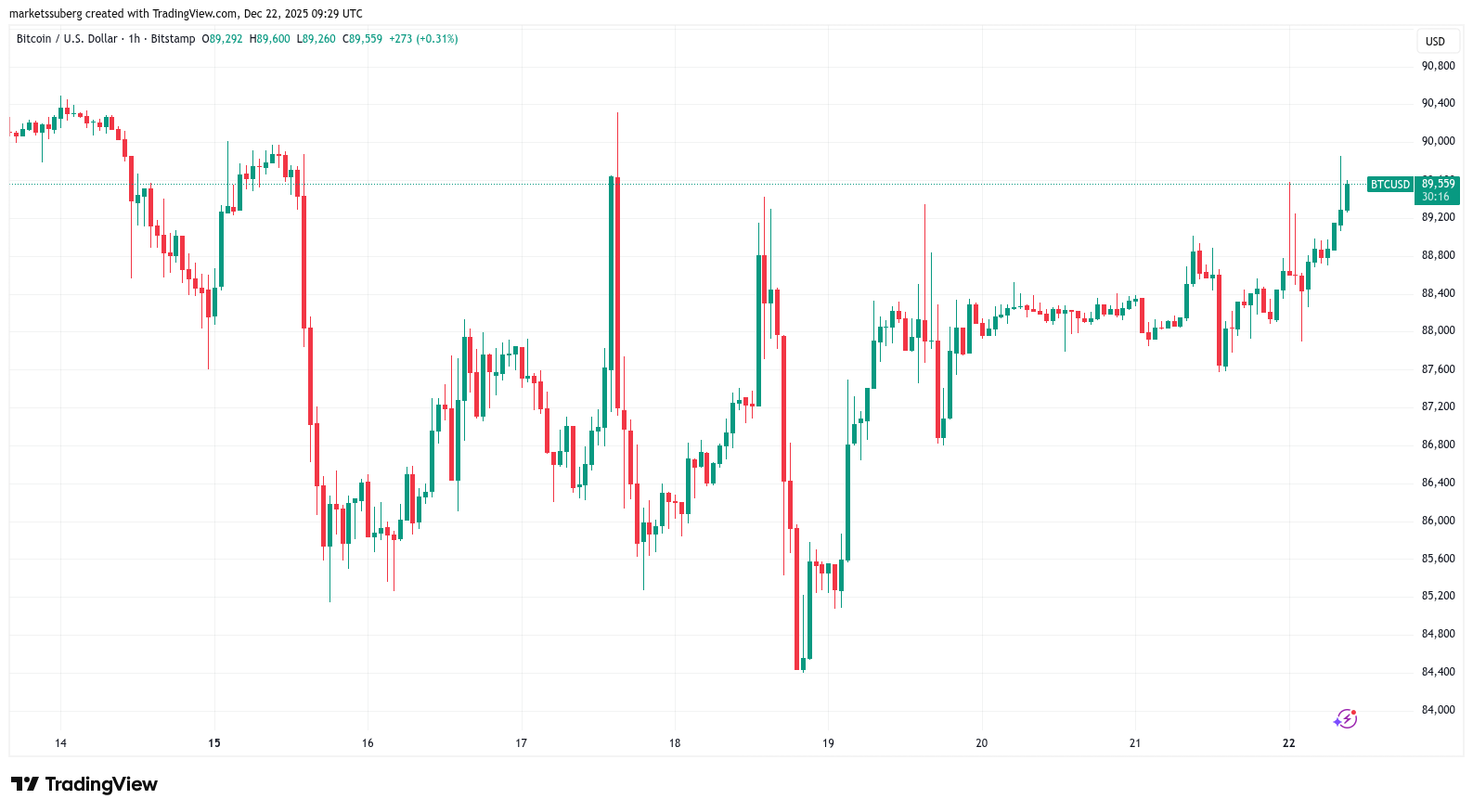
After initially wobbling at the weekly close, Bitcoin saw some much-needed relief as bulls sought to revisit $90,000.

Data from Cointelegraph Markets and TradingView shows BTC/USD circling multiday highs on Monday.

BTC/USD one-hour chart. Source: Cointelegraph/TradingView


Traders have become increasingly polarized on the outlook, with some warning of a return to yearly lows while others anticipate a full bull-market rebound.

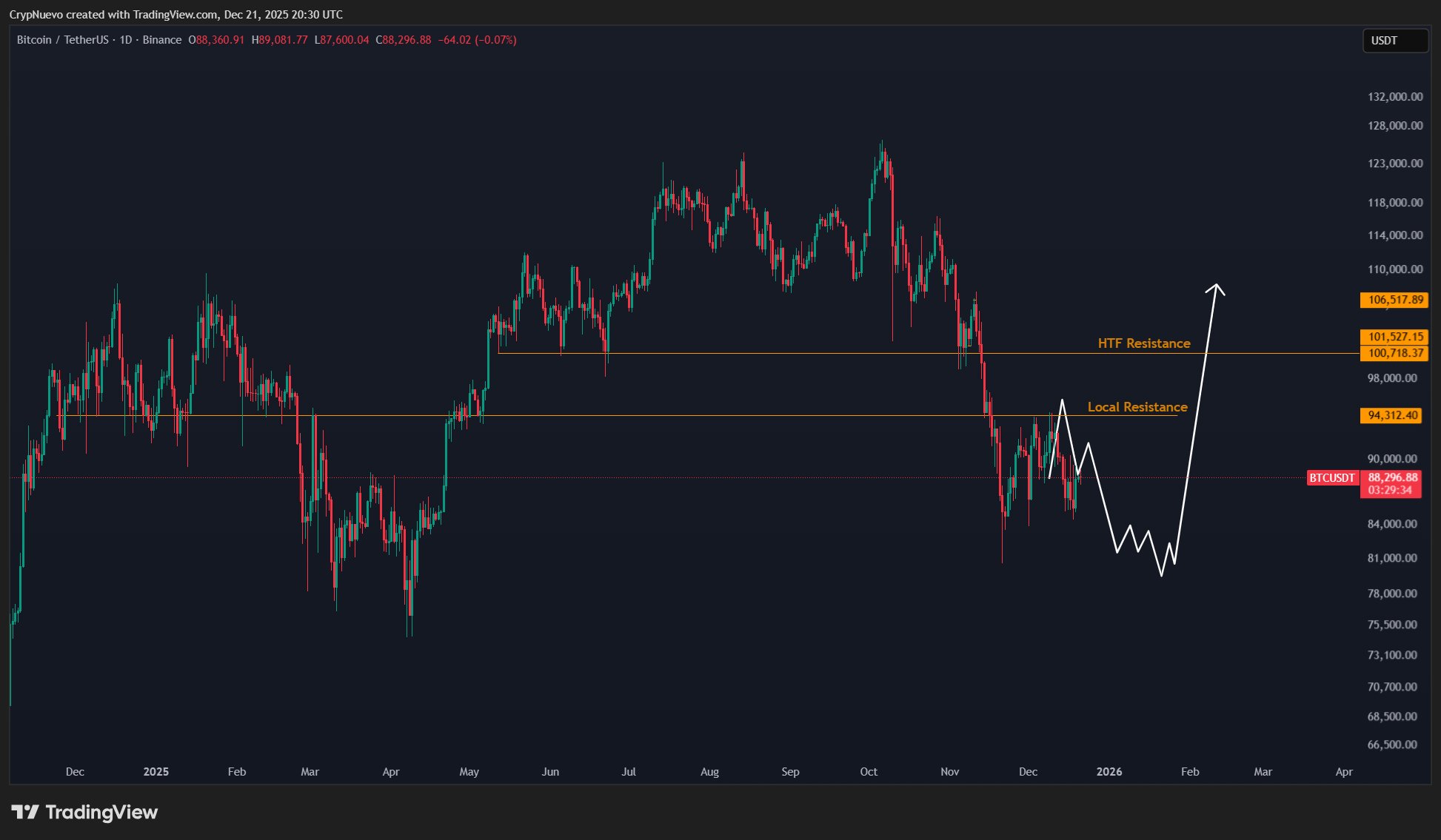
In his latest analysis on X, trader CrypNuevo considered both outcomes possible next.

Sellers, he argued, had disposed of the majority of their capital in the two months since Bitcoin saw its latest all-time highs of $126,000.

“I believe that there probably isn’t much left to sell right now. So the main bearish scenario is a sweep of the lows,” he wrote.

“Losing $80k would take price to the next support at $73k-$72k, but this information makes it more unlikely - unless if there is a new trigger for it to happen.”
BTC/USD one-day chart. Source: CrypNuevo/X


Instead, CrypNuevo eyed the 50-day exponential moving average (EMA) near the $93,500 yearly open as a potential target.

“With this information, it wouldn't surprise me to see an aggressive pump by EOY and the start of 2026,” the X thread continued.

“Clearing the local resistance at $94.5k (matches with the 1D50EMA) would be a clear sign. And then, it'd face a strong resistance at $100k.”
BTC/USD one-day chart with 50EMA. Source: Cointelegraph/TradingView


Expectations of the coming months also vary. Among the bearish takes is that of trader Killa, now seeing a comedown to $60,000 beginning in Q1 2026.

Reiterating his comparison to the end of Bitcoin’s previous bull market in 2021, trader Roman forecast a “very boring” festive period for crypto and stocks.

Gold, silver hit records as Japan casts a shadow

A relatively short week of US macro data releases gives the Fed pause for thought until January — but traders are seeing volatility everywhere.

Jobless claims and the delayed release of Q3 GDP numbers form the backbone of the macro data prints through Wednesday before markets close for Christmas.

As the week begins, however, it is precious metals and Japan’s economy that are stealing attention.

Japanese ten-year bond yields hit a record 2.1%, just days after the central bank hiked interest rates to 30-year highs and officials prepared a $140 billion stimulus package.

“Just as you think Japan's situation can't get worse, it gets even worse,” trading resource The Kobeissi Letter reacted on X.

Uncertainty over Japan has a history of sparking weakness in crypto markets, while the reaction to the contrarian rate hike was less pronounced.

A flight to safety could already be at hand — both gold and silver are hitting new all-time highs, while Bitcoin and altcoins languish far below theirs.

Gold reached $4,420 per ounce on Monday, while silver targeted the $70 mark for the first time, up nearly 150% in 2025.

XAU/USD one-day chart. Source: Cointelegraph/TradingView


“Asset owners keep on winning,” Kobeissi commented, calling stocks’ performance this year “historic.”

“US households now own more equities than real estate as a percentage of their net worth, the 3rd such occurrence over the last 65 years,” it noted.

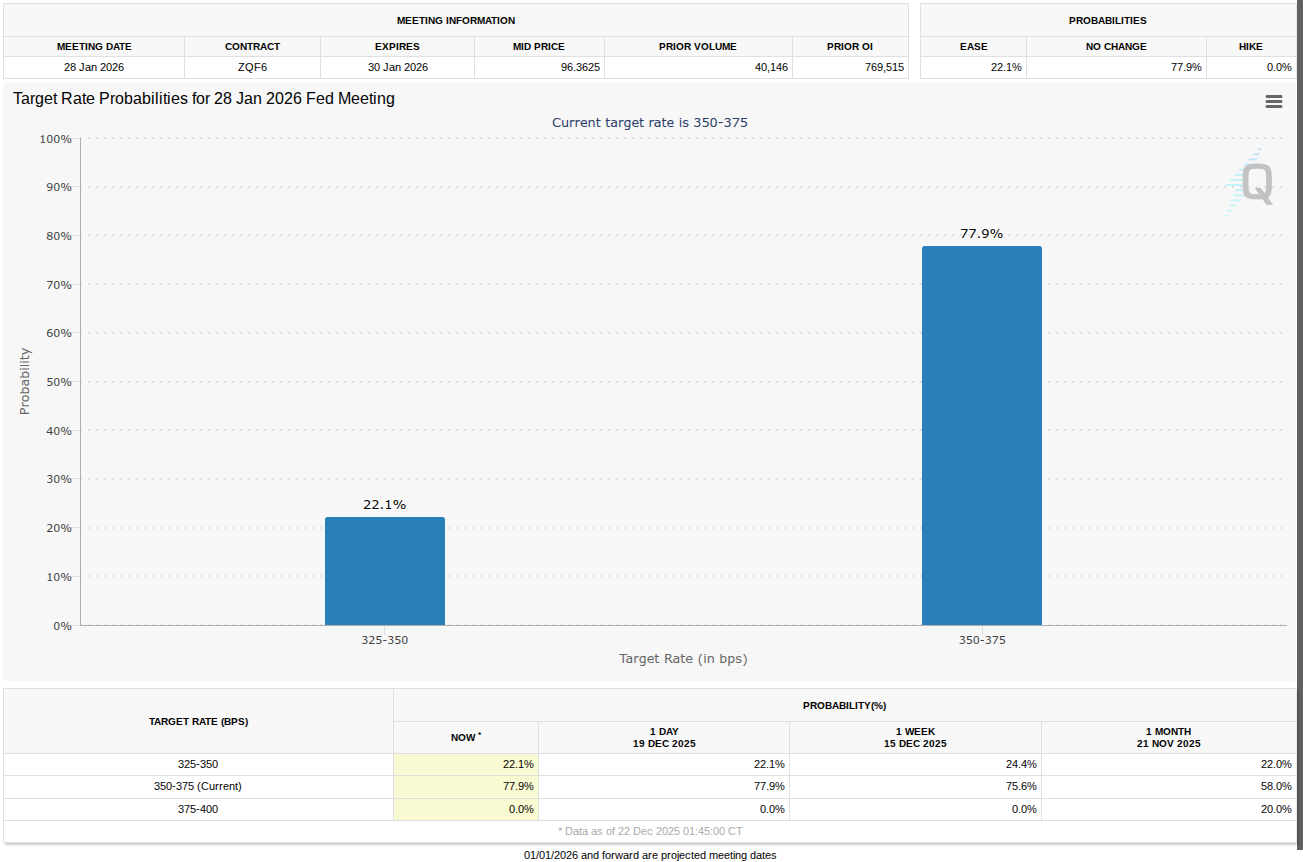
When it comes to the good times continuing, market sentiment remains skeptical. Data from CME Group’s FedWatch Tool currently puts the odds of the Fed cutting rates again in January at just 22%.

Fed target rate probabilities for January FOMC meeting (screenshot). Source: CME Group

Bull or bear? Bitcoin echoes 2022

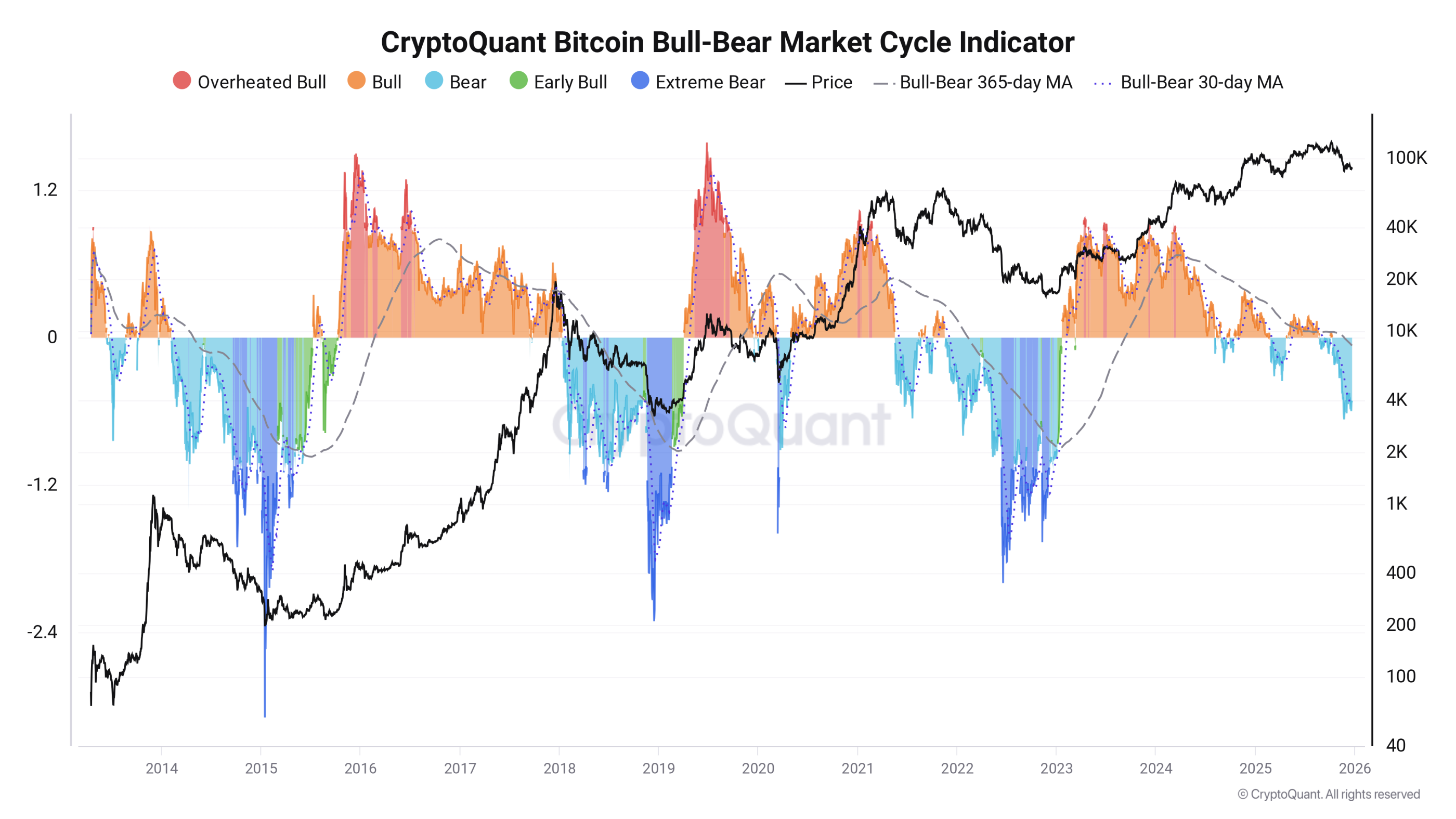
For onchain analytics platform CryptoQuant, Bitcoin is firmly in a bear market.

Among the various reasons, contributors argue, is the so-called Bull-Bear Market Cycle Indicator, which has been in negative territory since early September.

The Indicator measures the 30-day SMA of traders’ Profit & Loss (P&L) Index relative to its 365-day equivalent.

From mid-May to early September, the 30-day SMA was positive. Currently, it measures -0.52, having recently hit its lowest levels since the 2022 bear market.

“Prices enter into bear mode when the indicators switch from Bull to BEAR,” CryptoQuant explains.

Bitcoin Bull-Bear Market Cycle Indicator. Source: CryptoQuant


Continuing, contributor GugaOnChain described the Bull-Bear data as part of an overall market slowdown.

In one of CryptoQuant’s “Quicktake” blog posts on Monday, he likened the situation to 2018, another Bitcoin bear market year, also noting reduced network activity.

“The indicators confirm a defensive scenario, and looking ahead, the comparison with 2018 suggests that periods of low activity tend to precede greater volatility, but today’s broader user base signals stronger resilience in the ecosystem,” he summarized.

Bitcoin highly active address data (screenshot). Source: CryptoQuant

Coinbase Premium fails to inspire

US Bitcoin investors continue to signal a lack of faith as selling pressure from Coinbase stays strong.

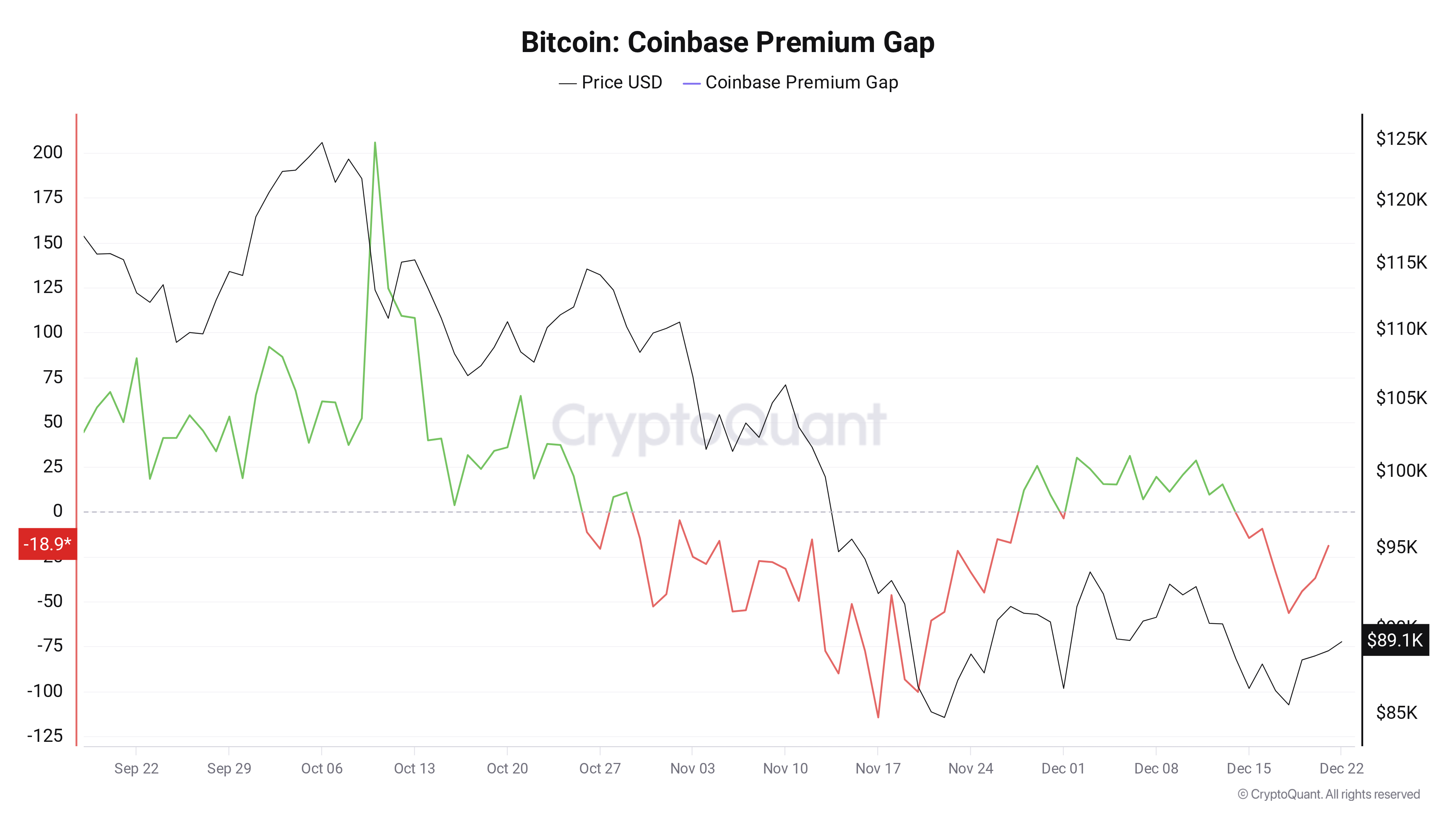
The latest readings from the Coinbase Premium, as reported by CryptoQuant, shows enduring US selling pressure.

The Premium measures the difference in price between Coinbase’s BTC/USD and Binance BTC/USDT pairs. When in negative territory, it signals that a lack of US buyer interest will likely deprive the market of upward momentum.

“Once the $BTC sell pressure there cools off, we can finally bounce,” blockchain technology expert Elja Boom commented on the issue over the weekend.

CryptoQuant shows that the Premium hit -$56 on Dec. 18 before rebounding, still in the red at the time of writing.

This, trader Daan Crypto Trades acknowledged, does not match lows seen as BTC/USD retested $80,000 earlier in the month.

“Market without any clear direction for a while now. No major outliers in the data either,” he told X followers Friday.

“Things point to a slow end of the year. Early next year we'll get a better idea of where this wants to head next.”
Bitcoin Coinbase Premium. Source: CryptoQuant

Sentiment primed for the worst to come

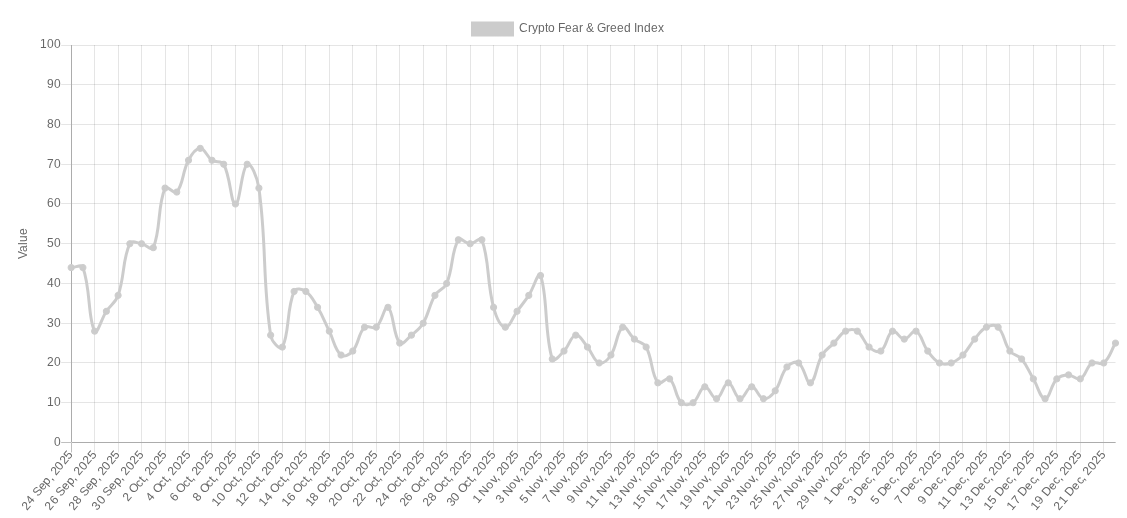
Bitcoin approaching $90,000 was enough to lift market sentiment a full nine points, per data from the Crypto Fear & Greed Index.

Related: Bitcoin weekly RSI falls to most oversold levels since $15K BTC price

Despite that, the overall mood remains one of “extreme fear” at 25/100 — a contrast to the 45/100 “neutral” reading for stocks.

As market consensus appears to agree that further downside is due for crypto, the few optimists going on record are holding firm.

“The markets are in extreme fear, which have often been providing to be a great opportunity to be seeing a strong move afterwards,” crypto trader, analyst and entrepreneur Michaël van de Poppe wrote Saturday.

“The recent crash on the markets for $BTC was a massive disconnect, and it's just a matter of time, in my opinion, that the markets are going back to the fair price.”
Crypto Fear & Greed Index (screenshot). Source: Alternative.me


That perspective is finding limited support as price sticks within a stubborn trading range. BTC price targets even include a return to all-time highs.

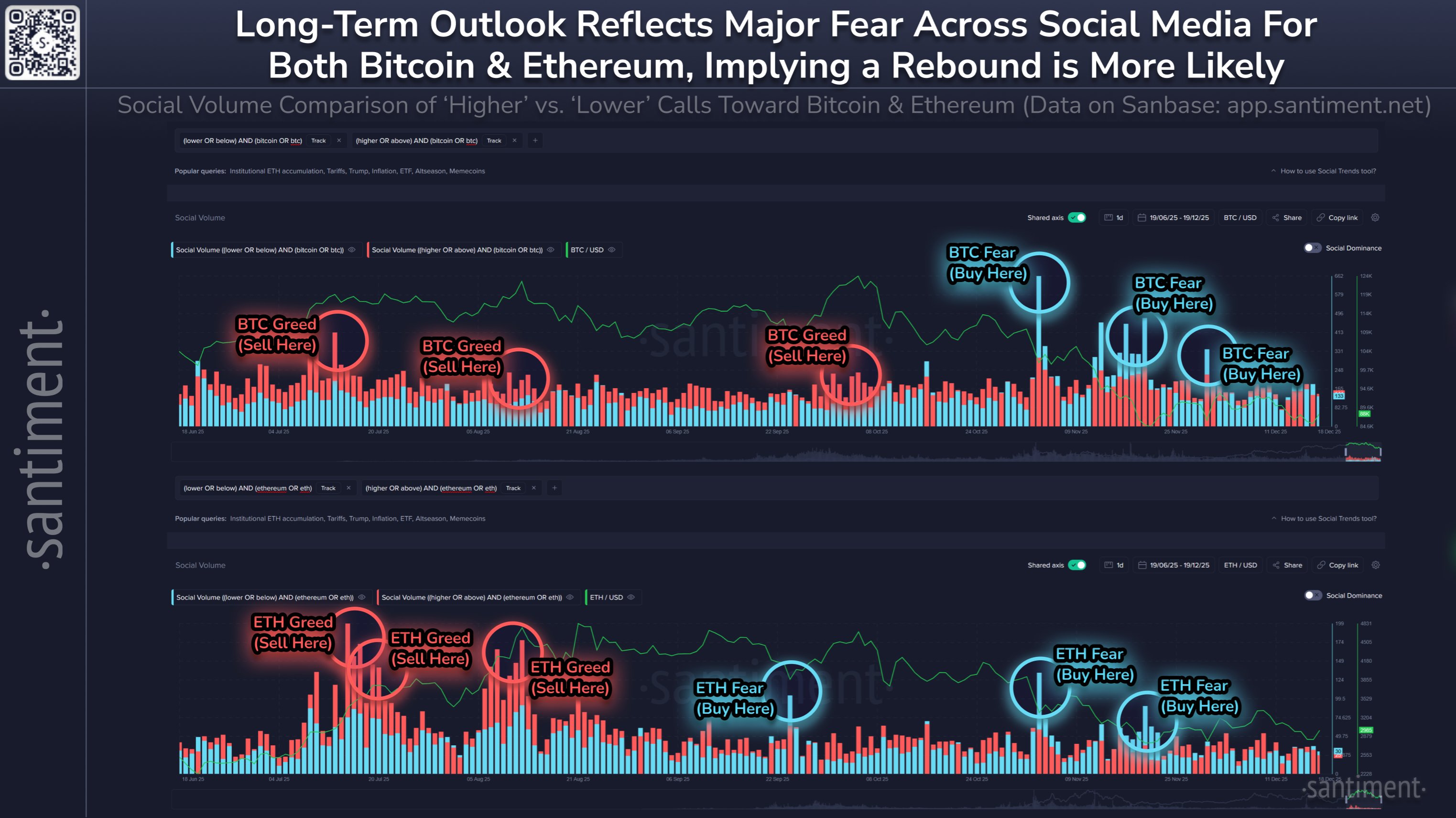
Research firm Santiment, meanwhile, reiterates that markets tend to do the opposite of what majority sentiment believes.

“For both swing trading and long-term trading, prices typically follow the path that retail traders least expect. When there are expected price climbs, prices fall. When there are expected price falls, prices climb,” it summarized Friday alongside crypto social media data.

Crypto social media sentiment data. Source: Santiment/X

This article does not contain investment advice or recommendations. Every investment and trading move involves risk, and readers should conduct their own research when making a decision. While we strive to provide accurate and timely information, Cointelegraph does not guarantee the accuracy, completeness, or reliability of any information in this article. This article may contain forward-looking statements that are subject to risks and uncertainties. Cointelegraph will not be liable for any loss or damage arising from your reliance on this information.


Related Questions

QWhat are the two main price targets for Bitcoin mentioned by trader CrypNuevo in the article?

ACrypNuevo mentioned two main scenarios: a bearish scenario involving a sweep of the lows to $73k-$72k if $80k is lost, and a bullish scenario targeting the 50-day exponential moving average near $93,500, with a move towards $100k.

QWhich two precious metals hit new all-time highs as discussed in the article, and what was silver's approximate gain for 2025?

AGold and silver hit new all-time highs. Gold reached $4,420 per ounce, and silver targeted the $70 mark, gaining nearly 150% in 2025.

QAccording to CryptoQuant's Bull-Bear Market Cycle Indicator, what market phase is Bitcoin currently in and since when?

AAccording to CryptoQuant, Bitcoin is in a bear market phase, with the Bull-Bear Market Cycle Indicator having been in negative territory since early September.

QWhat does a negative Coinbase Premium indicate about U.S. Bitcoin market activity?

AA negative Coinbase Premium indicates stronger selling pressure from U.S. investors on Coinbase compared to buying activity on Binance, suggesting a lack of U.S. buyer interest that deprives the market of upward momentum.

QWhat is the current reading of the Crypto Fear & Greed Index for crypto, and what does this level signify?

AThe Crypto Fear & Greed Index has a reading of 25/100, which signifies 'extreme fear' among market participants.

Related Reads

Where Is the AI Infrastructure Industry Chain Stuck?

The AI infrastructure (AI Infra) industry chain is facing unprecedented systemic bottlenecks, despite the rapid emergence of applications like DeepSeek and Seedance 2.0. The surge in global computing demand has exposed critical constraints across multiple layers of the supply chain—from core manufacturing equipment and data center cabling to specialty materials and cleanroom facilities. Key challenges include four major "walls": - **Memory Wall**: High-bandwidth memory (HBM) and DRAM face structural shortages as AI inference demand outpaces training, with new capacity not expected until 2027. - **Bandwidth Wall**: Data transfer speeds lag behind computing power, causing multi-level bottlenecks in-chip, between chips, and across data centers. - **Compute Wall**: Advanced chip manufacturing, reliant on EUV lithography and monopolized by ASML, remains the fundamental constraint, with supply chain fragility affecting production. - **Power Wall**: While energy demand from data centers is rising, power supply is a solvable near-term challenge through diversified energy infrastructure. Expansion is further hindered by shortages in testing equipment, IC substrates (critical for GPUs and seeing price hikes over 30%), specialty materials like low-CTE glass fiber, and high-end cleanroom facilities. Connection technologies are evolving, with copper cables resurging for short-range links due to cost and latency advantages, while optical solutions dominate long-range scenarios. Innovations like hollow-core fiber and advanced PCB technologies (e.g., glass substrates, mSAP) are emerging to meet bandwidth needs. In summary, AI Infra bottlenecks are multidimensional, spanning compute, memory, bandwidth, power, and supply chain logistics. Advanced chip manufacturing remains the core constraint, while substrate, material, and equipment shortages present immediate challenges. The industry is moving toward hybrid copper-optical solutions and accelerated domestic supply chain development.

marsbit15m ago

Where Is the AI Infrastructure Industry Chain Stuck?

marsbit15m ago

Autonomy or Compatibility: The Choice Facing China's AI Ecosystem Behind the Delay of DeepSeek V4

DeepSeek V4's repeated delay in early 2026 has sparked global discussions on "de-CUDA-ization" in AI. The highly anticipated trillion-parameter open-source model is undergoing deep adaptation to Huawei’s Ascend chips using the CANN framework, representing China’s first systematic attempt to run a core AI model outside the CUDA ecosystem. This shift, however, comes with significant engineering challenges. While the model uses a MoE architecture to reduce computational load, it places extreme demands on memory bandwidth, chip interconnects, and system scheduling—areas where NVIDIA’s mature CUDA ecosystem currently excels. Migrating to Ascend introduces complexities in hardware topology, communication latency, and software optimization due to CANN’s relative immaturity compared to CUDA. The move highlights a broader strategic dilemma: short-term compatibility with CUDA offers practical benefits and faster adoption, as seen in CANN’s efforts to emulate CUDA interfaces. Yet, long-term over-reliance on compatibility risks inheriting CUDA’s limitations and stifling native innovation. If global AI shifts away from transformer-based architectures, strict compatibility could lead to technological obsolescence. Despite these challenges, DeepSeek V4’s eventual release could demonstrate the viability of a full domestic AI stack and accelerate CANN’s ecosystem growth. However, true technological independence will require building an original software-hardware paradigm beyond compatibility—a critical task for China’s AI ambitions in the next 3-5 years.

marsbit33m ago

Autonomy or Compatibility: The Choice Facing China's AI Ecosystem Behind the Delay of DeepSeek V4

marsbit33m ago

How Blockchain Fills the Identity, Payment, and Trust Gaps for AI Agents?

AI Agents are rapidly evolving into autonomous economic participants, but they face critical gaps in identity, payment, and trust infrastructure. They currently lack standardized ways to prove who they are, what they are authorized to do, and how they should be compensated across different environments. Blockchain technology is emerging as a solution to these challenges by providing a neutral coordination layer. Public ledgers offer auditable credentials, wallets enable portable identities, and stablecoins serve as a programmable settlement layer. A key bottleneck is the absence of a universal identity standard for non-human entities—akin to "Know Your Agent" (KYA)—which would allow Agents to operate with verifiable, cryptographically signed credentials. Without this, Agents remain fragmented and face barriers to interoperability. Additionally, as AI systems take on governance roles, there is a risk that centralized control over models could undermine decentralized governance in practice. Cryptographic guarantees on training data, prompts, and behavior logs are essential to ensure Agents act in users' interests. Stablecoins and crypto-native payment rails are becoming the default for Agent-to-Agent commerce, enabling seamless, low-cost transactions for AI-native services. These systems support permissionless, programmable payments without traditional merchant onboarding. Finally, as AI scales, human oversight becomes impractical. Trust must be built into system architecture through verifiable provenance, on-chain attestations, and decentralized identity systems. The future of Agent economies depends on cryptographically enforced accountability, allowing users to delegate tasks with clearly defined constraints and transparent operation logs.

marsbit1h ago

How Blockchain Fills the Identity, Payment, and Trust Gaps for AI Agents?

marsbit1h ago

Trading

Spot
Futures

Hot Articles

What is $BITCOIN

DIGITAL GOLD ($BITCOIN): A Comprehensive Analysis Introduction to DIGITAL GOLD ($BITCOIN) DIGITAL GOLD ($BITCOIN) is a blockchain-based project operating on the Solana network, which aims to combine the characteristics of traditional precious metals with the innovation of decentralized technologies. While it shares a name with Bitcoin, often referred to as “digital gold” due to its perception as a store of value, DIGITAL GOLD is a separate token designed to create a unique ecosystem within the Web3 landscape. Its goal is to position itself as a viable alternative digital asset, although specifics regarding its applications and functionalities are still developing. What is DIGITAL GOLD ($BITCOIN)? DIGITAL GOLD ($BITCOIN) is a cryptocurrency token explicitly designed for use on the Solana blockchain. In contrast to Bitcoin, which provides a widely recognized value storage role, this token appears to focus on broader applications and characteristics. Notable aspects include: Blockchain Infrastructure: The token is built on the Solana blockchain, known for its capacity to handle high-speed and low-cost transactions. Supply Dynamics: DIGITAL GOLD has a maximum supply capped at 100 quadrillion tokens (100P $BITCOIN), although details regarding its circulating supply are currently undisclosed. Utility: While precise functionalities are not explicitly outlined, there are indications that the token could be utilized for various applications, potentially involving decentralized applications (dApps) or asset tokenization strategies. Who is the Creator of DIGITAL GOLD ($BITCOIN)? At present, the identity of the creators and development team behind DIGITAL GOLD ($BITCOIN) remains unknown. This situation is typical among many innovative projects within the blockchain space, particularly those aligning with decentralized finance and meme coin phenomena. While such anonymity may foster a community-driven culture, it intensifies concerns about governance and accountability. Who are the Investors of DIGITAL GOLD ($BITCOIN)? The available information indicates that DIGITAL GOLD ($BITCOIN) does not have any known institutional backers or prominent venture capital investments. The project seems to operate on a peer-to-peer model focused on community support and adoption rather than traditional funding routes. Its activity and liquidity are primarily situated on decentralized exchanges (DEXs), such as PumpSwap, rather than established centralized trading platforms, further highlighting its grassroots approach. How DIGITAL GOLD ($BITCOIN) Works The operational mechanics of DIGITAL GOLD ($BITCOIN) can be elaborated on based on its blockchain design and network attributes: Consensus Mechanism: By leveraging Solana’s unique proof-of-history (PoH) combined with a proof-of-stake (PoS) model, the project ensures efficient transaction validation contributing to the network's high performance. Tokenomics: While specific deflationary mechanisms have not been extensively detailed, the vast maximum token supply implies that it may cater to microtransactions or niche use cases that are still to be defined. Interoperability: There exists the potential for integration with Solana’s broader ecosystem, including various decentralized finance (DeFi) platforms. However, the details regarding specific integrations remain unspecified. Timeline of Key Events Here is a timeline that highlights significant milestones concerning DIGITAL GOLD ($BITCOIN): 2023: The initial deployment of the token occurs on the Solana blockchain, marked by its contract address. 2024: DIGITAL GOLD gains visibility as it becomes available for trading on decentralized exchanges like PumpSwap, allowing users to trade it against SOL. 2025: The project witnesses sporadic trading activity and potential interest in community-led engagements, although no noteworthy partnerships or technical advancements have been documented as of yet. Critical Analysis Strengths Scalability: The underlying Solana infrastructure supports high transaction volumes, which could enhance the utility of $BITCOIN in various transaction scenarios. Accessibility: The potential low trading price per token could attract retail investors, facilitating wider participation due to fractional ownership opportunities. Risks Lack of Transparency: The absence of publicly known backers, developers, or an audit process may yield skepticism regarding the project's sustainability and trustworthiness. Market Volatility: The trading activity is heavily reliant on speculative behavior, which can result in significant price volatility and uncertainty for investors. Conclusion DIGITAL GOLD ($BITCOIN) emerges as an intriguing yet ambiguous project within the rapidly evolving Solana ecosystem. While it attempts to leverage the “digital gold” narrative, its departure from Bitcoin's established role as a store of value underscores the need for a clearer differentiation of its intended utility and governance structure. Future acceptance and adoption will likely depend on addressing the current opacity and defining its operational and economic strategies more explicitly. Note: This report encompasses synthesised information available as of October 2023, and developments may have transpired beyond the research period.

363 Total ViewsPublished 2025.05.13Updated 2025.05.13

What is $BITCOIN

Discussions

Welcome to the HTX Community. Here, you can stay informed about the latest platform developments and gain access to professional market insights. Users' opinions on the price of BTC (BTC) are presented below.

活动图片