Iran Launches 'Sudden Strike' on US Base in Jordan; Oil Prices Jump Nearly 4%, Threatening Bitcoin Rally

cryptonews.ruPublished on 2026-07-29Last updated on 2026-07-29

Abstract

Iran launched a "sudden strike" with ballistic missiles targeting a US base near Jordan's Muwaffaq Salti Air Base on July 28. US Central Command reported all missiles were intercepted by Patriot air defense systems, with no casualties. Iran claimed the attack was retaliation for perceived US actions against its interests. This strike broke a brief ceasefire that began after President Trump paused offensive operations against Iran days earlier. The attack triggered immediate financial market reactions. WTI crude oil prices surged nearly 4% to $83.08 per barrel, while Brent crude rose to $87.34. US stock index futures also saw gains as traders priced in renewed Middle East risks. This price jump reversed a significant portion of the oil price decline that followed the initial ceasefire announcement. Bitcoin's price movement mirrored this volatile cycle. It had recovered to around $65,200 as oil prices fell during the ceasefire, but dropped back to the $63,600-$63,800 range following news of the missile strike. While Bitcoin has shown some resilience compared to purely risk-on assets during the conflict, the July 28 attack directly challenged the "truce" narrative that had supported its recent stability. The pattern of price declines following escalations and recoveries during pauses has become familiar since the conflict began in February.

In a statement, CENTCOM reported that at 5:45 PM Eastern Time on July 28, Islamic Revolutionary Guard Corps forces launched several ballistic missiles from Iran as part of an "attempted surprise attack" against U.S. troops in the Middle East; the missiles were aimed at U.S. positions near Jordan's Muwaffaq Salti Air Base. The Command reported that Patriot air defense batteries intercepted all inbound missiles, and there were no casualties.

Iranian military forces claimed responsibility for the attack, calling it a response to what they identified as "illegal and malicious actions" by Washington against Iranian interests. This attack marks the first strike by Iranian ballistic missiles on a U.S. base in the region since President Trump paused offensive strikes against Iran several days ago to give diplomacy with Tehran a chance, thereby breaking a brief lull in the war that began on February 28.

That previous pause had already been tested, given that an Iranian strike on Jordan's Al-Azraq air base on July 18 resulted in the deaths of two U.S. service members, with a third listed as missing—this was one of several flare-ups that have accompanied the five-month-long conflict. Jordanian military officials reported that this time, they also shot down some of the projectiles flying toward them, with no damage or casualties recorded on their territory.

Oil Futures and Stocks Surge Sharply

Financial markets reacted within hours: the price of WTI crude oil rose by 3.95% to $83.08 per barrel, while the price of Brent crude, the global benchmark, increased by 3.86% to $87.34. Dow Jones futures rose by 63 points, or 0.12%, to 53,007, while S&P 500 futures gained 26 points, and Nasdaq 100 futures rose by nearly 133 points, as traders priced in a resumption of Middle East risks.
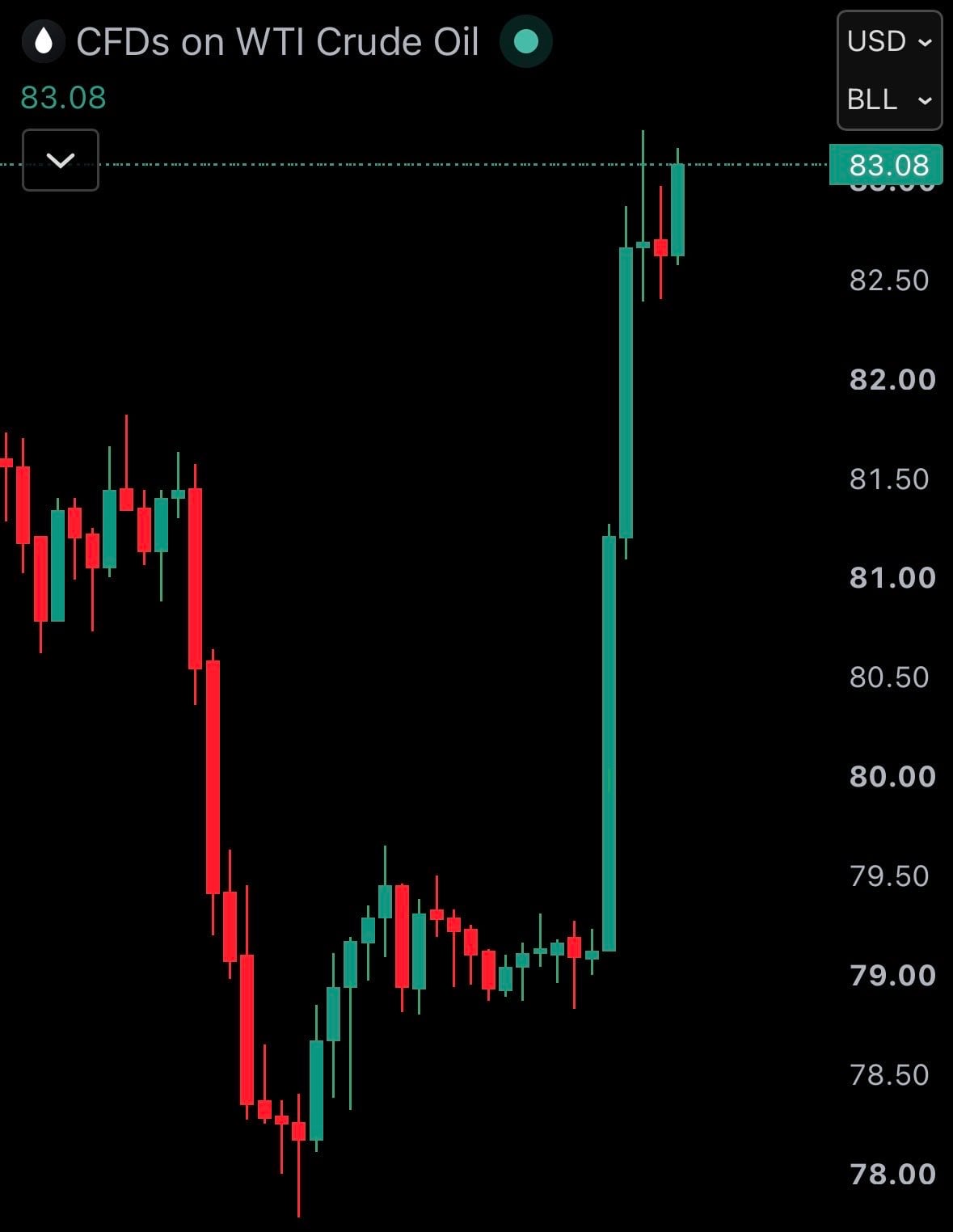
This rebound partially offset a sharp move in the opposite direction just days earlier. Oil prices had plunged by as much as 8% after the Trump administration first signaled the pause, with the price of Brent crude falling from above $100 per barrel to around $87 as mediators negotiated over the Strait of Hormuz. The July 28 attack erased a significant portion of that relief within hours—a pattern now familiar to traders tracking the start-stop rhythm of this conflict since February.

Bitcoin Rally Amid 'Truce' Faces Next Test

Cryptocurrency markets have moved in step with this same cycle, as by July 27 (when Brent crude collapsed to $87), Bitcoin had recovered to around $65,200, briefly reaching $65,600 at the start of futures trading. This recovery gave way to a decline the next day: by July 28, Bitcoin dropped to around $64,000 even before the evening strike, then continued to fall into the $63,600 to $63,800 range once news of the missile strike spread.

Bitcoin.com News previously reported that Bitcoin held near $63,000 during a previous escalation of the conflict in July—part of a trend where the network repeatedly recouped losses within days of each escalation, only to lose some of those gains again at the next flare-up.

Nevertheless, throughout this year, BTC has at times shown signs of decoupling from purely risk-on asset behavior amid the conflict, maintaining support even amid sharp swings in oil and stock prices (unlike the sharper and more consistent sell-offs observed for assets like Ether during the same periods). However, the July 28 strike posed the most direct challenge yet to the 'truce' narrative that underpinned last week's calm.

end-content


Trending Cryptos

Related Questions

QWhat did the Iranian attack on an American base in Jordan target, and what was the immediate military outcome according to CENTCOM?

AThe Iranian attack targeted American positions near Jordan's Muwaffaq Salti Air Base. According to CENTCOM, Patriot air defense batteries intercepted all of the incoming ballistic missiles, and there were no casualties reported.

QHow did the Iranian military justify their missile attack on the American base in Jordan?

AThe Iranian military claimed responsibility for the attack, justifying it as a response to what they identified as 'unlawful and malicious actions' by Washington against Iranian interests.

QWhat was the immediate impact of the July 28th attack on global oil prices?

AFollowing the attack, WTI crude oil prices rose by 3.95% to $83.08 per barrel, and Brent crude oil prices increased by 3.86% to $87.34 per barrel.

QHow did Bitcoin's price react in the hours surrounding the July 28th attack on the Jordanian base?

ABefore the evening attack on July 28th, Bitcoin had dropped to around $64,000. After news of the missile strike spread, its price fell further into the range of $63,600 to $63,800.

QWhat pattern has been observed regarding Bitcoin's price movements in relation to Middle East conflict escalations earlier in the year, according to the article?

AAccording to the article, Bitcoin has shown a pattern of repeatedly recovering losses within days after each escalation of the conflict, only to lose some of those gains again during the next escalation. However, it has also shown signs of decoupling from purely risk-on asset behavior, maintaining support even during sharp swings in oil and stock prices.

Related Reads

USDT Supply Shrinks by $5.5 Billion While Stablecoin Turnover Hits Record High

The supply of stablecoins has contracted for the first time in years, with total market capitalization falling 4.3% from its May peak to $308.5 billion. Despite this decline, June saw a record $1.83 trillion in adjusted transaction volume for stablecoins, a 60% increase from May. This divergence suggests a shift in usage patterns: less capital is sitting idle, while the remaining supply circulates more rapidly through payment and trading systems. Specifically, the supply of Tether's USDT decreased from approximately $189.54 billion to $184 billion between May 1 and July 29, while Circle's USDC supply fell from $77.27 billion to $72.41 billion. Part of this capital appears to have moved into tokenized Treasury products, a sector whose value has grown to over $16 billion, partly driven by regulations like the 2025 GENIUS Act that prohibit interest payments on payment-focused stablecoins. Transaction velocity is emerging as a key metric, with stablecoins now turning over about six times per month—double the rate from two years ago. USDC, despite having a smaller supply than USDT, processed about $1.21 trillion in adjusted volume in June, leading in settlement activity. While a significant portion of on-chain volume may not represent genuine economic payments, identifiable real-world payments have grown sharply, reaching an estimated $390 billion in 2025. The data indicates stablecoins are evolving from static collateral into active financial infrastructure.

cryptonews.ru21m ago

USDT Supply Shrinks by $5.5 Billion While Stablecoin Turnover Hits Record High

cryptonews.ru21m ago

Trading

Spot

Hot Articles

How to Buy 4

Welcome to HTX.com! We've made purchasing 4 (4) simple and convenient. Follow our step-by-step guide to embark on your crypto journey.Step 1: Create Your HTX AccountUse your email or phone number to sign up for a free account on HTX. Experience a hassle-free registration journey and unlock all features.Get My AccountStep 2: Go to Buy Crypto and Choose Your Payment MethodCredit/Debit Card: Use your Visa or Mastercard to buy 4 (4) instantly.Balance: Use funds from your HTX account balance to trade seamlessly.Third Parties: We've added popular payment methods such as Google Pay and Apple Pay to enhance convenience.P2P: Trade directly with other users on HTX.Over-the-Counter (OTC): We offer tailor-made services and competitive exchange rates for traders.Step 3: Store Your 4 (4)After purchasing your 4 (4), store it in your HTX account. Alternatively, you can send it elsewhere via blockchain transfer or use it to trade other cryptocurrencies.Step 4: Trade 4 (4)Easily trade 4 (4) on HTX's spot market. Simply access your account, select your trading pair, execute your trades, and monitor in real-time. We offer a user-friendly experience for both beginners and seasoned traders.

4.9k Total ViewsPublished 2025.10.20Updated 2026.06.02

How to Buy 4

Discussions

Welcome to the HTX Community. Here, you can stay informed about the latest platform developments and gain access to professional market insights. Users' opinions on the price of 4 (4) are presented below.

活动图片