Morgan Stanley's MSSE ETF Raises $5 Million on Launch Day, Ether ETFs Surpass Bitcoin in Daily Inflows with $14.5 Million

cryptonews.ruPublished on 2026-07-29Last updated on 2026-07-29

Abstract

On July 28, institutional cryptocurrency demand showed further divergence. Ether (ETH) exchange-traded funds (ETFs) continued to attract capital with a net inflow of $14.53 million, led by BlackRock's ETHB and Morgan Stanley's new MSSE fund, which saw a $5.15 million inflow on its debut. In contrast, Bitcoin ETFs experienced their fourth consecutive day of net outflows, totaling $49.75 million, primarily from BlackRock's IBIT. Solana (SOL) ETFs faced a sharp net outflow of $18.07 million, while ETFs for $HYPE recorded outflows for a fourth day. XRP products saw no net flows. Overall, the data indicates a selective market where Ether is gaining favor, while Bitcoin, Solana, and $HYPE face selling pressure.

On Tuesday, July 28th, institutional demand for cryptocurrencies became even more fragmented. Ether funds continued to attract fresh capital, but a series of losses for Bitcoin deepened, and Solana experienced one of its weakest sessions ever.

On July 28th, Bitcoin exchange-traded funds (ETFs) recorded a net outflow of $49.75 million. Funds for $HYPE also remained in negative territory, while products for $XRP saw neither net creation nor redemption.

Ether Attracts Fresh Capital Amid Deepening Bitcoin Decline

Inflows into Ether ETFs were distributed across three products.

The leader was BlackRock's ETHB ETF with an inflow of $5.91 million. The recently launched Morgan Stanley MSSE ETF, which supports staking, attracted $5.15 million, and BlackRock's ETHA ETF brought in $3.47 million.

Collectively, these funds provided a net inflow of $14.53 million. Total trading volume reached $633.51 million, and the combined net asset value at the end of the day was $10.50 billion.
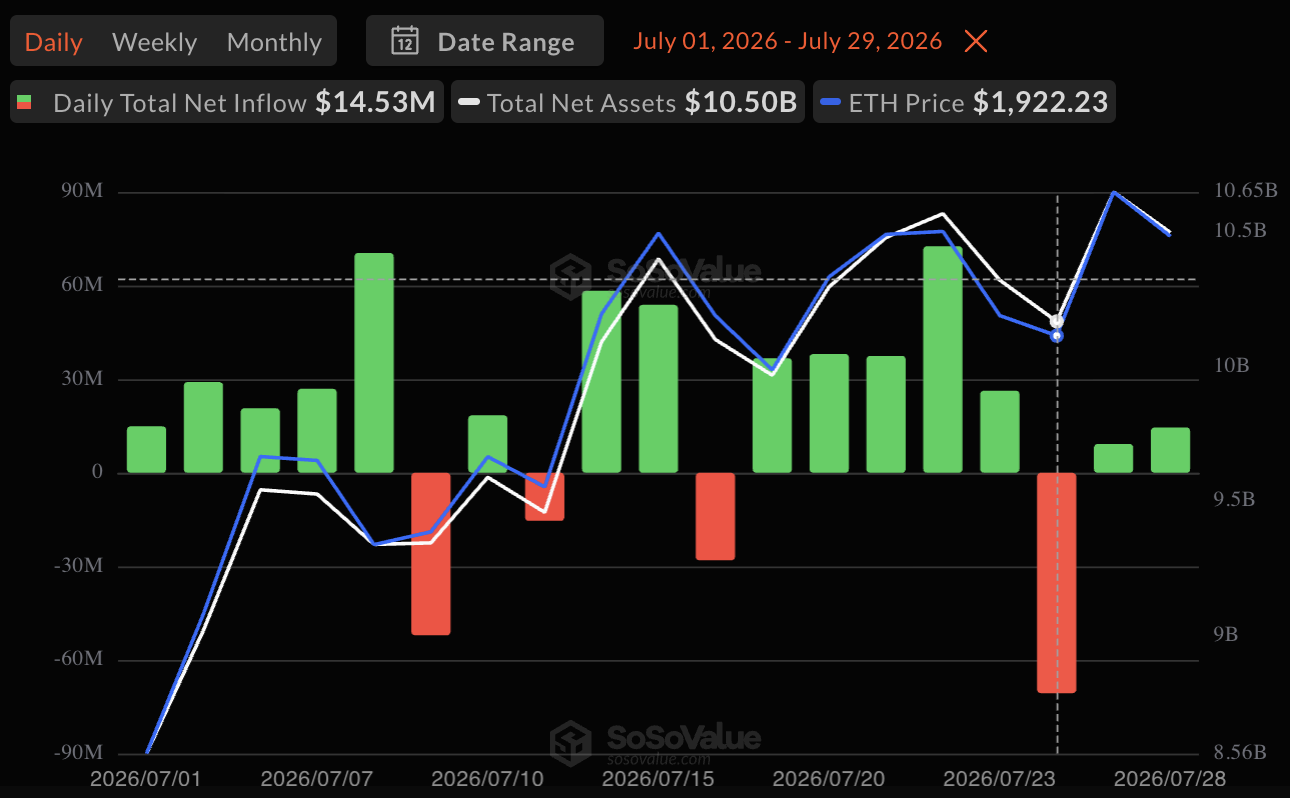
Ether ETFs demonstrated consistent inflows in July, with outflows observed on only four days. Source: Sosovalue

Bitcoin ETFs, in contrast, showed the opposite dynamic for the fourth consecutive session. BlackRock's IBIT fund recorded an outflow of $54.83 million, accounting for the entire gross outflow in this category.

Grayscale's "Bitcoin Mini Trust" ETF partially offset these losses with an inflow of $5.08 million. As a result, the group's net outflow was $49.75 million. Bitcoin ETF trading volume reached $1.40 billion. Total net assets fell to $77.23 billion from $78.71 billion the previous day.

The subdued activity at the fund level suggests the latest decline was localized rather than market-wide. Nevertheless, four consecutive days of outflows indicate weakening short-term demand for the largest crypto asset.

Solana Sees Sharp Outflow Amid Continued $HYPE Slump

Solana ETFs recorded a net outflow of $18.07 million—the second-largest daily outflow since these products launched. The majority of selling came from Bitwise's BSOL fund. The total trading volume for Solana ETFs rose to $78.76 million, while net assets shrank to $851.84 million.

$HYPE ETFs saw outflows for the fourth day in a row. Bitwise's BHYP fund lost $1.24 million, reducing the category's net assets to $269.40 million. Total trading volume reached $18.52 million.

ETFs for $XRP saw no net inflows. However, combined assets fell to $971.57 million, dropping below the $1 billion mark.

The recent outflows from $HYPE contrast with its strong early performance. Grayscale Research notes that inflows into $HYPE exchange-traded products grew quickly relative to the token's market value and still outpace Bitcoin, Solana, and $XRP at comparable stages in their ETF lifecycles.
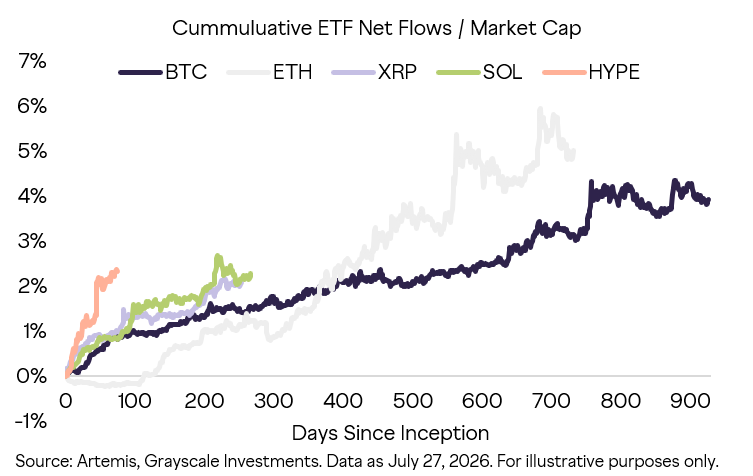
Source: Grayscale Research

These early successes have not prevented a short-term pullback. Tuesday's data, on the contrary, showed the market becoming more selective: Ether is attracting capital, while Bitcoin, Solana, and $HYPE products are facing renewed selling pressure.

end-content

Trending Cryptos

Related Questions

QWhich cryptocurrency ETF recorded a net inflow of $14.53 million on the reported date, and which specific ETFs contributed to this?

AEthereum ETFs recorded a net inflow of $14.53 million. The contributors were Blackrock's ETHB ETF with $5.91 million, Morgan Stanley's MSSE ETF with $5.15 million, and Blackrock's ETHA ETF with $3.47 million.

QWhat was the net flow for Bitcoin ETFs on July 28, and what were the main contributing funds?

ABitcoin ETFs recorded a net outflow of $49.75 million on July 28. The main contributor was Blackrock's IBIT fund with an outflow of $54.83 million, which was partially offset by an inflow of $5.08 million into Grayscale's Bitcoin Mini Trust.

QHow did Solana ETFs perform on the reported date, and what was notable about this performance?

ASolana ETFs recorded a net outflow of $18.07 million, marking the second-largest single-day outflow since their launch. Most of the selling pressure came from Bitwise's BSOL fund.

QWhat was the performance trend for the $HYPE ETF, and how does Grayscale Research contextualize its early performance?

AThe $HYPE ETF experienced its fourth consecutive day of outflows, with Bitwise's BHYP fund losing $1.24 million. Grayscale Research notes that despite the recent outflows, $HYPE's initial inflows grew faster relative to its token's market cap and outperformed Bitcoin, Solana, and XRP ETFs at comparable stages of their lifecycle.

QWhat overall market trend does the article suggest based on the ETF flow data?

AThe article suggests that the market is becoming more selective. Capital is flowing into Ethereum ETFs, while Bitcoin, Solana, and $HYPE products are facing new selling pressure, indicating a divergence in institutional demand.

Related Reads

In the Age of Artificial Intelligence, We Need 'Magicians,' Not 'Managers'

In the AI era, leadership must shift from management to magic. As knowledge rapidly expires, value shifts from what leaders know to what they can facilitate. Traditional "inside-out" management, driven by internal experience, is giving way to "outside-in" thinking focused on external opportunities, customer needs, and disruptive change. The core challenge is fostering new ideas that may invalidate existing knowledge. While technologies like steam, electricity, and AI provide the "skeleton" for innovation, it is human vision—connecting technology to customer dreams—that creates magic. Historical figures like Richard Arkwright and Eldridge R. Johnson succeeded not by inventing core technologies, but by reimagining work and business models from the outside in. Leaders must transition from controllers to "architects of flourishing." Their role is to design environments where empowerment, creativity, and adaptive learning thrive. This involves granting autonomy, fostering partnerships, and building resilient systems that scale innovation. Critical leadership qualities now include judgment, creativity, and the ability to learn continuously rather than relying on static expertise. Therefore, cultivating future leaders requires a focus on timeless fundamentals, humanities for broader perspective, and social acuity, rather than over-specialization in quickly outdated technical skills. The future rewards those who respond to the unseen and create conditions for better answers to emerge. Leadership in the AI age is less about having all the answers and more about enabling others to discover them—creating organizations where people explore, imagine, and thrive.

marsbit20m ago

In the Age of Artificial Intelligence, We Need 'Magicians,' Not 'Managers'

marsbit20m ago

Trading

Spot

Hot Articles

Discussions

Welcome to the HTX Community. Here, you can stay informed about the latest platform developments and gain access to professional market insights. Users' opinions on the price of S (S) are presented below.

活动图片