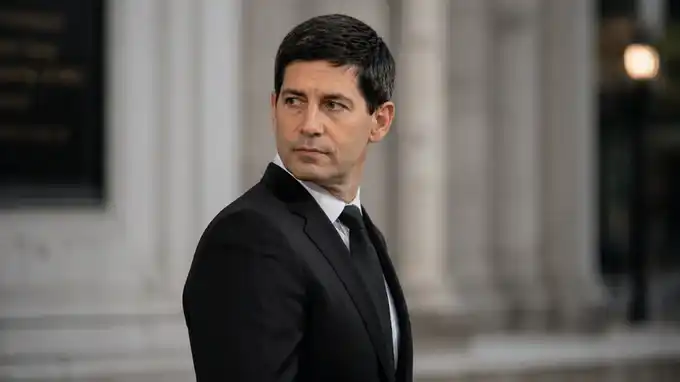
"Yes, I think he is." When asked if Kevin Warsh had become the top candidate for the next Federal Reserve Chair, U.S. President Trump affirmed in an interview with The Wall Street Journal on December 12. This statement instantly rewrote the competitive landscape for the Fed Chair position. Just as the market widely believed that White House National Economic Council Director Kevin Hassett was the frontrunner, a 45-minute meeting between Trump and Warsh on December 10 completely changed the situation. During this meeting, Trump's most pressing question was: "If you were to lead the Fed, would you cut interest rates?" Warsh's answer clearly won Trump's approval.
A Sudden Change in Candidate: How Did Warsh Overtake Hassett?
In the long game of selecting the Fed Chair, Kevin Warsh's comeback was no accident. Compared to the more academically inclined Hassett, Warsh possesses experience from both Wall Street and within the Federal Reserve system. This former Fed Governor served as a liaison between the Fed and Wall Street during the 2008 financial crisis, coordinated the sale of Bear Stearns to JPMorgan Chase, and participated in the decision to approve the collapse of Lehman Brothers.
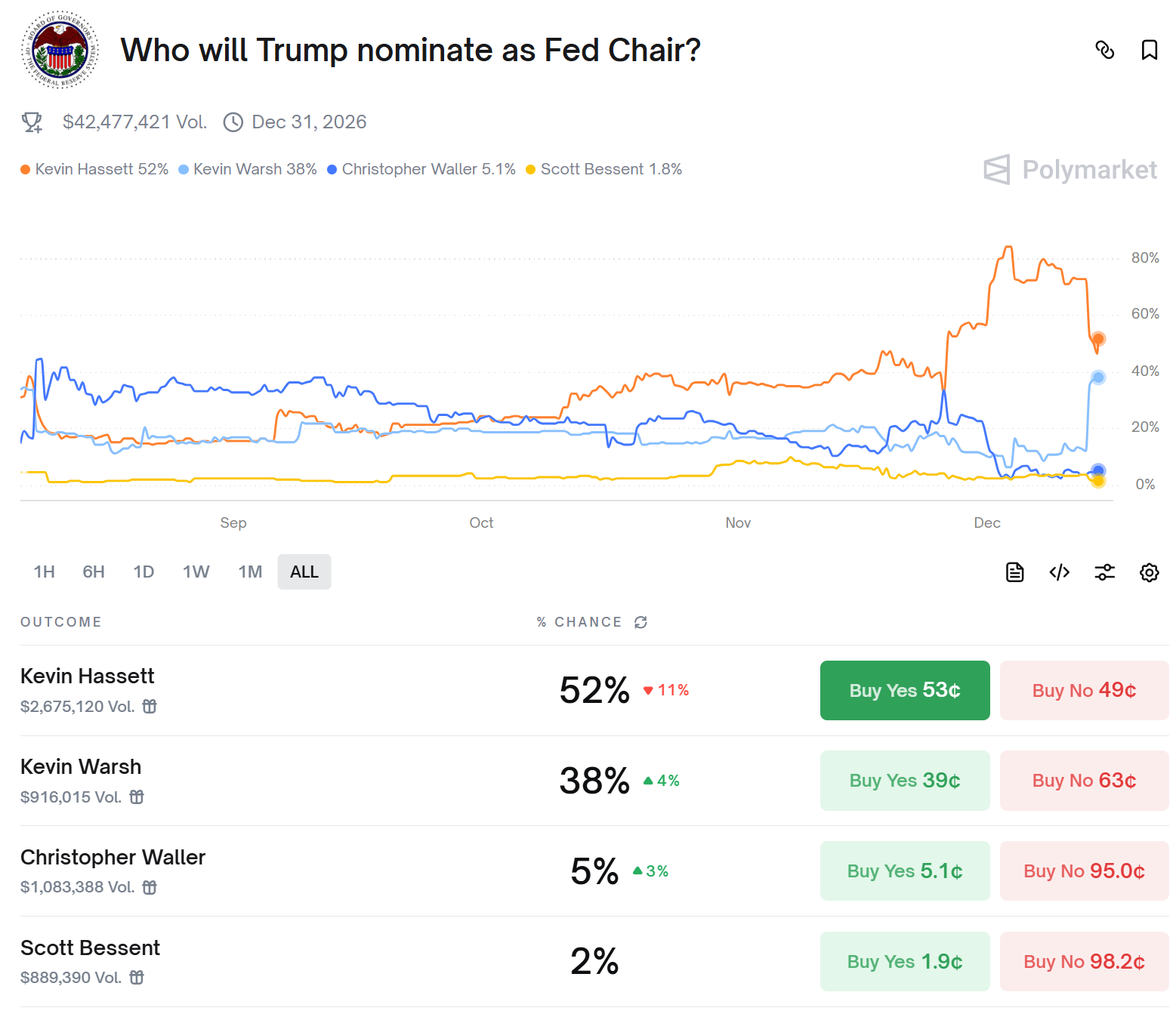
Trump tried to balance his public statements in the interview: "I think both Kevins are great," and added that "there are a few other very good people too." But the market敏锐ly picked up on this subtle change—on prediction markets, Hassett's nomination probability dropped from 85% to 52%, while Warsh's probability rose from 14% to 38%.
Warsh's monetary policy stance aligns closely with Trump's. "He believes we must lower interest rates," Trump emphasized in the interview, "Everyone else I've spoken to thinks so too." This statement dovetails with Trump's long-standing call for the Fed to cut rates more aggressively.
Power Play: Trump's Fed Transformation Plan
Trump's intervention in the Fed has long exceeded conventional bounds. Since taking office as president again in January this year, he has repeatedly publicly criticized Fed Chair Powell, accusing the Fed of cutting rates too slowly and even threatening to remove him from his post.
After the Fed announced its third rate cut this year on December 10, lowering the target range for the federal funds rate to 3.5%-3.75%, Trump immediately said the "cut was too small, it could have been larger." This reaction highlights his dissatisfaction with the Fed's monetary policy.
More controversially, Trump stated bluntly in the interview: The Fed Chair should consult the President on interest rate decisions.
This demand directly challenges the Fed's long-standing tradition of independence. "Usually, they don't do that anymore. In the past, it was routine. They should do it," Trump argued in his own defense, "My opinion is very insightful and should be heard."
Candidate Landscape: The Contest Among Five Contenders
Besides Warsh and Hassett, Trump has a list of five main candidates. U.S. Treasury Secretary Besant has planned a second round of interviews with the candidates before compiling a shortlist for Trump's consideration.
On this list, current Fed Governors Christopher Waller and Michelle Bowman, as well as Rick Rieder, BlackRock's Chief Investment Officer of Global Fixed Income, are also included. Among them, Bowman, whom Trump directly nominated to the Fed and who serves as Vice Chair, holds a special advantage.
She cast a dissenting vote in 2024 when the Fed began its rate-cutting cycle with a 50 basis point cut, favoring a more measured 25 basis point reduction—a stance that previously earned Trump's praise.
Warsh's greatest advantage lies in his diverse background: experience on Wall Street, a former term as a Fed Governor, and close ties to Trump's team. His academic credentials from Stanford University's Hoover Institute also add to his scholarly credibility.
Historical Shadow: The Risk of Politicizing the Fed
Trump's pressure on the Fed brings to mind historical lessons. In the 1970s, President Nixon coerced then-Fed Chair Burns into cutting rates continuously, ultimately triggering an explosion of inflation in the U.S. and a sharp decline in Burns' professional reputation.
This scene may now replay. ECB President Christine Lagarde has warned that Trump's meddling in Fed affairs poses a "very serious threat" to the U.S. economy and even the global economy. She emphasized: "If U.S. monetary policy is no longer independent but is directed by the instructions of one individual, it would have a huge impact on the global economy." U.S. Treasury Secretary Besant has also tried to balance various positions, stating on one hand that "the Fed is independent and should be independent," while on the other hand pointing out that "the Fed has made many mistakes." This seemingly contradictory rhetoric reflects the complexity of the current political environment surrounding the Fed.
Market Impact: Wall Street's Cautious Reaction
Regarding the potential change in Fed leadership, Wall Street is showing caution. JPMorgan Chase CEO Jamie Dimon expressed his views on the two main candidates at a recent closed-door event. Dimon believed Hassett was more likely to push for near-term rate cuts, while he also agreed with Warsh's writings about the Fed.
Barron's quoted Dimon as saying Warsh "would be a terrific chair." In terms of market reaction, U.S. stocks showed divergence after Trump's statement. Investors are rotating out of tech stocks into blue-chip or value stocks, reflecting market uncertainty about the future direction of Fed policy. Any erosion of Fed independence would directly impact investor confidence in the U.S. dollar, leading to significant volatility in the dollar exchange rate and dollar-denominated assets.
Looking back at history, during the end of the Bretton Woods system, political interference in monetary policy was "one of the important reasons for the great inflation of the 1970s in the U.S. and the collapse of the Bretton Woods system."
Powell's Legacy: An Approaching End of Term
Facing the end of his term next May, current Fed Chair Powell is focused on ensuring a smooth economic handover. Asked about his legacy at a recent press conference, Powell said: "I really hope that when I hand this job over to my successor... the economy is in very good shape. That's what I want to do." Powell's Fed has been unwilling to meet Trump's demand to slash the benchmark rate from current levels to 1% to reduce the federal government's borrowing costs. This stance has led Trump to repeatedly threaten to have Powell "removed."
The conflict between Powell and Trump has existed almost from the moment of his nomination in 2017. Trump has frequently resorted to insults and personal attacks, constantly urging the Fed to lower rates, remaining dissatisfied even though the central bank has cut its key rate by 0.75 percentage points since September. JPMorgan Chase CEO Jamie Dimon's assessment likely represents the consensus: Warsh "would be a terrific chair."
However, caught between political pressure and professional independence, who will lead the Fed is not only a matter of individual capability but also whether the Fed can withstand political pressure and maintain monetary policy independence. Trump left himself enough room to change his mind, noting "I think I have a favorite," but "I like them all, but I want to be careful." The final outcome of this personnel contest will influence the direction of global financial markets for years to come.