Fed Chair Race Takes a Surprising Turn: Warsh Overtakes Hassett, Trump's Interest Rate Gambit Places a New Piece

marsbitPublished on 2025-12-14Last updated on 2025-12-14

Abstract

US Federal Reserve Chair Race Shifts: Warsh Surpasses Hassett as Trump's Top Pick In a surprise turn of events, President Trump confirmed to The Wall Street Journal that former Fed Governor Kevin Warsh has become the leading candidate for the next Federal Reserve Chair, overtaking previously favored Kevin Hassett. This shift followed a 45-minute meeting where Warsh aligned with Trump’s desire for lower interest rates. Warsh’s Wall Street experience and previous role at the Fed during the 2008 financial crisis distinguished him from the more academic Hassett. Market probabilities reflected the change, with Hassett’s odds dropping from 85% to 52%, while Warsh’s rose to 38%. Trump has repeatedly criticized current Chair Jerome Powell for not cutting rates aggressively enough, and even suggested the Fed should consult the president on rate decisions—a direct challenge to the central bank’s independence. Other candidates include Fed Governors Christopher Waller and Michelle Bowman, and BlackRock’s Rick Rieder. Historical parallels were drawn to Nixon-era political pressure on the Fed, which led to high inflation. ECB President Christine Lagarde warned that political interference poses a “very serious threat” to global economic stability. Wall Street reacted cautiously, with Jamie Dimon noting both candidates' strengths but acknowledging Warsh’s potential to be an “outstanding chair.” Powell, whose term ends in May, aims to hand over a stable economy but has consistently resis...

"Yes, I think he is." When asked if Kevin Warsh had become the top candidate for the next Federal Reserve Chair, U.S. President Trump affirmed in an interview with The Wall Street Journal on December 12. This statement instantly rewrote the competitive landscape for the Fed Chair position. Just as the market widely believed that White House National Economic Council Director Kevin Hassett was the frontrunner, a 45-minute meeting between Trump and Warsh on December 10 completely changed the situation. During this meeting, Trump's most pressing question was: "If you were to lead the Fed, would you cut interest rates?" Warsh's answer clearly won Trump's approval.

A Sudden Change in Candidate: How Did Warsh Overtake Hassett?

In the long game of selecting the Fed Chair, Kevin Warsh's comeback was no accident. Compared to the more academically inclined Hassett, Warsh possesses experience from both Wall Street and within the Federal Reserve system. This former Fed Governor served as a liaison between the Fed and Wall Street during the 2008 financial crisis, coordinated the sale of Bear Stearns to JPMorgan Chase, and participated in the decision to approve the collapse of Lehman Brothers.
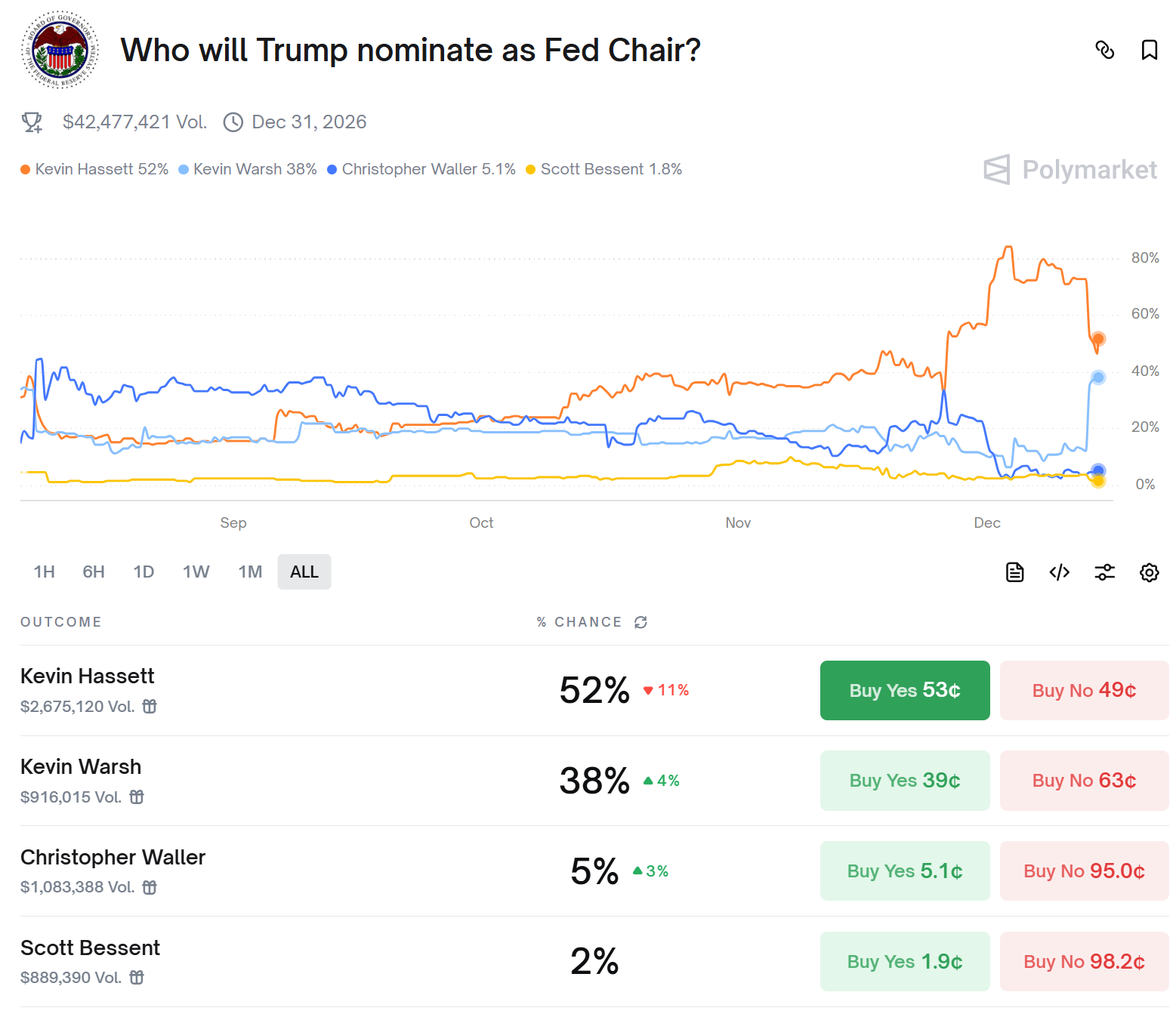
Trump tried to balance his public statements in the interview: "I think both Kevins are great," and added that "there are a few other very good people too." But the market敏锐ly picked up on this subtle change—on prediction markets, Hassett's nomination probability dropped from 85% to 52%, while Warsh's probability rose from 14% to 38%.

Warsh's monetary policy stance aligns closely with Trump's. "He believes we must lower interest rates," Trump emphasized in the interview, "Everyone else I've spoken to thinks so too." This statement dovetails with Trump's long-standing call for the Fed to cut rates more aggressively.

Power Play: Trump's Fed Transformation Plan

Trump's intervention in the Fed has long exceeded conventional bounds. Since taking office as president again in January this year, he has repeatedly publicly criticized Fed Chair Powell, accusing the Fed of cutting rates too slowly and even threatening to remove him from his post.

After the Fed announced its third rate cut this year on December 10, lowering the target range for the federal funds rate to 3.5%-3.75%, Trump immediately said the "cut was too small, it could have been larger." This reaction highlights his dissatisfaction with the Fed's monetary policy.

More controversially, Trump stated bluntly in the interview: The Fed Chair should consult the President on interest rate decisions.

This demand directly challenges the Fed's long-standing tradition of independence. "Usually, they don't do that anymore. In the past, it was routine. They should do it," Trump argued in his own defense, "My opinion is very insightful and should be heard."


Candidate Landscape: The Contest Among Five Contenders

Besides Warsh and Hassett, Trump has a list of five main candidates. U.S. Treasury Secretary Besant has planned a second round of interviews with the candidates before compiling a shortlist for Trump's consideration.

On this list, current Fed Governors Christopher Waller and Michelle Bowman, as well as Rick Rieder, BlackRock's Chief Investment Officer of Global Fixed Income, are also included. Among them, Bowman, whom Trump directly nominated to the Fed and who serves as Vice Chair, holds a special advantage.

She cast a dissenting vote in 2024 when the Fed began its rate-cutting cycle with a 50 basis point cut, favoring a more measured 25 basis point reduction—a stance that previously earned Trump's praise.

Warsh's greatest advantage lies in his diverse background: experience on Wall Street, a former term as a Fed Governor, and close ties to Trump's team. His academic credentials from Stanford University's Hoover Institute also add to his scholarly credibility.


Historical Shadow: The Risk of Politicizing the Fed

Trump's pressure on the Fed brings to mind historical lessons. In the 1970s, President Nixon coerced then-Fed Chair Burns into cutting rates continuously, ultimately triggering an explosion of inflation in the U.S. and a sharp decline in Burns' professional reputation.

This scene may now replay. ECB President Christine Lagarde has warned that Trump's meddling in Fed affairs poses a "very serious threat" to the U.S. economy and even the global economy. She emphasized: "If U.S. monetary policy is no longer independent but is directed by the instructions of one individual, it would have a huge impact on the global economy." U.S. Treasury Secretary Besant has also tried to balance various positions, stating on one hand that "the Fed is independent and should be independent," while on the other hand pointing out that "the Fed has made many mistakes." This seemingly contradictory rhetoric reflects the complexity of the current political environment surrounding the Fed.


Market Impact: Wall Street's Cautious Reaction

Regarding the potential change in Fed leadership, Wall Street is showing caution. JPMorgan Chase CEO Jamie Dimon expressed his views on the two main candidates at a recent closed-door event. Dimon believed Hassett was more likely to push for near-term rate cuts, while he also agreed with Warsh's writings about the Fed.

Barron's quoted Dimon as saying Warsh "would be a terrific chair." In terms of market reaction, U.S. stocks showed divergence after Trump's statement. Investors are rotating out of tech stocks into blue-chip or value stocks, reflecting market uncertainty about the future direction of Fed policy. Any erosion of Fed independence would directly impact investor confidence in the U.S. dollar, leading to significant volatility in the dollar exchange rate and dollar-denominated assets.

Looking back at history, during the end of the Bretton Woods system, political interference in monetary policy was "one of the important reasons for the great inflation of the 1970s in the U.S. and the collapse of the Bretton Woods system."


Powell's Legacy: An Approaching End of Term

Facing the end of his term next May, current Fed Chair Powell is focused on ensuring a smooth economic handover. Asked about his legacy at a recent press conference, Powell said: "I really hope that when I hand this job over to my successor... the economy is in very good shape. That's what I want to do." Powell's Fed has been unwilling to meet Trump's demand to slash the benchmark rate from current levels to 1% to reduce the federal government's borrowing costs. This stance has led Trump to repeatedly threaten to have Powell "removed."

The conflict between Powell and Trump has existed almost from the moment of his nomination in 2017. Trump has frequently resorted to insults and personal attacks, constantly urging the Fed to lower rates, remaining dissatisfied even though the central bank has cut its key rate by 0.75 percentage points since September. JPMorgan Chase CEO Jamie Dimon's assessment likely represents the consensus: Warsh "would be a terrific chair."

However, caught between political pressure and professional independence, who will lead the Fed is not only a matter of individual capability but also whether the Fed can withstand political pressure and maintain monetary policy independence. Trump left himself enough room to change his mind, noting "I think I have a favorite," but "I like them all, but I want to be careful." The final outcome of this personnel contest will influence the direction of global financial markets for years to come.


Trending Cryptos

Related Questions

QWho did President Trump indicate as the leading candidate for the next Federal Reserve Chair in his interview with The Wall Street Journal?

AKevin Warsh.

QWhat key question did President Trump ask Kevin Warsh during their meeting on December 10th?

AWhether Warsh would lower interest rates if he led the Federal Reserve.

QHow did the prediction markets react to Trump's comments about the Fed Chair candidates?

AKevin Hassett's nomination probability dropped from 85% to 52%, while Kevin Warsh's probability rose from 14% to 38%.

QWhat historical precedent was mentioned as a warning against politicizing the Federal Reserve?

APresident Nixon pressuring Fed Chair Arthur Burns to cut rates continuously in the 1970s, which led to runaway inflation.

QWhat did current Fed Chair Jerome Powell say he would achieve before handing over his position?

AHe hopes to hand over the job with the economy in very good shape.

Related Reads

Zhong Shanshan Invests in Liang Wenfeng

Chinese billionaire Zhong Shanshan, known for his low-profile and solitary investment style, has made a rare foray into the red-hot AI sector by indirectly investing approximately 350 million RMB into AI startup DeepSeek. This investment was executed through his private equity firm, Guānzī Venture Capital, as part of DeepSeek's first funding round in June, which also attracted major players like CATL, Tencent, JD.com, and state funds. Zhong, the founder of Nongfu Spring and a controlling shareholder of Wantai Biological, typically focuses his investments in pharmaceuticals and new materials through his investment vehicles under the Yangshengtang umbrella. These include Guānzī Venture Capital, Qiantang New Materials Laboratory, and the Kunshan Gewu Zhizhi Fund. His investment in DeepSeek marks a significant expansion into AI large models, following a previous investment in the AI optical chip company, X-Chip. The article highlights a growing trend of "Old Money" — successful entrepreneurs from traditional industries like consumer goods, healthcare, and apparel — entering the AI and hard tech investment arena. Examples from the same DeepSeek funding round include Jiuan Medical, By-Health, and Septwolves' Zhou Shaoxiong, who are all deploying capital from their industrial empires into next-generation tech companies. This shift illustrates how established wealth is seeking new growth vectors and aligning with the technological epoch, moving beyond their original sectors as those mature.

marsbit4m ago

Zhong Shanshan Invests in Liang Wenfeng

marsbit4m ago

Jackson Hole Becomes a Critical Battle for U.S. Treasuries, BofA Warns: If Warsh Doesn't Signal Rate Hikes, 30-Year Yield May Surge to 5.5%

The Jackson Hole Economic Policy Symposium is shaping up as a crucial battle for the US Treasury market, with the spotlight on Federal Reserve Chair Warsh's upcoming speech. Markets view this as the most critical near-term risk event for bond yields and the US dollar. A key concern is whether Warsh will provide clear signals on the Fed's willingness to resume interest rate hikes should inflation fail to improve. American Bank warns that if he avoids offering such forward guidance, the 30-year Treasury yield could surge toward or above 5.5%, putting further downward pressure on the dollar. This heightened sensitivity stems from fragile market conditions, including the Treasury's recent increased long-end bond buybacks and a string of weaker economic data. Analysts note that Warsh has historically been resistant to providing specific policy guidance, but sustained bond market pressure may force a shift in communication strategy. The market anticipates a framework outlining potential policy responses based on incoming inflation data. Barclays economists assign over a 50% probability to Warsh delivering a hawkish message. Historically, Jackson Hole speeches have had limited lasting market impact, but analysts suggest this year could be an exception due to the unique confluence of pressures, making Warsh's credibility and clarity paramount for stabilizing expectations.

marsbit14m ago

Jackson Hole Becomes a Critical Battle for U.S. Treasuries, BofA Warns: If Warsh Doesn't Signal Rate Hikes, 30-Year Yield May Surge to 5.5%

marsbit14m ago

“Economic Outcast”: US Treasury Takes Aim at Iran's Cryptocurrency, Technology, and Gold

On August 24, 2026, the U.S. Treasury Department, under Secretary Scott Bessent, launched "Operation Economic Outcast," a major campaign targeting the financial networks of the Islamic Republic of Iran and its affiliates. The primary goal is to cut off revenue streams supporting the Iranian regime, with a specific focus on denying funding to the Islamic Revolutionary Guard Corps (IRGC). The Office of Foreign Assets Control (OFAC) activated authorities to sanction any entities, regardless of location, operating in or servicing five key Iranian economic sectors: digital assets (cryptocurrency), technology, gold, aviation, and shipping. OFAC noted Iran's increasing use of cryptocurrency to evade sanctions, including for operations linked to the IRGC and government officials. Initial measures targeted nearly 60 organizations, individuals, and vessels across multiple jurisdictions involved in procuring nuclear/missile technology, conducting cyber operations, and facilitating illicit oil sales. The U.S. State Department joined the campaign, announcing additional sanctions against Iranian military officials, intelligence entities targeting U.S. forces, and networks moving Iranian oil. Treasury warned foreign partners that they have a specific deadline to halt identified Iran-related activities, or face unilateral U.S. action. Entities facilitating sanctions evasion risk being cut off from the U.S. financial system and the dollar economy. The operation consolidates sanctions against Iran's crypto, tech, and commodity financing into a unified campaign with clear deadlines. It expands OFAC's reach to crypto brokers and payment networks handling Iranian oil. Analysis suggests crypto tools are already embedded in Iran's trade practices, as seen with capital flight from the Nobitex exchange and discussions of Bitcoin payments for Strait of Hormuz transit, indicating new OFAC powers target existing, not hypothetical, evasion channels.

cryptonews.ru30m ago

“Economic Outcast”: US Treasury Takes Aim at Iran's Cryptocurrency, Technology, and Gold

cryptonews.ru30m ago

Trading

Spot

Hot Articles

Discussions

Welcome to the HTX Community. Here, you can stay informed about the latest platform developments and gain access to professional market insights. Users' opinions on the price of S (S) are presented below.

活动图片