The White House Did the Math: How Much More Could Banks Lend If Stablecoin Interest Is Banned?

marsbitDipublikasikan tanggal 2026-04-13Terakhir diperbarui pada 2026-04-13

Abstrak

The White House Council of Economic Advisers (CEA) refuted a previous claim that interest-bearing stablecoins could reduce bank lending by $1.5 trillion, estimating the actual impact at just $2.1 billion—nearly 700 times smaller. The key argument centers on where stablecoin reserves are allocated. Most major issuers, like Tether and Circle, hold the majority of reserves in U.S. Treasuries and repurchase agreements, not bank deposits. Only a small portion (around 12% for USDC) is held in bank deposits subject to 100% reserve requirements—the only scenario that meaningfully reduces bank lending capacity. Even if a ban on stablecoin interest payments drove an estimated $54.4 billion back to banks, only 12% of that would affect lending capacity. After accounting for reserve requirements and banks’ existing excess liquidity, the net increase in lending would be minimal. The report also highlights negative side effects: an $800 million annual welfare loss for stablecoin holders and potential reduced foreign demand for U.S. Treasuries, which could raise borrowing costs. The cost-benefit ratio of an interest ban is estimated at 6.6, making it an inefficient policy with clear costs and uncertain benefits.

Written & Compiled by: KarenZ, Foresight News

Last summer, during the debate over the "GENIUS Act" in the U.S. Congress, economist Andrew Nigrinis threw out a number—if stablecoins could pay interest, bank loans could evaporate by $1.5 trillion.

This number spread quickly in Washington. Banking lobby groups used it as an argument, some lawmakers used it as a reason, and ultimately a clear prohibition was added to the bill: any stablecoin issuer is prohibited from paying interest or returns to holders. The logic is straightforward—if you can earn more money on-chain, who would still deposit money in banks? With fewer deposits, banks have no ammunition, and borrowers suffer as a result.

Sounds reasonable, right?

However, the "GENIUS Act" did not explicitly restrict third-party platforms from offering interest-like yields. But parts of the currently proposed "CLARITY Act" attempt to plug this loophole.

In April this year, the White House Council of Economic Advisers (CEA) released a research report saying: wait, this claim might be a bit overblown. The CEA directly responded to this logic using a full set of equilibrium models and reached a possibly unexpected conclusion: banning stablecoins from distributing yields has a very small effect on protecting bank lending.

The number they calculated is: $2.1 billion, not $1.5 trillion—a difference of nearly 700 times.

Where Does a Dollar Go After Entering a Stablecoin?

The statement "stablecoins suck away deposits" sounds very visual, but it skips a key step—what does the issuer do with that money after it's used to buy the stablecoin?

The CEA breaks it down into three scenarios:

Scenario 1: The issuer buys Treasury bonds with the reserves:

A user withdraws $1 from Bank A to buy a stablecoin. The issuer takes this $1 and immediately buys a Treasury bond from a dealer. The dealer, after selling the bond, deposits the received $1 into Bank B. The final result: Bank A has one less deposit, Bank B has one more deposit. The total amount of deposits in the entire banking system remains unchanged; it just changed which bank owns it.

Scenario 2: The issuer deposits the reserves as cash in a bank, but the bank is required to hold 100% reserves:

Again, $1 enters the stablecoin system, and the issuer deposits it into Bank C. The book deposit of Bank C remains unchanged, but regulations require Bank C to back this deposit with 100% central bank reserves—meaning this $1 is "locked up" and cannot be expanded into loans via the credit multiplier. This is the true meaning of loss of bank lending capacity.

Scenario 3: Reserves flow into a money market fund:

If the fund then buys Treasury bonds, the logic returns to Scenario 1.

If the fund deposits the cash into the Fed's overnight reverse repo facility (ON RRP), this money becomes a liability of the Fed and is no longer a commercial bank deposit—but the CEA points out that this phenomenon is common to the entire non-bank financial system, not unique to stablecoins.

Therefore, the core of the issue is not the total amount of deposits, but the structure of the deposits—what proportion of stablecoin reserves actually enter that "100% reserved, un-lendable" pocket?

The CEA breaks this down. The two largest issuers in the current market, Tether and Circle, together account for over 80% of the stablecoin market share. What they do with the USD they receive from users is basically one thing: buying U.S. short-term Treasury bonds. Circle's reserve report for the end of 2025 shows that 88% of USDC reserves are held in Treasury bonds and repurchase agreements, with only 12% held in the form of bank deposits. Tether is even more extreme; out of its $147.2 billion in reserves, bank deposits are only $34 million, not even a fraction.

The only scenario that truly affects bank lending capacity is when the issuer deposits the reserves in a bank, and regulations require that bank to hold 100% reserves against that money. That is, for Circle's USDC reserves, only 12% of the reserves take this path. The remaining 88% continues to circulate within the banking system.

Even If It Leaks Out, It Has to Be Caught by Three Nets

Assume stablecoins no longer pay interest, and users start moving money back to banks. But for this capital to become actual bank loans, it must pass through three checkpoints.

First checkpoint: How much capital would actually flow back to banks? The report, referencing historical elasticity data from money market funds for calibration, estimates that under the baseline scenario, approximately $54.4 billion would shift from stablecoins back to traditional deposits due to the yield dropping to zero. This number itself is already high—a significant portion of stablecoin holders are not in it for the yield at all; they want the speed of cross-border transfers or a dollar account independent of their local banking system. Whether it pays interest or not has little impact on their decision.
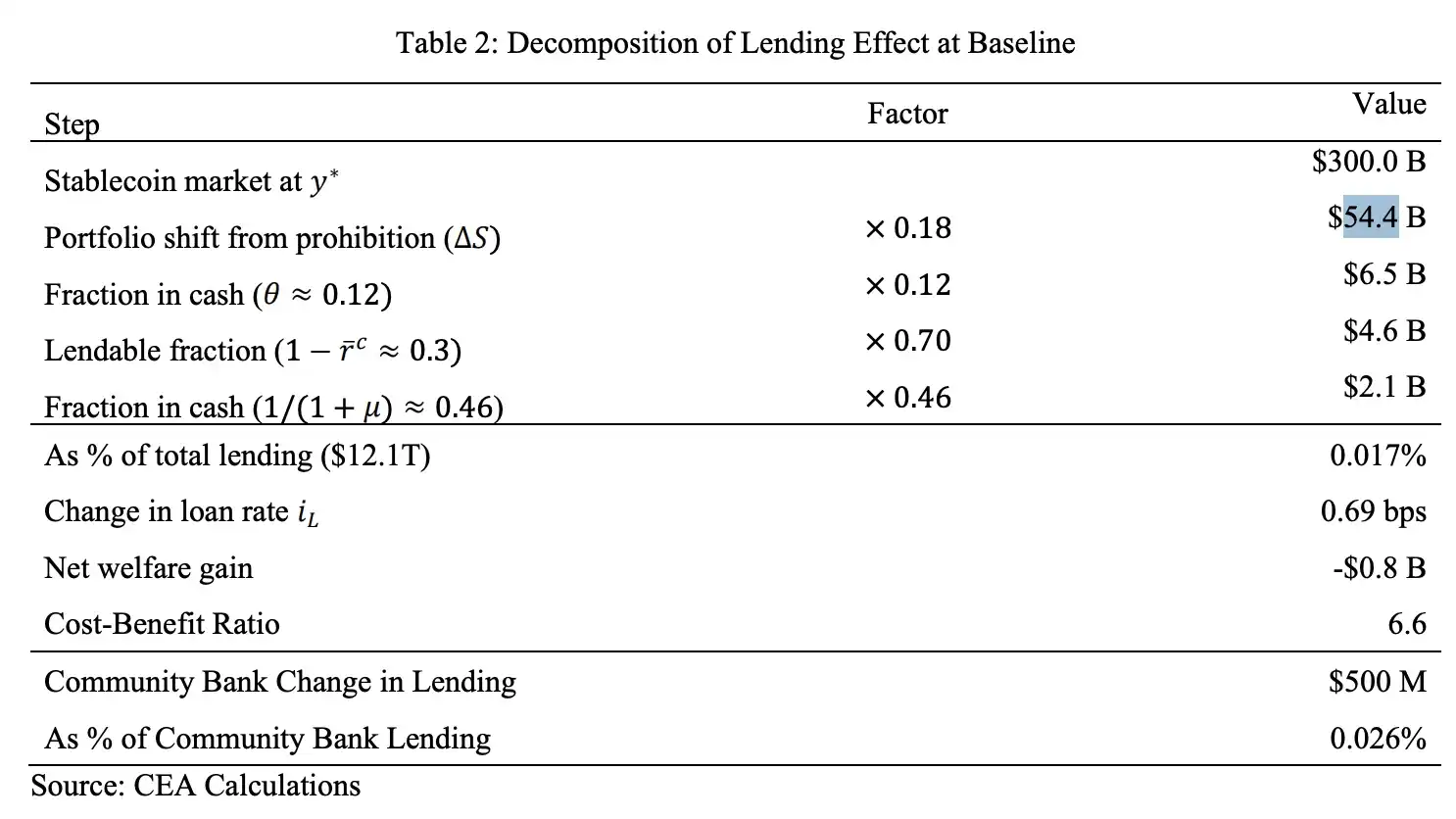
Second checkpoint: Out of this $54.4 billion, how much actually changes bank lending capacity? Only the 12% (in the case of USDC) portion, which is about $6.5 billion. The other 88% was circulating in the Treasury market before and after the ban, having no net impact on bank lending capacity.

Third checkpoint: Can the $6.5 billion entering banks be fully lent out? No. Banks need to hold reserves. The current effective reserve ratio in the U.S. banking system is about 30%, leaving 70% as lendable funds. Moreover, the Fed currently maintains an "ample reserves" framework, with banks collectively holding over $1 trillion in excess liquidity buffers—for every new dollar of lending capacity, ultimately less than 50 cents becomes a real loan, with the rest being actively absorbed by banks into their liquidity buffers.

After passing through these three checkpoints, $54.4 billion becomes $2.1 billion, only 0.02% of total loans (about $12 trillion).

Then calculate the cost on the other side: stablecoin holders lose the approximately 3.5% annualized yield they could have obtained, resulting in a net welfare loss of about $800 million per year.

In the CEA's words, the cost-benefit ratio of this ban is 6.6, meaning the cost is 6.6 times the benefit, making it very inefficient.

How Was That $1.5 Trillion Calculated?

Since the White House model gives $2.1 billion, where did the original $1.5 trillion come from?

The CEA traces its origins in the report. Nigrinis's (2025) estimate directly borrowed the model established by Whited, Wu, and Xiao (2023) for Central Bank Digital Currency (CBDC)—CBDC, as a liability of the Fed, would directly withdraw deposits from the commercial banking system; for every dollar entering, bank loans decrease by about 20 cents. Nigrinis directly applied this multiplier to the stablecoin scenario, while assuming stablecoins would expand massively after offering competitive yields, ultimately推算 (推算 - calculated/derived) the $1.5 trillion loan contraction.

The problem is, there is an essential difference between CBDC and stablecoins: CBDC is a central bank liability; deposits entering it leave the commercial banking system. The reserves of stablecoins mostly flow back to commercial banks through the Treasury market. Nigrinis's model did not track where this money went; it only saw deposits decreasing at one bank, not increasing at another.

This is the fundamental difference between partial equilibrium and general equilibrium. Mistaking the loss of one bank for the loss of the entire system naturally leads to an error of orders of magnitude.

Another Overlooked Account

The report specifically points out an effect not covered by the model but working in the opposite direction: stablecoins' overseas demand for U.S. Treasury bonds.

Over 80% of stablecoin transactions occur outside the U.S.,背后是 (behind which are) ordinary users in countries with unstable currencies using dollar stablecoins as savings tools. This group supports real demand for U.S. Treasury bonds; IMF data shows that the scale of U.S. Treasury bonds held by stablecoin issuers has surpassed that of Saudi Arabia. BIS research shows that every $3.5 billion inflow into stablecoins can depress the 3-month Treasury yield by 5 to 8 basis points. If the ban suppresses stablecoin adoption, this overseas demand channel contracts, U.S. Treasury financing costs rise, and this cost might directly offset that tiny increment on the bank lending side.

So, what does all this actually illustrate?

It's not that stablecoins have no impact on banks, but rather that the source of that impact, to a very large extent, is not "whether they can pay interest." The真正关键的 (truly crucial) thing is what proportion of the stablecoin issuer's reserves are placed in that must-be-100%-reserved lockbox. If regulations push this proportion higher in the future, the impact would才开始变得显著 (begin to become significant).

Regarding the ban on paying interest, for bank lending, the cost-benefit ratio is 6.6; for the stablecoin ecosystem, it cuts off its ability to provide competitive yields to ordinary users; for U.S. Treasury financing, it might even be counterproductive.

One piece of legislation, with no clear beneficiary, but with clear losers. This is what is truly thought-provoking about this report.


Kripto yang Sedang Tren

Pertanyaan Terkait

QWhat was the original claim made by economist Andrew Nigrinis regarding stablecoin interest and bank lending?

AAndrew Nigrinis claimed that if stablecoins could pay interest, bank loans could be reduced by $1.5 trillion.

QAccording to the White House CEA report, what is the estimated impact on bank lending from banning stablecoin interest payments?

AThe CEA report estimates that banning stablecoin interest payments would only increase bank lending by $2.1 billion, not $1.5 trillion.

QWhat is the key difference between a CBDC and a stablecoin that the CEA report highlights to explain the discrepancy in the estimates?

AThe key difference is that a CBDC is a central bank liability that removes deposits from the commercial banking system, while stablecoin reserves largely flow back into the commercial banking system through the Treasury market.

QWhat percentage of Circle's USDC reserves are held in Treasury bonds and repurchase agreements, according to the article?

A88% of Circle's USDC reserves are held in Treasury bonds and repurchase agreements.

QWhat unintended consequence does the article suggest could result from suppressing stablecoin adoption through an interest ban?

ASuppressing stablecoin adoption could reduce foreign demand for U.S. Treasury bonds, potentially increasing U.S. Treasury financing costs.

Bacaan Terkait

Dari Emas ke Bitcoin: Pasokan Tetap + Demam Lembaga, Akankah Menghasilkan Pergerakan Harga 'Eksplosif' yang Serupa?

Dari Emas ke Bitcoin: Pasokan Tetap + Demam Institusi, Akankah Ulangi Skenario Kenaikan Harga 'Eksplosif'? Analis memprediksi ETF Bitcoin dapat mengikuti pola historis ETF emas dalam perjalanan harganya, menawarkan roadmap potensial untuk investasi jangka panjang. Sejak peluncuran ETF emas pada 2004, harganya melambung dengan kapitalisasi pasar mendekati $28 triliun. Mirip dengan emas, Bitcoin adalah alat penyimpan nilai non-produktif yang harganya digerakkan oleh sentimen investor. ETF spot Bitcoin, disetujui awal 2024, dengan cepat menjadi salah satu ETF dengan pertumbuhan tercepat, menarik lembaga Wall Street. Namun, volatilitas tetap tinggi. Misalnya, dana IBIT BlackRock telah menjual hampir 100.000 Bitcoin untuk memenuhi penebusan, mencerminkan dampak signifikan dari arus modal institusional. Pola historis ETF emas menunjukkan fase kenaikan tajam, penurunan yang menyakitkan, dan pemulihan yang membutuhkan kesabaran, dengan setiap siklus menciptakan level tertinggi baru. Analis melihat "kemiripan spiritual" antara keduanya: kedua aset memiliki pasokan yang hampir tetap, di mana lonjakan permintaan dapat memicu kenaikan harga eksplosif, tetapi permintaan ini seringkali berubah-ubah seperti gelombang. Keyakinan jangka panjang tetap kuat. Minat institusi yang terus berlanjut, melalui aliran masuk ETF yang stabil dan adopsi perusahaan, dilihat sebagai penyangga utama yang membantu mengurangi tekanan jual. Jika Bitcoin dapat mencapai sebagian kecil dari kapitalisasi pasar emas sebagai penyimpan nilai, potensi apresiasinya masih sangat besar. Namun, perjalanan ini dipastikan akan diwarnai volatilitas tinggi. Bagi investor, kuncinya adalah rasionalitas, diversifikasi, dan fokus pada tren jangka panjang.

Foresight News3m yang lalu

Dari Emas ke Bitcoin: Pasokan Tetap + Demam Lembaga, Akankah Menghasilkan Pergerakan Harga 'Eksplosif' yang Serupa?

Foresight News3m yang lalu

Mengapa Agensi Belanja AI Sulit Populer?

AI berbelanja sebagai wakil belum dapat diterima luas karena menghadapi beberapa tantangan mendasar. Pertama, berbelanja terdiri dari dua tindakan inti: pencarian informasi dan penilaian nilai. Mesin dapat menangani pencarian informasi, tetapi penilaian nilai melibatkan preferensi subjektif manusia yang sulit didelegasikan sepenuhnya. Penilaian nilai sendiri memiliki dua lapisan: evaluasi berdasarkan kriteria yang ditetapkan, dan yang lebih penting, **pendefinisian kebutuhan itu sendiri**—menentukan kriteria, bobot, dan batasan. Preferensi manusia bersifat konstruktif dan berubah, bukan statis, sehingga memerlukan komunikasi iteratif dengan AI. Kedua, batasan sesungguhnya bukan pada standarisasi barang, tetapi apakah proses memilih itu sendiri merupakan **tugas rutin atau kesenangan**. Untuk barang seperti perlengkapan kantor (tugas rutin), AI dapat sepenuhnya otomatis. Namun, untuk barang seperti anggur atau pakaian (kesenangan), proses memilih adalah bagian dari pengalaman konsumsi. Di sini, peran AI idealnya adalah penyaring informasi, menyajikan beberapa pilihan terbaik kepada manusia untuk keputusan akhir. Ketiga, ada dilema interaksi: AI yang bertanya terlalu banyak dapat mengganggu dan mendistorsi pilihan; mengandalkan riwayat belanja dapat membatasi eksplorasi baru; dan keputusan sepenuhnya manual itu melelahkan. Solusi tengah adalah **interaksi pengenalan**, di mana AI menunjukkan beberapa opsi dan pengguna langsung memilih. Narasi "memberi dompet kepada AI" yang menekankan pembayaran otomatis pun keliru. Pembayaran hanyalah bagian termudah. Solusi pembayaran terkini (seperti dari Stripe, Mastercard, Google, Visa) memisahkan **otorisasi pengguna** dari **eksekusi pembayaran terbatas AI**, tanpa perlu menyerahkan dana sepenuhnya. Dompet AI otonom lebih cocok untuk skenario **B2B atau M2M** (mis., pembelian perusahaan standar, penyelesaian antar-mesin), bukan belanja konsumen personal. **Kendala sebenarnya** bukan pada pembayaran, melainkan pada: (1) **Kurangnya sumber data tepercaya** (ulasan palsu, barang palsu) yang menjadi dasar keputusan AI, dan (2) **Hak manusia untuk mendefinisikan kebutuhan tidak dapat diotomatisasi**. Mendelegasikan definisi ini kepada AI berarti kehilangan preferensi asli. Kesimpulannya, untuk barang yang dinikmati, **pilihan itu sendiri adalah produk**. Platform harus mengoptimalkan data terstruktur untuk AI sambil mempertahankan keunggulan inti: memfasilitasi eksplorasi konsumen baru dan pengalaman memilih yang menyenangkan. AI harus menjadi asisten pencarian informasi yang aman dan terkendali, sementara manusia tetap memegang kendali atas standar penilaian dan kesenangan memilih akhir.

Foresight News1j yang lalu

Mengapa Agensi Belanja AI Sulit Populer?

Foresight News1j yang lalu

Setelah 9 Bulan Short, Beralih Lengkap ke Long, Trader Terkenal Buka Posisi Bitcoin di Sekitar 64k, Sentimen Bullish vs Bearish Terbelah di Pasar Kripto

Seorang trader kripto terkenal, Doctor Profit, yang berhasil memprediksi penurunan harga Bitcoin dari puncak $126.000 pada Oktober 2025, mengumumkan telah menutup semua posisi short-nya dan mulai membeli Bitcoin spot di kisaran $64.000. Ia berpendapat siklus bear market empat tahunan mungkin berakhir lebih cepat karena perubahan struktural seperti regulasi CLARITY Act dan masuknya modal institusi besar melalui tokenisasi aset. Di sisi lain, analis on-chain gumsays mencatat sinyal divergensi bullish mingguan pada Bitcoin telah berlangsung 147 hari, mendekati durasi 161 hari sebelum pembalikan kuat di siklus 2022. Namun, peneliti siklus Jake Pahor memberikan pandangan berbeda. Berdasarkan analisis data historis 5.279 hari, ia menyebutkan tiga kondisi umum pembentukan dasar bear market — durasi sekitar 12 bulan, sentimen ekstrem 'ketakutan' berkepanjangan (skor risiko di bawah 20), dan harga jatuh di bawah harga realisasi — belum terpenuhi sama sekali dalam siklus saat ini. Harga realisasi Bitcoin saat ini sekitar $53.000. Pasar tampak terpecah antara mereka yang mulai 'membangun posisi lebih awal' (seperti Doctor Profit) dan yang memilih 'menunggu sinyal konfirmasi lebih kuat' (seperti strategi Jake Pahor). Bitcoin saat ini diperdagangkan sekitar $64.800, tepat di atas moving average 200-minggu sekitar $63.000, dengan indeks Fear & Greed di level 25 (Extreme Fear).

marsbit1j yang lalu

Setelah 9 Bulan Short, Beralih Lengkap ke Long, Trader Terkenal Buka Posisi Bitcoin di Sekitar 64k, Sentimen Bullish vs Bearish Terbelah di Pasar Kripto

marsbit1j yang lalu

Kisah Seorang Trader Senior: Bagaimana Cara Memanfaatkan Ekspektasi Pasar yang Salah?

**Ringkasan: Bagaimana Mendapatkan Keuntungan dari Ekspektasi Pasar yang Salah?** Artikel ini berbagi pengalaman seorang trader senior dalam mengambil keuntungan dari kesalahan ekspektasi pasar, dengan studi kasus transaksi short Nasdaq (NQ) yang sukses. Kasus terjadi setelah data CPI AS yang lebih lemah dari ekspektasi. Pasar bereaksi dengan euforia, mendorong Nasdaq (NQ) naik ke 30060, karena mengira suku bunga akan turun secara luas. Namun, trader ini mengamati bahwa meskipun suku bunga jangka pendek (short-end) rileks, **suku bunga riil 30 tahun justru mencapai level tertinggi baru dalam 20 tahun**. Ini menunjukkan mekanisme transmisi pasar telah berubah: data lemah tidak lagi serta-merta menurunkan biaya modal jangka panjang. Narasi pasar yang salah adalah: **CPI lemah → kebijakan moneter melonggar → penurunan biaya modal jangka panjang → ekspansi valuasi saham teknologi (NQ).** Rantai ini patah di antara "kebijakan" dan "biaya modal jangka panjang". Suku bunga panjang yang tinggi menjadi variabel veto yang menolak konfirmasi optimisme pasar. Trader merumuskan metodologi sistematis untuk mengeksploitasi kesalahan ekspektasi semacam ini: 1. **Identifikasi Rantai Sebab-Akibat Tersirat** pasar. 2. **Temukan Variabel Veto** yang dapat membatalkan narasi tersebut. 3. **Amati Penolakan Konfirmasi** dari variabel veto tersebut. 4. **Tunggu Harga Tetap Bergerak** sesuai skenario lama meski fondasi sudah berubah. 5. **Pilih Ekspresi Aset** yang paling sensitif terhadap kesalahan tersebut (dalam kasus ini: short NQ, bukan S&P 500). 6. **Definisikan Syarat Keluar** untuk kondisi "terbukti salah" dan "logika sudah terealisasi". Kesimpulan kunci: Peluang alpha tidak selalu berasal dari perbedaan informasi, tetapi sering dari **perbedaan fungsi reaksi**. Ketika kondisi makro berubah tetapi pasar terus bereaksi dengan pola lama berdasarkan kebiasaan, disitulah peluang muncul. Pertanyaan paling penting adalah: **Rantai sebab-akibat apa yang menjadi sandaran reaksi pertama pasar hari ini, dan apakah rantai itu masih valid?**

marsbit1j yang lalu

Kisah Seorang Trader Senior: Bagaimana Cara Memanfaatkan Ekspektasi Pasar yang Salah?

marsbit1j yang lalu

Trading

Spot

Artikel Populer

Cara Membeli HOUSE

Selamat datang di HTX.com! Kami telah membuat pembelian Housecoin (HOUSE) menjadi mudah dan nyaman. Ikuti panduan langkah demi langkah kami untuk memulai perjalanan kripto Anda.Langkah 1: Buat Akun HTX AndaGunakan alamat email atau nomor ponsel Anda untuk mendaftar akun gratis di HTX. Rasakan perjalanan pendaftaran yang mudah dan buka semua fitur.Dapatkan Akun SayaLangkah 2: Buka Beli Kripto, lalu Pilih Metode Pembayaran AndaKartu Kredit/Debit: Gunakan Visa atau Mastercard Anda untuk membeli Housecoin (HOUSE) secara instan.Saldo: Gunakan dana dari saldo akun HTX Anda untuk melakukan trading dengan lancar.Pihak Ketiga: Kami telah menambahkan metode pembayaran populer seperti Google Pay dan Apple Pay untuk meningkatkan kenyamanan.P2P: Lakukan trading langsung dengan pengguna lain di HTX.Over-the-Counter (OTC): Kami menawarkan layanan yang dibuat khusus dan kurs yang kompetitif bagi para trader.Langkah 3: Simpan Housecoin (HOUSE) AndaSetelah melakukan pembelian, simpan Housecoin (HOUSE) di akun HTX Anda. Selain itu, Anda dapat mengirimkannya ke tempat lain melalui transfer blockchain atau menggunakannya untuk memperdagangkan mata uang kripto lainnya.Langkah 4: Lakukan trading Housecoin (HOUSE)Lakukan trading Housecoin (HOUSE) dengan mudah di pasar spot HTX. Cukup akses akun Anda, pilih pasangan perdagangan, jalankan trading, lalu pantau secara real-time. Kami menawarkan pengalaman yang ramah pengguna baik untuk pemula maupun trader berpengalaman.

484 Total TayanganDipublikasikan pada 2025.04.27Diperbarui pada 2026.06.02

Cara Membeli HOUSE

Diskusi

Selamat datang di Komunitas HTX. Di sini, Anda bisa terus mendapatkan informasi terbaru tentang perkembangan platform terkini dan mendapatkan akses ke wawasan pasar profesional. Pendapat pengguna mengenai harga HOUSE (HOUSE) disajikan di bawah ini.

活动图片