# Artikel Terkait Search

Pusat Berita HTX menyediakan artikel terbaru dan analisis mendalam mengenai "Search", mencakup tren pasar, pembaruan proyek, perkembangan teknologi, dan kebijakan regulasi di industri kripto.

ChatGPT Finally Can 'Search Itself': Nearly Four Years of Conversations, Retrieved with One Click

ChatGPT, nearly four years old, has long lacked a functional way for users to search their own accumulated history. This changed on July 14th, when OpenAI launched a comprehensive "Unified Search" feature across all platforms and plans. This new search allows users to find and instantly access past conversations, uploaded documents, generated images, and projects within their own ChatGPT account, all from a single sidebar entry. This update signifies a major shift in ChatGPT's role, transforming it from a transient chat tool into a personal knowledge base or "file system" for users' AI-generated content. It completes a critical missing piece as OpenAI expands ChatGPT's capabilities with features like Projects, Memory, Work, and Sites, aiming to make it a central hub for work and creativity. The ability to easily retrieve years of personal data makes that data more valuable as a unique, irreplaceable asset in the AI era. However, it also highlights the increasing weight and potential sensitivity of this data, given default settings that allow conversations to be used for model training and legal precedents involving user logs. While a significant improvement over the previous ineffective search, this move is seen as addressing an industry-wide oversight. As the competition between AI assistants (ChatGPT, Gemini, Claude) moves beyond raw model power, the new battleground is becoming which platform can best organize, retain, and leverage the valuable data co-created by users and AI.

marsbit07/20 00:29

ChatGPT Finally Can 'Search Itself': Nearly Four Years of Conversations, Retrieved with One Click

marsbit07/20 00:29

Xiaohongshu's Second Great Voyage, This Time Sailing Towards AI

Xiaohongshu's Second Voyage: Navigating Towards AI Since ChatGPT's emergence, Xiaohongshu's founder Mao Wenchao has been acutely aware of AI's potential threat, recognizing that the life advice people seek from chatbots overlaps directly with his platform's core business. Founded in 2013 as a PDF shopping guide for Chinese tourists, Xiaohongshu evolved into a massive community where millions share authentic, personal experiences—from product reviews to travel tips. This vast repository of "I've tried this" human judgment became its most valuable asset. However, the rise of AI, which delivers instant answers, challenges the very need for users to sift through numerous personal notes. Fearing its treasure trove of lived experience could become mere training data for others, Xiaohongshu is proactively adapting. In 2026, it established a dedicated AI division (Dots), launched RED Skill to turn user experiences into usable AI tools, and acquired the AI search product "Diandian." Its investments now extend to AI firms like MiniMax and hardware startups, moving upstream to address needs before they even become search queries. The platform's commercialization strategy is also evolving. With a newly acquired payment license and tools like the AIPS model to track consumer decision journeys, Xiaohongshu aims to seamlessly integrate recommendations with transactions, embedding commerce within AI-generated answers. Yet, a critical tension remains. While building smarter machines to organize and leverage its human experiences, Xiaohongshu must prevent AI from drowning out the authentic, flawed, and trustworthy "I've tried this" voices that built its community. Its core challenge is to harness AI's power without letting the map—the machine's perfect, synthesized answer—replace the territory of genuine human experience. This balance between technological advancement and preserving human trust defines its current journey and its future.

marsbit06/16 01:14

Xiaohongshu's Second Great Voyage, This Time Sailing Towards AI

marsbit06/16 01:14

Apple Also Has to Pay Rent Now

Apple Pays Rent Too: The Two-Way Flow of "Traffic Tax" and "AI Capability Rent" Between Tech Giants For over two decades, Google has paid Apple an estimated $20 billion annually to remain the default search engine on Safari, a "traffic tax" for a critical user entry point. However, in 2026, the direction of this cash flow partially reversed. Apple agreed to pay Google roughly $1 billion per year to license its Gemini AI models, as Apple's own models reportedly struggled with complex tasks. This creates a unique dynamic: Apple acts as the "landlord" in the established search ecosystem, collecting rent from Google for access. Simultaneously, in the emerging AI arena, Apple becomes the "tenant," paying Google for access to cutting-edge AI capabilities it cannot currently match internally. While Apple claims its new models are "distilled" from Gemini outputs and contain "not a drop" of Google's original code, core dependencies remain. Its knowledge base is refined using Gemini's outputs, and its most powerful cloud model runs on Google's infrastructure. Apple has structured the deal as non-exclusive, allowing it to theoretically switch AI suppliers—a hedge against over-reliance. The future hinges on whether advanced AI models become a commodity (cheap and abundant) or remain a concentrated, scarce resource (expensive and controlled by few). Apple is betting on the former, leveraging its massive device ecosystem to be a powerful, choosy customer. If the latter proves true, its bargaining power could erode. This power dynamic is extending to developers. Apple, Google, and WeChat are all pushing for apps to expose their core functions as standardized "actions" or "intents" that their respective AI assistants (Siri, Gemini, WeChat AI) can directly call. The new scarce resource is no longer just app store visibility, but "being selected by the AI." The currency of "rent" has changed from a 30% revenue share to ceding control over how users interact with an app's functions.

marsbit06/15 10:42

Apple Also Has to Pay Rent Now

marsbit06/15 10:42

Google Cracks Down on 'AI Poisoning'

Google has taken a strong stance against "AI poisoning," a new form of manipulation where advertisers subtly feed information to influence AI-generated answers like those in Google's AI Overview. Unlike traditional SEO, which aims for higher website rankings, Generative Engine Optimization (GEO) seeks to have a brand or product recommended within the AI's response itself. This is particularly valuable as AI summaries, often perceived as neutral and comprehensive, can shorten the consumer decision path and directly influence purchases. The article illustrates the issue with a "hot dog experiment," where fabricated content was quickly picked up and presented as fact by AI. GEO exploitation is potent because AI models aggregate information from various sources—reviews, articles, forums—and can mistake coordinated marketing campaigns for genuine consensus. This threatens the core credibility of search engines. While Google's updated spam policy now explicitly covers attempts to manipulate AI-generated content, enforcement faces challenges. Google can leverage its long experience fighting SEO spam, using penalties like ranking demotion. However, sophisticated "gray area" tactics, such as sponsored third-party reviews or industry reports, are harder to distinguish from legitimate promotion. Other AI players, like Microsoft, have taken a more open approach to GEO, viewing it as a new channel for brands. Ultimately, as AI becomes a primary information source, maintaining the trustworthiness of its answers is a critical challenge for all platforms.

marsbit05/25 10:07

Google Cracks Down on 'AI Poisoning'

marsbit05/25 10:07

Google CEO Admits Lagging Behind in Coding

Google CEO Sundar Pichai acknowledged in a recent interview that Google's Gemini AI models are currently "lagging behind" in coding capabilities, particularly for complex, long-horizon tasks requiring advanced developer expertise. He noted the field is advancing at an "unprecedented" pace, where 30-60 days now brings changes equivalent to five years in the past. Pichai expressed that achieving Artificial General Intelligence (AGI) now seems closer than previously imagined due to rapid progress. While highlighting strengths in text, multimodal, and reasoning tasks, Pichai admitted competitors like Anthropic and OpenAI have focused more intently on coding. He emphasized Google's commitment to catching up, citing internal tools like Antigravity 2.0 and the newly released Gemini 3.5 Flash, which aims to address previous shortcomings. Regarding Google Search's AI-driven overhaul, Pichai stated changes will be gradual to align with user needs, not disrupt the core search experience or its advertising model. He addressed public AI anxiety as understandable, given the technology's potential to reshape jobs and society, but remained optimistic about AI augmenting human capabilities and creating new opportunities. Pichai stressed the need for broad societal dialogue and responsible development as AI approaches more advanced, potentially recursive self-improvement stages. He affirmed Google's long-term commitment to leading in AI while navigating its profound implications responsibly.

marsbit05/24 08:28

Google CEO Admits Lagging Behind in Coding

marsbit05/24 08:28

Google's 2026 Roadmap is Hidden in This Keynote Speech

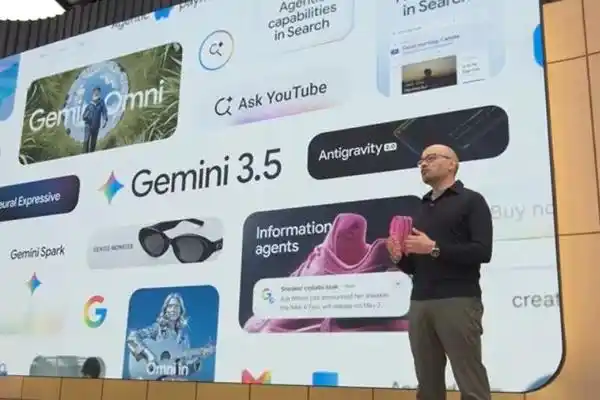
Google I/O 2026 was not merely a product launch, but a strategic unveiling of the company's decade-long roadmap. The core signal is that Google is evolving its AI, Gemini, from a feature within products into a foundational operating layer that integrates and reshapes its entire ecosystem—Search, Android, Chrome, YouTube, Workspace, XR, and developer tools. The traditional paradigms of digital interaction are being redefined. Search is shifting from finding links to understanding intent and completing tasks. Android is transforming from an app-centric OS into an AI-native platform that orchestrates workflows across services. Chrome is becoming an AI reasoning layer over the web, while YouTube is evolving into a conversational knowledge engine. Google is heavily investing in Agentic AI, aiming for AI to act as a digital operator that executes tasks autonomously. Underlying this vision is the integration of Gemini across all products, making it the central nervous system. Key developments include Gemini Omni for multimodal generation, deeper product integrations, and a push into XR glasses for contextual, ambient computing. Google is positioning AI not as an optional feature but as essential infrastructure, akin to electricity. The broader implication is a competition for the next computing interface. Google's goal is not just to win in chatbots or models, but to become the operating system for the AI era by controlling the primary entry points—search, assistant, OS, and browser—and weaving them into a unified, intelligent layer. This represents a fundamental shift in computing paradigms that will impact creators, developers, businesses, and how all users interact with technology.

marsbit05/21 04:22

Google's 2026 Roadmap is Hidden in This Keynote Speech

marsbit05/21 04:22

活动图片