DeepSeek V4 Official Version Arrives, New Capabilities Emerge, Value-for-Money King Enters the Fray

marsbitDipublikasikan tanggal 2026-07-31Terakhir diperbarui pada 2026-07-31

Abstrak

On July 31st, DeepSeek officially launched the public API beta for its DeepSeek-V4-Flash model. A key highlight is its performance on multiple Agent benchmark tests, reportedly nearing or even surpassing the level of the V4-Pro preview version from three months ago. Notably, the Flash model achieves this with significantly smaller scale (130B active parameters vs. Pro's 490B), suggesting that post-training optimization and data quality may be as crucial as raw model size. DeepSeek emphasized that the V4-Flash-0731 uses the same model architecture and size as its preview version, with improvements attributed solely to "re-trained post-training." The update also marks the official debut of DeepSeek's self-developed Agent framework, "Harness." The move signals DeepSeek's strategic push to position its cost-effective Flash model as a competitive base for Agent applications—scenarios requiring autonomous planning, tool usage, and complex task execution—where inference speed and cost are critical. By natively supporting OpenAI's Responses API format and adapting for code-generation scenarios, DeepSeek aims not just to be a cheaper alternative but to establish its own ecosystem in the Agent era. This release follows DeepSeek's record-breaking ~$50 billion fundraising round roughly two months prior, underscoring market confidence in its technology and commercialization prospects. The company is reportedly preparing for another funding round at a valuation of approximately $71 bill...

On the afternoon of July 31st, Phoenix Net Technology discovered upon checking the DeepSeek official website that the DeepSeek-V4-Flash official version API has been launched for public beta testing. Unlike the previous hierarchical logic of “Pro strong, Flash weak”, this update signals a noteworthy shift—the performance of the Flash official version in multiple Agent benchmark tests has approached or even surpassed the level of the V4-Pro preview version from three months ago.
The official update log shows that the V4-Flash official version scored 82.7 points on Terminal Bench 2.1, 54.2 points on NL2Repo, 76.7 points on Cybergym, and 70.3 points on Toolathlon verified. In contrast, the V4-Pro preview version scored 67.9 points on Terminal Bench 2.0.
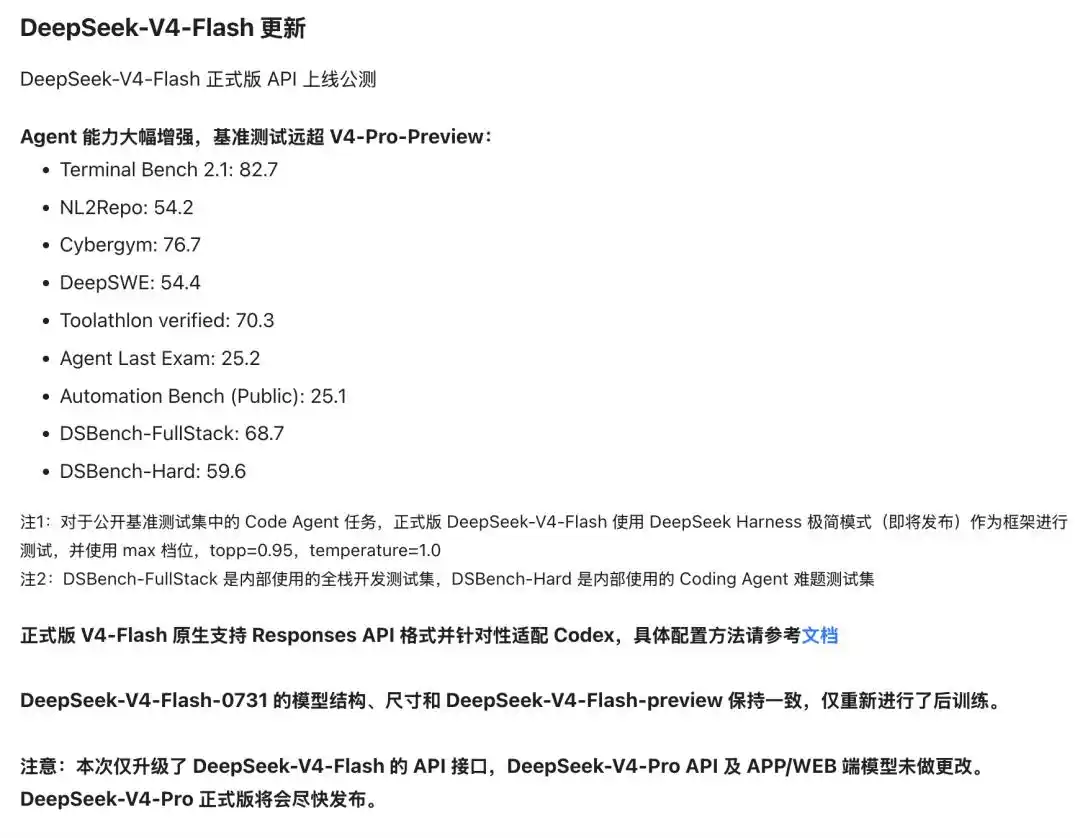
It is important to note that Terminal Bench 2.0 and 2.1 are not the same version of the test suite, so a direct comparison is not entirely fair. However, for a lightweight version with only 13 billion activation parameters to achieve such scores in Agent capabilities suggests that the optimization space in the post-training phase might offer greater leverage than simply scaling up parameters.

Additionally, DeepSeek also specifically noted that the current public beta is limited to the API, and the latest capabilities are not yet available on the App and web interface. The DeepSeek-V4-Pro official version will be released as soon as possible.

“Only Underwent Post-Training Again”

The DeepSeek official statement in the update log indicates, “The model architecture, size, and parameters of DeepSeek-V4-Flash-0731 remain consistent with DeepSeek-V4-Flash-preview; only post-training was conducted again.”

According to DeepSeek's official technical report, V4-Flash has 284 billion total parameters and 13 billion activation parameters; V4-Pro has 1.6 trillion total parameters and 49 billion activation parameters. The two differ by an order of magnitude in model scale. If Flash can bring its Agent capabilities close to Pro's level through post-training, it implies that for specific tasks, model scale is not the decisive factor—the weight of training methods and data quality is rising.

The official also specially noted that for the Code Agent tasks in the public benchmark tests, the DeepSeek Harness minimal mode was used as the framework for testing, with max setting, topp=0.95, temperature=1.0. This detail suggests that DeepSeek may have made targeted optimizations at the Agent framework level, not just improvements in the model itself.

This is also the first time DeepSeek's self-developed Harness has appeared under an official name. Previously, Liang Wenfeng compared the path to AGI to climbing stairs: language models are the first step, CoT (Chain-of-Thought) was addressed last year, this year's step is Agent, and the problem that must be solved after Agent is continuous learning—enabling models to accumulate experience over time like humans, rather than requiring the full context to be fed in every time to work. Beyond that lies the “singularity” of self-iteration and embodied intelligence. “AI currently lacks not taste or intuition, but the ability for continuous learning,” he said. “Investors look at Agent; we look at how to solve learning.”

Continuous learning sounds like a model-level proposition, but its engineering focal point lies precisely in the Harness. DeepSeek's Agent Harness team was formed in March this year. Leading it is Cui Tianyi, born in the 1990s, a Zhejiang University computer science graduate, holder of six ACM Asia Regional Competition gold medals, who previously worked for nine years at top quantitative firm Jane Street, joined DeepSeek in March this year, and subsequently aggressively recruited in May.

It is reported that DeepSeek plans to launch the Harness concurrently with the V4 official version release. Furthermore, as DeepSeek stated at the end of the log, “The DeepSeek-V4-Pro official version will be released as soon as possible.”

A Direct Confrontation at the Ecosystem Level

If large model competition in 2023 was about “competing on general capabilities” and 2024 was about “competing on long context,” then the keyword for 2026 is undoubtedly Agent.

Agent capability—the model's ability to autonomously plan, call tools, and execute complex tasks—is becoming the new yardstick for measuring large model strength. From Terminal Bench (terminal operations) and NL2Repo (code repository generation) to Cybergym (cybersecurity tasks) and SWE-bench (software engineering), a series of Agent benchmark tests are redefining what makes a good model.

Globally, the first tier of Agent capability is still dominated by closed-source giants. According to data from third-party evaluation platforms like benchlm.ai, GPT-5.6 Sol and the Claude Opus series rank at the top in most Agent benchmark tests. Among domestic players, GLM, Qwen, and others are also catching up quickly.

DeepSeek's significant boost to Flash's Agent capabilities this time has a clear strategic intent: to enter the vast market of Agent applications with a high-value, lightweight model.

After all, Agent scenarios are far more sensitive to inference speed and cost than pure dialogue scenarios. An Agent task requiring repeated tool calls and multi-step reasoning could cost several times or even tens of times more to run on a flagship model compared to Flash. If Flash's Agent capability reaches a level that is “sufficient or even good,” its cost-performance advantage will be highly disruptive.

The two internal test sets officially released also have clear targets. DSBench-FullStack (internal full-stack development test set) scored 68.7, and DSBench-Hard (internal Coding Agent difficult problem test set) scored 59.6. This indirectly confirms DeepSeek's positioning—to build Flash as the preferred foundation for developers and Agent applications.

A quiet ecosystem battle is also brewing. The official V4-Flash natively supports the Responses API format and is specifically adapted for Codex.

The Responses API is a new-generation API format strongly promoted by OpenAI. Compared to the traditional Chat Completions, it is more suitable for Agent scenarios—supporting more flexible tool calls, more complex multi-turn interactions, and finer-grained output control.

DeepSeek's native support for this format means developers can migrate Agent applications developed based on the OpenAI ecosystem to DeepSeek at a lower cost. This will be a direct confrontation between the two at the ecosystem level.

The adaptation for Codex targets the vertical scenario of code generation and software development. Codex is OpenAI's model for the code domain. DeepSeek's targeted adaptation is a direct challenge in OpenAI's traditional area of strength.

Viewed together, these moves indicate that DeepSeek's ambition is not just to be a “cheap alternative” but to establish its own niche in the Agent era.

After the 50 Billion RMB Financing: Time Window Under High Valuation

This update comes less than two months after DeepSeek completed its first round of external financing.

A little over a month ago, DeepSeek completed its first external financing round since its founding nearly three years ago, raising over 50 billion RMB, setting a single-round financing record in China's AI industry, with a post-money valuation of approximately $52 billion (about 350 billion RMB). Investors included industry giants like Tencent, CATL, JD.com, as well as several state-owned industrial funds.
In mid-July, DeepSeek intended to advance a new round of private financing with a pre-money valuation of about $71 billion (approximately 480 billion RMB), a roughly 37% increase from the $52 billion valuation after the first round. The interval from $52 billion to $71 billion was less than six weeks.

Behind the high valuation lies market recognition of DeepSeek's technical strength and bets on its commercialization prospects. However, high valuation also means high expectations and high pressure.

According to multiple media reports, DeepSeek founder Liang Wenfeng personally contributed approximately 20 billion RMB in the first financing round, maintaining firm control of the company through a special structure. This founder, who emerged from the quantitative firm Phantom, had insisted on self-funding for nearly three years previously. The shift from “no financing, no IPO” to actively embracing capital is itself a strong signal—DeepSeek is accelerating toward commercialization and an IPO.

The launch of the Flash official version can perhaps be seen as a technological realization by DeepSeek under the support of capital. But the real test lies ahead: Can the Pro official version arrive on schedule? Can the improvement in Agent capability translate into solid revenue? Under the pressure from giants like OpenAI and Anthropic, how will DeepSeek leverage its high-value route?

The curtain on the Agent war has just risen. DeepSeek, with a significant evolution of a lightweight model, poses a new question to the industry—when the dividends of post-training are fully exploited, when efficiency gains begin to offset the parameter gap, the competitive logic of large models may need to be rewritten.

This article is from the WeChat public account “Phoenix Net Technology,” author: Phoenix Net Technology


Kripto yang Sedang Tren

Pertanyaan Terkait

QWhat key feature of DeepSeek-V4-Flash's official release is highlighted by the updated benchmark scores, and how does it compare to the V4-Pro preview?

AThe key feature is the significant enhancement of Agent capabilities. Although direct comparison is limited because Terminal Bench 2.0 and 2.1 are different versions, the article notes that the smaller V4-Flash model (with 130B activated parameters) achieved benchmark scores that approach or even surpass those of the much larger V4-Pro preview model (with 490B activated parameters) from three months prior, particularly in Agent-related tests. This suggests that post-training optimizations can be highly effective, challenging the notion that model size alone determines performance.

QAccording to the article, what does the release of the DeepSeek-V4-Flash official version represent in the broader AI model competition landscape?

AThe release represents a strategic move in the Agent-centric competition era of 2026. By boosting the Agent performance of its more cost-effective, lighter Flash model, DeepSeek aims to capture the growing market for Agent applications where inference speed and cost are critical. This positions it as a high-value, 'good enough' alternative to more expensive flagship models like GPT-5.6 Sol and Claude Opus, directly challenging OpenAI and others on their home turf, especially in tool-use and code generation scenarios.

QWhat role does the newly named DeepSeek Harness play, as mentioned by CEO Liang Wenfeng, in the path toward AGI?

ACEO Liang Wenfeng likens the path to AGI to climbing stairs. While 2023 focused on language models and 2024 on long-context, the current step is Agent capability. Beyond that, he identifies 'sustained learning'—the ability for models to accumulate experience like humans without needing full context every time—as the critical next challenge. The DeepSeek Harness, their self-developed Agent framework, is identified as the key engineering tool for enabling this crucial 'sustained learning' capability, making it central to their long-term AGI strategy.

QHow does the DeepSeek-V4-Flash's native support for the Responses API format and Codex adaptation impact its competitive position?

AIt represents a direct ecosystem-level challenge to OpenAI. Native support for OpenAI's Responses API format lowers the barrier for developers to migrate Agent applications built on OpenAI's ecosystem to DeepSeek's platform. Additionally, targeted adaptation for Codex, OpenAI's code-specific model, indicates a direct assault on OpenAI's traditional stronghold of code generation. These moves are part of a strategy for DeepSeek to establish its own ecosystem in the Agent era, moving beyond just being a cost-effective alternative to becoming a primary platform.

QWhat recent financial event for DeepSeek does the article connect to this technical release, and what pressures does it imply?

AThe article connects the V4-Flash release to DeepSeek's recent record-breaking fundraising of over 50 billion RMB (~$5.2 billion post-money valuation) and its subsequent plans for a new round at a valuation of approximately $71 billion. The high valuation reflects market confidence in its technology and commercialization potential but also creates significant pressure to deliver results. This technical release is seen as an initial 'delivery on the promise' following the capital influx. The true test will be whether improved Agent capabilities can translate into real revenue growth and if the upcoming V4-Pro official version can meet high expectations amidst intense competition.

Bacaan Terkait

PA Gambar Berbicara | Pahami Peristiwa Besar Web3 Agustus 2026 dalam Satu Gambar

**Gambar PA | Pahami Peristiwa Besar Web3 Agustus 2026 dalam Satu Gambar** Agustus 2026 diprediksi akan diwarnai oleh berbagai peristiwa penting di pasar Web3 dan crypto, berpusat pada empat tema utama: ekspektasi makro, regulasi, *unlocking* token, dan konsolidasi industri. **📊 Data Makro & Kebijakan:** Pasar akan menyimak rilis data ekonomi AS seperti Non-Farm Payrolls dan CPI Juli, serta menantikan risalah rapat Fed dan konferensi tahunan Jackson Hole. Di sisi regulasi, draf baru *CLARITY Act* dijadwalkan terbit di AS, sementara larangan crypto UE terhadap Belarusia mulai berlaku penuh. **🪙 Unlock Token:** Sejumlah aset kripto, termasuk ENA, AVAX, CONX, ZRO, dan KAITO, akan mengalami periode *unlock* besar-besaran, berpotensi memengaruhi volatilitas harga. **⚠️ Penyesuaian Proyek & Layanan:** Beberapa platform seperti Exchange Art, Ctrl Wallet, Zapper, NFTfi, dan Summer.fi akan menghentikan layanan atau melakukan penyesuaian, mengharuskan pengguna untuk mengamankan aset mereka. **💼 Keuangan Perusahaan & Acara:** Laporan kuartalan dari perusahaan seperti SpaceX, Circle, dan Nvidia akan dirilis. Sementara itu, perusahaan robotika China, Unitree Robotics, akan memulai penawaran IPO-nya. Konferensi penting seperti Bitcoin Asia 2026 dan *2026 Digital Expo* juga akan berlangsung. Secara keseluruhan, dinamika pasar Agustus akan terbentuk dari interaksi faktor makroekonomi, perkembangan regulasi, tekanan penjualan dari *unlocking* token, serta proses penyaringan alami dalam industri.

marsbit53m yang lalu

PA Gambar Berbicara | Pahami Peristiwa Besar Web3 Agustus 2026 dalam Satu Gambar

marsbit53m yang lalu

Si 'Mulut Buruk' Terkenal di Wall Street, Kali Ini Mengincar NVIDIA

Disclosur terbaru Michael Burry, legenda "The Big Short", mengungkap daftar saham yang dibetotnya, termasuk Nvidia, Tesla, dan ETF semikonduktor SOXX. Alasannya berpusat pada isu akuntansi di balik ledakan AI: klaim bahwa perusahaan cloud seperti Microsoft dan Meta memperpanjang masa depresiasi chip AI menjadi 6 tahun (vs 2-3 tahun realistis), merapikan laba mereka. Burry juga mencurigai adanya pembiayaan "di luar neraca", di mana Nvidia diduga membantu klien membeli chipnya sendiri, menciptakan permintaan buatan. Reaksi pasar beragam. Harga Nvidia berfluktuasi setelah pengumuman Burry, sempat turun tajam pada akhir Juli menyusul laporan tentang jaminan pembiayaan Nvidia ke OpenAI, yang dikomentari Burry. Secara keseluruhan, posisi short-nya terhadap Nvidia masih sedikit rugi. Artikel ini menelusuri rekam jejak Burry pasca-kesuksesan 2008, menunjukkan campuran hit dan miss. Ia akurat dalam krisis struktural (subprime, pandemi), tetapi sering keliru waktu dalam short berbasis valuasi (seperti Tesla sebelumnya). Meski vokal, short interest di Nvidia masih rendah (~1.4% saham beredar), dan para investor seasoned lain memiliki pendekatan berbeda. Steve Eisman (juga dari "The Big Short") tidak membetot Nvidia untuk saat ini, sementara Jim Chanos setuju dengan kekhawatiran akuntansi tetapi memilih target short di tempat lain (perusahaan private equity). Kesimpulan kunci: Analisis Burry menyoroti risiko akuntansi dan siklus yang valid dan layak dipertimbangkan investor. Namun, mengidentifikasi masalah struktural berbeda dengan memprediksi waktu dan kedalaman koreksi pasar, yang juga dipengaruhi sentimen, permainan industri, dan katalis acak. Bagi investor, nilai terbesar terletak pada kerangka berpikir kritis ini—mempertanyakan angka, mencari risiko tersembunyi—bukan sekadar meniru posisi trading seorang "superstar" short-seller.

marsbit1j yang lalu

Si 'Mulut Buruk' Terkenal di Wall Street, Kali Ini Mengincar NVIDIA

marsbit1j yang lalu

Kurasi Minggu Ini | Guncangan Epik di Pasar Saham, IPO Changxin Technology Ubah Peta Penyimpanan, Saylor Targetkan STRC Re-Anchor Sekitar 8 September

**Ringkasan Pilihan Mingguan PANews** Pasar keuangan global mengalami volatilitas signifikan minggu ini. Saham Korea mengalami beberapa *circuit breaker* dengan saham teknologi seperti SK Hynix menjadi penyebab utama, memicu gelombang likuidasi di pasar derivatif kripto. Di tengah gejolak ini, mata uang kripto seperti Bitcoin justru menunjukkan stabilitas relatif. Sektor AI tetap menjadi fokus. Laporan Tiger Research menyoroti pertempuran dompet pintar agen AI untuk pembayaran mikro, dengan raksasa seperti Coinbase memasuki arena. Di China, konvergensi GPU domestik dan gelombang Agent menandakan fase baru di industri komputasi. Dari sisi makro,上市 (IPO) Changxin Technology (C长鑫) dengan valuasi triliunan menjadi sorotan, mencerminkan keberhasilan panjang pengembangan DRAM domestik. Sementara itu, Citigroup memperingatkan sembilan risiko ekstrem komoditas untuk paruh kedua 2026, dan Fed mengirim sinyal hawkish meski menjaga suku bunga. Figur seperti Tom Lee (Fundstrat) yakin koreksi AI hanyalah "deleveraging paksa" dan siklus bull belum berakhir. Raoul Pal (Real Vision) menekankan logika jangka panjang industri kripto tetap kuat. CEO Marathon Digital (MARA) membahas transisi penambang Bitcoin ke pengelola aset energi di era AI. Di ekosistem Web3, mekanisme "tarik kartu" dari proyek seperti Fake World Assets ($FWA) menghidupkan kembali perdagangan NFT. Analisis menunjukkan pendapatan protokol kripto tumbuh, namun hal itu tidak serta-merta mendorong harga token. Hyperliquid menghasilkan pendapatan besar dari mekanisme "biaya prioritas". Aset tokenisasi riil (RWA) telah mencapai skala besar, namun menghadapi tantangan utilisasi. Perkembangan penting lain termasuk peta jalan Ethereum 2030 untuk skalabilitas dan privasi, migrasi staking ETH besar-besaran oleh Lido, serta perang stablecoin yang semakin sengit. **Berita Singkat:** Saham AS menguat; Saham penambang kripto yang beralih ke AI meroket; Meta berkomitmen belanja besar untuk AI; Michael Saylor menargetkan realignment STRC sekitar 8 September; Aksi korporasi besar-besaran di Bitcoin dan Ethereum; Pendanaan besar untuk startup AI Simile dan Perceptron; Saham Korea dan Changxin Technology melonjak; Pertukaran Korea Upbit dan Bithumb menambahkan token baru.

marsbit1j yang lalu

Kurasi Minggu Ini | Guncangan Epik di Pasar Saham, IPO Changxin Technology Ubah Peta Penyimpanan, Saylor Targetkan STRC Re-Anchor Sekitar 8 September

marsbit1j yang lalu

Saat Pasar Mulai Mempertanyakan Pengeluaran Modal AI: Analisis Lengkap Laporan Keuangan Kuartal II Lima Raksasa Teknologi

Analisis Laporan Kuartal II 2026 Lima Raksasa Teknologi AS menunjukkan tren utama: pertumbuhan pendapatan dan laba melampaui ekspektasi, didorong oleh permintaan kuat untuk bisnis terkait AI, namun pasar mulai mempertanyakan pengeluaran modal besar-besaran untuk infrastruktur AI. Google melaporkan pertumbuhan pendapatan dua digit selama 12 kuartal berturut-turut, dengan Google Cloud melonjak 82%. Namun, pengeluaran modal yang berlipat ganda menyebabkan arus kas bebas negatif untuk pertama kalinya, membuat saham turun 7%. Intel mencatat pertumbuhan pendapatan terkuat dalam 15 tahun, tetapi kenaikan panduan pengeluaran modal juga menekan sahamnya. Microsoft menjadi pengecualian positif. Azure mencapai pendapatan tahunan $100 miliar, dan perusahaan menurunkan panduan pengeluaran modal untuk 2026 sambil menjanjikan arus kas bebas positif, mendorong saham mencapai kinerja terbaik dalam 18 tahun. Sebaliknya, Meta menghadapi penjualan terberat karena pengeluaran modal yang melonjak dan arus kas bebas yang menyusut drastis, dengan saham anjlok hampir 10%. Apple mencatat rekor pendapatan dan laba, namun panduan untuk kuartal berikutnya yang lebih rendah dari ekspektasi karena kendala rantai pasokan dan fluktuasi mata uang menyebabkan kapitalisasi pasarnya terkikis $300 miliar dalam sehari. Kesimpulannya, meskipun permintaan AI tetap kuat, fokus pasar telah bergeser dari pertumbuhan pendapatan ke jalan menuju pengembalian arus kas dari investasi besar-besaran tersebut, yang tercermin dari reaksi harga saham yang berbeda-beda.

Odaily星球日报1j yang lalu

Saat Pasar Mulai Mempertanyakan Pengeluaran Modal AI: Analisis Lengkap Laporan Keuangan Kuartal II Lima Raksasa Teknologi

Odaily星球日报1j yang lalu

Trading

Spot

Artikel Populer

Cara Membeli T

Selamat datang di HTX.com! Kami telah membuat pembelian Threshold Network Token (T) menjadi mudah dan nyaman. Ikuti panduan langkah demi langkah kami untuk memulai perjalanan kripto Anda.Langkah 1: Buat Akun HTX AndaGunakan alamat email atau nomor ponsel Anda untuk mendaftar akun gratis di HTX. Rasakan perjalanan pendaftaran yang mudah dan buka semua fitur.Dapatkan Akun SayaLangkah 2: Buka Beli Kripto, lalu Pilih Metode Pembayaran AndaKartu Kredit/Debit: Gunakan Visa atau Mastercard Anda untuk membeli Threshold Network Token (T) secara instan.Saldo: Gunakan dana dari saldo akun HTX Anda untuk melakukan trading dengan lancar.Pihak Ketiga: Kami telah menambahkan metode pembayaran populer seperti Google Pay dan Apple Pay untuk meningkatkan kenyamanan.P2P: Lakukan trading langsung dengan pengguna lain di HTX.Over-the-Counter (OTC): Kami menawarkan layanan yang dibuat khusus dan kurs yang kompetitif bagi para trader.Langkah 3: Simpan Threshold Network Token (T) AndaSetelah melakukan pembelian, simpan Threshold Network Token (T) di akun HTX Anda. Selain itu, Anda dapat mengirimkannya ke tempat lain melalui transfer blockchain atau menggunakannya untuk memperdagangkan mata uang kripto lainnya.Langkah 4: Lakukan trading Threshold Network Token (T)Lakukan trading Threshold Network Token (T) dengan mudah di pasar spot HTX. Cukup akses akun Anda, pilih pasangan perdagangan, jalankan trading, lalu pantau secara real-time. Kami menawarkan pengalaman yang ramah pengguna baik untuk pemula maupun trader berpengalaman.

982 Total TayanganDipublikasikan pada 2024.12.10Diperbarui pada 2026.06.02

Cara Membeli T

Diskusi

Selamat datang di Komunitas HTX. Di sini, Anda bisa terus mendapatkan informasi terbaru tentang perkembangan platform terkini dan mendapatkan akses ke wawasan pasar profesional. Pendapat pengguna mengenai harga T (T) disajikan di bawah ini.

活动图片