Planck Retracted? The Father of Quantum Tripped by an Algorithm

marsbitDipublikasikan tanggal 2026-06-30Terakhir diperbarui pada 2026-06-30

Abstrak

The recent discovery that two articles (published in 1940 and 1942) by Max Planck, the Nobel laureate and founder of quantum theory, are marked as "retracted" on Springer's digital platform highlights a curious clash between historical publishing practices and modern automated systems. An investigation suggests these retractions are algorithmic errors, not due to fraud or misconduct. The papers, philosophical reflections on science published in *Die Naturwissenschaften*, were likely flagged by the platform's systems. One article, a republished lecture, may have been mistaken for duplicate publication. Another, sharing a title with a prior article by a different author (a common practice for continuing debates at the time), may have triggered a similar automated check. The digital versions have even been replaced with blank pages, contrary to normal practice of preserving retracted texts. This incident underscores how contemporary digital infrastructure, built around concepts like "self-plagiarism" and strict copyright, can misclassify and obscure legitimate historical scholarly communication. It serves as a warning that digital archives are not neutral mirrors of the past but are filtered by platform rules, potentially distorting the scientific record. As AI systems increasingly rely on such databases, such erroneous metadata could propagate, affecting how future tools interpret and access historical knowledge.

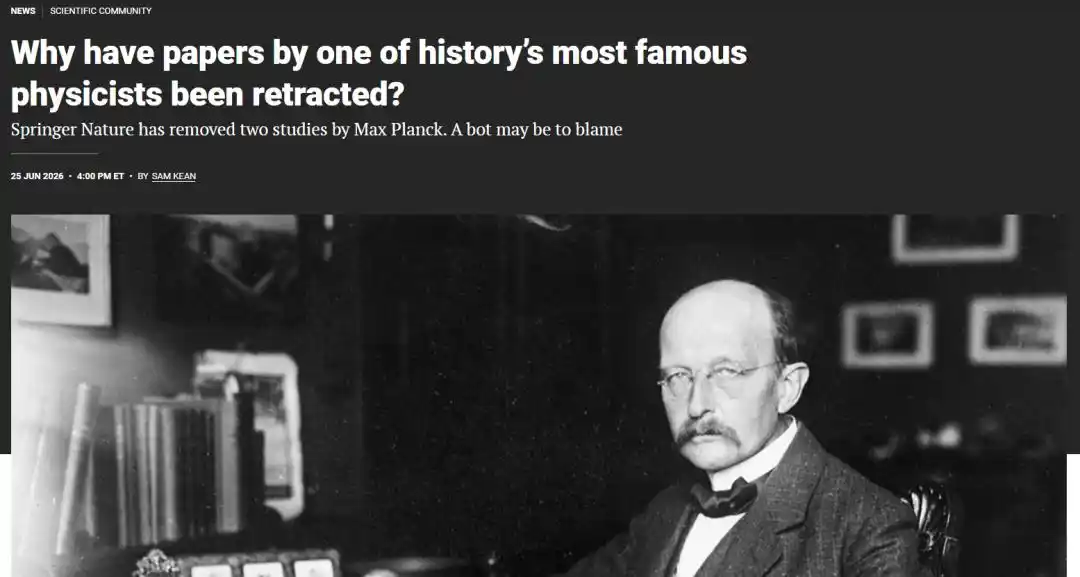
If one day you were to see the name Max Planck on a retraction list, you'd probably think you'd clicked on some academic parody site.

After all, this is no ordinary author. Planck was the founder of quantum theory, the 1918 Nobel Prize winner in Physics, and one of the most important names in 20th-century scientific history.

But a new paper points out that two of Planck's articles, published in 1940 and 1942, are actually marked as "retracted" on Springer's digital platform.
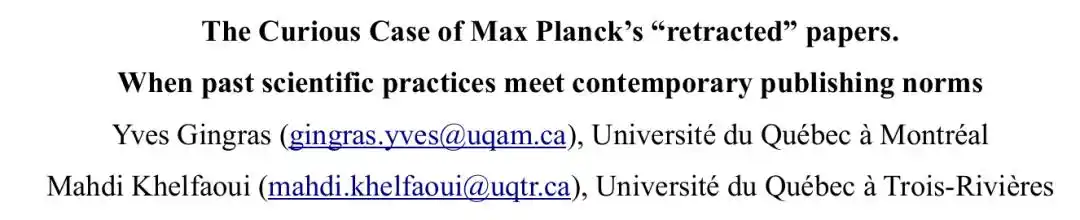
Paper Title: The Curious Case of Max Planck retracted papers. When past scientific practices meet contemporary publishing norms. Paper Address: https://arxiv.org/abs/2605.17534

Amusingly, according to the investigation by the paper's author, these two articles were not retracted due to fabrication, error, or academic misconduct, but were victims of an algorithmic error.

01

The story begins with a "Nobel Laureate Retraction List" from Retraction Watch, a website that tracks issues in academic publishing.

The author, as a researcher in the history of physics, was surprised to see Max Planck on the list because the two articles were published in the German science journal *Die Naturwissenschaften*. By then, Planck was already a world-renowned physicist, and the paper's author found it hard to believe these articles were truly retracted during his lifetime or that there were sufficient grounds for retraction later.
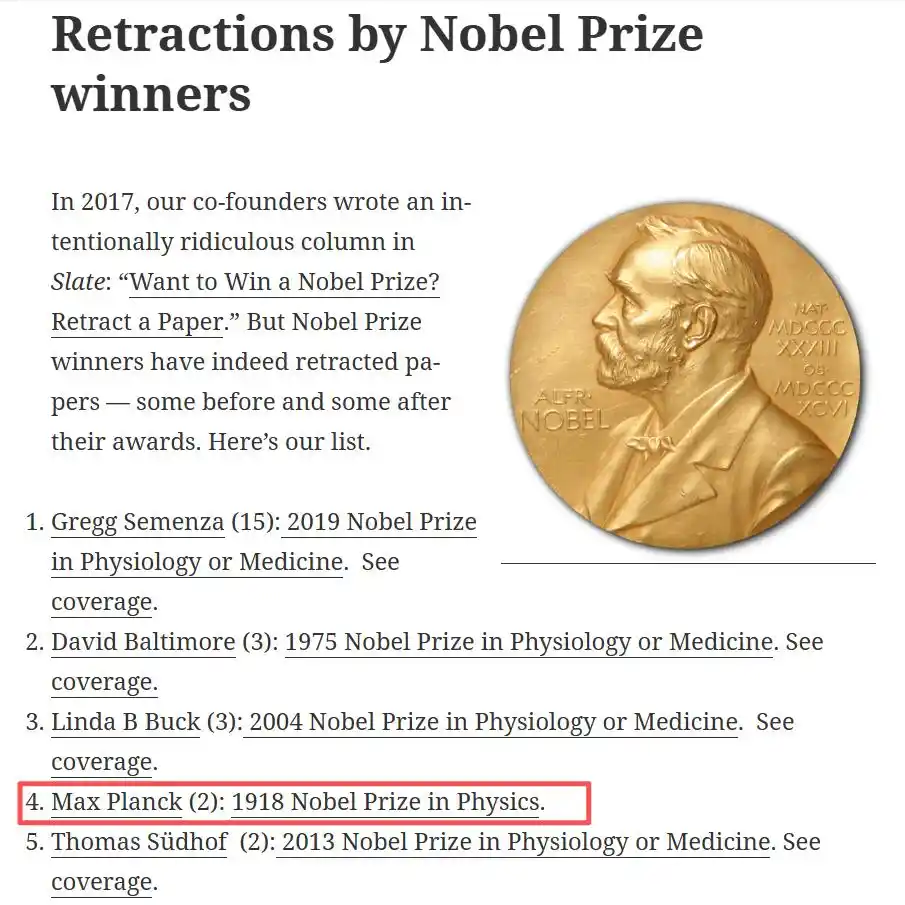
Link: https://retractionwatch.com/retractions-by-nobel-prize-winners/

The explanation given on the Springer platform is rather vague. The page title labels it as a "RETRACTED ARTICLE," but the statement in the PDF says, "This article has been withdrawn due to article violation"; the wording on the webpage is more specific, stating the articles were retracted due to "copyright violation."
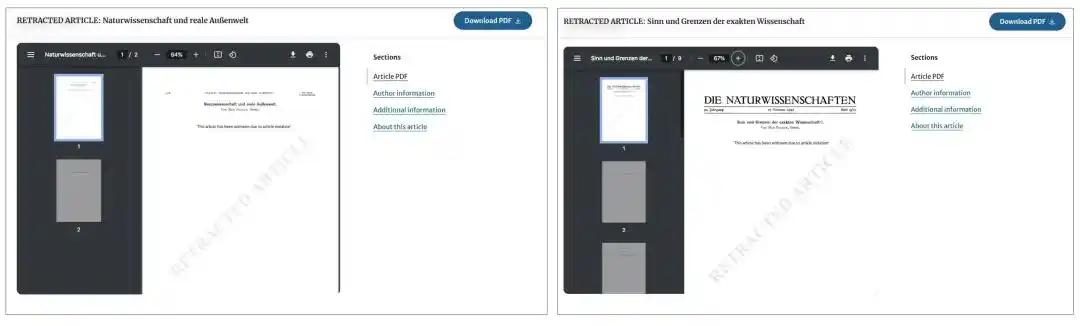
In other words, this is likely an accident manufactured by a combination of copyright, digital archiving, and platform metadata management—these old articles were processed by the system/publisher in modern databases as copyright or duplicate publication issues.

Let's first return to the ecology of scientific publishing in the first half of the 20th century. *Die Naturwissenschaften* was founded in 1913, published by Julius Springer Verlag, and positioned somewhat like the German-language equivalent of *Nature*: it was a comprehensive science weekly covering natural sciences, medicine, and technological advances. It published both technical papers and speeches, conference reports, as well as discussions on the philosophy of science and its cultural significance.

Planck's two articles themselves were not research papers reporting new experiments or theories, but rather philosophical reflections on the nature of scientific knowledge.

The 1942 article, "The Meaning and Limits of Exact Science," is particularly typical. It was originally a lecture Planck gave in 1941 at the Kaiser-Wilhelm-Gesellschaft in Berlin. It later circulated in multiple forms: published as a pamphlet in 1942, also appearing in *Europäische Revue* and *Die Naturwissenschaften*, and was included in a collection of Planck's speeches and essays in 1943.

Today, such a pathway could easily be identified by platforms or copyright systems as "duplicate publication." But at that time, multi-channel circulation—from lectures to journals, from pamphlets to essay collections—was simply part of how scientific ideas spread.

The case of the 1940 article, "Natural Science and the Real External World," is even more peculiar. The paper's author found no evidence of it being published elsewhere as a duplicate. One possible explanation proposed by the author is that a few months earlier in the same journal, another author, Aloys Müller, had published an article with the same title, discussing Planck's philosophical position. Planck then used the same title for a response, engaging in this intellectual debate.

Within the editorial culture of that era, this was clearly not a problem; it was even an explicit gesture of dialogue. But in later digital indexing, copyright management, and metadata systems, two identical titles might be flagged as a suspicious duplicate.

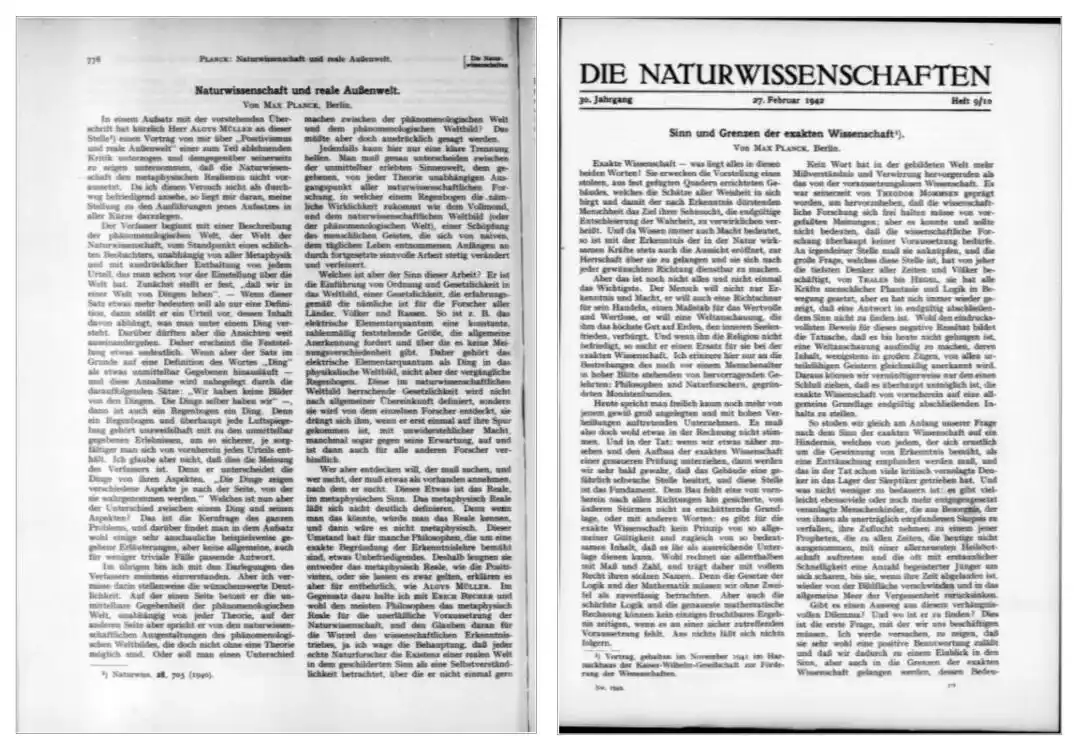
The paper also points out that these two "retracted" articles have even become blank pages on Springer's platform. Normally, even if a paper is retracted, the original text is preserved with a retraction notice added to maintain the integrity of the scientific record. But here, the two-page article from 1940 and the nine-page article from 1942 have both been erased on the digital platform. To read the original today, you can't find it at the original publisher Springer; you have to go to the non-profit Internet Archive.
02

At this point, the matter is no longer just the amusing story of "Planck being mistakenly retracted"; it's a failure of modern academic publishing infrastructure. When historical literature enters modern digital publishing platforms, who has the right to decide what counts as "duplicate publication," what counts as "copyright violation," and what should continue to be seen?

The paper's author argues that concepts like "duplicate publication" and "self-plagiarism" are not eternal, unchanging standards of academic ethics. They are modern categories bound up with bibliometrics, research evaluation, copyright transfer, and commercial publishing platforms from the late 20th century onwards. The paper explicitly states that "self-plagiarism" is a relatively recent concept that has gained prominence with the evaluation systems that measure academic productivity by paper counts since the 1990s.

This is also a point familiar to today's academic system: the issue isn't just "what the content is," but also "how the content is represented by the system."

Once a historical article enters a database, it is broken down into structured objects like DOI, title, author, copyright status, retraction labels, PDF files, citation records, etc. Once platforms process old literature automatically or semi-automatically according to contemporary rules, they may rewrite past normal publishing practices as today's violations.

This mismatch is particularly alarming in the AI era.

When we talk about training data, data cleaning, literature databases, knowledge graphs, and RAG today, we often assume that digital knowledge is stable, retrievable, and callable. But this incident reminds us that digital archives are not a neutral "mirror of the past"; they are a set of filters imbued with commercial logic, legal assumptions, and platform rules. Data can be renamed, re-categorized by platforms, or even replaced with blank pages.

A modern copyright and metrics system retroactively judged normal pre-digital scientific communication practices as suspicious operations. More seriously, this judgment didn't remain at the label level; it directly affected the accessibility of historical literature.

For the knowledge production systems entering the AI era, a wrong label, a missing PDF, or an opaque copyright handling can all be further amplified by models, search engines, and academic tools. Future AI assistants might not know that Planck's articles were "mistakenly retracted"; they might only see the cold, hard "retracted" marker in the database.

When scientific memory is increasingly entrusted to databases, publishers, platform rules, and commercial infrastructure, can we still accurately see science's past?

Reference Link: https://www.science.org/content/article/why-have-papers-one-history-s-most-famous-physicists-been-retracted

This article is from the WeChat public account "Almost Human" (ID: almosthuman2014), author: Focus on Academia


Kripto yang Sedang Tren

Pertanyaan Terkait

QWhat is the main reason Max Planck's articles from 1940 and 1942 were marked as 'retracted' on Springer's platform?

AThe primary reason is believed to be an error caused by automated algorithms or digital platform systems. They likely flagged the articles due to issues such as potential 'duplicate publication' or 'copyright violation' based on modern publishing norms, which misinterpreted the historical publication practices of that era.

QWhat was the original publication context of Max Planck's 1942 article 'The Meaning and Limits of Exact Science'?

AThe 1942 article was originally a lecture delivered by Max Planck in 1941 at the Berlin Kaiser-Wilhelm-Gesellschaft. It was subsequently published in multiple formats, including as a pamphlet, in the journals 'Europäische Revue' and 'Die Naturwissenschaften', and later included in a collection of Planck's speeches and essays. This was a normal method of disseminating scientific ideas at the time.

QWhat unusual outcome occurred for Planck's articles on Springer's platform besides the retraction label?

ABeyond being labeled as 'retracted,' the full texts of the articles were replaced with blank pages on Springer's digital platform. This removal of content is unusual, as standard practice for retracted articles is to keep the original text accessible with a retraction notice to preserve scientific record integrity.

QAccording to the article, why is the concept of 'self-plagiarism' considered a modern construct in relation to this incident?

AThe article argues that concepts like 'self-plagiarism' and 'duplicate publication' are relatively recent constructs tied to late-20th-century academic evaluation systems that emphasize paper counts. Planck's multi-format dissemination of his lecture was standard and acceptable scientific communication in his time but is judged by a different, contemporary set of digital platform rules.

QWhat broader concern does this case raise about digital archives and AI-era knowledge systems?

AThis case highlights that digital archives are not neutral mirrors of the past but are filtered through commercial logic, legal assumptions, and platform rules. An erroneous label or removal can distort the historical record. In the AI era, such errors in databases could be amplified by models, search engines, and tools, potentially leading to the loss or misinterpretation of scientific heritage as AI systems may uncritically accept platform metadata.

Bacaan Terkait

BNB Chain Lampaui Solana dalam Dorongan Perdagangan Saham Dijitoken Senilai $5,2M

TL;DR BNB Chain mencapai volume perdagangan kumulatif ekuitas tokenisasi $5,2B (terutama didorong oleh Ondo Finance Global Markets sebesar $5,12B), melampaui Solana yang sebesar $4,5B. Poin penting: bedakan antara "volume perdagangan kumulatif untuk saham tokenisasi" di BNB Chain dan "volume transfer kumulatif untuk ekuitas tokenisasi" di Solana. Inti Berita BNB Chain telah melampaui Solana dalam metrik volume perdagangan ekuitas tokenisasi, berdasarkan data dari dashboard Ondo Global Markets dan indeks RWA DefiLlama. Ini mencerminkan pergeseran selera risiko di pasar, di tengah arus ETF, leverage, dan likuiditas altcoin yang berputar. Kisah ini penting karena aset tokenisasi terkait dengan infrastruktur penyelesaian dan akses pasar. Peringatan Pasar kripto sering mengubah satu titik data sempit menjadi narasi luas. Data ini adalah sinyal, bukan jaminan. Aliran keluar tidak selalu berarti kehilangan keyakinan jangka panjang, dan pergeseran derivatif tidak menjamin pergerakan harga linear. Yang penting adalah memahami apa yang disinyalkan tentang posisi, kepercayaan, dan insentif. Langkah Selanjutnya Pantau apakah data selanjutnya mengonfirmasi tren ini melalui metrik lanjutan seperti aliran dana, metrik on-chain, open interest, atau pengumuman resmi. Ini akan menentukan apakah ini tema pasar yang bertahan atau sekadar pergeseran posisi jangka pendek. Kisah ini adalah satu bagian dari teka-teki likuiditas yang lebih luas yang harus dibaca bersama kondisi makro dan derivatif.

bitcoinist24m yang lalu

BNB Chain Lampaui Solana dalam Dorongan Perdagangan Saham Dijitoken Senilai $5,2M

bitcoinist24m yang lalu

Trading

Spot

Artikel Populer

Cara Membeli ONE

Selamat datang di HTX.com! Kami telah membuat pembelian Harmony (ONE) menjadi mudah dan nyaman. Ikuti panduan langkah demi langkah kami untuk memulai perjalanan kripto Anda.Langkah 1: Buat Akun HTX AndaGunakan alamat email atau nomor ponsel Anda untuk mendaftar akun gratis di HTX. Rasakan perjalanan pendaftaran yang mudah dan buka semua fitur.Dapatkan Akun SayaLangkah 2: Buka Beli Kripto, lalu Pilih Metode Pembayaran AndaKartu Kredit/Debit: Gunakan Visa atau Mastercard Anda untuk membeli Harmony (ONE) secara instan.Saldo: Gunakan dana dari saldo akun HTX Anda untuk melakukan trading dengan lancar.Pihak Ketiga: Kami telah menambahkan metode pembayaran populer seperti Google Pay dan Apple Pay untuk meningkatkan kenyamanan.P2P: Lakukan trading langsung dengan pengguna lain di HTX.Over-the-Counter (OTC): Kami menawarkan layanan yang dibuat khusus dan kurs yang kompetitif bagi para trader.Langkah 3: Simpan Harmony (ONE) AndaSetelah melakukan pembelian, simpan Harmony (ONE) di akun HTX Anda. Selain itu, Anda dapat mengirimkannya ke tempat lain melalui transfer blockchain atau menggunakannya untuk memperdagangkan mata uang kripto lainnya.Langkah 4: Lakukan trading Harmony (ONE)Lakukan trading Harmony (ONE) dengan mudah di pasar spot HTX. Cukup akses akun Anda, pilih pasangan perdagangan, jalankan trading, lalu pantau secara real-time. Kami menawarkan pengalaman yang ramah pengguna baik untuk pemula maupun trader berpengalaman.

565 Total TayanganDipublikasikan pada 2024.12.12Diperbarui pada 2026.06.02

Cara Membeli ONE

Diskusi

Selamat datang di Komunitas HTX. Di sini, Anda bisa terus mendapatkan informasi terbaru tentang perkembangan platform terkini dan mendapatkan akses ke wawasan pasar profesional. Pendapat pengguna mengenai harga ONE (ONE) disajikan di bawah ini.

活动图片