Bitcoin Bear Market Triggers Crypto Layoffs, Yet Fuels Industry's Most Aggressive M&A Wave Ever

marsbitDipublikasikan tanggal 2026-06-26Terakhir diperbarui pada 2026-06-26

Abstrak

A prolonged Bitcoin downturn is forcing crypto companies to lay off employees and automate operations, but has simultaneously triggered the industry's most aggressive wave of mergers and acquisitions (M&A). In the first half of 2026, crypto M&A deal value reached $93.7 billion, 26 times higher than the same period last year. This activity is primarily driven by traditional financial institutions—banks, payment processors, and asset managers—who are acquiring compliant crypto infrastructure like custody solutions, payment rails, and regulatory licenses instead of building them internally. Examples include Mastercard's acquisition of stablecoin firm BVNK and Franklin Templeton's launch of a dedicated crypto division via acquisition. This consolidation contrasts sharply with a shrinking crypto labor market, where active job openings have plummeted. Companies like Coinbase are restructuring to become "AI-native," leading to a sharp increase in roles requiring AI skills, while engineering and compliance positions now dominate hiring. Financially pressured crypto firms, such as Messari which was acquired at a fraction of its prior valuation, are becoming prime targets. Capital remains available but is highly selective, flowing overwhelmingly into businesses that bridge digital assets with traditional finance, such as tokenization platforms and regulated trading venues. The trend indicates a market where capital is rewarding compliant, utility-focused infrastructure while weaker m...

Author: Oluwapelumi Adejumo

Compiled by: Deep Chao TechFlow

Deep Chao's Guide: The ongoing decline of BTC is forcing crypto companies to conduct large-scale layoffs, but it is also spawning the most aggressive wave of mergers and acquisitions in the industry's history - with transaction volumes reaching $9.4 billion in the first half of 2026, 26 times the volume from the same period last year. Traditional financial institutions are no longer building their own infrastructure but are instead directly acquiring licenses, custody solutions, and payment rails. This divergence reveals the true direction of capital flow during a bear market.

Bitcoin's prolonged downturn is forcing cryptocurrency companies to cut staff, automate more tasks, and abandon expansion plans formulated during the last bull run. Simultaneously, it is creating one of the busiest periods for acquisitions in the sector's history.

In the second quarter of 2026, cryptocurrency M&A deals reached $7.23 billion, up from $2.14 billion in the first quarter.

The total transaction value for the two quarters reached $9.37 billion. Data from CryptoRank shows that the overall growth in the first half of the year was 26 times higher than the same period last year, highlighting a dramatic acceleration in deal activity even as spot market conditions worsen.
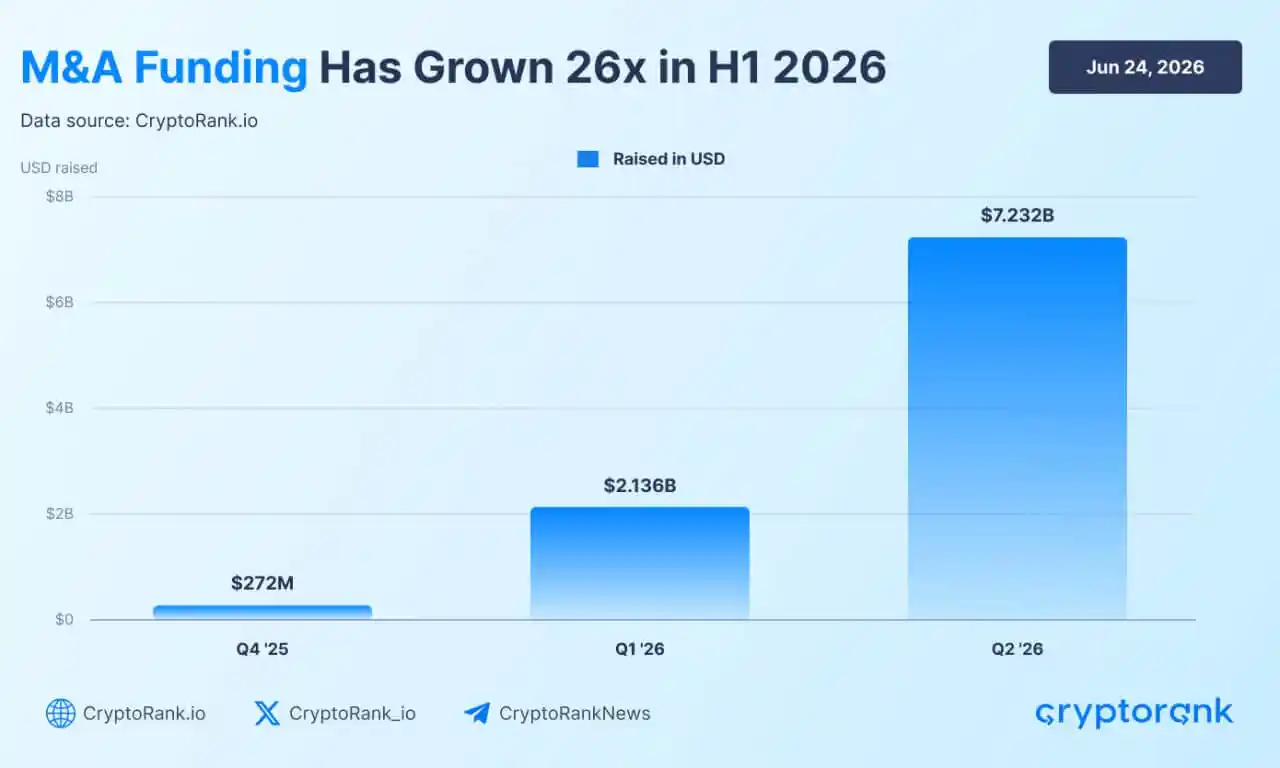
This acceleration is occurring against a backdrop of Bitcoin trading near its lowest levels in nearly two years and continued layoffs at some of the industry's largest employers.

This divergence shows where capital is flowing during the downturn – companies are spending less on broad hiring and speculative growth.

Instead, traditional financial institutions, banks, card networks, trading firms, and well-funded crypto businesses are acquiring payment systems, regulatory licenses, custody businesses, and market infrastructure that could take years to build internally.

The result is a bear market that is weakening many crypto companies but not eliminating institutional demand for their technology.

Traditional Finance Drives Wave of Crypto Infrastructure Acquisitions

Traditional financial institutions are driving the wave of crypto acquisitions, opting to buy fully-fledged digital asset infrastructure rather than building compliance and technical systems from scratch.

Banks, payment processors, and fintech companies are actively targeting startups that already possess custody solutions, payment rails, and regulatory approvals.

This acquisition frenzy is largely driven by the stabilization of global policy. The European Union's Markets in Crypto-Assets (MiCA) framework establishes unified licensing standards, while ongoing stablecoin legislation in the US gives corporate giants the confidence to make long-term bets.

Legal and consulting experts point to this policy support as a primary catalyst. According to Architect Partners' Q1 Crypto M&A and Financing Report, banking and securities industries are fully embracing blockchain, repositioning the technology as a foundational layer for traditional financial markets.

Mastercard's $1.8 billion acquisition of stablecoin company BVNK is a prime example. This acquisition gave the card network immediate access to the technology and licenses needed to process stablecoin payments, bypassing years of internal development.

Other Wall Street giants are also securing strategic footholds through targeted investments. Intercontinental Exchange backed prediction platform Polymarket, Citadel Securities invested in brokerage services provider Alpaca, and Standard Chartered's venture arm funded market maker Keyrock.

Asset managers are also capturing institutional demand through direct acquisitions. Franklin Templeton, which manages $1.7 trillion in assets, recently launched a dedicated digital assets unit called Franklin Crypto.

This move was executed via the acquisition of 250 Digital, which absorbed the firm's investment team and previously managed liquid crypto strategies under CoinFund, to offer actively managed cryptocurrency products directly to Franklin Templeton's global client base.

Overall, private capital strongly favors businesses that connect blockchain to the wider financial system. First-quarter financing data reveals a clear investor preference for stablecoin utility—such as foreign exchange, corporate payments, and cross-border settlement—over speculative crypto-native projects.

In this environment, regulatory credentials have become a major competitive barrier. Acquisition targets with broker-dealer capabilities, federal banking charters, or registered investment advisor qualifications, including Alpaca, Anchorage, and Superstate, attract stronger buyer interest as they provide immediate operational legitimacy.

While traditional finance demonstrates its balance sheet strength, blockchain networks are quietly emerging as a new class of aggressive buyers.

Historically, Layer 1 and Layer 2 networks relied on independent developers to build applications on their chains. Now, faced with fierce competition for users, these networks are directly purchasing consumer-facing applications.

Polygon's recent acquisitions of Coinme and Sequence highlight this shift. By buying payment channels and wallet infrastructure, the blockchain is securing an end-to-end user experience and locking in transaction volume, suggesting that technical capability alone is insufficient to maintain market share.

Crypto Layoffs Deepen, AI and Compliance Reshape Workforce

The pace of corporate acquisitions starkly contrasts with the continued contraction of the digital asset labor market.

According to data compiled by Tiger Research for June 2026, the industry currently has only 2,932 active job openings globally.
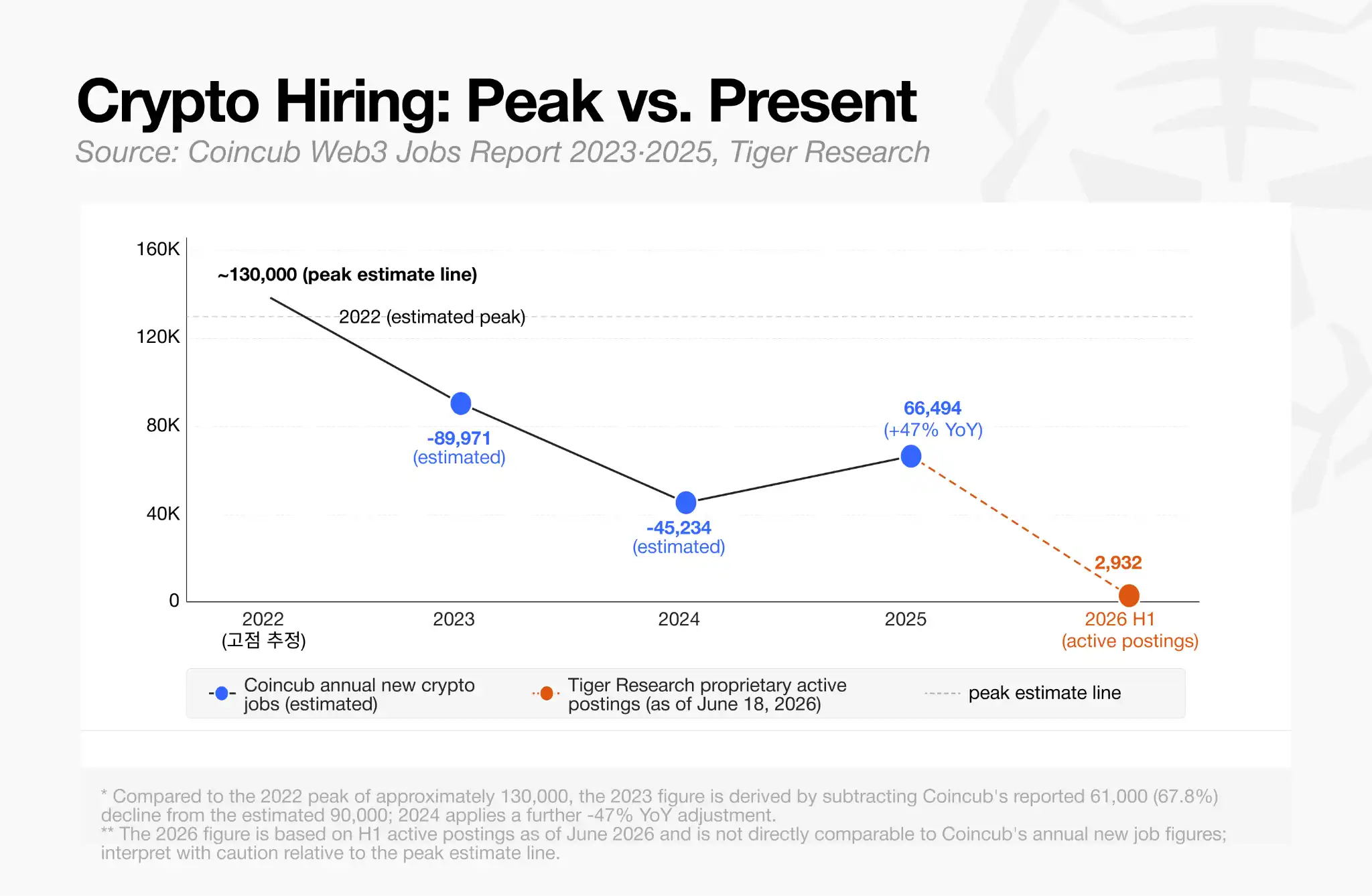
This figure pales in comparison to the aggressive hiring sprees of 2021 and early 2022, when trading platforms, DeFi protocols, and NFT markets were all expanding headcount simultaneously.

The employment shrinkage began during the market downturn of 2022 and accelerated after the FTX collapse, leading to roughly a 40% decline in job openings across North America and Europe. The market has not rebounded to previous highs.

Indeed, layoffs have been steadily continuing throughout the first half of this year. Major platforms including Gemini, Coinbase, Kraken, Algorand, Crypto.com, and most recently, the Ethereum Foundation, have initiated new rounds of job cuts.

Executives have attributed the cuts to low token valuations, broader macroeconomic pressures, and AI-driven operational efficiencies. Specifically, Coinbase framed its restructuring as a shift towards an "AI-native" operational model.

This technological pivot is evident in the hiring data: the proportion of crypto jobs requiring AI skills has more than doubled in a year, surging from 23% in early 2025 to over 53% by March 2026.
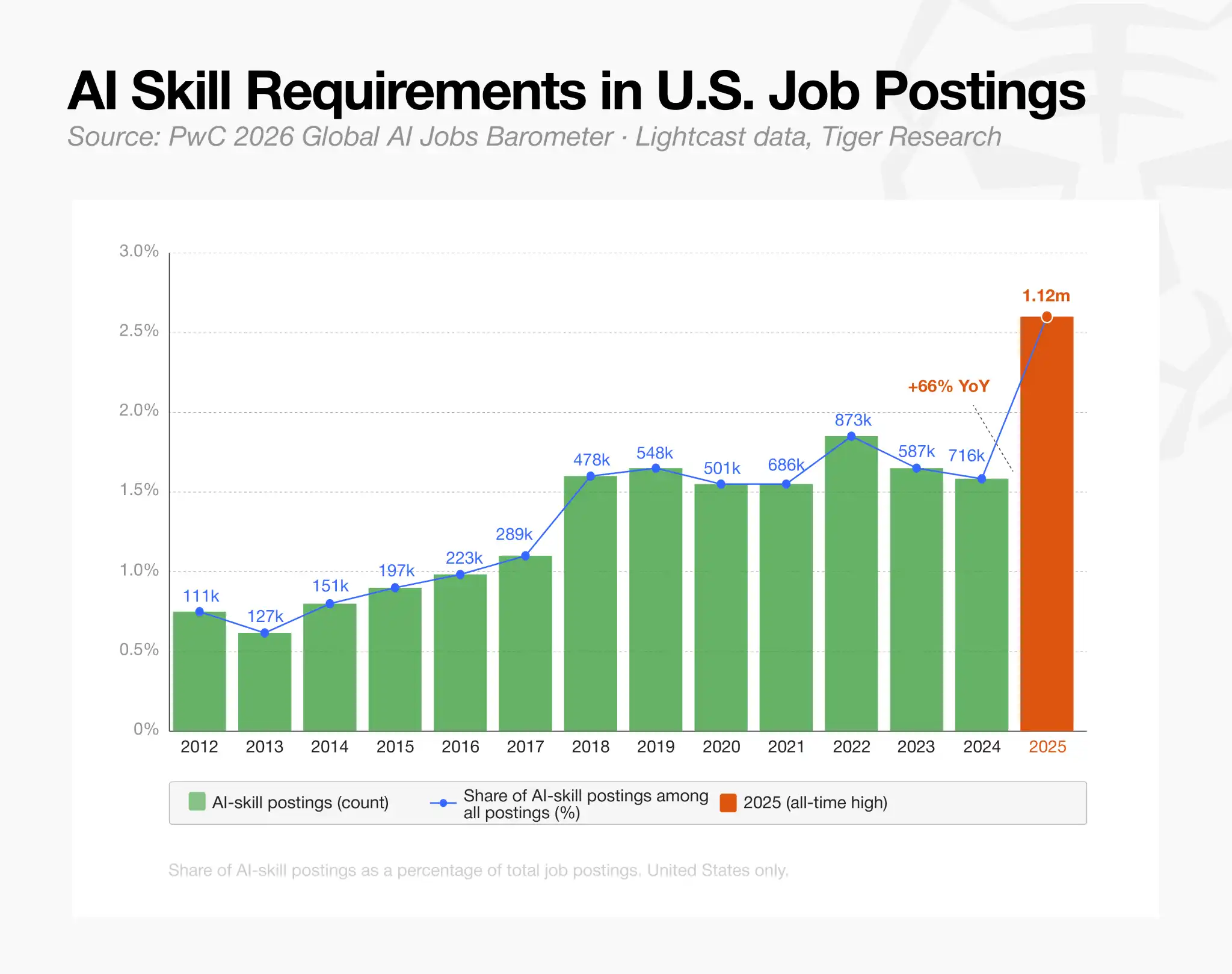
While overall hiring remains sluggish, the composition of the workforce is undergoing a fundamental change. Companies are not implementing a complete hiring freeze. Instead, they are actively narrowing their focus to technical and regulatory expertise.

According to Tiger Research, engineering roles constitute approximately 34% of active openings, while legal and compliance roles account for about 10%. This shift is more pronounced at centralized exchanges, where compliance positions make up 16% of vacancies—more than double the share for sales and business development roles.

This indicates these companies are prioritizing staffing needs to obtain licenses, manage risk, and maintain core infrastructure, while reducing spending on marketing and community growth.

Furthermore, the limited hiring that exists is highly concentrated among a few heavyweights rather than distributed across early-stage startups. Centralized exchanges generate nearly one-third of all open positions.

Stablecoin and payments divisions account for another significant portion, but this activity is highly concentrated. Tether and Ripple alone constitute over 80% of listings in that category.

Ultimately, the data paints a picture of targeted corporate restructuring and a defensive posture, not an industry-wide labor market recovery.

Distressed Crypto Companies Become Acquisition Targets

Blockworks' recent acquisition of Messari perfectly embodies the intersection of large-scale layoffs and accelerated consolidation.

The crypto analytics company Blockworks acquired the analytics provider for approximately $10 million, a significant markdown from its $300 million valuation following a 2022 funding round. Prior to the sale, the research firm underwent three separate rounds of layoffs starting in 2023.

Shortening runways and slow revenue growth are forcing smaller businesses to the negotiating table, enabling well-funded buyers to absorb specialized talent, proprietary data, and distribution channels for a fraction of their former private market valuations.

Industry analysts expect these financial pressures to soon ripple into digital asset treasury sectors. Throughout 2025, many public treasury entities successfully raised capital by trading at a premium relative to their crypto reserves.

Meanwhile, the M&A wave may also eventually encompass Decentralized Autonomous Organizations, thanks to maturing legal frameworks.

Recent legislative progress, such as Wyoming's Decentralized Unincorporated Nonprofit Association (DUNA) structure, provides DAOs with a recognized legal mechanism to hold off-chain assets and intellectual property.

With clearer governance and ownership, protocol treasuries are better positioned to acquire complementary software projects or specialized development teams.

However, compared to the traditional, compliance-driven corporate acquisitions dominating the current market cycle, these decentralized mergers remain highly experimental.

Capital Remains Available, But Has Become Discerning

Despite nearly $10 billion in crypto deal activity in the first half of 2026, capital allocation has become more discerning.

A notable exception to this strict institutional focus is the prediction markets sector. Event-betting platforms have secured significant funding commitments as they vie for mainstream dominance.

For context, Kalshi is reportedly negotiating a funding round that would value the federally regulated exchange at $40 billion, nearly double its previous $22 billion price tag. Polymarket has also absorbed substantial backing as competition for prediction market supremacy intensifies.

However, outside of predictions, the venture capital thesis has narrowed dramatically. Capital is overwhelmingly flowing to businesses acting as bridges between digital assets and the traditional financial system.

Tokenization firms and institutional trading venues secure large checks because they pitch sustainable, isolated revenue models: charging banks, brokerages, and asset managers fees for regulated services, rather than relying on fickle retail crypto traders. Superstate recently closed an $82.5 million funding round to expand its blockchain-based securities issuance, while Alpaca dominates in settling tokenized US stocks and ETFs.

This funding trajectory indicates investors are shifting bets from conceptual tokenization pilots to live, regulated financial products.

Notably, pure DeFi protocols and experimental base-layer blockchains are entirely absent from this quarter's major funding rounds.

This selective deployment of venture capital mirrors the broader M&A trend. Liquidity exists, but it is ring-fenced for startups with regulatory licenses, institutional distribution channels, and specific utility for traditional finance.

The bear market is effectively pruning the industry, forcing weaker models to consolidate or cut staff, while richly rewarding the infrastructure providers built to weather the crypto winter.

Kripto yang Sedang Tren

Pertanyaan Terkait

QWhat has been the impact of the prolonged Bitcoin downturn on the crypto industry, according to the article?

AThe prolonged Bitcoin downturn has forced crypto companies to conduct mass layoffs, automate more work, and abandon expansion plans from the previous bull market. However, it has simultaneously created one of the industry's busiest periods for mergers and acquisitions (M&A).

QHow does the scale of crypto M&A activity in the first half of 2026 compare to the previous year?

AThe total value of crypto M&A deals in the first half of 2026 reached $9.37 billion. According to CryptoRank, this represented a growth that was 26 times higher compared to the same period in the previous year.

QWhat is the primary driver behind the wave of crypto infrastructure acquisitions by traditional financial institutions?

AThe primary driver is the stabilization of global crypto policy, such as the EU's MiCA framework and ongoing stablecoin legislation in the US. This provides traditional banks and financial institutions the confidence to make long-term bets by purchasing ready-made digital asset infrastructure (like custody, payment rails, and regulatory licenses) instead of building it internally.

QHow is the composition of the crypto workforce changing during this period of layoffs, as highlighted in the article?

AThe composition is shifting towards a greater emphasis on technical and regulatory expertise. Engineering roles now make up about 34% of active job vacancies, while legal and compliance roles account for about 10%. There is also a significant increase in demand for AI skills, with over 53% of crypto job postings requiring them by March 2026.

QWhat type of companies are currently receiving the majority of venture capital funding, according to the article's analysis?

AVenture capital is overwhelmingly flowing to companies that act as bridges between digital assets and the traditional financial system. This includes tokenization firms and institutional trading venues with regulated, fee-based revenue models, rather than speculative crypto-native projects or pure DeFi protocols.

Bacaan Terkait

Trading

Spot

Artikel Populer

Apa Itu DOGE M

Doge Matrix ($doge m): Ras Baru Cryptocurrency yang Didorong oleh Komunitas Pendahuluan Dalam lanskap cryptocurrency yang terus berkembang, proyek-proyek baru terus muncul, masing-masing bertujuan untuk menarik minat investor dan penggemar. Salah satu pendatang terbaru di domain ini adalah Doge Matrix, yang diwakili oleh simbol ticker $doge m. Proyek ini menarik perhatian berkat akarnya dalam budaya meme populer yang mengelilingi Dogecoin, menetapkan tempatnya dalam ruang web3. Artikel ini bertujuan untuk memberikan analisis komprehensif tentang Doge Matrix, mencakup gambaran umum, pencipta, investor, fungsionalitas, garis waktu, dan aspek-aspek penting. Apa itu Doge Matrix ($doge m)? Doge Matrix adalah proyek cryptocurrency yang didorong oleh komunitas yang tampaknya membangun daya tarik luas dari Dogecoin, mata uang digital yang dikenal dengan maskot Shiba Inu dan asal-usul meme-nya. Meskipun tujuan keseluruhan Doge Matrix tidak didefinisikan secara luas, proyek ini ditandai dengan komitmen untuk memanfaatkan keterlibatan dan dukungan komunitas. Berbeda dengan cryptocurrency tradisional yang sering menekankan utilitas atau nilai intrinsik melalui teknologi yang mendasarinya, Doge Matrix memposisikan dirinya dalam ruang yang merangkul fenomena budaya cryptocurrency, terutama menarik bagi mereka yang sejalan dengan etos aset berbasis meme. Mengandalkan kekuatan komunitas Dogecoin, Doge Matrix beroperasi sebagai bagian dari ekosistem yang lebih luas, mengundang partisipasi dan keterlibatan dari pengguna yang berbagi minat dalam cryptocurrency dan lanskap digital. Siapa Pencipta Doge Matrix ($doge m)? Identitas pencipta Doge Matrix tetap tidak diketahui. Kurangnya transparansi ini bukanlah hal yang tidak biasa dalam ruang cryptocurrency, di mana beberapa proyek diluncurkan tanpa mengungkapkan identitas pendirinya. Ketidakadaan informasi mengenai tim pendiri dapat menimbulkan pertanyaan di antara calon investor tentang akuntabilitas dan arah proyek tersebut. Siapa Investor Doge Matrix ($doge m)? Saat ini, tidak ada informasi yang tersedia untuk umum yang merinci investor atau yayasan investasi yang mendukung Doge Matrix. Proyek ini tampaknya mengandalkan dukungan komunitas daripada investasi institusional. Model ini sejalan dengan sifat proyek yang didorong oleh komunitas, menciptakan lingkungan di mana arah proyek dibentuk oleh para pesertanya daripada ditentukan oleh sekelompok kecil pendukung finansial. Bagaimana Cara Kerja Doge Matrix ($doge m)? Spesifikasi mengenai mekanisme operasional Doge Matrix agak samar, mencerminkan tren yang lebih luas dari proyek-proyek di ruang koin meme di mana fungsionalitas inovatif tidak selalu diartikulasikan dengan jelas. Meskipun demikian, Doge Matrix tampaknya dirancang untuk memanfaatkan ekosistem cryptocurrency yang ada dengan mendorong partisipasi pengguna sambil memanfaatkan referensi budaya yang sudah dikenal yang terkait dengan Dogecoin. Karakteristik uniknya mungkin berasal dari interaksi komunitas daripada kemajuan teknologi, menekankan pengalaman bersama dan kolaborasi di antara pemegang token. Meskipun inovasi yang tepat belum diuraikan secara eksplisit, proyek ini tampaknya menciptakan ruang di mana anggota komunitas dapat terlibat, berbagi ide, dan mendorong potensi proyek ke depan. Garis Waktu Doge Matrix ($doge m) Merefleksikan garis waktu proyek ini mengungkapkan peristiwa penting yang telah mendefinisikan perjalanannya hingga saat ini: 25 November 2024: Doge Matrix mencapai nilai tertinggi sepanjang masa, menandai tonggak penting dalam sejarah awalnya. 1 Januari 2025: Sebaliknya, Doge Matrix mencapai nilai terendah sepanjang masa, menggambarkan volatilitas yang sering terkait dengan cryptocurrency, terutama di tahap awal siklus hidup proyek. Sedang Berlangsung: Proyek ini terus diperdagangkan secara aktif dan didukung oleh komunitasnya, meskipun tonggak atau tujuan masa depan yang spesifik belum diungkapkan. Poin Kunci tentang Doge Matrix ($doge m) Fokus Komunitas Di jantung Doge Matrix adalah komitmen terhadap keterlibatan komunitas. Proyek ini berkembang atas dasar kolaborasi dan tujuan bersama di antara anggotanya, menekankan pentingnya upaya kolektif. Berbeda dengan proyek terpusat yang sering memiliki struktur kepemimpinan yang jelas, Doge Matrix saat ini menunjukkan pendekatan yang lebih fleksibel terhadap tata kelola, di mana suara setiap anggota komunitas dihargai. Volatilitas Pasar cryptocurrency terkenal dengan volatilitasnya, dan Doge Matrix tidak terkecuali. Riwayat harganya mencerminkan fluktuasi signifikan antara nilai tinggi dan rendah, yang merupakan hal biasa bagi banyak cryptocurrency baru tetapi menyoroti risiko yang terkait dengan investasi dalam token yang sedang berkembang. Kurangnya Informasi Detail Salah satu fitur paling mencolok tentang Doge Matrix adalah kelangkaan informasi detail mengenai dasar-dasar teknologinya dan mekanisme operasional. Ambiguitas ini mengharuskan calon investor untuk melakukan penelitian menyeluruh sebelum terlibat dengan proyek tersebut. Kesimpulan Singkatnya, Doge Matrix ($doge m) menggambarkan gelombang baru proyek cryptocurrency yang sangat bergantung pada keterlibatan komunitas dan relevansi budaya. Meskipun kurang dalam beberapa spesifikasi—seperti kepemimpinan yang jelas, tujuan yang terdefinisi, dan fungsionalitas yang detail—proyek ini berhasil menarik minat dalam komunitas crypto, memanfaatkan daya tarik yang sudah ada dari budaya meme. Seperti halnya investasi di ruang cryptocurrency, memahami risiko yang melekat dan melakukan penelitian yang komprehensif sangat penting bagi calon peserta. Doge Matrix berdiri sebagai pengingat tentang sifat dinamis, terkadang tidak terduga dari industri crypto, yang ditandai dengan evolusi konstan dan antusiasme untuk inisiatif yang didorong oleh komunitas.

529 Total TayanganDipublikasikan pada 2025.02.03Diperbarui pada 2025.02.03

Apa Itu DOGE M

Apa Itu $M

Memahami Mantis ($M): Era Baru dalam Interoperabilitas Lintas Rantai Dalam lanskap Web3 dan cryptocurrency yang terus berkembang, proyek-proyek baru berusaha menawarkan solusi inovatif yang bertujuan untuk meningkatkan pengalaman pengguna dan memperluas kemungkinan fungsional dalam ekosistem keuangan terdesentralisasi. Salah satu proyek yang menarik perhatian adalah Mantis ($M), sebuah protokol perintis yang didirikan berdasarkan prinsip interoperabilitas lintas rantai dan penyelesaian berbasis niat. Artikel ini membahas aspek-aspek penting dari Mantis, termasuk fungsionalitas inti, pencipta, dukungan investasi, fitur inovatif, dan tonggak sejarah yang kritis. Apa itu Mantis ($M)? Mantis dijelaskan sebagai protokol penyelesaian niat multi-domain yang menyederhanakan interaksi lintas rantai, memungkinkan pengguna untuk melakukan transaksi keuangan kompleks di berbagai platform blockchain dengan mulus. Protokol ini beroperasi melalui tiga lapisan utama: Ekspresi Niat: Pengguna dapat mengungkapkan tujuan transaksi mereka menggunakan bahasa alami yang difasilitasi oleh DISE LLM, model bahasa AI canggih. Misalnya, seorang pengguna mungkin mengungkapkan keinginan untuk menukar Ethereum (ETH) dengan Solana (SOL) dengan toleransi slippage tertentu sebesar 1%. Eksekusi: Lapisan ini menggunakan jaringan penyelesai yang bersaing untuk memenuhi niat pengguna. Transaksi dieksekusi menggunakan mekanisme seperti Coincidence of Wants (CoWs) dan Order Flow Auctions (OFAs), yang memastikan bahwa permintaan pengguna terpenuhi secara optimal. Penyelesaian: Dengan memanfaatkan protokol Inter-Blockchain Communication (IBC), Mantis memungkinkan transaksi lintas rantai atomik, memungkinkan pengguna untuk beroperasi di berbagai rantai yang didukung, termasuk Ethereum, Solana, dan Cosmos. Mantis dirancang untuk memperkenalkan generasi hasil asli untuk aset yang tidak aktif, menggunakan bukti kriptografi untuk menjaga integritas transaksi sepanjang proses. Pencipta & Tim Pengembangan Mantis diciptakan oleh Composable Foundation, sebuah organisasi yang didorong oleh penelitian yang terkenal karena penekanannya pada solusi interoperabilitas blockchain. Yayasan ini bekerja sama dengan institusi akademis terkemuka, termasuk Universitas Harvard dan Universitas Lisbon, berkontribusi pada upaya penelitian dan pengembangan yang luas yang menginformasikan arsitektur dan fungsionalitas Mantis. Komitmen Composable Foundation untuk mendorong inovasi di ruang blockchain menempatkan Mantis sebagai solusi yang kuat untuk permintaan yang terus berkembang akan interoperabilitas di antara berbagai jaringan blockchain. Investor & Dukungan Meskipun rincian spesifik tentang investor individu belum dipublikasikan, Mantis menikmati dukungan substansial dari berbagai entitas, termasuk: Grants ekosistem dari rantai yang mendukung IBC, yang mendukung pertumbuhan dan integrasi protokol dalam ekosistem keuangan terdesentralisasi. Kemitraan strategis dengan penyedia infrastruktur yang meningkatkan kemampuan jaringan Mantis dan strategi penerapannya. Pendanaan melalui kas Composable Foundation, memastikan dukungan keuangan yang berkelanjutan untuk pengembangan dan biaya operasional yang sedang berlangsung. Upaya kolaboratif ini mencerminkan konsensus di antara para pemangku kepentingan tentang pentingnya meningkatkan fungsionalitas lintas rantai dan potensi utilitas inovasi infrastruktur Mantis. Inovasi Kunci Mantis membedakan dirinya melalui beberapa inovasi perintis yang meningkatkan fungsionalitas dan utilitasnya: Niat yang Tidak Bergantung pada Rantai: Pengguna dapat memulai transaksi dari rantai yang didukung mana pun sambil menyelesaikan di rantai lain. Fleksibilitas ini memberdayakan pengguna, mendorong interaksi yang lebih besar di antara berbagai platform. Antarmuka Berbasis AI: Integrasi DISE LLM memungkinkan pengguna untuk melakukan operasi DeFi yang kompleks menggunakan bahasa alami, sehingga menyederhanakan interaksi dan membuat teknologi blockchain lebih dapat diakses oleh audiens yang lebih luas. Penangkapan MEV Lintas Domain: Mantis menciptakan pasar internal untuk nilai ekstraksi maksimal (MEV) melalui kompetisi di antara penyelesai. Pendekatan inovatif ini memungkinkan efisiensi dan ekstraksi nilai yang lebih besar dalam transaksi kompleks. Lapisan Penyelesaian Modular: Protokol ini mendukung berbagai metode verifikasi, termasuk bukti nol-pengetahuan dan optimistic rollups, menyediakan kerangka kerja yang fleksibel yang dapat beradaptasi dengan teknologi blockchain yang muncul. Garis Waktu Sejarah Pengembangan Mantis ditandai oleh beberapa tonggak kritis yang menggambarkan trajektori dan pertumbuhannya: | Tahun | Tonggak | |————|————————————————————————-| | 2022 | Pengembangan konsep awal dalam divisi penelitian Composable Foundation. | | Q3 2024 | Peluncuran testnet dengan kemampuan bridging antara Solana dan Ethereum. | | Q1 2025 | Acara Generasi Token (TGE) yang diantisipasi bersamaan dengan peluncuran mainnet. | | Q2 2025 | Integrasi DISE LLM yang diharapkan dan ekspansi kemampuan lintas rantai. | | H2 2025 | Dukungan yang direncanakan untuk lebih dari 15 rantai melalui peningkatan IBC lebih lanjut. | Garis waktu ini menggambarkan evolusi Mantis, dari diskusi konseptual hingga implementasi aktif dan fase pertumbuhan di masa depan. Strategi Pertumbuhan Ekosistem Strategi Mantis untuk pertumbuhan ekosistem mencakup beberapa inisiatif yang dirancang untuk mendorong partisipasi pengguna dan keterlibatan pengembang: Sistem Kredit: Pengguna dapat memperoleh kredit protokol dengan menyediakan likuiditas dan terlibat dalam program rujukan. Kredit ini dapat ditukarkan untuk insentif di masa depan, mendorong komunitas pengguna yang kuat. Modular Software Development Kit (SDK): Toolkit ini memberdayakan pengembang untuk membuat aplikasi berdasarkan model berbasis niat yang memanfaatkan infrastruktur Mantis, sehingga mendorong inovasi dalam ekosistemnya. Model Tata Kelola: Seiring dengan matangnya protokol, pemegang token $M akan memiliki suara dalam tata kelola protokol, memungkinkan mereka untuk memberikan suara pada peningkatan dan perubahan yang diusulkan, sehingga meningkatkan keterlibatan komunitas dan desentralisasi. Mantis mewakili kemajuan signifikan dalam ranah arsitektur lintas rantai. Dengan mengintegrasikan algoritma AI canggih dengan kerangka penyelesaian yang kuat, Mantis berupaya menangani masalah fragmentasi dalam ekosistem multi-rantai. Pendekatan inovatifnya memprioritaskan peningkatan pengalaman pengguna sambil mematuhi prinsip dasar desentralisasi dan keamanan, menetapkan standar baru untuk interoperabilitas teknologi blockchain di masa depan. Saat Mantis melanjutkan perjalanan pertumbuhan dan implementasinya, proyek ini menjanjikan untuk menjadi perhatian dalam lanskap kompetitif Web3 dan keuangan terdesentralisasi. Dengan fokusnya pada melintasi batas dan meningkatkan keterlibatan pengguna, Mantis siap menjadi bagian integral dari perkembangan masa depan di ruang cryptocurrency.

49 Total TayanganDipublikasikan pada 2025.03.18Diperbarui pada 2025.03.18

Apa Itu $M

Cara Membeli M

Selamat datang di HTX.com! Kami telah membuat pembelian MemeCore (M) menjadi mudah dan nyaman. Ikuti panduan langkah demi langkah kami untuk memulai perjalanan kripto Anda.Langkah 1: Buat Akun HTX AndaGunakan alamat email atau nomor ponsel Anda untuk mendaftar akun gratis di HTX. Rasakan perjalanan pendaftaran yang mudah dan buka semua fitur.Dapatkan Akun SayaLangkah 2: Buka Beli Kripto, lalu Pilih Metode Pembayaran AndaKartu Kredit/Debit: Gunakan Visa atau Mastercard Anda untuk membeli MemeCore (M) secara instan.Saldo: Gunakan dana dari saldo akun HTX Anda untuk melakukan trading dengan lancar.Pihak Ketiga: Kami telah menambahkan metode pembayaran populer seperti Google Pay dan Apple Pay untuk meningkatkan kenyamanan.P2P: Lakukan trading langsung dengan pengguna lain di HTX.Over-the-Counter (OTC): Kami menawarkan layanan yang dibuat khusus dan kurs yang kompetitif bagi para trader.Langkah 3: Simpan MemeCore (M) AndaSetelah melakukan pembelian, simpan MemeCore (M) di akun HTX Anda. Selain itu, Anda dapat mengirimkannya ke tempat lain melalui transfer blockchain atau menggunakannya untuk memperdagangkan mata uang kripto lainnya.Langkah 4: Lakukan trading MemeCore (M)Lakukan trading MemeCore (M) dengan mudah di pasar spot HTX. Cukup akses akun Anda, pilih pasangan perdagangan, jalankan trading, lalu pantau secara real-time. Kami menawarkan pengalaman yang ramah pengguna baik untuk pemula maupun trader berpengalaman.

912 Total TayanganDipublikasikan pada 2025.07.02Diperbarui pada 2026.06.02

Cara Membeli M

Diskusi

Selamat datang di Komunitas HTX. Di sini, Anda bisa terus mendapatkan informasi terbaru tentang perkembangan platform terkini dan mendapatkan akses ke wawasan pasar profesional. Pendapat pengguna mengenai harga M (M) disajikan di bawah ini.

活动图片