Bitcoin Exchange Outflows Don’t Mean Supply Shock—It’s Just ETFs, Says CryptoQuant

bitcoinistDipublikasikan tanggal 2025-08-19Terakhir diperbarui pada 2025-08-19

Abstrak

CryptoQuant has pushed back on popular Bitcoin "supply shock" claims, revealing BTC exiting exchanges is just shifting to ETF custody....

Trusted Editorial content, reviewed by leading industry experts and seasoned editors. Ad Disclosure

CryptoQuant has pushed back on popular Bitcoin “supply shock” claims, revealing BTC exiting exchanges is just shifting to ETF custody.

Bitcoin Leaving Exchanges Has Just Moved Into ETFs

In a new post on X, on-chain analytics firm CryptoQuant has addressed a popular idea that’s present among cryptocurrency traders: that a decline in the Exchange Reserve implies a supply shock could be coming.

The “Exchange Reserve” here refers to a metric that keeps track of the total amount of Bitcoin that’s being held in wallets associated with all centralized exchanges.

Generally, investors keep their coins on these platforms when they want to use one of the services that they provide, which can include selling. As such, it’s often assumed that the tokens sitting on the exchanges represent the sell supply of the asset.

An increase in it, therefore, could be a bearish signal for the cryptocurrency. Similarly, a decline could prove to be a bullish sign instead, as it suggests the BTC available for trading is becoming scarcer.

This has been the traditional interpretation of what the Exchange Reserve’s trends mean for the market. Today, while the idea does still hold some weight, there is more to the story than just exchanges. Namely, there exists an alternative means of trading Bitcoin now: spot exchange-traded funds (ETFs).

Launched in the US at the start of last year, the spot ETFs are still relatively new, but they have quickly cemented themselves as an important corner of the sector. In other words, the full picture of the market today requires looking not only at the exchanges, but also these new funds.

Below is the chart shared by CryptoQuant that shows the trend in the Bitcoin Exchange Reserve, as well as the holdings of the spot ETFs, over the history of the cryptocurrency:
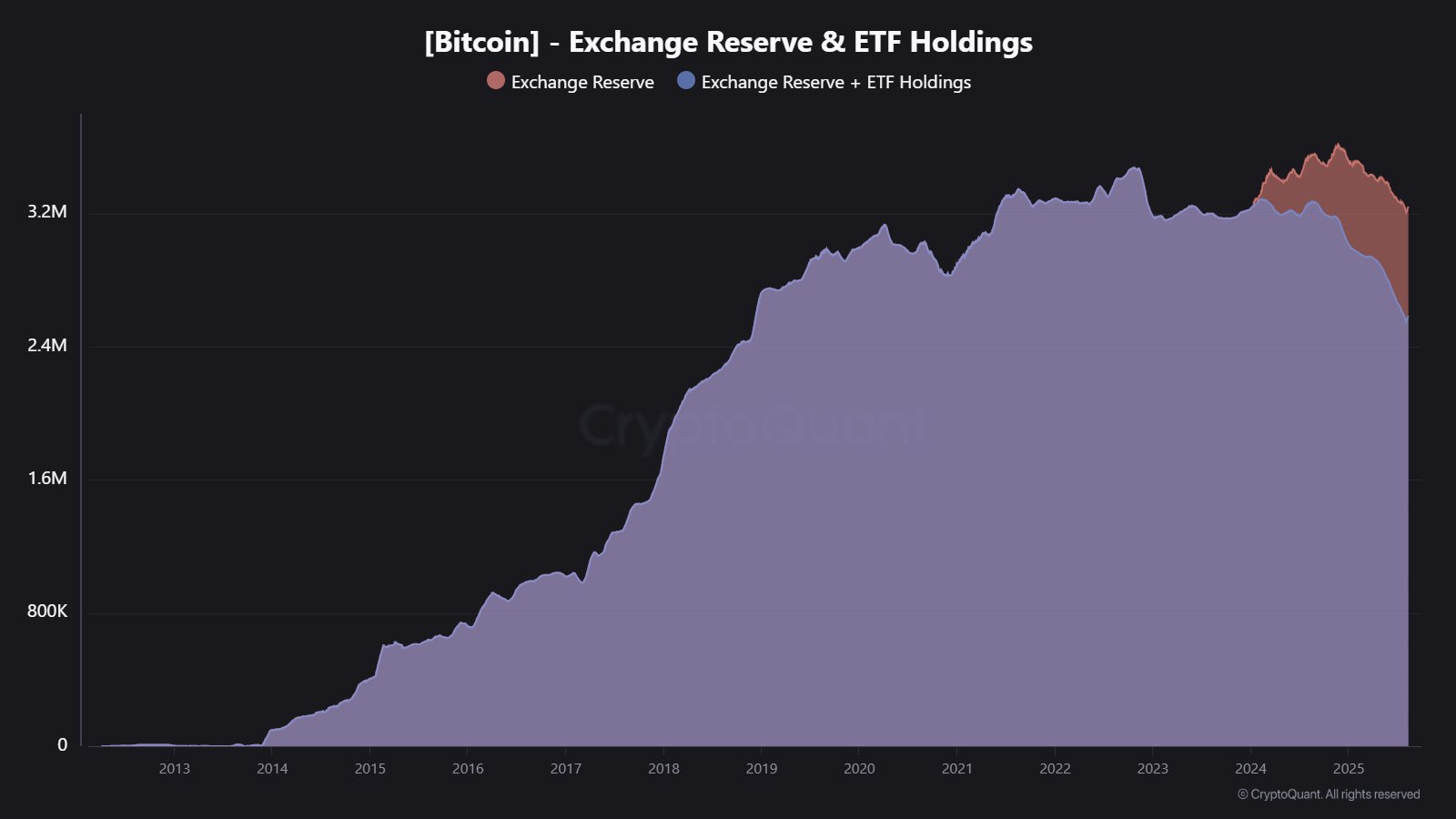
Bitcoin Exchange Reserve Vs ETFs

Looks like the Exchange Reserve has been on the decline since a while now | Source: CryptoQuant on X

As displayed in the above graph, the Bitcoin Exchange Reserve has been following a steep downward trajectory since last year, a sign that investors have constantly been withdrawing coins from the custody of these central entities.

This trend has made some traders believe that the asset is becoming scarcer on the market, a classic bullish signal. But as is apparent from the chart, the rise of the ETFs has offset this decline, meaning that the combined supply held across funds and exchanges is in fact unchanged from its baseline from the last few years.

Based on this, CryptoQuant has concluded that the reality isn’t that of a supply shock brewing, but rather that of supply moving from one type of custody to another. “Same coins, different wrapper,” notes the analytics firm.

BTC Price

Bitcoin slipped below $115,000 during the past day, but it appears the coin has found a small rebound as its price is now back at $116,600.

Bitcoin Price Chart

The price of the coin seems to have gone down over the last few days | Source: BTCUSDT on TradingView
Featured image from Dall-E, CryptoQuant.com, chart from TradingView.com
Editorial Process for bitcoinist is centered on delivering thoroughly researched, accurate, and unbiased content. We uphold strict sourcing standards, and each page undergoes diligent review by our team of top technology experts and seasoned editors. This process ensures the integrity, relevance, and value of our content for our readers.

Keshav is a Physics graduate who has been employed as a writer with Bitcoinist since June 2021. He is passionate about writing and through the years, he has gained experience working in a variety of niches. Keshav holds an active interest in the cryptocurrency market, with on-chain analysis being an area he particularly likes to research and write about.

Bacaan Terkait

CFTC AS Lanjutkan Investigasi Luas terhadap Polymarket, Musim Pesta Pasar Prediksi Akan Berakhir?

Platform prediksi Polymarket kini sedang diselidiki secara luas oleh CFTC AS, menyusul tuduhan pemasaran menipu dan promosi produk mirip perjudian kepada pengguna AS. Investigasi ini terjadi di tengah lonjakan volume perdagangan pasar prediksi, didorong oleh Piala Dunia, dengan platform seperti Kalshi dan Polymarket mencatat pertumbuhan pesat. Pemeriksaan CFTC menandai potensi berakhirnya fase ekspansi liar industri ini, dengan regulator diperkirakan akan memperketat aturan pemasaran, konten kontrak, dan perlindungan investor. Konflik yurisdiksi juga memanas antara regulator federal (CFTC) dan otoritas negara bagian AS (seperti Kentucky), yang memperdebatkan apakah pasar prediksi termasuk dalam kategori derivatif komoditas federal atau perjudian ilegal tingkat negara bagian. Perselisihan ini melibatkan kepentingan pajak negara bagian dan batasan definisi regulasi. Sementara itu, ketegangan juga muncul antara CFTC dan bursa tradisional seperti CME, yang menggugat persetujuan CFTC atas kontrak berjangka Kalshi. Di balik layar, keluarga Trump, melalui Donald Trump Jr., memiliki kepentingan investasi di kedua platform utama (Kalshi dan Polymarket), menjembatani hubungan antara modal dan regulator. Intinya, penyelidikan terhadap Polymarket mungkin merupakan langkah penertiban dalam perjalanan industri pasar prediksi menuju fase pertumbuhan yang lebih matang dan teregulasi.

marsbit1j yang lalu

CFTC AS Lanjutkan Investigasi Luas terhadap Polymarket, Musim Pesta Pasar Prediksi Akan Berakhir?

marsbit1j yang lalu

CFTC AS Lakukan Investigasi Mendalam terhadap Polymarket, Musim Ramai Pasar Prediksi Bakal Berakhir?

Polymarket, sebuah platform pasar prediksi, sedang menghadapi penyelidikan luas oleh Komisi Perdagangan Berjangka Komoditas AS (CFTC). Penyebabnya adalah dugaan pemasaran menipu, termasuk menggunakan KOL berbayar untuk mempromosikan produk seperti perjudian kepada audiens AS. Investigasi ini muncul di tengah lonjakan volume perdagangan pasar prediksi yang didorong oleh Piala Dunia. Data menunjukkan pertumbuhan eksponensial industri ini. Platform seperti Kalshi dan Polymarket mencatat volume dan pendapatan yang meningkat pesat. Bahkan raksasa seperti Meta dilaporkan tertarik untuk berkolaborasi atau mengembangkan aplikasi serupa. Namun, pertumbuhan ini diiringi konflik regulasi. CFTC berselisih dengan beberapa negara bagian AS (seperti Kentucky) mengenai yurisdiksi atas pasar prediksi. Negara bagian menganggapnya sebagai perjudian ilegal, sementara CFTC mengklaim wewenang federal atas kontrak turunan "event contract". Konflik ini melibatkan kepentingan pajak negara bagian dan batas definisi antara perjudian dan pasar prediksi. Di balik layar, jaringan kepentingan yang kompleks terungkap. Donald Trump Jr. memiliki peran sebagai penasihat dan investor di kedua platform utama, Kalshi dan Polymarket. Hal ini dianggap sebagai faktor pendorong di balik dukungan politik dari pemerintahan Trump terhadap industri ini. Penyelidikan CFTC terhadap Polymarket menandai berakhirnya fase pertumbuhan liar awal dan awal dari regulasi yang lebih ketat. Meski mungkin mendinginkan euforia jangka pendek, ini dilihat sebagai langkah menuju industri yang lebih matang dan stabil di masa depan.

Odaily星球日报1j yang lalu

CFTC AS Lakukan Investigasi Mendalam terhadap Polymarket, Musim Ramai Pasar Prediksi Bakal Berakhir?

Odaily星球日报1j yang lalu

Pendiri Claude Code Mengungkap Prediksi Terbaru: Divisi Kerja Tim Dirombak di Era AI, "Lima Tipe Orang" Ini Paling Dibutuhkan

Dengan maraknya Agent Coding yang membentuk ulang industri perangkat lunak, perubahan tidak hanya terjadi pada peran "insinyur" tradisional. Boris Cherny, pemimpin tim Claude Code di Anthropic, mengamati bahwa fungsi teknik, produk, desain, dan ilmu data semakin menyatu. Dia mengusulkan lima peran baru berbasis pola perilaku, tidak terikat pada jabatan tradisional: 1. **The Prototyper (Pembuat Prototipe):** Menghasilkan banyak ide dan konsep baru, fokus pada kuantitas dan disruptif. 2. **The Builder (Pembangun):** Mengubah prototipe kasar menjadi produk atau infrastruktur yang siap produksi dan dapat diskalakan. 3. **The Sweeper (Pembersih):** Menyederhanakan antarmuka, mengatur ulang kode, dan menghapus fitur berlebihan untuk meningkatkan kinerja dan kemampuan pemeliharaan. 4. **The Growth (Pertumbuhan):** Mengiterasi produk yang sudah jadi agar lebih dekat dengan pasar, meningkatkan retensi pengguna, dan mengubahnya dari "dapat digunakan" menjadi "diperlukan". 5. **The Maintainer (Pemelihara):** Memastikan keamanan, keandalan, efisiensi, dan ketahanan sistem yang matang dalam jangka panjang. Peran-peran ini tidak eksklusif. Satu orang dapat merangkul beberapa peran (misalnya, 1+3 atau 2+3) yang berubah sesuai tahap produk atau proyek. Tim yang sehat membutuhkan kombinasi peran yang berbeda bergantung pada kematangan produk: produk baru membutuhkan peran 1,2,3; produk yang sedang tumbuh membutuhkan 2,3,4 dengan beberapa 5; produk matang membutuhkan 3,4,5 dengan beberapa 2. Diskusi online menyoroti bahwa klasifikasi kaku dapat membatasi fleksibilitas. Di era AI, batas peran semakin kabur. Meskipun AI seperti Claude dapat membantu tugas Builder dan Sweeper, peran manusia tetap kritis untuk beradaptasi dan memimpin setiap fase siklus hidup produk.

marsbit1j yang lalu

Pendiri Claude Code Mengungkap Prediksi Terbaru: Divisi Kerja Tim Dirombak di Era AI, "Lima Tipe Orang" Ini Paling Dibutuhkan

marsbit1j yang lalu

Trading

Spot
活动图片