Binance mulls new US strategy, CZ potentially reducing stake: Report

cointelegraphPublished on 2025-12-17Last updated on 2025-12-17

Abstract

Binance, the world's largest cryptocurrency exchange, is reportedly considering a strategic reshuffle to strengthen its US presence, which may involve reducing co-founder Changpeng "CZ" Zhao's majority stake. His controlling ownership has been a major hurdle for expansion into key US states. The company is exploring partnerships with US-based firms like BlackRock and World Liberty Financial. This follows CZ's pardon by former President Donald Trump in October, which sparked criticism from some US lawmakers who called it "corruption" and "pay-to-play." Binance.US currently operates as a separate, compliant entity for US users. The US is a critical market, ranked second in global crypto adoption, and gaining access would open significant liquidity for Binance.

Binance, the world’s largest cryptocurrency exchange by trading volume, is considering a strategic reshuffling to strengthen its presence in the US market, a move that could see Binance co-founder Changpeng “CZ” Zhao’s majority stake in the company reduced.

Zhao’s controlling stake in Binance has been a “major hurdle” to the company expanding to strategically critical US states, according to Bloomberg, citing people familiar with the matter. Although no concrete plans have been announced, the conversation surrounding any potential action remains reportedly “fluid.”

The company is also considering partnerships with US-based companies, including asset manager BlackRock and decentralized finance (DeFi) platform World Liberty Financial (WLFI), which is linked to US President Donald Trump, to strengthen its footprint in the country.

Rumors of Binance’s return to the US began to circulate in October after Trump pardoned Zhao, fueled by speculation from crypto industry executives and comments that Zhao made on social media.

“Will do everything we can to help make America the capital of crypto and advance Web3 worldwide,” Zhao said in October after the pardon.
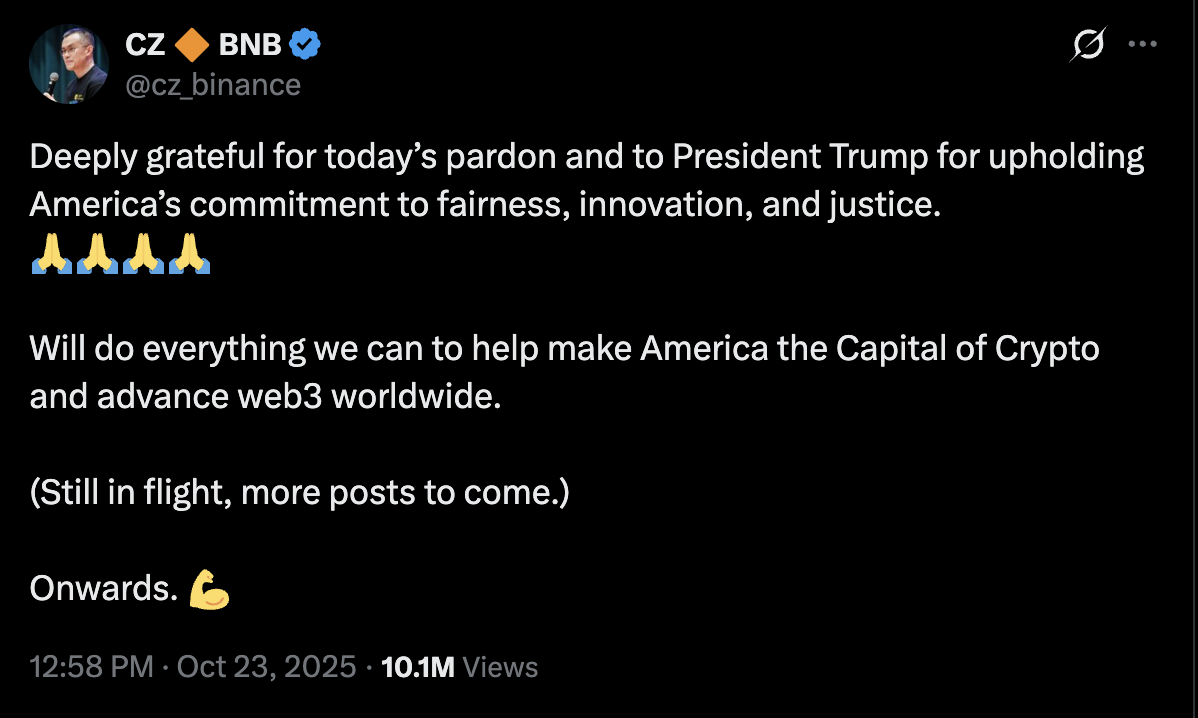
Source: CZ

In June 2019, Binance announced that it would stop serving US customers, and a separate company, called Binance.US and operated by BAM Trading Services, was formed to provide regulatory-compliant services to US users.

In 2023, the US Securities and Exchange Commission alleged that Binance Holdings Ltd. operated both Binance.com and BAM Trading Services.

Binance.US does not feature crypto derivatives or access to the global Binance exchange’s liquidity and operates as a completely separate crypto exchange.

Cointelegraph reached out to Binance and Binance.US but did not receive a response by the time of publication.

The US is considered a key market for crypto exchanges and is ranked as the number two for global crypto adoption, according to Chainalysis’ 2025 Global Crypto Adoption Index. Expanding to the US would open up US liquidity to the world’s largest crypto exchange.
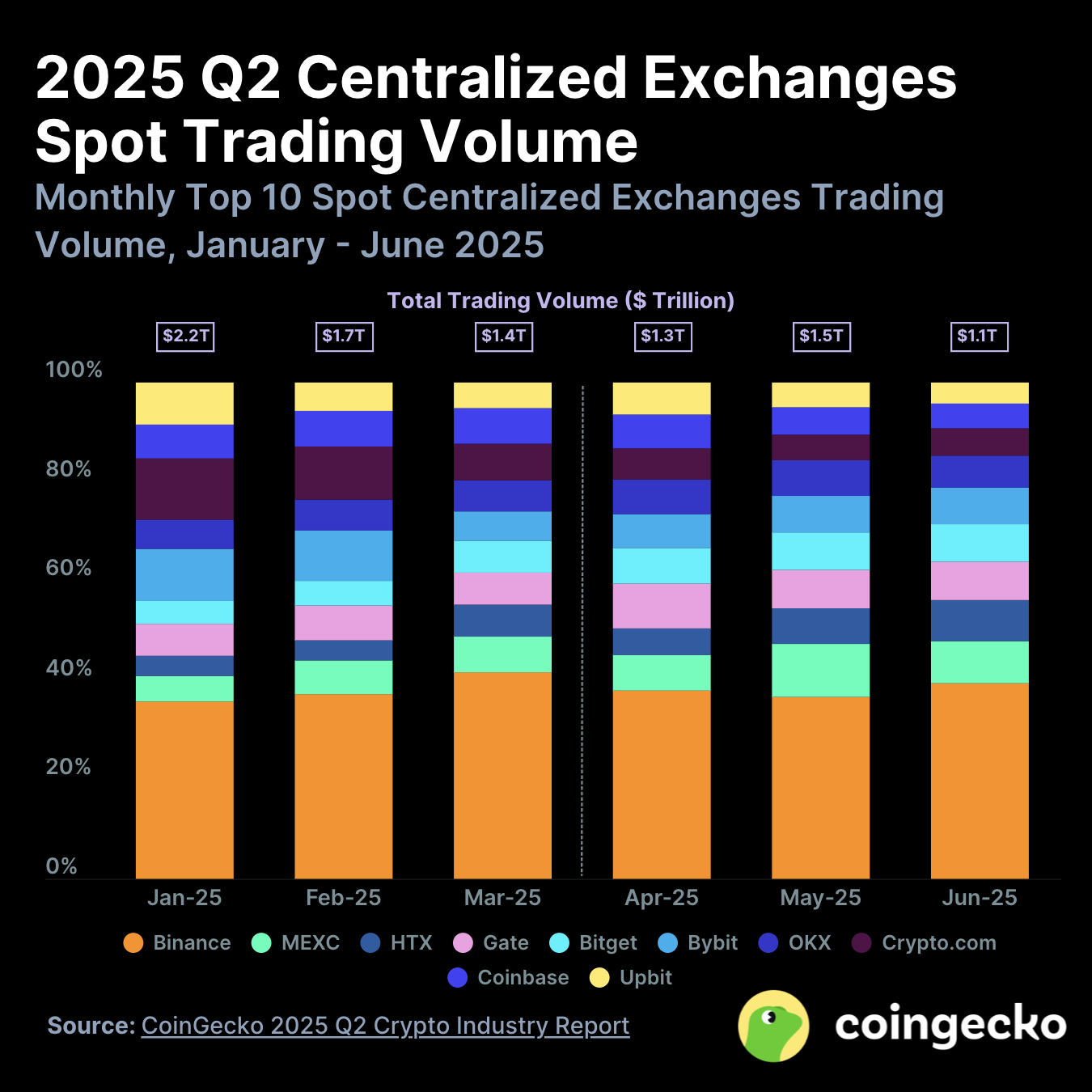
Binance claims the top spot among centralized crypto exchanges in terms of trading volume. Source: CoinGecko

Related: Binance names co-founder Yi He co-CEO alongside Richard Teng

Several US lawmakers voice opposition to the CZ pardon and the crypto industry

Trump’s pardon of Zhao in October drew backlash from several Democratic Party lawmakers in the US, including Massachusetts Senator Elizabeth Warren and California Congresswoman Maxine Waters.

Waters said the pardon was a form of pay-to-play and accused Trump of doing political favors for the crypto industry that “helped line his pockets.”

Warren, who is one of the most vocal critics of the crypto industry, also criticized the pardon, characterizing it as “corruption.”

The comments reflect pockets of resistance among some Democratic lawmakers to the crypto industry’s continued expansion in the US and could signal potential opposition to Binance returning to the US.

Magazine: Unstablecoins: Depegging, bank runs and other risks loom

Related Reads

IOSG: After the Number of Developers Halved, Crypto Did Not Die

The crypto development community has undergone a significant transformation, with monthly active developers on GitHub halving from 45K in 2022 to approximately 23K by 2026. This decline is largely attributed to the departure of newcomers, whose roles were often tied to market-driven hype cycles like NFTs and forked DeFi protocols, leading to a 52% churn rate among those with less than a year of experience. However, the core of the industry has strengthened. Established developers with over two years of experience have reached a record high, contributing about 70% of the code. They are consolidating around ecosystems with genuine users and revenue, such as Bitcoin and Solana, while moving away from narrative-driven projects. The talent shift represents a "deleveraging" and an increase in core density. This core group has developed a unique skillset by operating in an environment of "code is law," with zero tolerance for error and no external recourse. They have learned to build trust and functional systems from the ground up without central authorities, as demonstrated by protocols like Uniswap and MakerDAO. These capabilities are now being repriced and leveraged in the AI era. The structural challenges of AI scaling—such as trust, coordination, and verification—mirror those long addressed in crypto. Examples include CoreWeave pivoting from GPU mining to AI compute, OpenSea's founder applying NFT market logic to AI model routing with OpenRouter, and projects like NEAR and Catena Labs transitioning crypto-native architectural and financial insights into AI infrastructure and agent banking. Key areas where crypto-bred skills are directly applicable to AI include: 1. **Compute Aggregation & Optimization**: Using token incentives and cryptographic verification (e.g., Proof of Sampling & Privacy) to create trusted, decentralized GPU networks, as seen with Hyperbolic. 2. **AI Governance & Incentive Design**: Applying economic mechanism design from DAOs and tokenomics to align the goals of multiple, fast-acting AI agents, a direction explored by EigenLayer's EigenCloud. 3. **AI Agent Autonomous Payments**: Leveraging stablecoins and programmable, permissionless blockchains to enable the micro-transactions required for AI agent economies, exemplified by protocols like x402. The role of the crypto builder is evolving from writing smart contracts to designing trust mechanisms for autonomous AI systems. This convergence is reflected in hiring trends at major firms and significant capital allocation from funds like Paradigm and a16z crypto, which are investing at the intersection of crypto and AI. Regional differences exist, with the US favoring foundational protocol innovation and Asia focusing on compliant application-layer integration, but the underlying trend is clear. The industry's "deleveraging" has not signaled its demise but rather a maturation, positioning its core builders to solve critical trust and coordination problems in the age of AI.

marsbit28m ago

IOSG: After the Number of Developers Halved, Crypto Did Not Die

marsbit28m ago

Currency and Stock Market Barometer: Strategy Invested Over $2 Billion to Buy Over 24,800 BTC Last Week; Bitmine's ETH Holdings Increase to 4.37% of Total Supply (May 19)

Crypto & Stock Market Watch: Institutional BTC Buying Surges, ETH Holdings Grow Major listed companies aggressively accumulated Bitcoin last week, with net purchases skyrocketing over 44x to $2.03 billion. Strategy (formerly MicroStrategy) led the charge, spending approximately $2.01 billion to buy 24,869 BTC, bringing its total holdings to 843,738 BTC. Overall, listed firms (excluding miners) now hold 1,113,841 BTC, valued at ~$86.16 billion. On the Ethereum front, Bitmine purchased 71,672 ETH in the past week. It now holds 5,278,462 ETH, worth $11.56 billion and representing 4.37% of ETH's total supply. A significant portion (4,712,917 ETH) is staked, generating an annualized yield of $289 million. Industry leaders note a divergence from the MicroStrategy model, with ETH treasury firms increasingly focusing on staking yields and simpler balance sheets. In traditional markets, Morgan Stanley warns of a potential significant U.S. stock market correction if bond yields and volatility continue rising. Investment giants like Berkshire Hathaway and Bridgewater adjusted portfolios in Q1, with Bridgewater notably increasing its stakes in chipmakers like Nvidia, Broadcom, and Micron while shedding software stocks. Among other crypto-focused public companies, Solana treasury firm Upexi reported a widened net loss of $109 million for its fiscal Q3, driven by a decline in its crypto holdings' value. Meanwhile, Hyperion DeFi, a HYPE token treasury company, reported a Q1 net profit of $8.8 million and increased its HYPE holdings past 2 million tokens.

marsbit28m ago

Currency and Stock Market Barometer: Strategy Invested Over $2 Billion to Buy Over 24,800 BTC Last Week; Bitmine's ETH Holdings Increase to 4.37% of Total Supply (May 19)

marsbit28m ago

Global Long-Term Bonds Break Down: The Fiscal Illusion of the Low-Interest Era is Collapsing

Global long-term bonds are experiencing a widespread breakdown, as the fiscal illusion of the low-interest-rate era collapses. Sovereign yields are hitting multi-year highs in the US, UK, Japan, and France, signaling a market repricing driven by a common reality: unsustainable debt and deficits outpacing economic growth, compounded by renewed inflationary pressures from energy shocks. The direct trigger is the blockade of the Strait of Hormuz, which has pushed oil prices higher and reignited inflation fears. This squeezes central bank policy space, with expectations shifting from future rate cuts to potential hikes. The core "fiscal Ponzi scheme" is becoming evident—governments rely on new debt to service existing obligations, but as growth lags and borrowing costs rise, investors demand higher yields. Key developments include the US 30-year yield surpassing 5% for the first time since 2007, with tepid auction demand; Japan's 30-year yield reaching 4%, threatening its long-standing low-rate financial system; and political paralysis in the UK and France making meaningful fiscal consolidation unlikely. The marginal buyer for US debt is also shifting from foreign central banks to more price-sensitive private investors. While debt managers may adjust issuance, fundamental drivers—deteriorating fiscal paths, persistent inflation, and constrained central banks—remain. The market is conclusively repricing the end of the low-interest-rate financing model for highly indebted developed economies.

marsbit55m ago

Global Long-Term Bonds Break Down: The Fiscal Illusion of the Low-Interest Era is Collapsing

marsbit55m ago

Trading

Spot
Futures

Hot Articles

How to Buy US

Welcome to HTX.com! We've made purchasing Talus Network (US) simple and convenient. Follow our step-by-step guide to embark on your crypto journey.Step 1: Create Your HTX AccountUse your email or phone number to sign up for a free account on HTX. Experience a hassle-free registration journey and unlock all features.Get My AccountStep 2: Go to Buy Crypto and Choose Your Payment MethodCredit/Debit Card: Use your Visa or Mastercard to buy Talus Network (US) instantly.Balance: Use funds from your HTX account balance to trade seamlessly.Third Parties: We've added popular payment methods such as Google Pay and Apple Pay to enhance convenience.P2P: Trade directly with other users on HTX.Over-the-Counter (OTC): We offer tailor-made services and competitive exchange rates for traders.Step 3: Store Your Talus Network (US)After purchasing your Talus Network (US), store it in your HTX account. Alternatively, you can send it elsewhere via blockchain transfer or use it to trade other cryptocurrencies.Step 4: Trade Talus Network (US)Easily trade Talus Network (US) on HTX's spot market. Simply access your account, select your trading pair, execute your trades, and monitor in real-time. We offer a user-friendly experience for both beginners and seasoned traders.

4.6k Total ViewsPublished 2025.12.11Updated 2025.12.11

How to Buy US

Discussions

Welcome to the HTX Community. Here, you can stay informed about the latest platform developments and gain access to professional market insights. Users' opinions on the price of US (US) are presented below.

活动图片