Holding 4% of Global Bitcoin! Market Closely Watches MSTR's "Bitcoin Selling Logic", Stock Price Has Fallen 75% in a Year

华尔街日报Publié le 2026-07-07Dernière mise à jour le 2026-07-07

Résumé

MicroStrategy, the world's largest corporate holder of Bitcoin (approx. 4% of supply), faces mounting liquidity pressures, forcing a shift from its "never sell" pledge. The company recently sold 3,588 BTC for $216 million, its largest sale ever, to cover preferred stock dividends, marking a significant scaling up from a small, symbolic sale in May. This move underscores a fundamental challenge to its business model: using stock premium as "currency" to buy Bitcoin continuously. A key metric, mNAV (enterprise value vs. Bitcoin holdings), has fallen below 1, indicating the market values the company below its Bitcoin stash, eroding its core acquisition logic. With annual dividend obligations around $1.5 billion and software cash flow insufficient, MicroStrategy is caught in a mathematical bind. Its $2.55 billion cash buffer provides ~17 months of coverage, but if financing remains tight and mNAV stays depressed, the company may face pressure for larger Bitcoin sales, posing a potential systemic risk to the crypto market given its massive holdings.

MicroStrategy is using Bitcoin to pay for its capital structure. This company, the world's largest corporate holder of Bitcoin, is facing a mathematical dilemma triggered by its own business model — as the stock price premium vanishes and the financing window narrows, the "never sell" promise has quietly given way to the pressure of real-world liquidity.

An article by Wall Street Journal writes that MicroStrategy disclosed on July 6th that it sold 3,588 Bitcoins between June 29th and July 5th, raising approximately $216 million, to pay dividends for its preferred shares. This is the company's largest single Bitcoin sale in history, and its third sale since launching its Bitcoin strategy in 2020.

Following this announcement, MSTR's stock price fell over 5% intraday, and Bitcoin dropped to around $61,800, below the company's average holding cost of approximately $75,700. The company confirmed an $8.32 billion digital asset impairment loss for Q2, as Bitcoin prices fell 14% during the same period.

Market caution stems not only from the sale itself but also from the underlying shift in logic. MicroStrategy holds 843,775 Bitcoins, accounting for about 4% of the global Bitcoin supply. Any large-scale selling could significantly impact the coin's price.

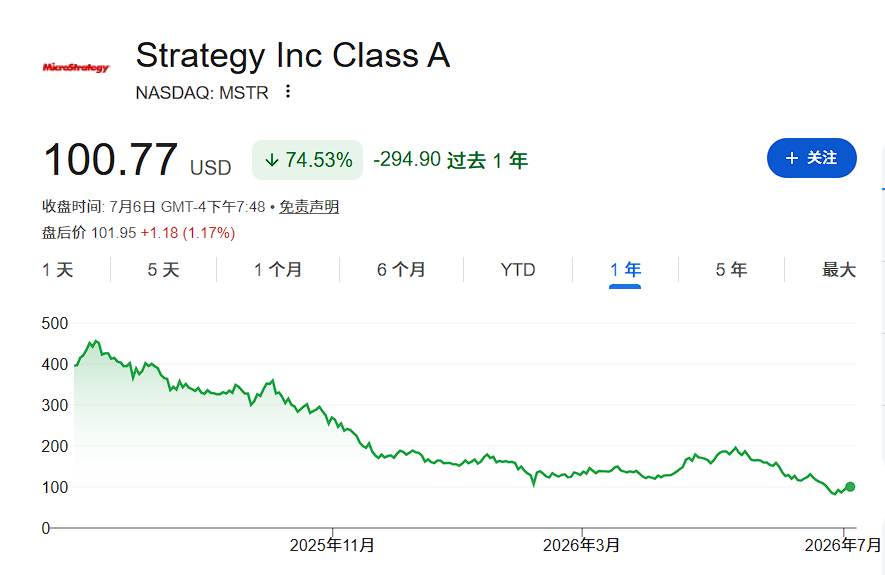
According to Wall Street Journal analysis, MicroStrategy's core valuation metric, mNAV, has fallen below 1, meaning the market values the company at less than the value of its Bitcoin holdings. This fundamentally undermines its business logic of "exchanging premium stock for Bitcoin."

"Never Sell" Promise Softens, Sale Scale Expands by a Hundredfold

MicroStrategy had long regarded "never selling Bitcoin" as the cornerstone of its business model, but this promise has developed significant cracks.

In late May, the company broke precedent for the first time, selling 32 Bitcoins for about $2.5 million to pay preferred stock dividends, emphasizing it was merely fulfilling its promise to preferred stock investors and did not represent a strategic shift.

However, the latest sale scale has expanded to 3,588 Bitcoins, roughly a hundred times the amount sold in May. According to the company's disclosure, 1,363 were sold at an average price of about $59,300, with the remaining 2,225 sold at around $60,800.

An article by Wall Street Journal writes that proceeds from this sale will be specifically used to pay the Q2 dividends for four preferred securities (STRF, STRE, STRK, STRD) and the June monthly dividend for STRC. Selling Bitcoin is no longer a one-time, symbolic operation but is gradually being integrated into the company's routine financing system.

Notably, on June 29th, MicroStrategy officially announced that its board had authorized the sale of up to $1.25 billion worth of Bitcoin for stock buybacks and to pay interest and preferred stock dividends. This marks the company's formal abandonment at the official level of its "hold Bitcoin at all costs" philosophy.

It's worth noting that the capital structure supporting this business model is under increasing pressure.

Analyst Zach Pandl points out that MicroStrategy's annual preferred stock dividend payout alone is about $1.5 billion, far exceeding what its software business cash flow can cover. When cash reserves are insufficient, the company can only continue financing or sell Bitcoin.

As of July 5th, MicroStrategy holds 843,775 Bitcoins with a cash reserve of $2.55 billion. The company estimates this cash buffer provides about 17 months of runway for interest and preferred stock dividend payments without needing to tap its crypto assets.

MicroStrategy's operational logic is becoming clearer: continuously buy Bitcoin when financing is smooth; sell small amounts of Bitcoin to pay dividends when financing tightens, maintaining the closed loop of its capital operations system.

Although after its first sale in late May, the company quickly bought another 1,550 Bitcoins, and also completed large-scale purchases of $2.54 billion and $2 billion in April and May respectively, the sustainability of this system is being questioned as Bitcoin prices face downward pressure.

mNAV Falls Below 1, Core Business Logic Faces Fundamental Challenge

The core of MicroStrategy's business model lies in using its stock premium as "currency" to continuously buy Bitcoin. The quantitative anchor for this logic is precisely the company's self-created mNAV metric.

According to Wall Street Journal analysis, MicroStrategy defines mNAV as the multiple of the company's enterprise value relative to the value of its Bitcoin holdings. During its peak, this metric remained at a high premium level for a long time, allowing the company to continuously issue stock to buy more Bitcoin, operating similarly to traditional acquisition-driven companies using highly valued stock as currency for serial acquisitions.

However, as MSTR's stock price has fallen about 75% over the past year, mNAV fell below 1 last month, meaning the market values MicroStrategy at less than the book value of its Bitcoin holdings. This "snowball" logic has started to work in reverse.
More alarmingly, this metric itself has a systematic overvaluation problem. The Wall Street Journal points out that when calculating enterprise value, MicroStrategy uses the principal amount of debt and the face value of preferred stock, not their market value. However, as the company's bonds and preferred stock prices have fallen sharply along with the stock price, this calculation method has become severely distorted.

Taking June 26th as an example, MicroStrategy reported its mNAV was about 0.99, but if calculated using the market value of debt and preferred stock, the actual mNAV was only about 0.89. At that time, the company's debt was trading at a 7% discount, and its various series of preferred stock had a combined discount of about 28%.

As of last Thursday's close, MicroStrategy's website showed an mNAV of 1.09, but the actual figure calculated using market values was only about 1.04, leaving the premium space extremely limited.

Selling Pressure and Market Chain Reaction

The scale of MicroStrategy's Bitcoin holdings gives any selling action systemic significance at the market level.

MicroStrategy holds about 4% of the global Bitcoin supply. Even the small-scale operation in May, selling just 32 Bitcoins for $2.5 million, had a noticeable downward pressure on Bitcoin's price and MSTR's stock price.

Analysis suggests that although this sale of 3,588 Bitcoins is still a tiny fraction of its holdings, market concern about potential large-scale selling has significantly intensified.

According to MicroStrategy's own logic, when mNAV remains in a discounted state, the company should sell Bitcoin to buy back its own securities. Investors are closely watching whether this signal will evolve into large-scale action.

To stabilize preferred stock prices, MicroStrategy increased the dividend rate on its largest preferred stock series, STRC, to 12% on June 29th, trying to attract buyers and push the price back to par value. This move itself indicates the company's focus on the market price of its preferred stock far exceeds the attitude presented in its mNAV calculation.

The Wall Street Journal notes that if the market once again fixes MicroStrategy's valuation in the discount range and it persists, the company will face a scenario where its cash runs out, forcing it to tap its Bitcoin reserves on a large scale. MicroStrategy may have bought itself some time, but no one can be sure just how long that time will last.


Cryptos en tendance

Questions liées

QWhat is the core reason for MicroStrategy's recent change in its 'never sell bitcoin' policy?

AThe core reason is the increasing liquidity pressure stemming from its capital structure. With its stock premium disappearing and the financing window narrowing, MicroStrategy's commitment to holding bitcoin has given way to the reality of needing funds to pay substantial annual preferred stock dividends (approximately $1.5 billion), which its software business cash flow cannot cover.

QWhat is the mNAV metric, and why is it significant for understanding MicroStrategy's business model?

AmNAV (MicroStrategy Net Asset Value) is a company-created metric defined as the ratio of its enterprise value to the value of its bitcoin holdings. It is significant because MicroStrategy's core business model relies on using its stock as a 'currency' to buy more bitcoin, which only works when mNAV is above 1 (meaning the market values the company *more* than just its bitcoin). Its recent drop below 1 challenges this fundamental model.

QHow did the scale of MicroStrategy's latest bitcoin sale on July 6 compare to its first sale in May, and what was the purpose of the proceeds?

AThe latest sale of 3,588 bitcoin was approximately 100 times larger than the first sale of 32 bitcoin in May. The proceeds from the July sale, amounting to about $216 million, were specifically used to pay quarterly dividends on several series of its preferred securities (STRF, STRE, STRK, STRD) and a monthly dividend on the STRC preferred stock.

QAccording to the analysis in the article, what is the problem with MicroStrategy's calculation of its mNAV metric?

AThe article states that MicroStrategy's calculation of mNAV is systematically overestimated. It uses the face value (par value) of its debt and preferred stock in the enterprise value calculation, rather than their actual, lower market trading value. This inflates the mNAV figure. For example, when the official mNAV was 0.99, the 'real' mNAV calculated using market values was only about 0.89.

QWhy are market participants concerned about MicroStrategy's potential future bitcoin sales, despite its recent sale being a small fraction of its total holdings?

AMarket participants are concerned because MicroStrategy holds approximately 4% of the global bitcoin supply, making any significant sale potentially impactful on the price. Furthermore, if its mNAV remains below 1, the logical action for the company according to its own framework would be to sell bitcoin to buy back its discounted securities. The fear is that this could trigger a large-scale, sustained selling pressure.

Lectures associées

Le Bitcoin rebondit grâce à des données d'emploi plus faibles qui ravivent les espoirs de baisse des taux

Le Bitcoin profite d'un contexte macroéconomique plus favorable après la publication de données américaines sur l'emploi plus faibles que prévu. Ces chiffres, indiquant un refroidissement du marché du travail, renforcent les anticipations de baisses des taux d'intérêt par la Réserve Fédérale (Fed). Des taux plus bas sont généralement positifs pour les actifs risqués comme le Bitcoin, car ils rendent les liquidités moins attractives et améliorent les perspectives de liquidité sur les marchés. Cependant, l'article nuance cet optimisme. D'une part, des données d'emploi trop faibles pourraient aussi signaler un ralentissement économique, ce qui inquiète les marchés. D'autre part, ce soulagement macroéconomique intervient à un moment où le Bitcoin fait face à des pressions liées à l'offre, notamment des transferts importants depuis des portefeuilles gouvernementaux et les remboursements liés à Mt. Gox, qui pourraient peser sur les cours. Pour l'instant, le marché interprète ces données sur l'emploi comme un facteur de soutien. La question est de savoir si cet effet positif persistera face à d'éventuels mouvements massifs de Bitcoins vers les plateformes d'échange ou si la Fed tempère les anticipations de baisses de taux. En somme, le Bitcoin réagit aux facteurs macroéconomiques traditionnels (liquidités, force du dollar, appétit pour le risque), mais son prix résulte d'un équilibre entre ce soulagement macro et les pressions spécifiques à son écosystème.

bitcoinistIl y a 20 mins

Le Bitcoin rebondit grâce à des données d'emploi plus faibles qui ravivent les espoirs de baisse des taux

bitcoinistIl y a 20 mins

Rendez-vous dans quatre ans : Ethereum peut-il s'emparer du créneau du règlement institutionnel ?

L'annonce par Vitalik Buterin du plan « Lean Ethereum », une feuille de route sur trois à quatre ans pour la troisième grande mise à jour du réseau depuis la fusion, vise explicitement à positionner Ethereum comme une infrastructure de règlement pour les institutions financières. Ce plan ambitieux prévoit des finalités de transaction en quelques secondes, une capacité de traitement de 10 milliards de gaz par seconde sur la couche 1, une expansion à des billions de gaz sur la couche 2, une sécurité post-quantique et des fonctionnalités de confidentialité natives. L'objectif est de répondre aux besoins des banques, des gestionnaires d'actifs et des entreprises pour des actifs numériques de grande valeur. Cependant, cette transformation radicale du protocole, incluant des changements majeurs comme les preuves STARK récursives, une refonte du stockage des états et le chiffrement résistant aux quantiques, présente des risques importants. Le principal défi réside dans la coordination complexe de tous les acteurs de l'écosystème (développeurs, portefeuilles, applications de couche 2) lors de cette transition longue, tout en préservant la neutralité et la fiabilité du réseau. Les quatre prochaines années seront donc déterminantes. Si les mises à jour se déroulent avec succès, Ethereum renforcera considérablement sa valeur en tant qu'infrastructure de règlement. En revanche, des retards ou des difficultés d'adoption pourraient inciter les institutions à se tourner vers des alternatives plus stables, malgré leurs éventuels compromis sur la décentralisation. Le plan « Lean Ethereum » fournit ainsi aux investisseurs institutionnels un cadre aussi bien pour évaluer le potentiel que pour identifier les risques de leur engagement sur Ethereum.

Foresight NewsIl y a 42 mins

Rendez-vous dans quatre ans : Ethereum peut-il s'emparer du créneau du règlement institutionnel ?

Foresight NewsIl y a 42 mins

Le Bitcoin rebondit à 64 000 dollars, alors que les anticipations de hausse des taux de la Fed s'effondrent ?

Le Bitcoin a rebondi au-dessus de 64 000 dollars cette semaine, se redressant après avoir touché des creux récents. Cette remontée intervient alors que les anticipations de hausse des taux de la Réserve fédérale américaine (Fed) s’atténuent, suite à la publication de données économiques mitigées. Le rapport sur l’emploi américain de juin a montré une création d’emplois bien inférieure aux attentes, bien que le taux de chômage ait légèrement baissé. Cependant, la croissance des salaires reste robuste, alimentant les préoccupations inflationnistes. Les regards se tournent désormais vers les prochaines données sur l’inflation (IPC) pour évaluer la trajectoire future des taux d’intérêt. Les analystes notent que la baisse récente des prix du pétrole pourrait contribuer à calmer l’inflation, incitant potentiellement la Fed à adopter une posture moins restrictive. Cela améliorerait la liquidité et soutiendrait les actifs risqués comme le Bitcoin. Le président de la Fed, Kevin Wash, a récemment indiqué que les risques inflationnistes diminuaient, renforçant les anticipations d’un maintien des taux. À l’avenir, le prix du Bitcoin restera très sensible aux données économiques américaines, aux flux des ETF institutionnels, aux développements géopolitiques et surtout aux anticipations de politique monétaire de la Fed. Une orientation plus accommodante de la banque centrale pourrait offrir un soutien significatif au marché cryptographique.

marsbitIl y a 47 mins

Le Bitcoin rebondit à 64 000 dollars, alors que les anticipations de hausse des taux de la Fed s'effondrent ?

marsbitIl y a 47 mins

Trading

Spot

Articles tendance

Comment acheter 4

Bienvenue sur HTX.com ! Nous vous permettons d'acheter 4 (4) de manière simple et pratique. Suivez notre guide étape par étape pour commencer votre parcours crypto.Étape 1 : Création de votre compte HTXUtilisez votre adresse e-mail ou votre numéro de téléphone pour ouvrir un compte sur HTX gratuitement. L'inscription se fait en toute simplicité et débloque toutes les fonctionnalités.Créer mon compteÉtape 2 : Choix du mode de paiement (rubrique Acheter des cryptosCarte de crédit/débit : utilisez votre carte Visa ou Mastercard pour acheter instantanément 4 (4).Solde :utilisez les fonds du solde de votre compte HTX pour trader en toute simplicité.Prestataire tiers :pour accroître la commodité d'utilisation, nous avons ajouté des modes de paiement populaires tels que Google Pay et Apple Pay.P2P :tradez directement avec d'autres utilisateurs sur HTX.OTC (de gré à gré) : nous offrons des services personnalisés et des taux de change compétitifs aux traders.Étape 3 : stockage de vos 4 (4)Après avoir acheté vos 4 (4), stockez-les sur votre compte HTX. Vous pouvez également les envoyer ailleurs via un transfert sur la blockchain ou les utiliser pour trader d'autres cryptos.Étape 4 : tradez des 4 (4)Tradez facilement 4 (4) sur le marché Spot de HTX. Il vous suffit d'accéder à votre compte, de sélectionner la paire de trading, d'exécuter vos trades et de les suivre en temps réel. Nous offrons une expérience conviviale aux débutants comme aux traders chevronnés.

504 vues totalesPublié le 2025.10.20Mis à jour le 2026.06.02

Comment acheter 4

Discussions

Bienvenue dans la Communauté HTX. Ici, vous pouvez vous tenir informé(e) des derniers développements de la plateforme et accéder à des analyses de marché professionnelles. Les opinions des utilisateurs sur le prix de 4 (4) sont présentées ci-dessous.

活动图片