The Safest Middleman in the Chip Industry Is Taking the Most Dangerous Path

marsbitPublicado a 2026-03-25Actualizado a 2026-03-25

Resumen

Arm, the semiconductor IP licensing giant, is embarking on a high-risk strategic shift by developing its own data center CPU, the Neoverse V3-based AGI CPU. This move, its first in-house chip in 35 years, aims to catapult the company's annual revenue from $4 billion to a targeted $15 billion for its chip business by 2031. This ambitious goal requires creating a new business line nearly the size of Intel's entire data center division. The core driver is the threat from its largest customers. Major cloud providers like AWS, Google, and Microsoft are increasingly designing and deploying their own powerful Arm-based server chips (Graviton, Axion, Cobalt), capturing the chip profits while Arm earns only licensing fees and royalties. This trend places a visible ceiling on Arm's traditional revenue growth from the data center sector. By building its own chip, Arm is now competing directly with its own licensees. While its first customer, Meta, lacks a mature in-house chip program, the strategy risks alienating key partners like Amazon and Google. Arm's bet is that the explosive growth of AI-driven data center demand, particularly for CPU-based AI inference tasks, is large enough to support both its new chip business and its ongoing IP licensing model. The success of this unprecedented dual-role strategy hinges on navigating this inherent conflict.

Between $4 billion and $15 billion lies not a growth curve, but a self-disruption of a business model.

On March 24, Arm unveiled the first self-developed data center CPU in its 35-year history in San Francisco. This chip, named the AGI CPU, features 136 Neoverse V3 cores, is built on TSMC's 3nm process, has a 300W TDP, with Meta as its first customer, and is set for large-scale deployment within the year. Simultaneously announced collaborations include OpenAI, Cerebras, Cloudflare, SAP, and SK Telecom.

At the launch event, Arm CEO Rene Haas presented a set of target figures, stating that the chip business aims to achieve $15 billion in annual revenue by 2031, with total company revenue reaching $25 billion and earnings per share of $9.

What do these numbers signify? Arm's total company revenue for FY2025 (ending March 2025) is $4.007 billion. According to Arm's annual report data, this includes $1.839 billion in licensing revenue and $2.168 billion in royalty revenue, with a gross margin of 97%. In other words, a company with $4 billion in annual revenue aims to build a new business nearly the size of Intel's entire data center division within five years. According to Intel's Q4 2024 earnings report, Intel's DCAI (Data Center and AI) division generated $12.8 billion in revenue for the full year 2024.
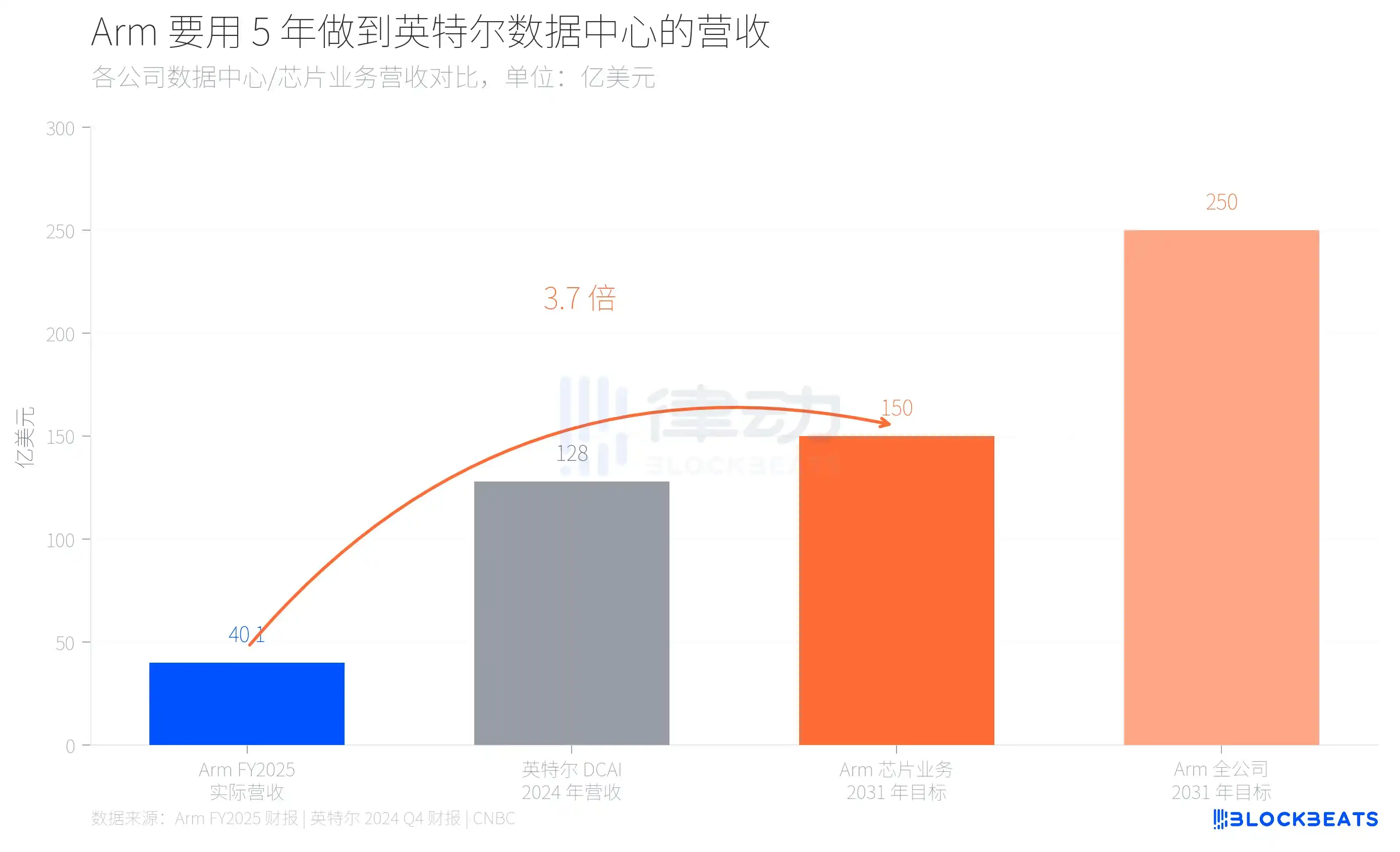
Behind the 3.7-fold leap from $4 billion to $15 billion is Arm's attempt to transform from a pure IP licensing company into a hybrid that sells both design blueprints and finished products. There is no precedent for this in the chip industry.

Why is Arm taking this risk? The answer lies in its customer list.

Over the past three years, Arm's largest data center customers have all been doing the same thing. According to AWS public data, Amazon has migrated over 50% of its EC2 computing power to its self-developed Graviton chips, with the latest Graviton5 reaching 192 cores. As disclosed by Google Cloud, Google's Axion chip has already facilitated the migration of over 30,000 internal applications, improving energy efficiency by 80%. Microsoft's Cobalt 200 is also based on the Arm Neoverse architecture, built on TSMC's 3nm process, with 132 cores.
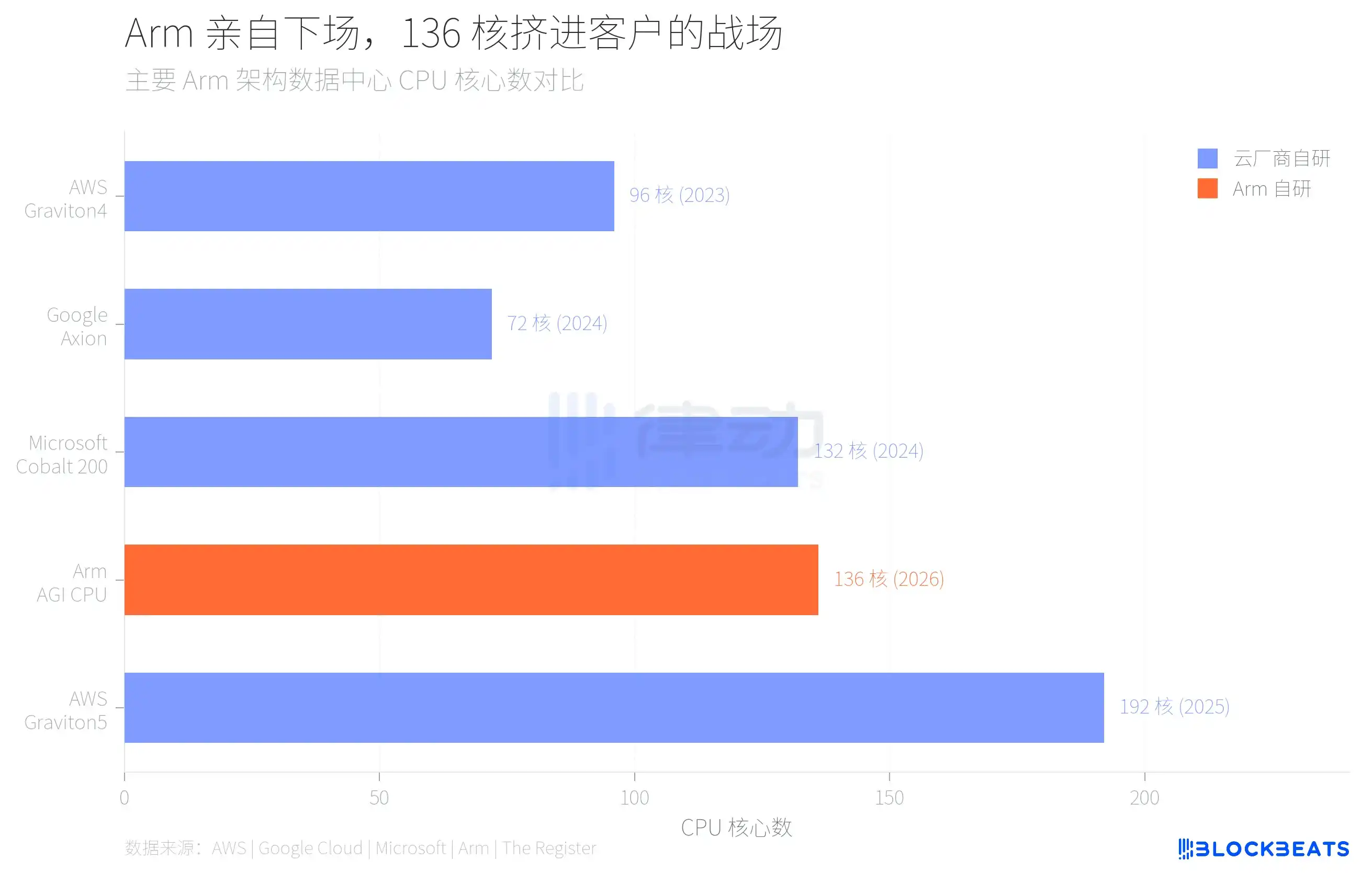
These cloud providers all use Arm's architectural license, but they design, tape out, and deploy the chips themselves. Arm earns licensing fees and royalties from this, not the profits from the chips. As more computing demands are absorbed by these self-developed chips, the revenue ceiling for Arm in the data center becomes increasingly clear.

Examining Arm's revenue structure over the past four years reveals this ceiling more concretely. According to Arm's financial reports from FY2022 to FY2025, total company revenue grew from $2.7 billion to $4.0 billion, with an average annual growth of about 14%. Within this, royalty revenue increased from $1.562 billion to $2.168 billion, while licensing revenue grew from $1.141 billion to $1.839 billion. Royalty growth has already slowed to around 20% in recent years, and much of this 20% growth comes from the upgrade cycle to the Armv9 architecture in mobile, not the data center.
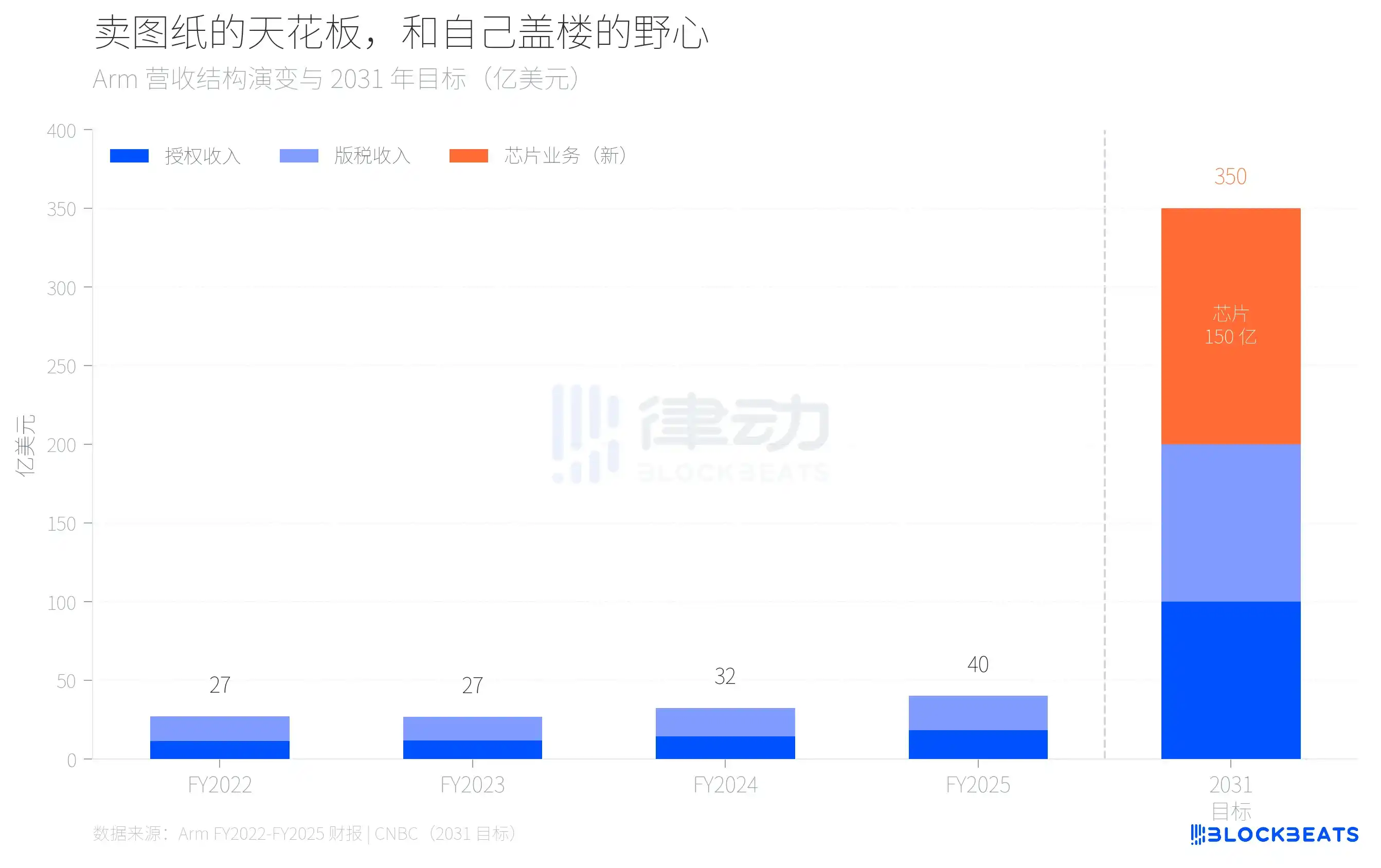
Extrapolating at this growth rate, even if both licensing and royalty revenues maintain around 20% annual growth, they would only reach approximately $10 billion by 2031. The remaining $5 billion to reach the $15 billion target must come from a business that does not exist today. This is the arithmetic logic behind Arm's decision to build its own chips.

By choosing to manufacture its own chips, Arm is essentially competing with its own customers. A company that sells architectural blueprints has started building houses itself, while its blueprint buyers have been building for several years.

This is the true backdrop of the 136-core AGI CPU. According to The Register, this chip has a base frequency of 3.2 GHz, boosting to 3.7 GHz, 12-channel DDR5 memory, 6 GB/s bandwidth per core, 96 PCIe 6.0 lanes, and supports CXL 3.0. Arm positions it as the "computing foundation for the agentic AI cloud era," specializing in CPU-side task scheduling and data flow management for AI inference, rather than directly competing with GPUs.

The pace of market share change is also telling. According to Omdia estimates, Arm architecture servers will account for about 21% of global shipments in 2025, with a growth rate of 70%. However, within hyperscale data centers, this proportion is already close to 50%. The 40-year monopoly of x86 is not collapsing; it's being replaced chip by chip.

The risk for Arm's self-developed chips lies not in technology, but in relationships. Meta's willingness to be the first customer is partly because Meta does not have a mature self-developed chip project like Amazon or Google. But how will Amazon, Google, and Microsoft view this? If a supplier starts competing for your business, would you still entrust it with your most critical architectural licenses?

Arm's bet is that the total data center market will grow faster than customer relationships deteriorate. Rene Haas evidently believes that the incremental demand for CPUs in the AI era is large enough for self-developed chips and architectural licensing to coexist. The $15 billion target is the price tag on this judgment.

After 35 years of selling blueprints, it's building its first house. The blueprints are still for sale, and the house is also being built. The question is whether there's enough room on the same plot of land for both.


Criptos en tendencia

Preguntas relacionadas

QWhat is the significance of Arm's first self-developed data center CPU, the AGI CPU, and who is its first major customer?

AThe AGI CPU is Arm's first self-developed data center CPU, marking a significant shift from its traditional IP licensing model to also manufacturing and selling finished chips. It is built on TSMC's 3nm process, features 136 Neoverse V3 cores, and has a 300W TDP. Meta is the first major customer and plans to deploy it at scale within the year.

QWhat are Arm's ambitious financial targets for its chip business by 2031, and how do they compare to its current revenue?

AArm aims for its chip business to achieve $15 billion in annual revenue by 2031, with total company revenue reaching $25 billion and earnings per share of $9. This is a massive increase from its FY2025 total revenue of approximately $4 billion, meaning the new chip business alone would need to grow to nearly the size of Intel's entire Data Center and AI division, which had $12.8 billion in revenue in 2024.

QWhy is Arm taking the risk of manufacturing its own chips, a strategy that puts it in competition with its own customers?

AArm is taking this risk because its largest data center customers, like Amazon (Graviton), Google (Axion), and Microsoft (Cobalt), are increasingly designing their own chips based on Arm's architecture licenses. While Arm earns licensing fees and royalties from these designs, it misses out on the larger profits from the actual chips. This trend places a clear ceiling on Arm's future revenue growth from its traditional business model, forcing it to seek new revenue streams by selling finished products.

QWhat is the potential conflict or risk for Arm in its new strategy of selling both IP licenses and finished chips?

AThe primary risk is damaging its relationships with its major architecture licensees, such as Amazon, Google, and Microsoft. By becoming a direct supplier of finished chips, Arm is now competing with its own customers. These companies may become reluctant to share their most critical architectural plans and designs with a supplier that is also a competitor, potentially jeopardizing Arm's core licensing business.

QHow does Arm justify its new strategy and what market trend is it betting on for success?

AArm is betting that the total market demand for data center CPUs, particularly driven by the agentic AI era, is growing fast enough to accommodate both its traditional licensing business and its new chip manufacturing venture. CEO Rene Haas believes the AI-driven demand for CPU-based tasks like AI inference scheduling and data flow management will be so substantial that the potential revenue from selling chips outweighs the risk of alienating some licensing customers.

Lecturas Relacionadas

Diálogo con Ray Dalio: Nos encontramos en una burbuja de IA actualmente, el 1% de mi cartera de inversiones está en Bitcoin

**Fuente: The Diary Of A CEO** **Resumen: Felix, PANews** Ray Dalio, fundador de Bridgewater Associates, advierte sobre una burbuja en la inteligencia artificial actual, comparable a burbujas históricas como la de Internet en 2000. Según Dalio, los signos clásicos están presentes: precios inflados, endeudamiento basado en ganancias especulativas y una posible corrección brusca si suben las tasas de interés o cambian las condiciones económicas. Dalio explica que esta burbuja se enmarca en un "gran ciclo" más amplio —de unos 80 años— caracterizado por tres dinámicas: creciente desigualdad interna, déficits fiscales gubernamentales y cambios en el orden geopolítico mundial. Estados Unidos y otros países occidentales se encuentran en una fase de declive relativo dentro de este ciclo. Para proteger la riqueza personal, Dalio recomienda diversificar las inversiones más allá del efectivo, incluyendo activos como oro, acciones y bonos. Aunque revela que alrededor del 1% de su cartera está en Bitcoin —considerándolo un activo escaso—, prefiere el oro físico por su seguridad histórica y su rol como reserva de los bancos centrales. Sobre el impacto laboral de la IA, Dalio prevé que aumentará la desigualdad, beneficiando sobre todo a los dueños de capital. Sin embargo, destaca que las habilidades humanas —como la intuición y la emoción— seguirán siendo valiosas y complementarias a la IA. En el ámbito geopolítico, Dalio anticipa un mundo más regionalizado, con EE.UU. y China como potencias líderes en sus respectivas esferas, y advierte que conflictos como el de Irán han expuesto debilidades estratégicas de Estados Unidos, acelerando un cambio en el equilibrio global de poder.

marsbitHace 39 min(s)

Diálogo con Ray Dalio: Nos encontramos en una burbuja de IA actualmente, el 1% de mi cartera de inversiones está en Bitcoin

marsbitHace 39 min(s)

¡Récord de compras netas extranjeras de 7,2 billones de wones en un solo día! Wall Street: Los vientos en contra de los flujos de capital en el mercado coreano se han disipado

La situación de los flujos de capital en el mercado de valores surcoreano está mostrando un cambio sustancial. El 31 de julio, la inversión extranjera realizó una compra neta récord de aproximadamente 7.2 billones de wones en acciones del KOSPI, marcando una reversión fundamental tras meses de importantes salidas de capital. Según análisis de Citi Research, las ventas netas mensuales de inversores extranjeros se redujeron drásticamente a 9.8 billones de wones en julio, comparado con 48.4 y 44.5 billones en junio y mayo, respectivamente. Paralelamente, los fondos de pensiones y fondos de inversión nacionales se convirtieron en compradores netos en julio (1.0 billón de wones), luego de ser vendedores netos en los dos meses anteriores. Además, la Comisión de Servicios Financieros de Corea implementó nuevas regulaciones que restringen el acceso de inversores minoristas a los ETF apalancados, lo que ha reducido significativamente su volumen de negociación y se espera que mitigue la volatilidad del mercado. Citi Research mantiene su objetivo para el KOSPI en 10,000 puntos, destacando fundamentos sólidos en el sector de chips de memoria, valoraciones históricamente bajas, una fuerte economía local y un entorno político favorable como factores de apoyo. La firma considera que los vientos en contra relacionados con los flujos de capital se están disipando, mientras que los impulsores fundamentales y políticos están ganando fuerza, creando condiciones para una mejora en el mercado.

marsbitHace 39 min(s)

¡Récord de compras netas extranjeras de 7,2 billones de wones en un solo día! Wall Street: Los vientos en contra de los flujos de capital en el mercado coreano se han disipado

marsbitHace 39 min(s)

Cómo Convertirse en Algo que la Inteligencia Artificial Jamás Podrá Reemplazar

**Resumen: Cómo ser irremplazable por la IA** Ante el temor de que la IA elimine trabajos, la solución no es resistirse, sino volverse "inempleable": un individuo autónomo que construya su propio proyecto vital y económico. El artículo critica la "esclavitud salarial"—depender de un empleo sin sentido—y propone escapar de ella desarrollando estas cinco capacidades clave: 1. **Agencia**: Capacidad de actuar sin pedir permiso. 2. **Gusto**: Criterio para discernir qué vale la pena crear. 3. **Persuasión**: Habilidad para conectar y lograr que otros valoren tu trabajo. 4. **Persistencia**: Resiliencia para ver los errores como aprendizaje. 5. **Iteración**: Proceso constante de ajuste basado en la retroalimentación. Estas habilidades se cultivan únicamente **haciendo**: creando algo propio. Se recomienda enfocarse en **crear contenido (medios)** más que solo en código, ya que el valor del contenido es subjetivo y requiere un criterio humano que la IA no puede replicar fácilmente, abriendo espacio para talentos auténticos. **Cómo empezar:** El cambio real requiere una transformación de identidad. Para ello: 1. Cambia radicalmente tu entorno (físico y digital). 2. Elige un "vehículo" (como crear contenido) que te dé retroalimentación real del mundo. 3. Dedica 15 minutos a responder preguntas introspectivas para encontrar tu "material en bruto" único y tu perspectiva contraria a la convencional. 4. **Publica tu primera idea mañana mismo.** La acción, el feedback y la iteración constante son el único camino. La conclusión es clara: en lugar de temer a la IA, conviértete en un creador que utilice todas las herramientas (incluida la IA) para construir una vida y un trabajo con significado, autonomía e impacto personal.

marsbitHace 2 hora(s)

Cómo Convertirse en Algo que la Inteligencia Artificial Jamás Podrá Reemplazar

marsbitHace 2 hora(s)

Los lanzamientos de dados mantienen las claves de Bitcoin en un modo aislado, pero no todo el mundo se molestará

El título sugiere que las claves de Bitcoin pueden almacenarse fuera de línea mediante lanzamientos de dados, aunque no todos los usuarios adoptarán este método. El artículo comienza explicando la entropía en la teoría de la información, utilizando ejemplos como monedas y dados. Tras un escándalo reciente con Coldcard, se popularizó la generación de semillas de billetera mediante dados. El texto explica que, aunque físicamente determinista, el lanzamiento es impredecible en la práctica, lo que lo hace útil para la seguridad. Se detalla cómo convertir los resultados en datos binarios, con métodos que van desde el simple "par/impar" hasta el uso de funciones hash para preservar más entropía. Para una frase de recuperación de 12 palabras (128 bits de entropía), se necesitan unos 50 lanzamientos; Coldcard recomienda 99 para mayor seguridad. La vulnerabilidad en Coldcard, relacionada con su generador de números aleatorios, puso en riesgo fondos. Las semillas generadas manualmente con dados no se vieron afectadas, pero el investigador Kevin Loaec señaló que otras funciones del dispositivo (como creación de billeteras de papel o claves de coproreseguridad) sí podían estar comprometidas, incluso si la semilla principal era segura. El artículo argumenta que, aunque técnicamente robusto, el proceso de lanzar dados es lento, propenso a errores y poco práctico para la mayoría, especialmente para nuevos usuarios. Concluye que, aunque debe ser una opción para expertos, el objetivo a largo plazo es que el hardware y software generen aleatoriedad fuerte de forma fiable y accesible. Se aconseja a los usuarios de Coldcard verificar su firmware y las funciones utilizadas, y se destaca la utilidad de las billeteras multisig con dispositivos de diferentes fabricantes para mitigar riesgos.

cryptonews.ruHace 5 hora(s)

Los lanzamientos de dados mantienen las claves de Bitcoin en un modo aislado, pero no todo el mundo se molestará

cryptonews.ruHace 5 hora(s)

Trading

Spot

Artículos destacados

Cómo comprar 4

¡Bienvenido a HTX.com! Hemos hecho que comprar 4 (4) sea simple y conveniente. Sigue nuestra guía paso a paso para iniciar tu viaje de criptos.Paso 1: crea tu cuenta HTXUtiliza tu correo electrónico o número de teléfono para registrarte y obtener una cuenta gratuita en HTX. Experimenta un proceso de registro sin complicaciones y desbloquea todas las funciones.Obtener mi cuentaPaso 2: ve a Comprar cripto y elige tu método de pagoTarjeta de crédito/débito: usa tu Visa o Mastercard para comprar 4 (4) al instante.Saldo: utiliza fondos del saldo de tu cuenta HTX para tradear sin problemas.Terceros: hemos agregado métodos de pago populares como Google Pay y Apple Pay para mejorar la comodidad.P2P: tradear directamente con otros usuarios en HTX.Over-the-Counter (OTC): ofrecemos servicios personalizados y tipos de cambio competitivos para los traders.Paso 3: guarda tu 4 (4)Después de comprar tu 4 (4), guárdalo en tu cuenta HTX. Alternativamente, puedes enviarlo a otro lugar mediante transferencia blockchain o utilizarlo para tradear otras criptomonedas.Paso 4: tradear 4 (4)Tradear fácilmente con 4 (4) en HTX's mercado spot. Simplemente accede a tu cuenta, selecciona tu par de trading, ejecuta tus trades y monitorea en tiempo real. Ofrecemos una experiencia fácil de usar tanto para principiantes como para traders experimentados.

704 Vistas totalesPublicado en 2025.10.20Actualizado en 2026.06.02

Cómo comprar 4

Discusiones

Bienvenido a la comunidad de HTX. Aquí puedes mantenerte informado sobre los últimos desarrollos de la plataforma y acceder a análisis profesionales del mercado. A continuación se presentan las opiniones de los usuarios sobre el precio de 4 (4).

活动图片