The Catfish Effect Emerges: Stablecoins Are Forcing the Banking System to Improve Efficiency and Interest Rates

比推Publicado a 2025-12-19Actualizado a 2025-12-19

Resumen

The article "The Catfish Effect: Stablecoins Are Forcing Banks to Improve Efficiency and Interest Rates" challenges the initial fear that stablecoins would trigger massive bank deposit outflows. Instead, research indicates that due to the "stickiness" of deposits—where traditional checking accounts remain central for interoperability with mortgages, credit cards, and salaries—no significant correlation exists between stablecoin growth and bank disintermediation. Rather than being a threat, stablecoins act as a competitive force, compelling banks to offer higher deposit rates and improve operational efficiency. Proper regulation, like the GENIUS Act which mandates full reserve backing with safe assets, addresses risks such as runs and liquidity issues. Ultimately, stablecoins complement the traditional system, promising efficiency gains through atomic settlement and faster cross-border payments, potentially upgrading the dollar's infrastructure and fostering greater financial inclusion.

Author: Christian Catalini, Forbes

Compiled by: Peggy, BlockBeats

Original Title: The Catfish Effect? Stablecoins Are Truly Not the Enemy of Bank Deposits


Editor's Note: Whether stablecoins would impact the banking system was one of the core debates in recent years. However, as data, research, and regulatory frameworks gradually become clearer, the answer is becoming more measured: stablecoins have not triggered large-scale deposit outflows. Instead, constrained by the reality of "deposit stickiness," they have become a competitive force that compels banks to improve interest rates and efficiency.

This article reexamines stablecoins from the perspective of banks. They may not be a threat but rather a catalyst forcing the financial system to renew itself.

Below is the original text:

A dollar sign flashing on an IBM computer monitor in 1983.

Back in 2019, when we announced the launch of Libra, the global financial system's reaction was, to put it mildly, quite intense. The near-existential fear was: once stablecoins become instantly accessible to billions of people, would the banking system's control over deposits and payment systems be completely broken? If you could hold a "digital dollar" in your phone that transfers instantly, why would you keep your money in a checking account that offers zero interest, charges numerous fees, and essentially shuts down on weekends?

At the time, this was a perfectly reasonable question. For years, the mainstream narrative has been that stablecoins are "stealing the banks' business." There were concerns that "deposit flight" was imminent.

Once consumers realized they could directly hold a form of digital cash backed by Treasury-grade assets, the foundation providing low-cost funding for the U.S. banking system would quickly crumble.

But a rigorous research paper recently published by Professor Will Cong of Cornell University suggests the industry may have panicked too soon. By examining real evidence rather than emotional judgments, Cong presents a counterintuitive conclusion: when properly regulated, stablecoins are not disruptors draining bank deposits but rather a complement to the traditional banking system.

The "Sticky Deposits" Theory

The traditional banking model is essentially a bet built on "friction."

Since the checking account is the only true interoperable hub for funds, almost any transfer of value between external services must go through the bank. The entire system is designed on the logic that as long as you don't use a checking account, operations become more cumbersome—the bank controls the only bridge connecting the isolated "islands" of your financial life.

Consumers are willing to accept this "toll" not because checking accounts are superior, but because of the power of the "bundling effect." You keep money in your checking account not because it's the best place for funds, but because it's a central node: mortgages, credit cards, direct deposit salaries all interface and operate together here.

If the assertion that "banks are dying" were true, we should have seen massive bank deposits flowing into stablecoins. But reality is different. As Cong points out, despite the explosive growth in stablecoin market capitalization, "existing empirical research has found little evidence of a clear correlation between the emergence of stablecoins and the outflow of bank deposits." The friction mechanism remains effective. So far, the adoption of stablecoins has not caused substantial outflows from traditional bank deposits.

It turns out that those warnings about "mass deposit flight" were more panic-driven rhetoric from incumbents based on their own positions, ignoring the most basic economic "laws of physics" in the real world. The stickiness of deposits is an incredibly powerful force. For most users, the convenience value of the "bundled service" is too high—too high to move their life savings into a digital wallet just for a few extra basis points of yield.

Competition is a Feature, Not a System Bug

But real change is happening here. Stablecoins may not "kill banks," but they will almost certainly make banks uncomfortable and force them to become better. The Cornell study points out that even the mere existence of stablecoins already acts as a disciplinary constraint, forcing banks to no longer rely solely on user inertia but to start offering higher deposit interest rates and more efficient, sophisticated operational systems.

When banks truly face a credible alternative, the cost of sticking to the old ways rises rapidly. They can no longer take it for granted that your funds are "locked in," but are forced to attract deposits with more competitive pricing.

Under this framework, stablecoins do not "shrink the pie"; instead, they promote "more credit extension and broader financial intermediation, ultimately enhancing consumer welfare." As Professor Cong states: "Stablecoins are not meant to replace traditional intermediaries but can serve as a complementary tool to expand the boundaries of what banks are good at."

It turns out that the "threat of exit" itself is a powerful motivator for incumbents to improve their services.

Regulatory "Unlocking"

Of course, regulators have good reason to worry about so-called "run risk"—the possibility that if market confidence wavers, the reserve assets backing stablecoins could be forced into fire sales, triggering a systemic crisis.

But as the paper points out, this is not some unprecedented new risk; it is a standard risk profile long inherent in financial intermediation, highly similar in nature to the risks faced by other financial institutions. We already have a mature set of frameworks for managing liquidity and operational risks. The real challenge is not "inventing new physical laws" but correctly applying existing financial engineering to a new technological form.

This is where the GENIUS Act plays a key role. By explicitly requiring stablecoins to be fully backed by reserves of cash, short-term U.S. Treasuries, or insured deposits, the act mandates safety at the institutional level. As the paper states, these regulatory guardrails "appear to cover the core vulnerabilities identified in academic research, including run risk and liquidity risk."

The legislation sets minimum statutory standards for the industry—full reserve backing and enforceable redemption rights—but leaves the specific operational details to be implemented by bank regulators. Next, the Federal Reserve and the Office of the Comptroller of the Currency (OCC) will be responsible for translating these principles into enforceable rules, ensuring stablecoin issuers adequately account for operational risks, the possibility of custody failures, and the unique challenges involved in large-scale reserve management and integration with blockchain systems.
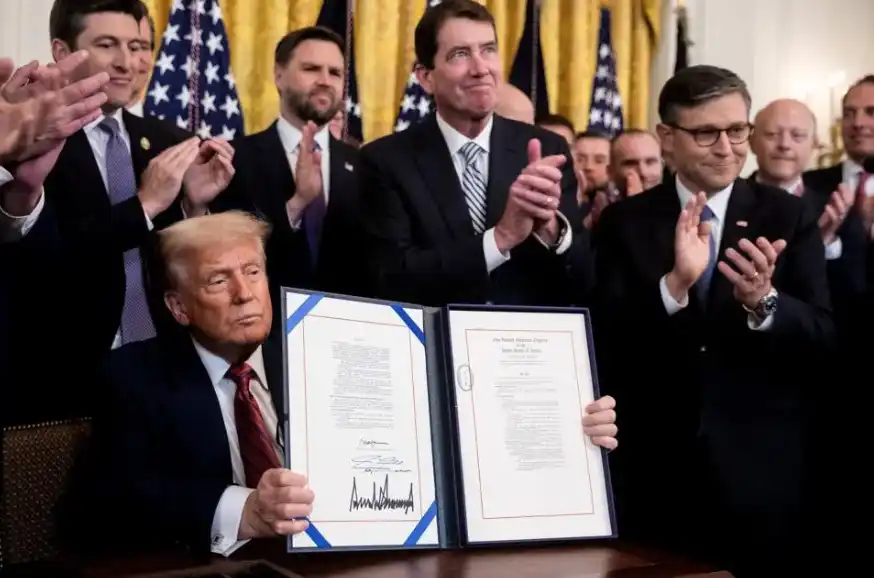
July 18, 2025 (Friday): U.S. President Donald Trump displays the newly signed GENIUS Act during a signing ceremony in the East Room of the White House in Washington.

Efficiency Dividend

Once we move beyond the defensive mindset of "deposit diversion," the real upside becomes apparent: the "underlying plumbing" of the financial system itself has reached a point where it must be restructured.

The true value of tokenization is not just 24/7 availability, but "atomic settlement"—the instant transfer of value across borders without counterparty risk, a problem the current financial system has long failed to solve.

The current cross-border payment system is costly and slow, with funds often needing to pass through multiple intermediaries for days before final settlement. Stablecoins compress this process into a single on-chain, final, and irreversible transaction.

This has profound implications for global cash management: funds are no longer trapped "in transit" for days but can be moved across borders instantly, releasing liquidity currently tied up long-term in the correspondent banking system. In domestic markets, the same efficiency gains promise lower-cost, faster merchant payments. For the banking industry, this is a rare opportunity to update the traditional clearing infrastructure that has long been held together with tape and COBOL.

The Upgrade of the Dollar

Ultimately, the U.S. faces a binary choice: either lead the development of this technology or watch the future of finance take shape in offshore jurisdictions. The U.S. dollar remains the world's most popular financial product, but the "rails" supporting it are clearly aging.

The GENIUS Act provides a truly competitive institutional framework. It "domesticates" this field: by bringing stablecoins within the regulatory perimeter, the U.S. transforms what was an不安 element of the shadow banking system into a transparent, robust "global dollar upgrade," shaping an offshore novelty into a core component of domestic financial infrastructure.

Banks should stop fixating on competition itself and start thinking about how to leverage this technology to their advantage. Just as the music industry was forced to move from the CD era to the streaming era—initially resistant but ultimately discovering a goldmine—banks are resisting a transformation that will ultimately save them. When they realize they can charge for "speed" rather than profit from "delay," they will truly learn to embrace this change.

A New York University student downloads music files from the Napster website in New York. On September 8, 2003, the Recording Industry Association of America (RIAA) filed lawsuits against 261 file-sharers who downloaded music files over the internet; additionally, the RIAA issued over 1,500 subpoenas to internet service providers.


Twitter:https://twitter.com/BitpushNewsCN

Bitpush TG Discussion Group:https://t.me/BitPushCommunity

Bitpush TG Subscription: https://t.me/bitpush

Original article link:https://www.bitpush.news/articles/7597093

Preguntas relacionadas

QWhat is the main argument presented in the article regarding stablecoins and the banking system?

AThe article argues that stablecoins are not a threat that will drain bank deposits, but rather a competitive force that is pushing the traditional banking system to become more efficient and offer higher deposit rates, acting as a catalyst for self-renewal within the financial system.

QAccording to the research by Professor Will Cong, what was the relationship between the growth of stablecoins and bank deposits?

AProfessor Will Cong's research found that despite the explosive growth in stablecoin market value, there is almost no clear correlation between the emergence of stablecoins and an outflow of bank deposits, indicating that deposit 'stickiness' is a powerful force.

QHow does the article suggest the GENIUS Act impacts the stablecoin industry?

AThe GENIUS Act provides a regulatory framework by mandating that stablecoins must be fully backed by reserves like cash, short-term U.S. Treasuries, or insured deposits. It sets minimum legal standards and brings the industry under regulatory oversight, transforming it into a transparent and robust 'global dollar upgrade方案'.

QWhat efficiency advantages do stablecoins offer over the traditional financial system, as mentioned in the article?

AStablecoins offer 'atomic settlement,' enabling instant, cross-border value transfer without counterparty risk. This compresses a process that traditionally takes days through multiple intermediaries into a single, irreversible on-chain transaction, freeing up liquidity and enabling lower-cost, faster payments.

QWhat historical analogy does the article use to describe the banking industry's potential journey with stablecoin technology?

AThe article uses the analogy of the music industry's transition from CDs to streaming. It suggests that banks, initially resistant to stablecoins, may eventually discover that this technology represents a golden opportunity, allowing them to charge for 'speed' rather than profit from 'delay'.

Lecturas Relacionadas

Tendencia del Mercado de Valores Estadounidense: Una Publicación en Redes Sociales Intercambiada por un Rebote de 930 Puntos, Esta Noche le Toca a SpaceX

**Resumen del Mercado de Valores Estadounidense: Una Publicación Provoca una Recuperación de 930 Puntos, Hoy le Toca a SpaceX** Los mercados protagonizaron un rebote en "V" el jueves, con el Dow Jones subiendo 930 puntos (+1.86%) recuperando los 50,000 puntos, a pesar de un dato de PPI de mayo muy caliente (6.5% anual). La clave fue el anuncio de Trump sobre un borrador de acuerdo de paz para el conflicto con Irán, lo que hizo caer el precio del petróleo y alimentó las expectativas de un pico de inflación. En este contexto, las acciones de semiconductores (como Micron, Intel) lideraron las ganancias, mientras que las de software como Oracle y Adobe cayeron, mostrando la preferencia actual del mercado por el hardware de IA sobre el software. El foco ahora está en la OPI histórica de SpaceX (código SPCX), que debutará en el Nasdaq. Valorada en 1.75 billones de dólares, recaudará unos 75 mil millones. Su inclusión en el índice Nasdaq 100 en 15 días podría generar una compra forzosa de fondos por hasta 27 mil millones de dólares, aunque su elevada valoración (88 veces ventas) genera escepticismo. La calidad del rebote se cuestiona, ya que depende de frágiles noticias geopolíticas. La inflación sigue siendo un riesgo, con alzas en los precios mayoristas aún por transmitirse. La apertura de SpaceX medirá el apetito real de riesgo del mercado.

marsbitHace 19 min(s)

Tendencia del Mercado de Valores Estadounidense: Una Publicación en Redes Sociales Intercambiada por un Rebote de 930 Puntos, Esta Noche le Toca a SpaceX

marsbitHace 19 min(s)

Examen de valoración de un billón de dólares: ¿Los tres super IPO son un carnaval de las acciones tecnológicas o una pesadilla para el mercado cripto?

**Resumen del artículo en español:** La posible salida a bolsa (IPO) de tres gigantes tecnológicos —SpaceX (valuado en ~1,75 billones de dólares), OpenAI (~852.000 millones) y Anthropic (~965.000 millones)—, con una valuación combinada superior a los 3,5 billones de dólares, está generando un intenso debate en los mercados. Existe preocupación sobre un posible efecto de "succión" de liquidez que podría presionar a otras acciones de crecimiento y a las criptomonedas, especialmente a los tokens vinculados a la IA. El análisis sugiere que estas preocupaciones podrían estar exageradas. Históricamente, las grandes IPO (como Alibaba o Aramco) han generado más una reconfiguración de carteras que una desaparición de liquidez del sistema, ya que también atraen nuevo capital. SpaceX ya no se valúa principalmente por sus cohetes, sino por su infraestructura global de comunicaciones (Starlink). OpenAI y Anthropic ofrecen por primera vez una inversión directa en los modelos de IA centrales, lo que podría revaluar el sector y presionar a empresas o criptoactivos que dependen más de narrativas que de fundamentos. Para las criptomonedas, la competencia por el capital de riesgo es real, y algunos tokens de IA podrían sufrir. Sin embargo, el mercado cripto sigue regido principalmente por su propio ciclo, la liquidez macro y la regulación. El verdadero riesgo no es la IPO en sí, sino si estas empresas pueden justificar sus altísimas valuaciones con crecimiento y rentabilidad futuros. Si no logran cumplir las expectativas, podrían generar una revaluación a la baja en el sector tecnológico, más que un colapso general del mercado.

链捕手Hace 24 min(s)

Examen de valoración de un billón de dólares: ¿Los tres super IPO son un carnaval de las acciones tecnológicas o una pesadilla para el mercado cripto?

链捕手Hace 24 min(s)

Prueba de valoración del billón de dólares: ¿Son los tres super-IPO una fiesta para las acciones tecnológicas o una pesadilla para el mercado de criptomonedas?

Resumen: En 2026, el mercado de capitales se enfrenta a una posible ola de ofertas públicas iniciales (IPO) masivas protagonizada por tres gigantes tecnológicos: SpaceX, OpenAI y Anthropic, con valoraciones combinadas que superan los 3,5 billones de dólares. El debate central gira en torno a si estas emisiones pueden "absorber" la liquidez del mercado y generar presión sobre otros activos, como las criptomonedas. SpaceX, con una posible valoración de 1,75 billones, ya no se valora principalmente por sus cohetes, sino por su red de infraestructura global de comunicaciones, Starlink, que ahora genera la mayor parte de sus ingresos. OpenAI y Anthropic, valuados en unos 852.000 y 965.000 millones respectivamente, representan la inversión directa en modelos de IA fundamentales, lo que podría revalorizar todo el sector de la IA. Históricamente, las IPO grandes (como Alibaba o Aramco) han causado más una reconfiguración del capital que una crisis de liquidez, ya que el mercado total es mucho mayor. Para las acciones tecnológicas, estas IPO podrían provocar una reevaluación interna, presionando a las empresas más especulativas. Para el mercado cripto, algunos tokens con narrativa de IA podrían enfrentar competencia por capitales, pero el ciclo de Bitcoin y los factores macroeconómicos siguen siendo más determinantes. El verdadero riesgo no es la IPO en sí, sino si estas empresas pueden cumplir con las altísimas expectativas de crecimiento implícitas en sus valoraciones. La conclusión es que estas emisiones son un evento de valoración masiva, no un presagio de colapso del mercado.

marsbitHace 25 min(s)

Prueba de valoración del billón de dólares: ¿Son los tres super-IPO una fiesta para las acciones tecnológicas o una pesadilla para el mercado de criptomonedas?

marsbitHace 25 min(s)

¿Quién asumirá la responsabilidad después de que SpaceX salga a bolsa?

Autor: BitalkNews El 12 de junio, SpaceX saldrá a bolsa con una valoración de 1,8 billones de dólares. Sin embargo, solo circularán unas 556 millones de acciones, con una capitalización bursátil flotante de unos 75.000 millones de dólares (4,2% de la valoración total). La demanda inicial vendrá en tres oleadas. Primero, la suscripción de la OPV a 135 dólares por acción. Segundo, la negociación en el mercado secundario tras la apertura. Tercero, y más relevante, la compra obligatoria por parte de fondos indexados al Nasdaq 100, que se ha modificado para incluir a SpaceX solo 15 días después de su salida a bolsa, generando una demanda concentrada. No obstante, este desequilibrio entre oferta y demanda no durará. SpaceX ha diseñado un sistema de desbloqueo escalonado de las acciones restringidas (alrededor del 54% del capital) para inversores internos y empleados. Los primeros desbloqueos parciales podrían comenzar tras los resultados del Q2 (agosto), seguidos de varias rondas en días específicos y tras el Q3. Elon Musk mantendrá bloqueado su 42% durante 366 días. Así, en los primeros meses, la oferta estará limitada con una demanda fuerte. En la segunda mitad del año, la presión vendedora aumentará a medida que se liberen acciones. Curiosamente, hacia diciembre, durante la rebalanceo anual del Nasdaq 100, el peso de SpaceX en el índice se ajustará al alza, obligando a los fondos pasivos a comprar más, lo que podría actuar como soporte tras meses de ventas internas.

marsbitHace 1 hora(s)

¿Quién asumirá la responsabilidad después de que SpaceX salga a bolsa?

marsbitHace 1 hora(s)

Anthropic se disculpó, pero el negocio de la "seguridad" no se ha detenido

El 11 de junio, Anthropic se disculpó por una función de "clasificador de seguridad inteligente" en su nuevo modelo Claude Fable 5. Este sistema identificaba y degradaba silenciosamente solicitudes de desarrollo de IA avanzada a un modelo inferior, lo que generó críticas. Anthropic argumentó que era para "proteger" su ventaja competitiva y a los usuarios, pero muchos lo vieron como una defensa comercial disfrazada de seguridad, apuntando específicamente a investigadores rivales. Tras ser descubierto, la compañía prometió hacer las degradaciones visibles, admitiendo que esto podría causar más falsos positivos y afectar a usuarios comunes. El artículo sostiene que la "seguridad" para Anthropic es un negocio. Critica su estrategia de publicar investigaciones que amplifican los riesgos de la IA (como un modelo que acelera la creación de exploits) justo antes de lanzar productos premium con primas de seguridad, creando un ciclo de ansiedad y monetización. Su valoración de 965.000 millones de dólares y planes de OPV se basan en esta imagen de "IA más segura". Se contrasta con OpenAI, que se centra en herramientas y escala. Anthropic, en cambio, vende ansiedad y una supuesta indispensabilidad a clientes corporativos y gubernamentales preocupados por el riesgo. El incidente revela que su definición de "riesgo" incluye actividades que amenazan su liderazgo comercial. La disculpa, por tanto, es vista como un simple parche de relaciones públicas que no cambia su lógica comercial central: la seguridad como un producto rentable, donde incluso las disculpas son parte del servicio postventa.

marsbitHace 1 hora(s)

Anthropic se disculpó, pero el negocio de la "seguridad" no se ha detenido

marsbitHace 1 hora(s)

Trading

Spot
Futuros
活动图片





