Polymarket Sues Massachusetts Over Prediction Market Regulation – SUBBD Token Takes Advantage

bitcoinistPublicado a 2026-02-10Actualizado a 2026-02-10

Resumen

Polymarket, the world's largest prediction market, is suing the Commonwealth of Massachusetts after receiving a cease-and-desist order from the state's Attorney General, who accused it of operating an unlicensed gambling platform. The company argues its markets are financial derivatives under the jurisdiction of the Commodity Futures Trading Commission (CFTC), not gambling subject to state laws. This lawsuit represents a critical test for the crypto industry's ability to operate under a single federal framework rather than fragmented state regulations. Amid this regulatory battle, the SUBBD Token is capitalizing on the demand for decentralized platforms. It aims to disrupt the $85 billion creator economy by merging Web3 financial sovereignty with AI tools, offering lower fees and censorship-resistant monetization for content creators. The project has already raised $1.47 million in its presale and offers a 20% APY staking reward, positioning itself as a utility-driven alternative in a market seeking alternatives to centralized control.

Trusted Editorial content, reviewed by leading industry experts and seasoned editors. Ad Disclosure

Quick Facts:

  • ➡️ Polymarket is suing Massachusetts to establish that prediction markets are federally regulated derivatives, not state-regulated gambling.
  • ➡️ The lawsuit represents a critical test for the crypto industry’s ability to operate under federal oversight rather than fragmented state laws.
  • ➡️ SUBBD Token leverages similar decentralized principles to disrupt the $85B creator economy, offering AI tools and lower fees than Web2 competitors.
  • ➡️ The conflict highlights a broader market trend toward platforms that offer user sovereignty and resistance to centralized censorship.

The battle for decentralized information markets just hit a breaking point.

Polymarket, the world’s largest prediction platform, has officially filed a lawsuit against the Commonwealth of Massachusetts. This legal maneuver serves as a sharp counter-offensive to the Cease and Desist order issued by the state’s Attorney General, who accused the platform of running an unlicensed gambling operation.

Polymarket’s argument hangs on a single hook: federal preemption. The company contends its markets are financial derivatives under the jurisdiction of the Commodity Futures Trading Commission (CFTC), not games of chance subject to state-level gambling laws.

That distinction isn’t just legalese, it’s survival. If prediction markets are classified merely as gambling, they face a fractured nightmare of 50 different state regulators. If they’re derivatives? They face a single federal framework.

This lawsuit follows the precedent set by Kalshi, a regulated competitor that recently scored a massive win against the CFTC, emboldening platforms to challenge regulatory overreach.

But this isn’t just about election betting or sports outcomes. The conflict highlights the friction between decentralized protocols and legacy frameworks that struggle to categorize Web3 innovation. The market’s reaction? Telling.

Rather than fleeing, liquidity in decentralized sectors has deepened. Investors are hunting for sovereignty and utility outside the reach of arbitrary restrictions.

While prediction markets fight for the right to trade truth, SUBBD Token ($SUBBD) is using this sentiment to disrupt the $85 billion creator economy. As users look for platforms that guarantee ownership and freedom from censorship, SUBBD is capitalizing on the shift toward decentralized monetization.

Explore the SUBBD Token ecosystem.

Disrupting The $85B Content Economy With AI And Web3

While the Polymarket case highlights the struggle for permissionless trading, the content creation industry faces a parallel crisis: centralization.

Right now, Web2 giants strangle the landscape, extracting up to 70% of creator earnings through fees and maintaining absolute authority over who can monetize. Sound familiar?

This centralized control creates a fragile ecosystem where influencers face arbitrary bans, demonetization, and payment processor restrictions. SUBBD Token has emerged to fix these inefficiencies by merging Web3 financial sovereignty with advanced AI tooling.

The project’s architecture is built to return value to the user (a concept foreign to most legacy platforms). By utilizing the Ethereum blockchain, SUBBD eliminates the intermediaries that typically siphon revenue, offering a transparent payment infrastructure that supports creators, fans, and even AI-driven influencers.

The platform integrates proprietary AI models directly into the ecosystem, offering features like AI Personal Assistants for automated interactions and AI Voice Cloning. Why does that matter? It lets creators scale their output without the burnout associated with traditional streaming.
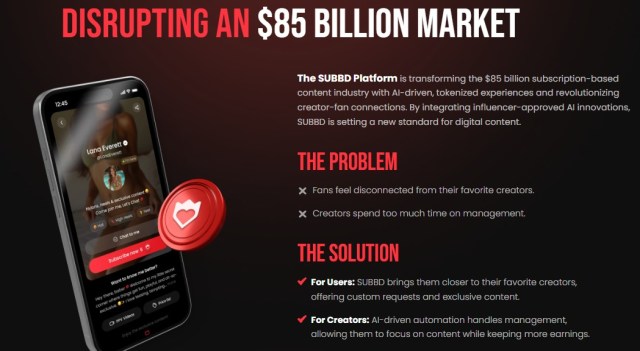
From a market perspective, the utility here goes beyond simple tokenization. The platform introduces governance mechanisms that allow token holders to vote on feature rollouts and creator curation, fostering a community-owned ecosystem rather than a corporate dictatorship.

For investors watching the regulatory squeeze on platforms like Polymarket, SUBBD represents a tangible application of decentralized tech, solving a clear operational problem rather than relying on purely speculative trading. The integration of ‘HoneyHive’ membership tiers and token-gated exclusive content further aligns the token’s velocity with platform growth.

Read more about $SUBBD here.

SUBBD Presale Momentum Signals Demand For Decentralized Monetization

You can see the hunger for utility-driven crypto assets in the project’s early numbers. According to official presale data, SUBBD Token has already raised $1.47M, indicating strong capital inflows despite the broader market’s regulatory uncertainty.

The token’s current price of $0.057495 offers a vital entry point for investors looking to capitalize on the intersection of AI and the creator economy before the platform fully launches.
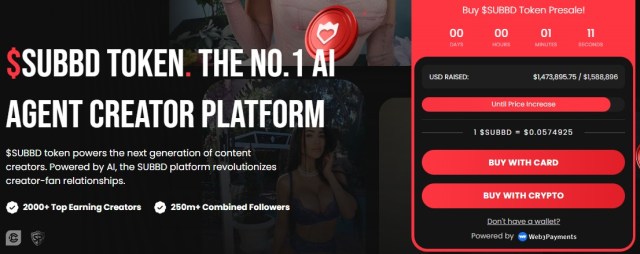
Financial incentives play a major role in this early accumulation phase. The protocol offers a robust staking mechanism, providing a fixed 20% APY for the first year to users who lock their tokens. This strategy is designed to reduce circulating supply volatility during the project’s initial expansion phase.

Plus, stakers unlock platform-specific benefits, including exclusive livestreams, daily behind-the-scenes drops, and XP multipliers that enhance their standing within the ecosystem.

Smart money seems to be betting on the convergence of two high-growth narratives: the explosion of AI tools and the necessity of censorship-resistant payments. While the Polymarket lawsuit dominates the headlines regarding regulatory jurisdiction, projects like SUBBD Token are building the infrastructure that renders traditional gatekeepers obsolete.

By offering a solution that combines lower fees, AI utility, and staking yields, the project positions itself as a hedge against the centralization risks currently plaguing both the prediction and content markets.

Buy your $SUBBD tokens here.

This article is for informational purposes only and doesn’t constitute financial advice. Cryptocurrencies are volatile assets; always conduct your own research before investing. The regulatory landscape is evolving and may impact project viability.

Editorial Process for bitcoinist is centered on delivering thoroughly researched, accurate, and unbiased content. We uphold strict sourcing standards, and each page undergoes diligent review by our team of top technology experts and seasoned editors. This process ensures the integrity, relevance, and value of our content for our readers.

patrubogdan

Follow

Full Profile

Related Posts

Binance Dominates Trump’s USD1 Supply as Bitcoin Hyper Breaks Records

Cathie Wood’s Ark Invest Buys More Bullish Assets Just Days After Last Purchase, While LiquidChain Turns Heads

Bitcoin Hyper Could Conquer 2026 if Bitcoin Regains Lost Ground

Tether Pushes for $1 Despite Market Crash, While Maxi Doge Reaches New Heights

Ethereum Holds Strong Above $2K, While $LIQUID Starts Turning Heads: Price Analysis & Outlook

Convicted FTX CEO SBF Cries ‘Biden Lawfare’ In Trump Pardon Pitch

Preguntas relacionadas

QWhat is the core legal argument Polymarket is using in its lawsuit against Massachusetts?

APolymarket argues that its prediction markets are financial derivatives under the jurisdiction of the Commodity Futures Trading Commission (CFTC), not state-regulated gambling, and are therefore subject to federal preemption.

QHow does the SUBBD Token aim to disrupt the creator economy?

ASUBBD Token aims to disrupt the $85 billion creator economy by merging Web3 financial sovereignty with AI tools, eliminating high fees from Web2 intermediaries, and offering a transparent, censorship-resistant payment infrastructure for creators and fans.

QWhat precedent did the prediction market platform Kalshi set that is relevant to Polymarket's case?

AKalshi, a regulated prediction market competitor, recently scored a significant win against the CFTC, which emboldened other platforms like Polymarket to challenge regulatory overreach and assert that they operate under federal oversight.

QWhat financial incentive does the SUBBD Token offer to early investors during its presale?

AThe SUBBD Token offers a fixed 20% APY for the first year to users who stake their tokens, along with platform-specific benefits like exclusive content and XP multipliers, to encourage early adoption and reduce supply volatility.

QWhat two major market trends does the SUBBD Token capitalize on, according to the article?

AThe SUBBD Token capitalizes on the convergence of two high-growth narratives: the explosion of AI tools and the necessity for censorship-resistant, decentralized payment systems in the creator economy.

Lecturas Relacionadas

Diálogo con Ray Dalio: Nos encontramos en una burbuja de IA actualmente, el 1% de mi cartera de inversiones está en Bitcoin

**Fuente: The Diary Of A CEO** **Resumen: Felix, PANews** Ray Dalio, fundador de Bridgewater Associates, advierte sobre una burbuja en la inteligencia artificial actual, comparable a burbujas históricas como la de Internet en 2000. Según Dalio, los signos clásicos están presentes: precios inflados, endeudamiento basado en ganancias especulativas y una posible corrección brusca si suben las tasas de interés o cambian las condiciones económicas. Dalio explica que esta burbuja se enmarca en un "gran ciclo" más amplio —de unos 80 años— caracterizado por tres dinámicas: creciente desigualdad interna, déficits fiscales gubernamentales y cambios en el orden geopolítico mundial. Estados Unidos y otros países occidentales se encuentran en una fase de declive relativo dentro de este ciclo. Para proteger la riqueza personal, Dalio recomienda diversificar las inversiones más allá del efectivo, incluyendo activos como oro, acciones y bonos. Aunque revela que alrededor del 1% de su cartera está en Bitcoin —considerándolo un activo escaso—, prefiere el oro físico por su seguridad histórica y su rol como reserva de los bancos centrales. Sobre el impacto laboral de la IA, Dalio prevé que aumentará la desigualdad, beneficiando sobre todo a los dueños de capital. Sin embargo, destaca que las habilidades humanas —como la intuición y la emoción— seguirán siendo valiosas y complementarias a la IA. En el ámbito geopolítico, Dalio anticipa un mundo más regionalizado, con EE.UU. y China como potencias líderes en sus respectivas esferas, y advierte que conflictos como el de Irán han expuesto debilidades estratégicas de Estados Unidos, acelerando un cambio en el equilibrio global de poder.

marsbitHace 3 hora(s)

Diálogo con Ray Dalio: Nos encontramos en una burbuja de IA actualmente, el 1% de mi cartera de inversiones está en Bitcoin

marsbitHace 3 hora(s)

¡Récord de compras netas extranjeras de 7,2 billones de wones en un solo día! Wall Street: Los vientos en contra de los flujos de capital en el mercado coreano se han disipado

La situación de los flujos de capital en el mercado de valores surcoreano está mostrando un cambio sustancial. El 31 de julio, la inversión extranjera realizó una compra neta récord de aproximadamente 7.2 billones de wones en acciones del KOSPI, marcando una reversión fundamental tras meses de importantes salidas de capital. Según análisis de Citi Research, las ventas netas mensuales de inversores extranjeros se redujeron drásticamente a 9.8 billones de wones en julio, comparado con 48.4 y 44.5 billones en junio y mayo, respectivamente. Paralelamente, los fondos de pensiones y fondos de inversión nacionales se convirtieron en compradores netos en julio (1.0 billón de wones), luego de ser vendedores netos en los dos meses anteriores. Además, la Comisión de Servicios Financieros de Corea implementó nuevas regulaciones que restringen el acceso de inversores minoristas a los ETF apalancados, lo que ha reducido significativamente su volumen de negociación y se espera que mitigue la volatilidad del mercado. Citi Research mantiene su objetivo para el KOSPI en 10,000 puntos, destacando fundamentos sólidos en el sector de chips de memoria, valoraciones históricamente bajas, una fuerte economía local y un entorno político favorable como factores de apoyo. La firma considera que los vientos en contra relacionados con los flujos de capital se están disipando, mientras que los impulsores fundamentales y políticos están ganando fuerza, creando condiciones para una mejora en el mercado.

marsbitHace 3 hora(s)

¡Récord de compras netas extranjeras de 7,2 billones de wones en un solo día! Wall Street: Los vientos en contra de los flujos de capital en el mercado coreano se han disipado

marsbitHace 3 hora(s)

Cómo Convertirse en Algo que la Inteligencia Artificial Jamás Podrá Reemplazar

**Resumen: Cómo ser irremplazable por la IA** Ante el temor de que la IA elimine trabajos, la solución no es resistirse, sino volverse "inempleable": un individuo autónomo que construya su propio proyecto vital y económico. El artículo critica la "esclavitud salarial"—depender de un empleo sin sentido—y propone escapar de ella desarrollando estas cinco capacidades clave: 1. **Agencia**: Capacidad de actuar sin pedir permiso. 2. **Gusto**: Criterio para discernir qué vale la pena crear. 3. **Persuasión**: Habilidad para conectar y lograr que otros valoren tu trabajo. 4. **Persistencia**: Resiliencia para ver los errores como aprendizaje. 5. **Iteración**: Proceso constante de ajuste basado en la retroalimentación. Estas habilidades se cultivan únicamente **haciendo**: creando algo propio. Se recomienda enfocarse en **crear contenido (medios)** más que solo en código, ya que el valor del contenido es subjetivo y requiere un criterio humano que la IA no puede replicar fácilmente, abriendo espacio para talentos auténticos. **Cómo empezar:** El cambio real requiere una transformación de identidad. Para ello: 1. Cambia radicalmente tu entorno (físico y digital). 2. Elige un "vehículo" (como crear contenido) que te dé retroalimentación real del mundo. 3. Dedica 15 minutos a responder preguntas introspectivas para encontrar tu "material en bruto" único y tu perspectiva contraria a la convencional. 4. **Publica tu primera idea mañana mismo.** La acción, el feedback y la iteración constante son el único camino. La conclusión es clara: en lugar de temer a la IA, conviértete en un creador que utilice todas las herramientas (incluida la IA) para construir una vida y un trabajo con significado, autonomía e impacto personal.

marsbitHace 5 hora(s)

Cómo Convertirse en Algo que la Inteligencia Artificial Jamás Podrá Reemplazar

marsbitHace 5 hora(s)

Los lanzamientos de dados mantienen las claves de Bitcoin en un modo aislado, pero no todo el mundo se molestará

El título sugiere que las claves de Bitcoin pueden almacenarse fuera de línea mediante lanzamientos de dados, aunque no todos los usuarios adoptarán este método. El artículo comienza explicando la entropía en la teoría de la información, utilizando ejemplos como monedas y dados. Tras un escándalo reciente con Coldcard, se popularizó la generación de semillas de billetera mediante dados. El texto explica que, aunque físicamente determinista, el lanzamiento es impredecible en la práctica, lo que lo hace útil para la seguridad. Se detalla cómo convertir los resultados en datos binarios, con métodos que van desde el simple "par/impar" hasta el uso de funciones hash para preservar más entropía. Para una frase de recuperación de 12 palabras (128 bits de entropía), se necesitan unos 50 lanzamientos; Coldcard recomienda 99 para mayor seguridad. La vulnerabilidad en Coldcard, relacionada con su generador de números aleatorios, puso en riesgo fondos. Las semillas generadas manualmente con dados no se vieron afectadas, pero el investigador Kevin Loaec señaló que otras funciones del dispositivo (como creación de billeteras de papel o claves de coproreseguridad) sí podían estar comprometidas, incluso si la semilla principal era segura. El artículo argumenta que, aunque técnicamente robusto, el proceso de lanzar dados es lento, propenso a errores y poco práctico para la mayoría, especialmente para nuevos usuarios. Concluye que, aunque debe ser una opción para expertos, el objetivo a largo plazo es que el hardware y software generen aleatoriedad fuerte de forma fiable y accesible. Se aconseja a los usuarios de Coldcard verificar su firmware y las funciones utilizadas, y se destaca la utilidad de las billeteras multisig con dispositivos de diferentes fabricantes para mitigar riesgos.

cryptonews.ruHace 8 hora(s)

Los lanzamientos de dados mantienen las claves de Bitcoin en un modo aislado, pero no todo el mundo se molestará

cryptonews.ruHace 8 hora(s)

Trading

Spot
活动图片





