The House of Lords, the upper chamber of the UK parliament, has urged financial regulators to reconsider some of their controversial stablecoin proposals, warning that the country risks falling behind global leaders if regulation is not done right.
House Of Lords Outlines Concerns Over Stablecoin Rules
On Wednesday, the House of Lords’ Financial Services Regulation Committee published a report on the regulation of stablecoins, urging the Bank of England (BoE) to review some areas of its proposed rules “where the desired balance between supporting innovation and risk mitigation appears less appropriately calibrated.”
The committee affirmed its support for many of the central bank’s proposals, including the requirement that issuers back stablecoins 1:1 and the backstop lending facility. However, it noted that aspects of the proposals “need further consideration.”
Last year, the central bank proposed that systemic stablecoin issuers hold at least 40% of the reserves backing the token as unremunerated bank deposits to ensure “robust redemption” and “public confidence.”
It also suggested a temporary cap on stablecoin ownership, setting holding limits of £10,000 to £20,000 for individuals and £10 million for businesses. The measure resembled the BoE’s proposed approach to the digital pound, aiming to mitigate financial stability risks “stemming from large and rapid outflows of deposits from the banking sector.”
The policymakers consider that regulators should reevaluate the asset allocation and redemption requirements, citing the “considerable operational burdens this would create” and potential negative impact on the sustainability of stablecoin issuers and the UK’s global market competitiveness.
In addition, the report suggested that the holding limits should be reconsidered, arguing that they could unnecessarily hinder the expansion of pound-based stablecoins and prove impractical to implement.
It also shared concerns about the lack of clarity on the transition from the Financial Conduct Authority’s (FCA) regime to joint regulation alongside the BoE, and the uncertainty surrounding HM Treasury’s plans to determine whether stablecoins are systemic and to bring them into the payments regulatory perimeter.
UK At Risk Of Falling Behind
The Committee affirmed that the shape of the pound-denominated stablecoin market will be “strongly influenced by the direction of the regulatory regime,” and authorities must “create a level playing field so that stablecoins can compete with other forms of payment in the UK.”
Therefore, the regime must be flexible, responsive, and clear to accommodate future innovations, or the UK will risk “lagging behind global counterparts, where regulatory regimes are more established and provide clarity for market participants.”
The House of Lords’ report follows pressure from industry participants and other lawmakers to fight the controversial proposals. In December, members of the House of Lords, the House of Commons, and peers sent a letter to Chancellor Rachel Reeves asking her to oppose the BoE’s stablecoin rules, arguing that they could undermine the government’s efforts to position the UK as an industry leader.
Last month, BoE’s Deputy Governor for financial stability, Sarah Breeden, stated that the central bank was preparing to ease its regulatory plans. As reported by Bitcoinist, Breeden admitted that the proposals may have been “overly conservative.” She also shared that the financial regulator was “genuinely open” to revisiting the rules and establishing a better regime in which stablecoins can thrive.
Ultimately, the committee urged regulators to adhere to current timelines and ensure that the final regulatory regime is not delayed. A BoE spokesperson told Reuters that the central bank will publish its final policy and draft rules later this month.
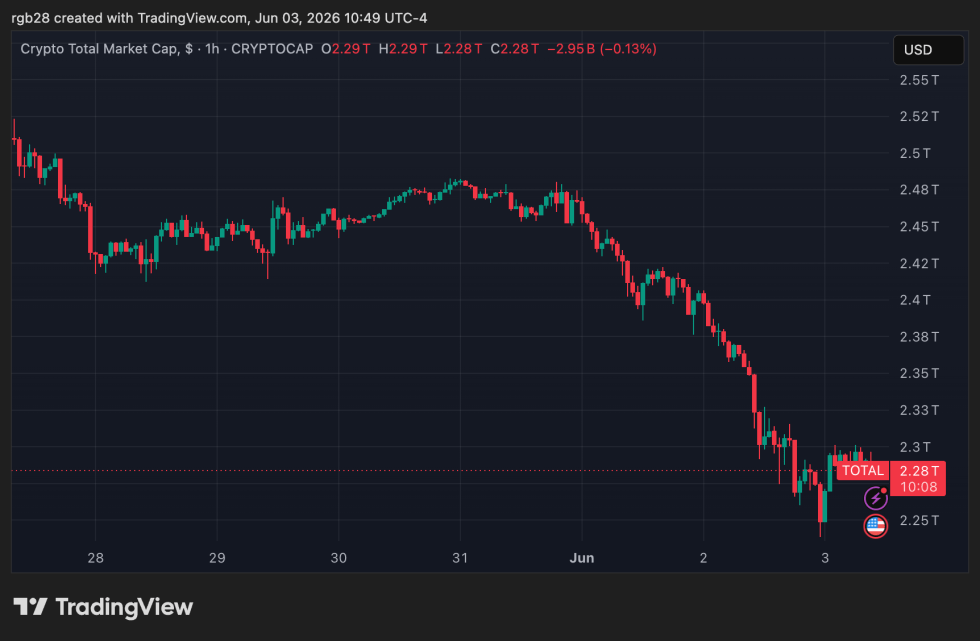
The total crypto market capitalization is at $2.28 trillion in the one-week chart. Source: TOTAL on Tradingview