The Silicon-Carbon Co-Governance Journey of a Crypto Company — Cobo's Internal AI Transformation

marsbitPublished on 2026-02-25Last updated on 2026-02-25

Abstract

From its core crypto custody and stablecoin payment operations, Cobo began exploring AI integration in late 2024. Initially, the team experimented with an MCP-based app store but pivoted due to high development costs and lack of standardization. Facing high talent costs and internal resistance, Cobo shifted focus inward, aiming to transform internal operations rather than client-facing products first. A major challenge was security: the company implemented a permission-based internal knowledge system and agent framework using Claude and Gemini with zero-data-retention agreements, ensuring strict data isolation and auditability. Adoption was slow until management enforced AI integration top-down, starting with an OKR Agent that automated goal-setting, progress tracking, and performance reviews. This “silicon-carbon co-governance” approach made AI use mandatory and performance-linked. Over 100 department-specific agents were developed—for customer service, legal, sales, and more—shifting the company’s mindset from hiring more people to deploying AI systems first. Key learnings: healthy cash flow is essential for such transformations; change must be driven from leadership; enforced usage is necessary; and internal AI maturity must precede external AI products. As an outcome, Cobo recently launched WaaS Skill, an AI-agent-integrated financial API layer, reducing development cycles from weeks to conversation-level interactions—a direct result of its internal AI transformation...

Since late 2024, besides its core crypto custody and stablecoin payment businesses, Cobo has been exploring the integration of AI and blockchain.

We initially saw the potential for standardization brought by MCP. Theoretically, if skills were sufficiently standardized, AI could call upon capabilities like plugins, and blockchain would become the most natural financial infrastructure for AI.

Consequently, we internally incubated an MCP app store. But it was quickly invalidated.

At that time, the barrier to entry for AI was still so high that only seasoned engineers could proficiently make calls, and MCP wasn't standardized enough. Each integration was time-consuming and labor-intensive, with high costs and slow progress; the actual implementation fell far short of expectations.

But the AI team was already assembled. It was expensive, hard to recruit for, and couldn't be easily disbanded.

So we decided to change direction. If we couldn't transform the client world yet, we would start by transforming ourselves.

First Problem: Security

As an asset custody company, Cobo's data and internal technical processes and frameworks are extremely sensitive. We also have strict internal data tiers. But without data and real business input, it's impossible to train the company's own Agent.

Our first thought was local model deployment. But the reality is, the intelligence level of local models didn't meet the requirements. They could run, but weren't user-friendly; they could answer, but weren't smart enough.

We ultimately chose Claude and Gemini as the foundation (applying for ZDR—Zero Data Retention clauses to achieve the highest level of isolation).

But large language models are just the underlying "brain" of the business. The real complexity lies in data and permissions.

We later built a complete internal knowledge base and Agent framework.
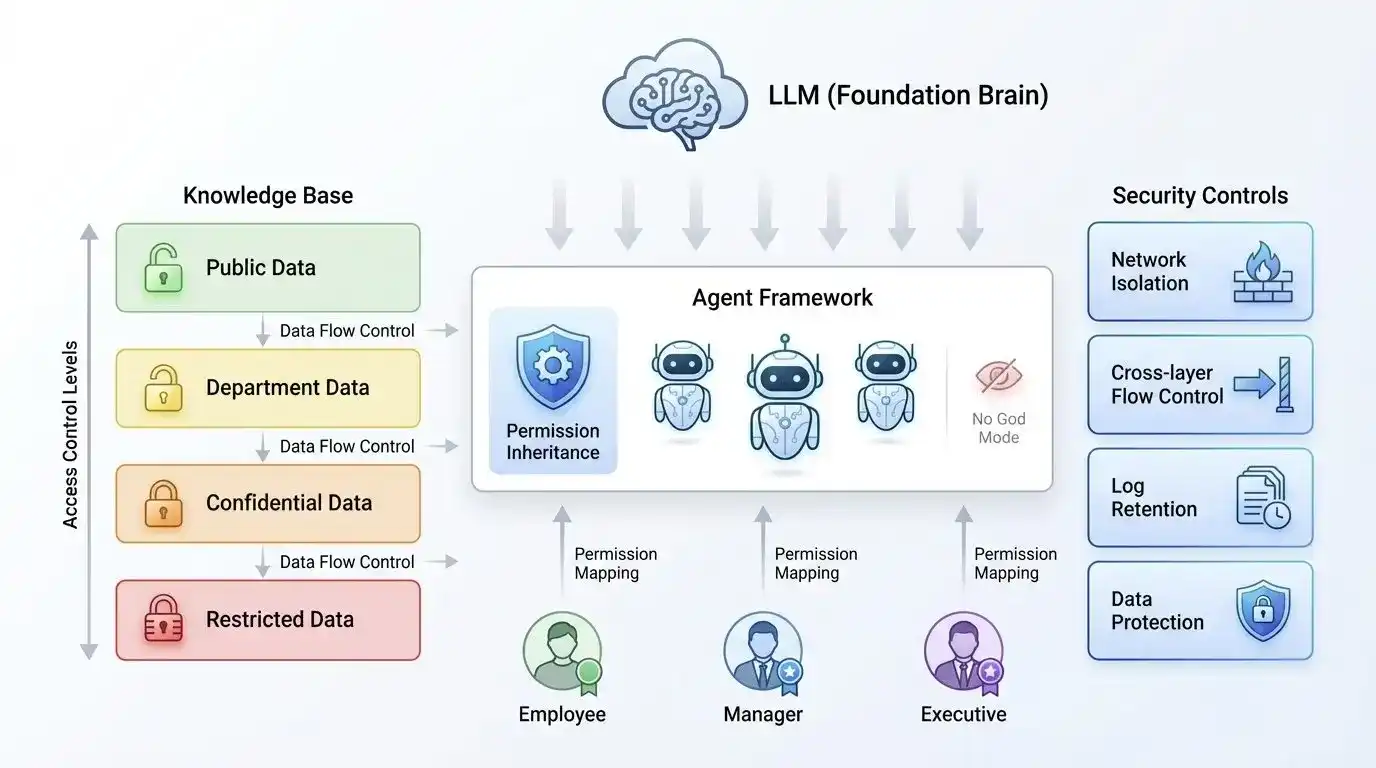
Internal knowledge base + Cobo's self-developed agent system

The knowledge base is responsible for the hierarchical classification of internal company data. It assigns readable scopes based on employee permissions.

When Agents call the knowledge base, they also inherit the employee's permissions, rather than having a "God's-eye view".

The details here include:

  • How to isolate the network environment
  • How to restrict cross-layer data flow
  • How to control log retention for auditability
  • How to prevent sensitive information leakage

These aspects aren't glamorous, but they determine whether this can run long-term. AI must not become a security vulnerability.

Problem After Architecture Was Built: No One Used It

Even today, the company still faces a reality: many front-line business units are dismissive of AI.

If it's just encouraged usage, AI-driven workflow change won't happen.

We later realized we had to start with company management.

First Breakthrough: OKR Agent

Our first strongly pushed scenario wasn't customer service, nor was it writing code.

It was OKR (Objectives and Key Results).

We used AI to break down company strategy, used AI to help set OKRs, used AI to track progress, and used AI to review bottlenecks.

In other words, we slowly transformed company management from human management to silicon-carbon co-governance. This process was extremely uncomfortable for employees.

Previously, goals could be written more vaguely, and processes could be explained more loosely. Now, with weekly data right there, excuses became fewer and fewer.

From that moment on, goals were no longer just discussions in meetings; they became continuous records in the system.
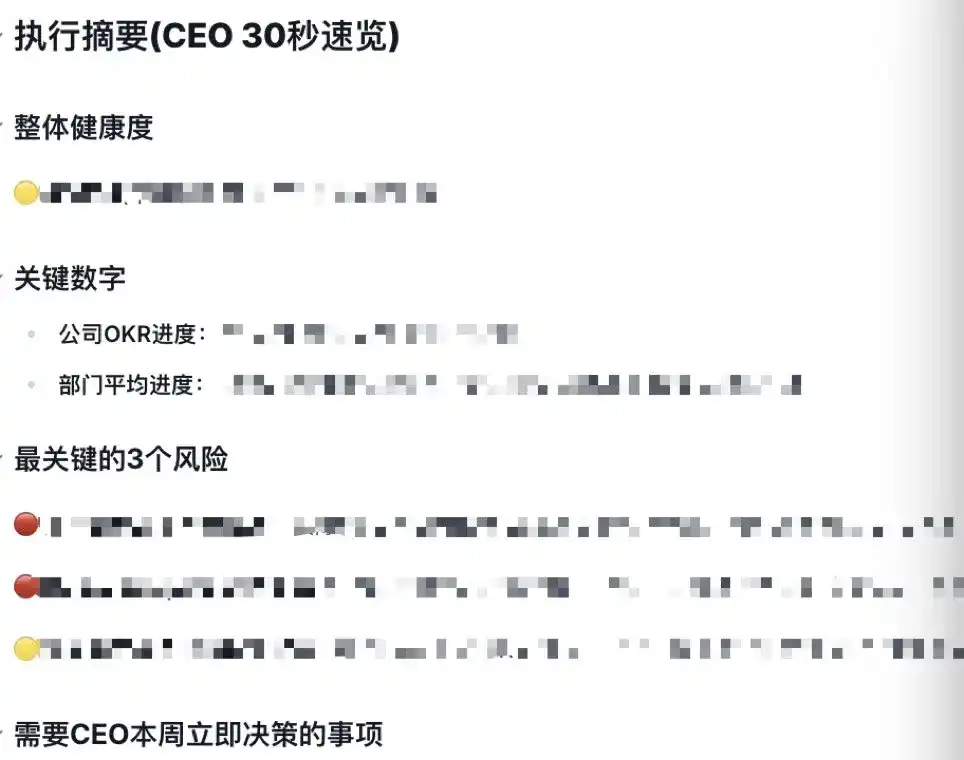
Strategy OKR督促业务进展 (Strategy OKR督促业务进展 - Supervising business progress weekly)

But it was also starting with performance that everyone truly became familiar with AI. Because if you didn't participate, it directly affected your compensation.

From Performance to Business: Comprehensive Agent-ification

After OKRs were up and running, we began promoting the agent-ification of internal services. We used evaluations + bonuses to强制 (mandate) each department to establish Agents related to their own business.

Customer service built customer service Agents. Legal built contract assistance Agents. Sales built CRM Agents.
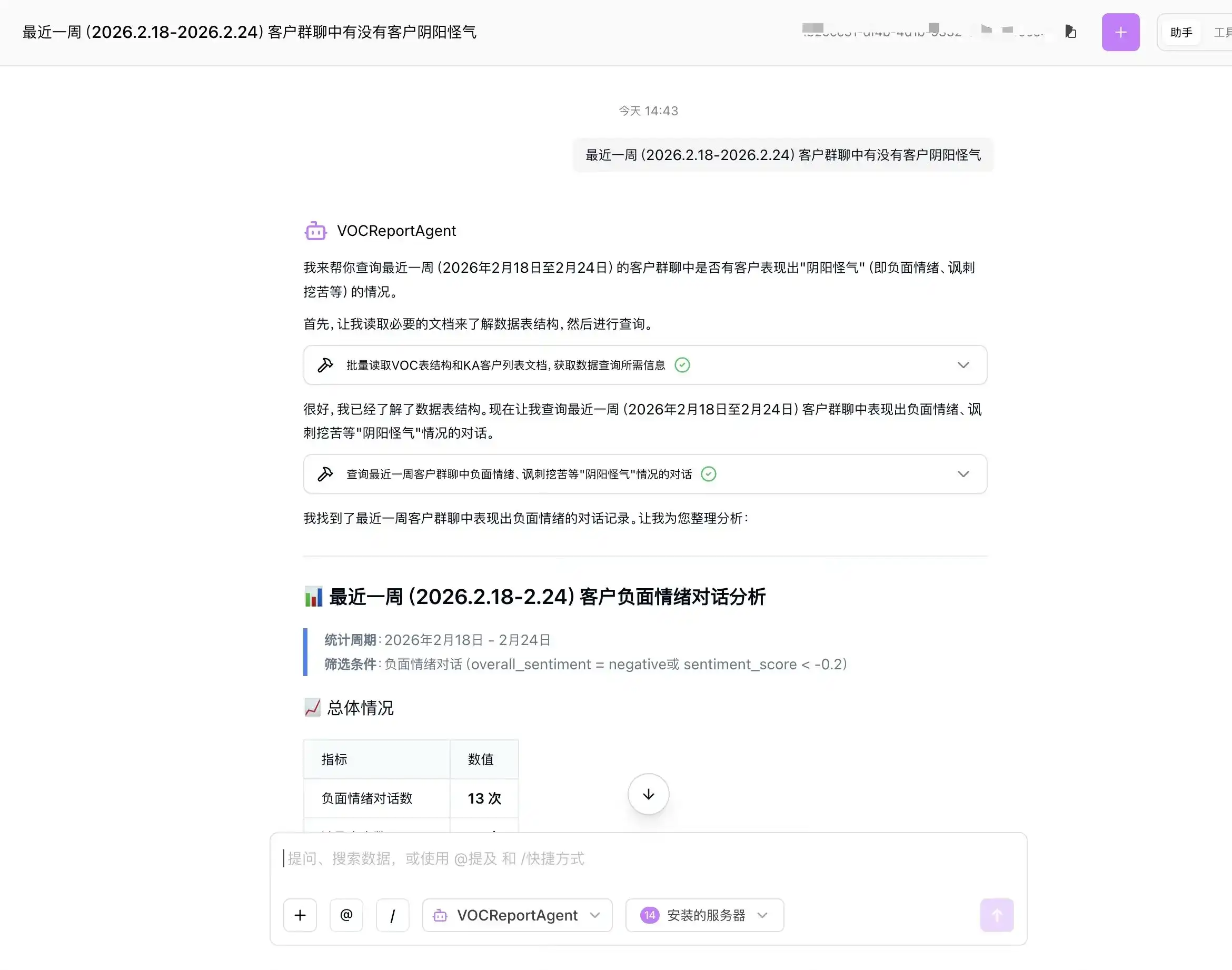
寻找最阴阳怪气的客户agent (Looking for the most passive-aggressive customer agent)

In the end, over 100 Agents were launched.

We cannot precisely quantify the results of "silicon-carbon co-governance".

But at least one change is clear:

Before, the first reaction to a problem was "Should we hire another person?". Now the first reaction is, "Can we get the system involved first?".

This is essentially our understanding of silicon-carbon co-governance. It's not about AI replacing humans. It's about humans becoming accustomed to working alongside systems.

Lessons Learned from This Year's Journey, Some Very Practical

First, have healthy cash flow.

If the company's cash flow isn't healthy, this kind of transformation won't reach the finish line. AI is not a cost-saving tool; it's an upfront investment for long-term structural upgrades. Thanks to Cobo's main business still having healthy cash flow.

Second, it must be top-down推进 (driven).

Organizations don't change spontaneously. If management doesn't strongly push it, this will naturally fail.

As is well known, Cobo's founders are重度ai玩家 (heavy AI users/enthusiasts), CTO Dr. Jiang started some AI research as a postdoc at CMU in the 2000s.

Third, mandatory usage is necessary.

If it's just encouragement, AI will always remain at writing emails. Real process change inevitably involves a degree of "compulsion".

Fourth, solve your own business first.

Many companies talk about AI + Web3. But if you haven't completed your own internal AI transformation, what you talk about externally is just概念 (concept).

Looking Back

We also cannot fully quantify this transformation. The company began shifting from "people-driven processes" slowly towards "goal-driven systems".

If "intelligent organizations" truly emerge in the future, they certainly won't evolve naturally. They will be pushed out through round after round of discomfort.

Because of the participation of the entire team, the company can also better understand the real demands in the AI era.

This is also a byproduct of our internal transformation.

Recently we launched Cobo Waas Skill. Cobo WaaS Skill is an integration and operational capability layer specifically designed for AI Coding Agents. It enables Agents to accurately call WaaS APIs through structured knowledge, executable examples, and scenario orchestration. We are upgrading wallet APIs into financial capability modules that can be directly called by AI Agents. The development cycle is shortened from weeks to conversation-level.

This isn't the result of a single product inspiration. Rather, it's the natural溢出 (spillover) of capabilities after our internal round of silicon-carbon co-governance.

We are still摸索 (figuring things out).

But at least, today's Cobo is no longer the company it was in 2024.

Trending Cryptos

Related Questions

QWhat was Cobo's initial approach to combining AI and blockchain, and why did it fail?

ACobo initially explored the potential of MCP (Model Context Protocol) to standardize skills, hoping AI could call capabilities like plugins and use blockchain as a natural financial infrastructure. They internally incubated an MCP app store. However, it failed because the AI barrier was too high, requiring mature engineers to use it effectively, and MCP lacked standardization. Each integration was time-consuming and costly, with poor落地 results.

QHow did Cobo address the critical issue of security when implementing internal AI agents?

ACobo addressed security by using Claude and Gemini models with Zero Data Retention (ZDR) clauses for maximum isolation. They built a comprehensive internal knowledge base and agent framework that inherited employee permissions, not granting 'god-mode' access. This included isolating network environments, restricting cross-layer data flow, controlling audit logs, and preventing sensitive information leaks.

QWhat was the first internal process Cobo强制 (strongly enforced) using AI to drive organizational change?

AThe first process Cobo强制 enforced was OKR management. They used AI to break down company strategy, help set OKRs, track progress, and review bottlenecks. This shifted company management from human-led to a 'silicon-carbon co-governance' model, making goals data-driven and reducing excuses, which directly impacted employee compensation to ensure adoption.

QWhat key lesson did Cobo learn about implementing AI transformation in an organization?

ACobo learned that AI transformation requires: 1) Healthy cash flow, as it's a long-term investment, not a cost-saving tool; 2) Top-down enforcement, as organizations won't change spontaneously; 3) Mandatory usage, as encouragement alone leads to superficial use like email writing; 4) Solving internal problems first before promoting external AI+Web3 concepts.

QWhat tangible product resulted from Cobo's internal AI transformation journey?

AThe internal transformation led to the launch of Cobo WaaS Skill, a capability layer designed for AI Coding Agents. It provides structured knowledge, executable examples, and scenario orchestration, allowing agents to accurately call WaaS APIs. This reduced development cycles from weeks to conversation-level, representing a natural溢出 (spillover) of their internal silicon-carbon co-governance efforts.

Related Reads

Must-Watch Events Next Week|CLARITY Act Could Face Senate Vote; SpaceX, Circle to Report Earnings (8.3-8.9)

**Summary: Key Events and Developments to Watch (August 3-9)** The upcoming week is marked by significant financial disclosures, key legislative deadlines, and notable product updates. **Major Financial Events:** Several companies are scheduled to release their Q2 2026 earnings. American Bitcoin (ABTC) will report on August 3, followed by SpaceX and Hut 8 Mining Corp. on August 4, and Circle on August 5. Notably, a significant portion of SpaceX shares (up to 12% of total shares) will be unlocked on August 6 following their earnings release. **Key Legislative Deadline:** The U.S. Senate faces an August 7 deadline to secure 60 votes for the CLARITY Act, a bipartisan bill aiming to establish a federal regulatory framework for cryptocurrencies. The Senate may hold a full vote on the bill during the week. **Economic Data:** The U.S. July Non-Farm Payrolls report will be released on August 7, providing crucial labor market data. **Technology & Product Updates:** * **Shutdowns:** DeFi portfolio tracker Zapper and wallet app Ctrl Wallet will cease operations on August 3. * **Upgrades:** LayerZero will deprecate its v1 relayers on August 3. XRP Ledger's new version 3.3.0, featuring five new functions, is expected next week. * **AI:** Elon Musk announced that the advanced Grok 4.6 AI model is set for release around August 7. * **Bitcoin:** The BIP-110 forced signaling for a potential Bitcoin network change is scheduled to begin around August 8. **Other Notable Events:** Chinese robotics firm Unitree Tech has set its preliminary price inquiry for its IPO for August 5. South Korean exchange Upbit will delist AQT and AERGO tokens on August 3.

marsbit1h ago

Must-Watch Events Next Week|CLARITY Act Could Face Senate Vote; SpaceX, Circle to Report Earnings (8.3-8.9)

marsbit1h ago

Stocks Are Plummeting More Sharply Than Cryptocurrencies. Where Has the Money Gone?

Stock Markets Plunge Deeper Than Cryptocurrencies: Where Did the Money Go? In late July, Seoul's Kospi index triggered circuit breakers for two consecutive days, plummeting over 40% from its June high. The collapse was led by heavyweight stocks like SK Hynix, whose record profits still disappointed investors, and devastating leveraged ETFs, with one major product losing over 83% of its value. This signaled a global, forced deleveraging targeting the most crowded trades. Interestingly, while stocks exhibited extreme volatility akin to crypto markets, Bitcoin rose nearly 15% in July after a prior steep drop. Analysis shows the money fleeing equities did not flow into Bitcoin. Instead, Bitcoin had already absorbed its sell-off in May-June, when U.S. spot Bitcoin ETFs saw historic outflows. The true safe-haven beneficiary was gold, whose price rose over 20% year-on-year, highlighting a decoupling between Bitcoin and gold as "digital gold." The sell-off was a targeted unwinding of leveraged positions in tech and semiconductors, accelerated by broker-dealer risk management and shifts in the AI narrative, including new competition from Chinese memory chipmakers. The retreat path was clear: from high-valuation tech stocks to cash and U.S. Treasuries, then to gold. For Bitcoin to attract sustained institutional inflows, conditions like eased global liquidity pressure, a "soft-landing" Fed rate cut, and U.S. regulatory clarity via legislation like the stalled CLARITY Act are needed. Currently, Bitcoin is not a safe haven but an already-cleared asset. Its low correlation with tech stocks, however, makes it a potential diversification play for institutional portfolios once the storm passes. The money isn't here yet, but the positioning is underway.

marsbit1h ago

Stocks Are Plummeting More Sharply Than Cryptocurrencies. Where Has the Money Gone?

marsbit1h ago

In Conversation with Ray Dalio: We Are Currently in an AI Bubble, with 1% of My Portfolio in Bitcoin

Ray Dalio, founder of Bridgewater Associates, warns in an interview that the current AI boom shows classic bubble characteristics, which could lead to significant economic downturns as seen in past cycles like 1929 or 2000. He explains that speculative enthusiasm, fueled by debt and overvaluation, often precedes a crash when rising rates or taxation force asset sales, causing widespread losses and recession. Dalio also outlines his "Big Cycle" theory, describing an approximate 80-year pattern where widening wealth gaps, massive government deficits, and shifting geopolitical power (like China's rise) create internal conflict and global instability. He emphasizes that we are in a late-cycle, transitional phase where traditional powers like the US and UK face decline. For personal wealth protection, Dalio advises diversification beyond cash into assets like stocks, bonds, real estate, and particularly gold, which he prefers over Bitcoin. While he holds about 1% of his portfolio in Bitcoin as a non-printable hard asset, he views gold as more secure from technological or governmental threats. Regarding AI's impact, Dalio believes it will disproportionately benefit capital owners, worsening inequality by replacing both physical and cognitive labor. He suggests that human intuition and emotional intelligence, combined with AI, will be key for future workers. On taxation, Dalio argues that wealth taxes are impractical and risk triggering asset sell-offs, reducing productive investment. He points to the UK as a cautionary example of debt, low productivity, and political strife. Geopolitically, Dalio foresees a more regionalized world, with the US showing weakness in prolonged conflicts like with Iran, akin to past imperial declines. The ideal outcome, he suggests, is coexisting powerful blocs (e.g., Americas, China-Asia Pacific) without major war.

marsbit5h ago

In Conversation with Ray Dalio: We Are Currently in an AI Bubble, with 1% of My Portfolio in Bitcoin

marsbit5h ago

Trading

Spot

Hot Articles

Discussions

Welcome to the HTX Community. Here, you can stay informed about the latest platform developments and gain access to professional market insights. Users' opinions on the price of AI (AI) are presented below.

活动图片















