Ray Dalio: The Revival of a China-led 'Tribute System', and the AI Industry Will Develop Like the EV Industry

Odaily星球日报Published on 2026-06-08Last updated on 2026-06-08

Abstract

Ray Dalio, founder of Bridgewater Associates, discusses shifting global power dynamics and the AI competition between the U.S. and China. He argues U.S. credibility as a global power willing to fight for its interests is declining, while China is accumulating wealth and influence. Dalio observes a trend where world leaders visit China, which he compares to a modern "tribute system"—not oppressive, but a hierarchy where nations acknowledge China's strength, affecting trade and security. This shift creates market uncertainty, prompting investors to seek asset diversification, including gold. Regarding AI, Dalio contrasts the U.S. and Chinese approaches. U.S. companies like OpenAI focus on monetization and subscriptions for revenue. In contrast, China treats AI as a public utility, akin to electricity or water, aiming for widespread worker accessibility over immediate profitability. He draws a parallel to China's electric vehicle industry success, where companies like BYD achieved rapid market growth. Dalio and JPMorgan's Mary Callahan Erdoes note China lacks U.S.-style fear of AI displacing jobs; instead, it focuses on leveraging AI for development and dominance in next-generation industries like robotics.

Source:"Wall Street Week" Program: Dalio's Warning&Ray Dalio on China-U.S. AI Development

Compiled | Odaily Planet Daily (@OdailyChina)

Translator | Wenser (@wenser2010)
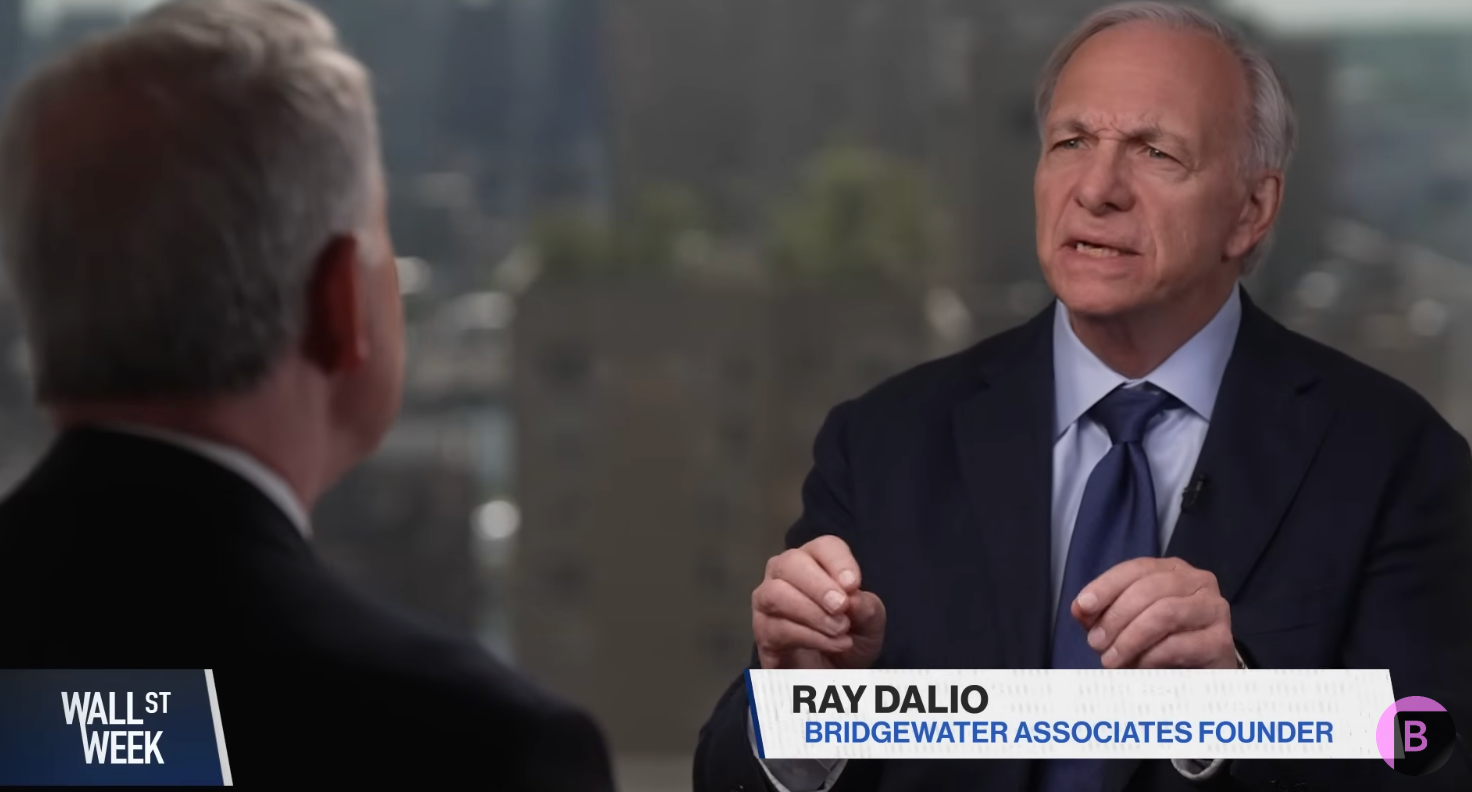
Editor's Note: As the founder of Bridgewater Associates, the world's largest hedge fund, Ray Dalio's remarks have always garnered significant attention from various sectors of society. His insights into the global macroeconomic landscape and different industries, in particular, are a frequent topic of discussion. Following the visits to China last month by leaders including US President Donald Trump and Russian President Vladimir Putin, Ray Dalio has put forward a new perspective – "The world structure is changing, a China-led tribute system is being established." Recently, regarding the "competition landscape between AI giants in China and the US," he has also offered his targeted views. The following content is compiled and translated by Odaily Planet Daily, with some details edited for brevity.

Ray Dalio on a "China-led World": The Reappearance of the Tribute System

Last month, after US President Donald Trump and Russian President Vladimir Putin visited China, Ray Dalio was interviewed by David Westin for Bloomberg's "Wall Street Week" program.

In the interview, Ray Dalio stated directly, "America's credibility as a global power willing to fight for its own interests is declining, while China is continually accumulating its own global wealth and world influence. This situation is fundamentally changing how other countries view these two nations."

"Currently, the United States has about 750 military bases in over 80 countries worldwide, and thus has long been seen as a trustworthy ally when facing (war) attacks." However, after concluding a roughly one-month trip to Asia (which included about 10 days of meetings with multiple leaders in China), Ray Dalio sensed an important shift: a growing number of countries are gradually coming to believe – "America cannot be counted on to win wars."

Dalio's remarks further elaborate on his long-held view: "America's strength is gradually waning, while China's strength is correspondingly increasing." Thanks to Bridgewater's significant engagement with China, this perspective has gained considerable acceptance. On the other hand, due to his relatively close relationship with Chinese leaders, these views have also drawn criticism.

Dalio then stated that international recognition is very important for China. Currently, China's economic scale is about 60% to 70% that of the United States, a proportion that has more than tripled over the past 20 years. He said that while China does not seek to conquer or occupy other countries, it places great emphasis on recognition from political leaders worldwide. "You can see leaders from many countries visiting China one after another, which is akin to the 'tribute system' in Chinese history – countries come to acknowledge and respect China's formidable strength, but this system is not an oppressive or controlling one." (Odaily Planet Daily Note: The original term used was 'tribute system')

"So, this tribute system is essentially a hierarchical structure. When dealing with other countries, what's important is how such a system affects trade and national security between the parties. I believe, from a political perspective, we are now entering a period where arrangements resembling a tribute system will form between (China and) various countries, and the relative strength between nations will become the determining factor (in the world's political landscape)." During the discussion, Ray Dalio also mentioned that concepts like the nation-state and borders only gradually emerged in Western societies around the mid-17th century. Before that, power structures in Western societies were constituted by different royal families, which is fundamentally different from the concept of frontiers consistently maintained throughout Chinese history.

He believes this change will directly impact (global capital and financial) markets. Because investors must navigate the current turbulent situation: currency values are at risk, and (global) uncertainty demands that investors maintain liquidity and diversify their asset allocations, including investments in gold.

Ray Dalio on the "Competition Landscape in AI Between China and the US": China's AI Industry Will Develop Like the EV Industry

In June, Business Insider reported Ray Dalio's views on the competition in the AI sector between China and the United States, similarly highlighting the vast differences and potential implications between the two.

Ray Dalio stated that China views artificial intelligence as an important tool that should be accessible to all workers. "It's like electricity and tap water, something everyone should have access to,"

As a prominent entrepreneur who first visited China as early as 1984, Ray Dalio has long been optimistic about China's development. He previously told attendees at a Forbes magazine conference in New York: "China has earned enormous profits through exports, and these funds are being widely utilized for research and development in the field of artificial intelligence, thereby driving economic growth through improved production efficiency."

It is worth noting that Ray Dalio emphasized that while American companies like OpenAI and Anthropic are adjusting (AI model) subscription package structures, striving to increase revenue in preparation for public listings, Chinese companies are committed to making their models accessible to as many ordinary employees as possible. "It doesn't necessarily have to be expensive, and it doesn't even necessarily have to be profitable (right now)."

"To some extent," Dalio believes, "it mimics the country's successful path in sectors like the electric vehicle industry – where domestic Chinese enterprises like BYD have achieved rapid growth in markets such as Europe."

In a guest discussion following Dalio's speech, JPMorgan Chase executive Mary Callahan Erdoes pointed out that unlike the social atmosphere in the US, where "employment issues are treated as political topics," executives of Chinese AI companies and political figures, when mentioning AI, show "no fear of AI displacing jobs." Instead, the country focuses more on "leveraging AI to drive various developments" and is committed to identifying the next industrial sector where it can achieve dominance. "The robotics sector can basically be seen as China's 'next-generation electric vehicle industry,'" she stated.


Trending Cryptos

Related Questions

QWhat does Ray Dalio mean by the 'tribute system' returning under Chinese leadership?

ARay Dalio suggests that as China's global influence grows, many countries' leaders are visiting China to acknowledge and respect its power. He likens this dynamic to a historical 'tribute system,' where other states recognize a dominant power's strength. He clarifies this is not an oppressive or controlling system, but rather a hierarchical arrangement that influences trade and national security between nations.

QAccording to Ray Dalio, what is the primary difference between U.S. and Chinese AI companies' current goals?

ARay Dalio states that while U.S. AI companies like OpenAI and Anthropic are adjusting subscription models and focusing on increasing revenue for potential IPOs, Chinese AI companies are primarily focused on making their AI models accessible and affordable for as many ordinary workers as possible, even if they are not immediately profitable.

QHow does Ray Dalio compare the development of China's AI industry to its electric vehicle industry?

ARay Dalio draws a parallel by suggesting that China's approach to AI development is mimicking its successful path in the electric vehicle industry. Just as Chinese companies like BYD achieved rapid growth in markets like Europe, the focus in AI is on widespread adoption and technological advancement as a tool for national development, potentially leading to a similar dominant position in the global market.

QWhat key change in global perception does Ray Dalio identify after his recent travels in Asia?

ARay Dalio identifies a significant shift in perception among many countries: a growing belief that they 'cannot count on the U.S. to win a war.' He contrasts this with the past view of the U.S. as a trustworthy ally willing to fight for its interests, noting that this change is fundamental to how nations view both the U.S. and the rising power of China.

QWhat investment advice does Ray Dalio offer in light of the current global geopolitical shifts?

AIn response to the turbulent global situation marked by currency risks and uncertainty, Ray Dalio advises investors to maintain liquidity and diversify their asset allocations. He specifically mentions including investments in gold as part of this strategy to hedge against the prevailing risks.

Related Reads

In Conversation with Ray Dalio: We Are Currently in an AI Bubble, with 1% of My Portfolio in Bitcoin

Ray Dalio, founder of Bridgewater Associates, warns in an interview that the current AI boom shows classic bubble characteristics, which could lead to significant economic downturns as seen in past cycles like 1929 or 2000. He explains that speculative enthusiasm, fueled by debt and overvaluation, often precedes a crash when rising rates or taxation force asset sales, causing widespread losses and recession. Dalio also outlines his "Big Cycle" theory, describing an approximate 80-year pattern where widening wealth gaps, massive government deficits, and shifting geopolitical power (like China's rise) create internal conflict and global instability. He emphasizes that we are in a late-cycle, transitional phase where traditional powers like the US and UK face decline. For personal wealth protection, Dalio advises diversification beyond cash into assets like stocks, bonds, real estate, and particularly gold, which he prefers over Bitcoin. While he holds about 1% of his portfolio in Bitcoin as a non-printable hard asset, he views gold as more secure from technological or governmental threats. Regarding AI's impact, Dalio believes it will disproportionately benefit capital owners, worsening inequality by replacing both physical and cognitive labor. He suggests that human intuition and emotional intelligence, combined with AI, will be key for future workers. On taxation, Dalio argues that wealth taxes are impractical and risk triggering asset sell-offs, reducing productive investment. He points to the UK as a cautionary example of debt, low productivity, and political strife. Geopolitically, Dalio foresees a more regionalized world, with the US showing weakness in prolonged conflicts like with Iran, akin to past imperial declines. The ideal outcome, he suggests, is coexisting powerful blocs (e.g., Americas, China-Asia Pacific) without major war.

marsbit1h ago

In Conversation with Ray Dalio: We Are Currently in an AI Bubble, with 1% of My Portfolio in Bitcoin

marsbit1h ago

Daily 7.2 Trillion KRW: Foreign Capital's Record Net Buying on Friday! Wall Street Says Headwinds for Korean Stock Fund Flows Have Subsided

South Korean stock market sees a dramatic shift in fund flows. On July 31, foreign investors made a record net purchase of approximately KRW 7.2 trillion in KOSPI stocks, marking a fundamental reversal from the persistent large-scale net outflows seen in previous months. This contributed to a significant narrowing of foreign net selling in July to KRW 9.8 trillion, down sharply from KRW 48.4 trillion in June and KRW 44.5 trillion in May. Simultaneously, domestic institutional pressure eased. South Korean pension funds and asset managers turned to a net buying position in July, purchasing KRW 1.0 trillion worth of KOSPI shares, contrasting with net sales in May and June. Market volatility is expected to be dampened by new financial regulations. Effective July 31, the Financial Services Commission tightened access for retail investors to single-stock leveraged ETFs by raising the minimum cash deposit requirement. Trading volumes for these products subsequently dropped to about 50% of their monthly average. Citigroup Research maintains its year-end KOSPI target of 10,000 points. The firm cites several supportive factors: the substantial easing of headwinds from capital outflows, a robust fundamental outlook for the semiconductor sector, historically low market valuations, strong economic fundamentals, and the potential for policy support from financial authorities if needed.

marsbit1h ago

Daily 7.2 Trillion KRW: Foreign Capital's Record Net Buying on Friday! Wall Street Says Headwinds for Korean Stock Fund Flows Have Subsided

marsbit1h ago

Thanks to Dice Rolls, Bitcoin Keys Are Stored Offline, But Not Everyone Will Do It

The article discusses using dice rolls to generate secure Bitcoin wallet seeds, providing entropy independent of potentially flawed hardware random number generators. It explains that each fair dice roll offers about 2.585 bits of entropy, with around 50 rolls needed for a standard 12-word seed phrase and 99+ recommended for higher security. This method gained attention after a vulnerability was revealed in some Coldcard hardware wallets, where a faulty firmware RNG (dating back to 2021) compromised generated keys. The analysis notes that while a dice-generated main seed was safe from this specific flaw, other Coldcard functions (like creating paper wallets, backup keys, or passwords) could still be vulnerable if they used the defective RNG. The piece argues that while dice-based entropy is technically robust, the manual process is error-prone, tedious, and unrealistic for most new users, who might make mistakes in recording or inputting rolls. It concludes that while manual entropy generation should remain an option for advanced users, the long-term goal is to develop reliable, user-friendly hardware and software that securely generates randomness without requiring specialized knowledge. Coldcard users are advised to check their firmware version and replace any secondary secrets (like paper wallet keys) created with vulnerable devices, while also considering multi-signature setups with devices from different manufacturers for added security.

cryptonews.ru6h ago

Thanks to Dice Rolls, Bitcoin Keys Are Stored Offline, But Not Everyone Will Do It

cryptonews.ru6h ago

Trading

Spot

Hot Articles

Discussions

Welcome to the HTX Community. Here, you can stay informed about the latest platform developments and gain access to professional market insights. Users' opinions on the price of AI (AI) are presented below.

活动图片














