Prediction Markets Hit Record Highs As Bets Explode On Global Conflict

bitcoinistPublished on 2026-03-31Last updated on 2026-03-31

Abstract

Prediction markets are experiencing unprecedented growth, driven by automated AI agents and high-frequency trading bots that extracted approximately $40 million from market inefficiencies in a single month. These markets are increasingly dominated by bets on geopolitical events, such as the US-Israeli conflict with Iran, and major political events like the 2028 US Presidential primary, rather than cryptocurrency prices. TRM Labs reported a 2,800% year-over-year increase, with March 2026 seeing 191 million transactions totaling nearly $24 billion. This surge has attracted regulatory scrutiny over potential insider trading, leading to bipartisan efforts to ban "casino-style" event contracts. Platforms like Kalshi and Polymarket are implementing internal restrictions to preempt stricter regulations, as the industry balances its role as a forecasting tool with concerns over speculation on global conflicts.

Prediction markets are being dominated by automated AI agents and high-frequency trading bots, which extracted around $40 million from market inefficiencies within a single month.

These digital traders look for news of global unrest and respond in milliseconds, often moving the price of a contract before the rest of us can even think about the headline.

This new world of professionalized, machine-based speculation has turned what was once a niche hobby for crypto enthusiasts into a high-stakes financial arena.

Blockchain analytics company TRM Labs reported that prediction markets have seen substantial growth, fueled by greater accessibility, regulatory progress, and integration with mainstream platforms like Google Finance.
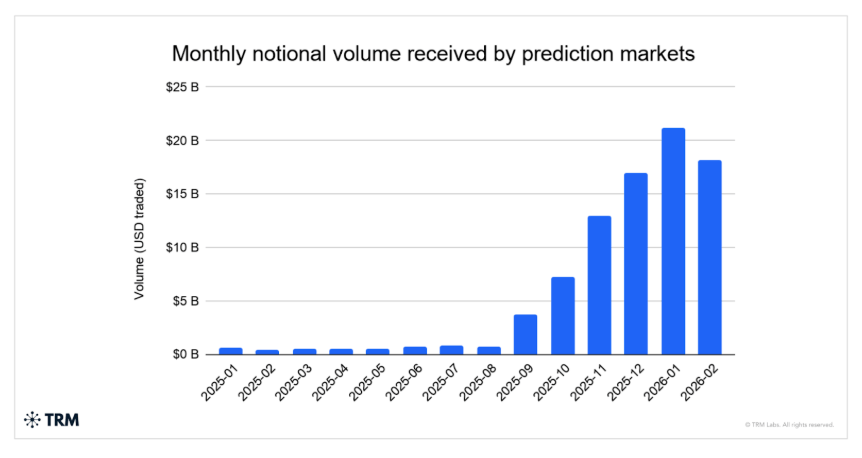
The firm noted that these markets are increasingly serving as real-time indicators for geopolitical and macroeconomic events, gaining attention from major media outlets.

War And Elections Drive Unprecedented Volume

The primary catalyst for this massive activity is no longer the price of digital coins. Instead, traders are putting money on the line over the US-Israeli conflict with Iran and other international flashpoints.
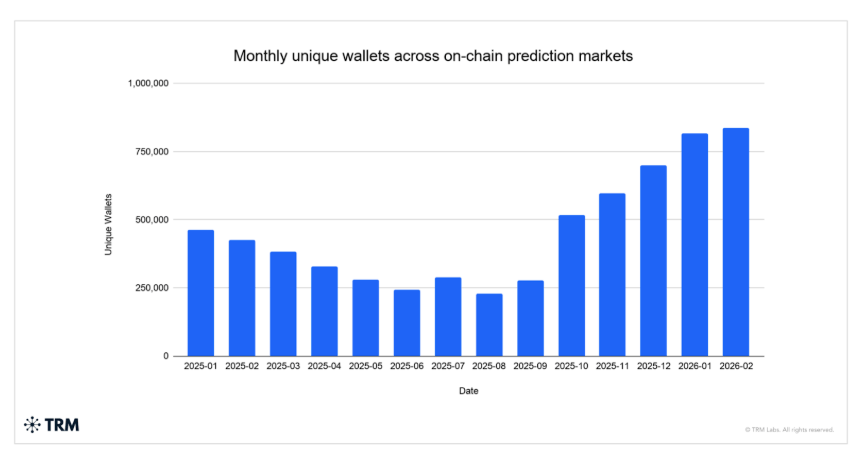
The political implications are also significant, with huge monetary stakes riding on the 2028 US Presidential primary nominations. It has been suggested that such platforms are now being used as a measure of the way in which public opinion is shifting, with their probabilities featured on Google Finance and in the news as a more fluid alternative to traditional political polling.

The extent to which this industry is growing can be quantified by recent figures, which showed an increase of over 2,800% compared to the previous year. Indeed, in March 2026, there were over 191 million transactions in the space.

BTCUSD currently trading at $67,503. Chart: TradingView

To put that in perspective, that figure equates to almost $24 billion in total value for that month alone, representing a staggering increase from the $1.85 billion in March 2025. This indicates that people and investors are viewing these markets as crucial in hedging against any changes in economic policies or shifts in interest rates.

Prediction Markets: Lawmakers Target Event Based Betting

However, the sudden increase in value has caught the attention of regulators in Washington. The regulators have expressed concerns that people may be using inside information to make profits from military actions and other government decisions.

These suspicions of insider trading have led to a bipartisan push for new legislation. US President Donald Trump and members of Congress are looking at a bill that would effectively ban contracts tied to “casino-style” events, potentially stripping the industry of its most popular categories.

Platforms Introduce New Trading Guardrails

In an effort to stave off a total shutdown, major platforms like Kalshi and Polymarket are beginning to implement their own internal restrictions. These measures aim to curb the most controversial types of betting while maintaining the market’s role as a forecasting utility.

Data shows that the outcome of these regulatory battles will determine if the sector stays a permanent fixture of the financial world. For now, the industry remains in a volatile state, balancing between its value as a source of truth and its reputation as a venue for speculating on global tragedy.

Featured image from Unsplash, chart from TradingView

Trending Cryptos

Related Questions

QWhat is the primary catalyst for the massive growth in prediction market activity according to the article?

AThe primary catalyst is no longer the price of digital coins, but traders betting on geopolitical events like the US-Israeli conflict with Iran and other international flashpoints, as well as major political events like the 2028 US Presidential primary nominations.

QHow much value did automated AI agents and trading bots extract from market inefficiencies in a single month?

AAutomated AI agents and high-frequency trading bots extracted around $40 million from market inefficiencies within a single month.

QWhat are US lawmakers concerned about regarding prediction markets, and what action are they considering?

AUS lawmakers are concerned that people may be using inside information to profit from military actions and government decisions. They are considering a bipartisan bill that would ban contracts tied to 'casino-style' events.

QWhat was the reported percentage increase in prediction market transactions in March 2026 compared to the previous year?

AThe reported increase was over 2,800% compared to the previous year, with over 191 million transactions in March 2026.

QHow are major prediction market platforms like Kalshi and Polymarket responding to regulatory pressure?

AThey are implementing their own internal restrictions to curb the most controversial types of betting in an effort to stave off a total shutdown and maintain the market's role as a forecasting utility.

Related Reads

Qualcomm Chip Price Hike Deals a Blow to Android Phones

Qualcomm has officially announced a new round of price increases for its entire chip portfolio, effective September 1. The hikes, reaching up to 18% for the flagship Snapdragon 8 Elite Gen 6 Pro, follow similar moves by MediaTek, intensifying cost pressures on the already strained smartphone industry. CEO Cristiano Amon confirmed the plan, citing the need to offset rising industry-wide costs and restore declining profit margins. Qualcomm's Q3 FY2026 results showed a 25% drop in net profit, with mobile revenue plunging 20% year-over-year, hitting its lowest level since 2021. The surge in AI computing demand has led memory manufacturers to prioritize HBM production, creating a shortage in general-purpose DRAM and NAND Flash chips. Their prices soared by 93%-98% and 55%-60% respectively in Q1 2026, causing the memory cost share in smartphones to jump from 10%-15% to over 30%. Coupled with the soaring cost of advanced nodes like TSMC's 2nm and packaging, overall chip costs have reached historic highs. These upstream pressures are forcing downstream smartphone brands like Xiaomi, OPPO, and vivo to cut orders for mid-to-low-end models by up to 20% and use cost-saving measures like older chipsets. Reportedly, the Snapdragon 8E5 will be repurposed as a "long-lasting" chip for sub-brand phones in H2 2026. Amid this cost crisis, the Android market remains sluggish. Q2 2026 smartphone shipments in China fell 4.3% year-over-year, marking five consecutive quarters of decline. Major Android brands saw market share drop, while Huawei and Apple, with their in-house chip advantages, gained share. Qualcomm is diversifying into automotive and IoT sectors to reduce reliance on smartphones, but these new segments cannot yet fill the mobile revenue gap. Industry observers warn that the full impact of component cost hikes will hit in the second half of 2026, likely leading to higher-than-expected price increases for Android flagships and a further contraction in the Chinese smartphone market.

marsbit32m ago

Qualcomm Chip Price Hike Deals a Blow to Android Phones

marsbit32m ago

Breaking: GPT-5.6 Prices Slashed Effective Today

OpenAI has announced significant price cuts for its GPT-5.6 model API, effective immediately. The entry-level **GPT-5.6 Luna** sees the most drastic reduction, with input prices dropping 80% to $0.20 per million tokens and output prices falling to $1.20 per million tokens. The mid-tier **GPT-5.6 Terra** is reduced by 20%, now costing $2.00 (input) and $12.00 (output) per million tokens. The flagship **GPT-5.6 Sol** maintains its original price but introduces a new **Fast mode**, offering speeds up to 2.5 times faster for double the cost. The company attributes these price reductions to efficiency gains achieved through **GPT-5.6 Sol's own involvement in optimizing its production systems**. The model assisted in rewriting GPU kernels and improving speculative decoding, leading to a 20% reduction in end-to-end service costs and over 15% improvement in token generation efficiency. OpenAI emphasizes this process remained human-led. A key focus of the降价 is to lower the barrier for running **AI agent workflows**. By making the capable, tool-calling Luna model significantly cheaper, OpenAI aims to enable more frequent use in cost-sensitive, high-volume tasks like code review and monitoring. This creates a potential feedback loop: model-assisted efficiency gains lead to lower costs, which enables broader agent deployment, which in turn drives further optimization. The new pricing and features will also apply to Codex and ChatGPT Work subscriptions. The changes intensify competition in the large language model market, with OpenAI directly challenging rivals like Anthropic to respond.

marsbit1h ago

Breaking: GPT-5.6 Prices Slashed Effective Today

marsbit1h ago

Trading

Spot

Hot Articles

Discussions

Welcome to the HTX Community. Here, you can stay informed about the latest platform developments and gain access to professional market insights. Users' opinions on the price of AI (AI) are presented below.

活动图片