Original Author: Paul Veradittakit, Partner, Pantera Capital
Original Compilation: Saoirse, Foresight News
Content Summary
- AI and blockchain are converging and landing around four pillars: payment settlement, identity systems, open systems, and resource aggregation. All four tracks have commercially viable projects, and Pantera's portfolio companies have deployments in all areas.
- Their underlying logics are inherently complementary: AI represents infinite supply abundance (massive content, endless agents), while blockchain represents the scarcity of verifiable ownership (verifiable provenance, native on-chain settlement); the former generates content and services, the latter authenticates ownership and settles value.
- There is a clear market valuation mismatch: the valuation of the ten leading AI companies tracked by Pantera shows the largest divergence in history from crypto asset valuations, yet their industrial foundations are deeply intertwined.
- AI agents will not open corporate bank accounts, use Fedwire, or ACH clearing channels. Instead, they will rely on stablecoins to complete machine-speed transactions on-chain; the agent economy is being built on blockchain infrastructure that existing institutions have barely allocated to.
While global capital is currently focused on AI, AI is only half the story of industrial transformation. A new era-defining technological convergence is quietly taking shape at the intersection of AI and blockchain. Massive capital piled into primary and secondary markets has inflated AI company valuations, with many targets already in a valuation bubble; in contrast, the crypto sector is fundamentally undervalued, representing a premium opportunity to position for this long-term tech shift. Neither technology can reach its full potential alone; empowering each other is the core thesis. For years, the market has viewed AI and crypto as separate trends, but in essence, they are two landing paths for the same industrial wave.
AI has given rise to a new economic entity—autonomous agents. These entities need to hold assets, transfer value, and collaborate at scale, and crypto and blockchain are the only financial collaboration infrastructure designed from the ground up for non-human entities. Agents and programmatic bots are already native blockchain users, leading us to conclude that the vast majority of agent-driven transactions will occur on-chain in the future. The convergence of AI and blockchain is one of Pantera's strongest research and investment theses, and the team is dedicating significant resources and capital to this sector.
Technology Convergence Patterns from Industrial Development History
Throughout history, the collision of two leading technologies often catalyzes leaps in economic development: steam engines paired with railroads, electricity paired with manufacturing, the internet paired with smartphones. Each time, new technological capabilities combined with supporting infrastructure gave birth to entirely new economic models and enduring companies.
AI enables the mass production of intelligence, content, agents, and digital identities at near-zero marginal cost, bringing infinite supply; blockchain anchors scarcity, providing verifiable asset ownership, collaboration with minimal trust, and cryptographically secure data. As Dan Morehead and Cosmo Jiang stated in Pantera's latest blockchain research report, talent pools for both technologies highly overlap (rooted in math and open-source culture), and their underlying logics are complementary yin and yang: AI creates abundance, blockchain defines ownership.
Previously, at the Convergence Summit hosted by YZi Labs, I had an in-depth conversation with Alex Odagiu about this macro shift, discussing how AI agents can leverage blockchain for programmable trust, the utility value of stablecoins and asset tokenization, and the adoption timeline for the agent economy.
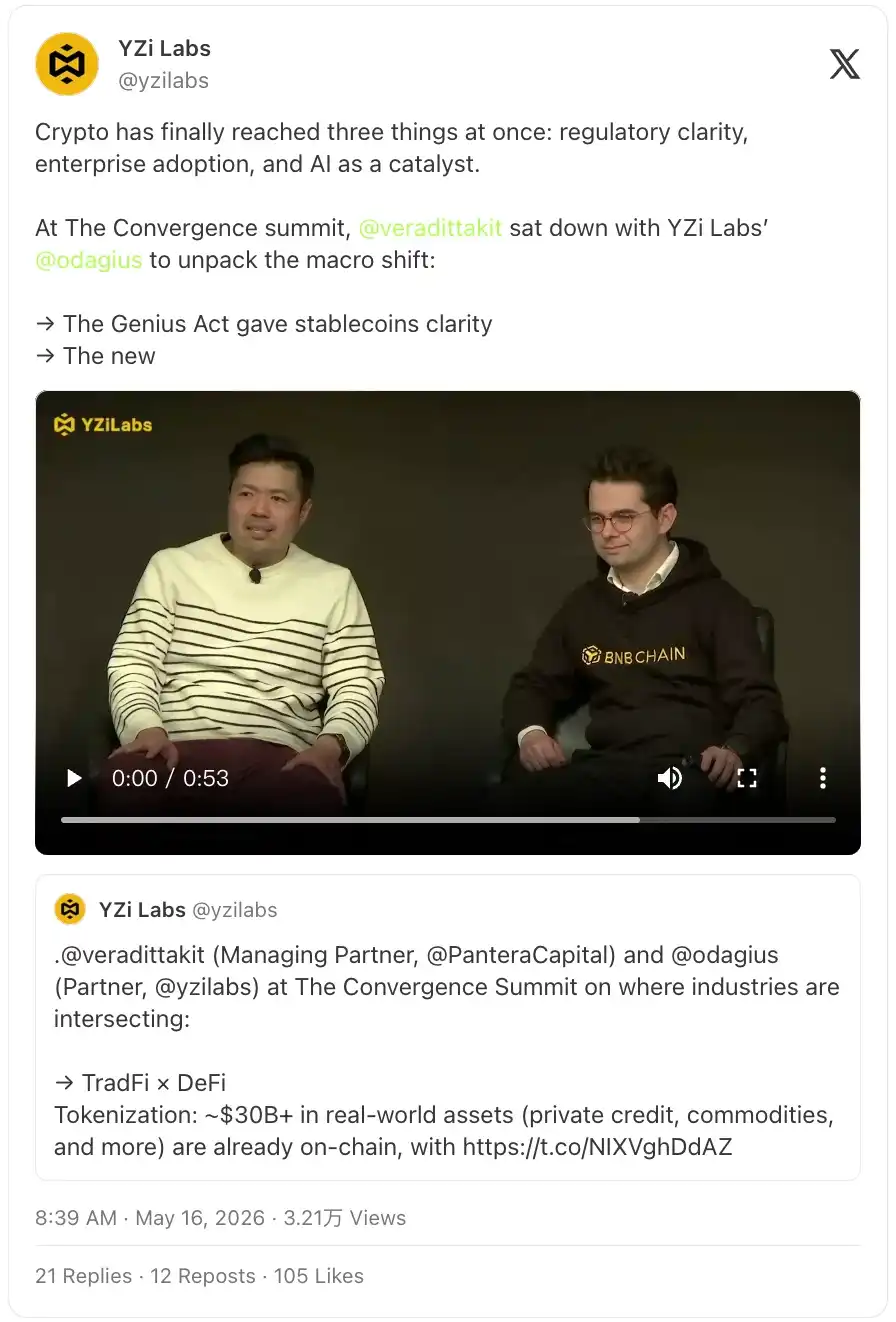
Source:YZi Labs Convergence Summit, May 2026
Current State of Convergence Applications
AI Agents Need a Native Financial System Built for Machines
The current financial system is designed for humans, with cumbersome approvals, limited access, and heavy reliance on centralized intermediaries. The industry urgently needs infrastructure tailored for agents, and blockchain is the optimal solution ready for scale.
Transaction and Payment Scenarios
Use cases are already live and validated. OpenFX uses stablecoins as its underlying settlement layer, with annualized transaction settlement volume exceeding $60 billion. The firm explicitly states: the next generation of users are not natural persons but software programs, and within a decade, AI agents will become the largest trading group in the forex market.
Agents cannot open bank accounts, access Fedwire, or the SWIFT system. They need low-cost, permissionless, 24/7, programmatically clearable payment rails, which are precisely blockchain's core strengths.
Another benchmark project, Alchemy, hailed as the AWS of Web3, is a core development platform for next-gen AI + crypto applications. From agent-specific wallets to on-chain execution layers, Alchemy significantly lowers the barrier for developers building agent infrastructure.
Human Identity Verification and Attestation Become Essential
In an environment flooded with AI-generated content and synthetic accounts, distinguishing real humans, programs, and AI-generated content has become essential. Traditional identity systems like passports, government records, and bank cards, built on centralized institutions, are unfit for the current landscape. The industry urgently needs a global, cryptographically secure, privacy-preserving, censorship-resistant online identity verification solution, and blockchain perfectly fits the bill.
World (formerly Worldcoin) is the leading project in this space, building a global, privacy-preserving identity and financial network based on a human identity attestation protocol, using cryptographic proofs to verify users as unique individuals:
- Users verify via iris scanning using the World Orb biometric device;
- Users obtain a World ID, with identity information hashed and stored on the Worldchain public blockchain;
- The project has verified over 18 million unique real users, ranking among the top five most active public chains globally.
Its practical value is evident from enterprise partnerships disclosed in Pantera's latest Stateful podcast: Tinder uses it to combat fake accounts, Reddit uses it to filter real users, and Zoom integrates deepfake detection for video calls. OpenAI founder Sam Altman co-founded World, anticipating the massive identity fraud challenges his own AI technology would create.
We also invested in TransCrypts, which focuses on a self-sovereign identity and verifiable credentials blockchain base layer. Users can self-custody trusted records like education, employment, and income on-chain, preventing AI-forged identities and deepfake scams at the source. In the age of agents, programmable trust is becoming the industry standard.
AI Valuation Bubble, Crypto Assets Undervalued
AI sector valuations have surged, while crypto assets have corrected, creating a historically rare relative value investment window. As of May 2026, the leading AI index traded at a 49% premium to its four-year long-term trend line; Bitcoin's price traded at a 42% discount to its own historical long-term trend line. Even though the agent economy will ultimately run on crypto infrastructure, the degree of their valuation divergence has reached a historical extreme.
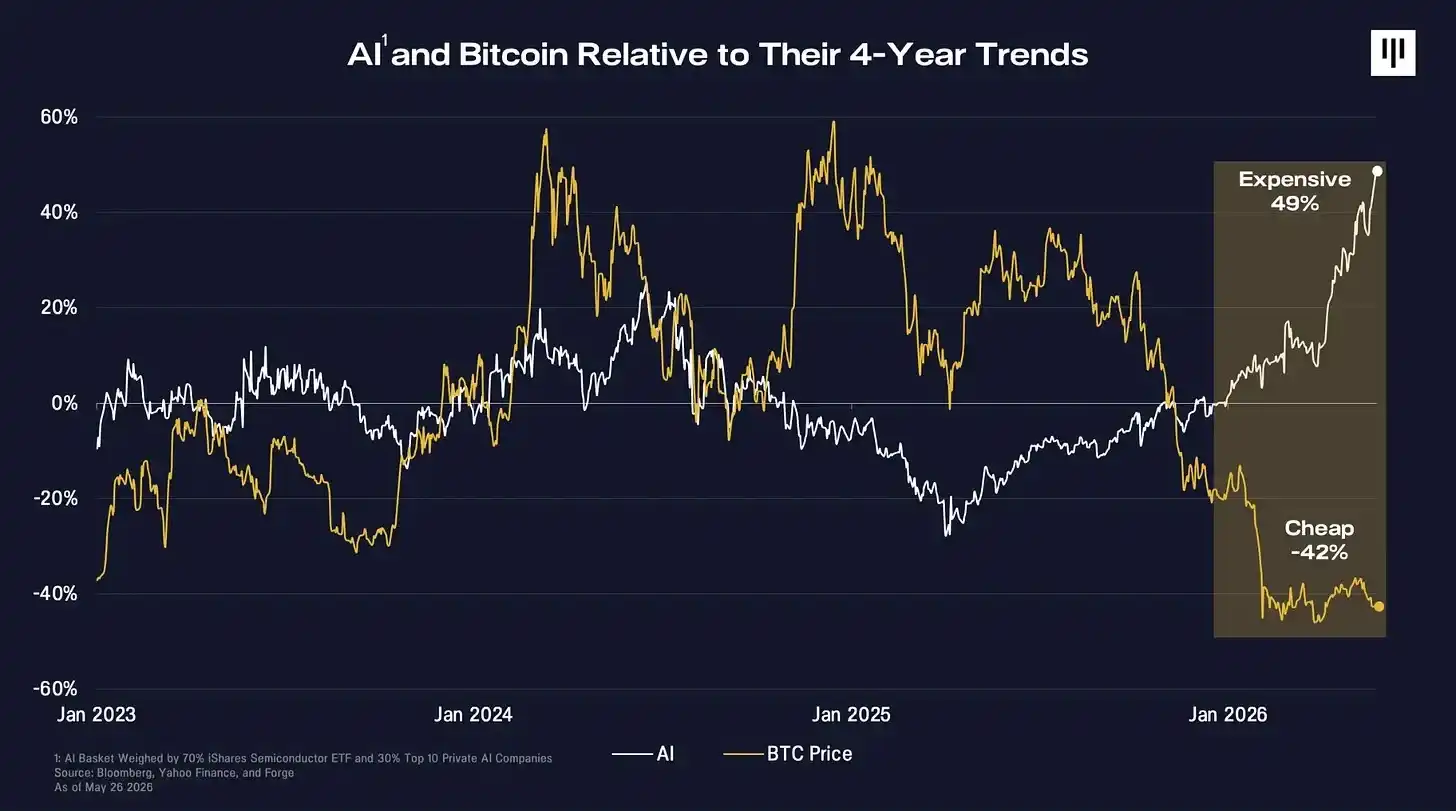
Bitcoin is Undervalued Relative to AI and its Trend
Investment competition in the AI and crypto crossover sector is intensifying. BlackRock's Robbie Mitchnick recently stated: AI agents will not use the traditional banking system; they will only use blockchain financial tools. Cryptocurrencies are the native currency of the machine intelligence era.
The Window for Industrial Adoption is Open
Entrepreneurs currently building in this space should know: the convergence of AI and blockchain is not a future trend, but a present reality being deployed. Agents require dedicated payment rails, decentralized identity verification systems, verifiable credentials, programmable money, and development infrastructure that treats agents as native users—none of which traditional finance can provide.
Underlying projects within Pantera's investment and research ecosystem, like Alchemy, World, TransCrypts, and OpenFX, are maturing. The global regulatory environment continues to improve favorably, and capital is gradually recognizing the valuation discount in the crypto sector. If you are working on agent-native finance, decentralized identity, attestation and provenance for AI-generated content, or autonomous system collaboration on-chain, now is the golden time to start. The industry is still early, underlying technology is ready, and market demand is exploding.