Bitcoin spot demand weakens as new capital hesitates despite ETF inflows

ambcryptoPublished on 2026-07-20Last updated on 2026-07-20

Abstract

Bitcoin remains unable to decisively break above the $65k-$67k local supply zone despite a recent positive turnaround in spot Bitcoin ETF inflows since mid-July. Analyst data shows a significant drop-off in 30-day Bitcoin spot demand, deteriorating from -80k BTC to -170k BTC. While short-covering in derivatives and reduced sell pressure from short-term holders have provided stability, key indicators suggest this is stabilization, not a bullish reversal. The Bitcoin New Investors metric, while increased, remains near yearly lows at 8.1, indicating insufficient new capital strength. Furthermore, the short-term holder spent output profit ratio (STH SOPR) remains below 1.0, meaning these holders are on average realizing losses, a sign bearish sentiment persists. The overall conclusion is that the market lacks the momentum from new capital and positive short-term holder sentiment required for a sustained bullish trend reversal.

1alt HD: ETF Turnaround Proves Insufficient to Trigger True Macro Bullish Turnaround for Bitcoin Traders

Bitcoin [BTC] was struggling to scale the $65k local supply zone. Since July 14, the spot Bitcoin ETF inflows have been positive. The injection of capital has not been enough to substantially elevate prices yet.
Source: CryptoQuant

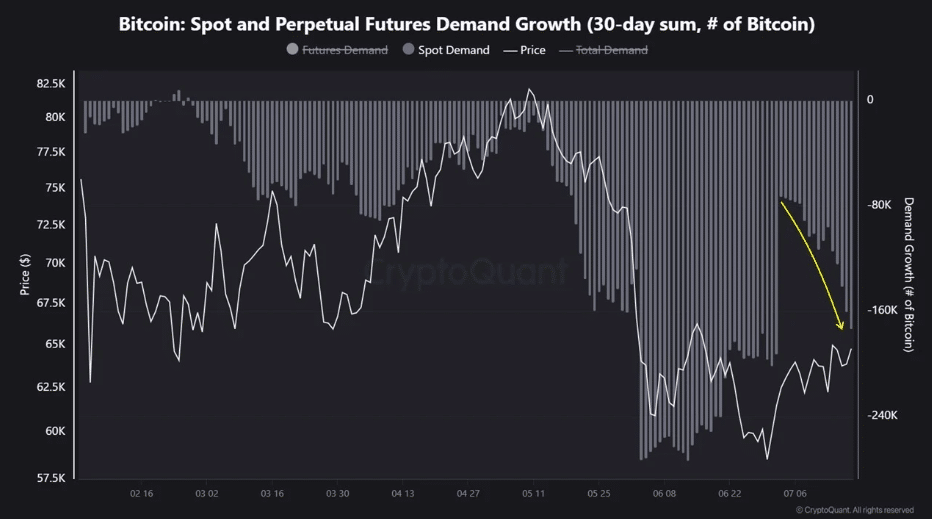
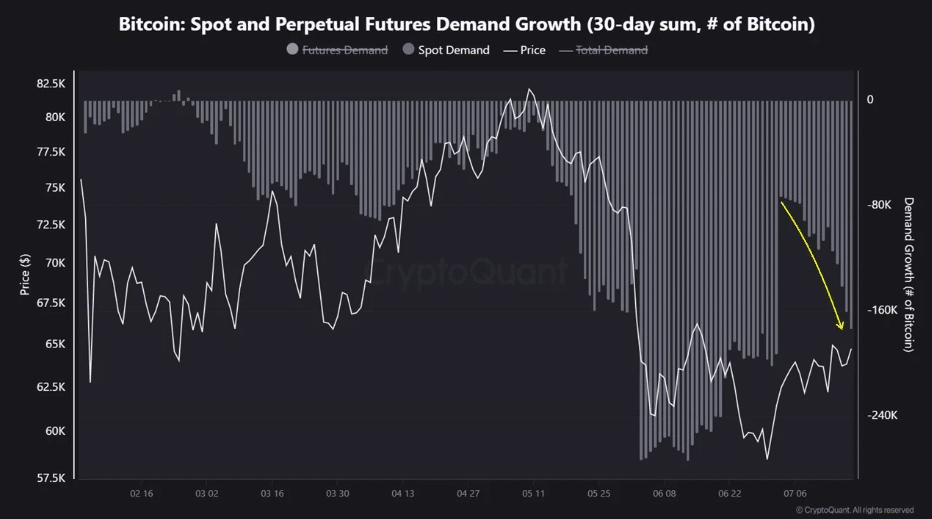
Crypto analyst ScenarioX noted a steady drop-off in the 30-day Bitcoin spot demand. The metric recovered to -80k BTC in early July, but has since deteriorated to -170k BTC, the analyst explained in a post on CryptoQuant Insights.

Despite decreased demand, prices have stayed relatively stable around $65k because of short-covering in the derivatives market. Easing short-term holder sell pressure was also a contributing factor.

AMBCrypto reported that the turnaround in ETF flows was not enough to confirm a bullish reversal. A reading of the short-term price structure highlighted the importance of the $67.3k local swing high.

Lack of new investors growth signals stabilization, not reversal
Source: Axel Adler Jr.

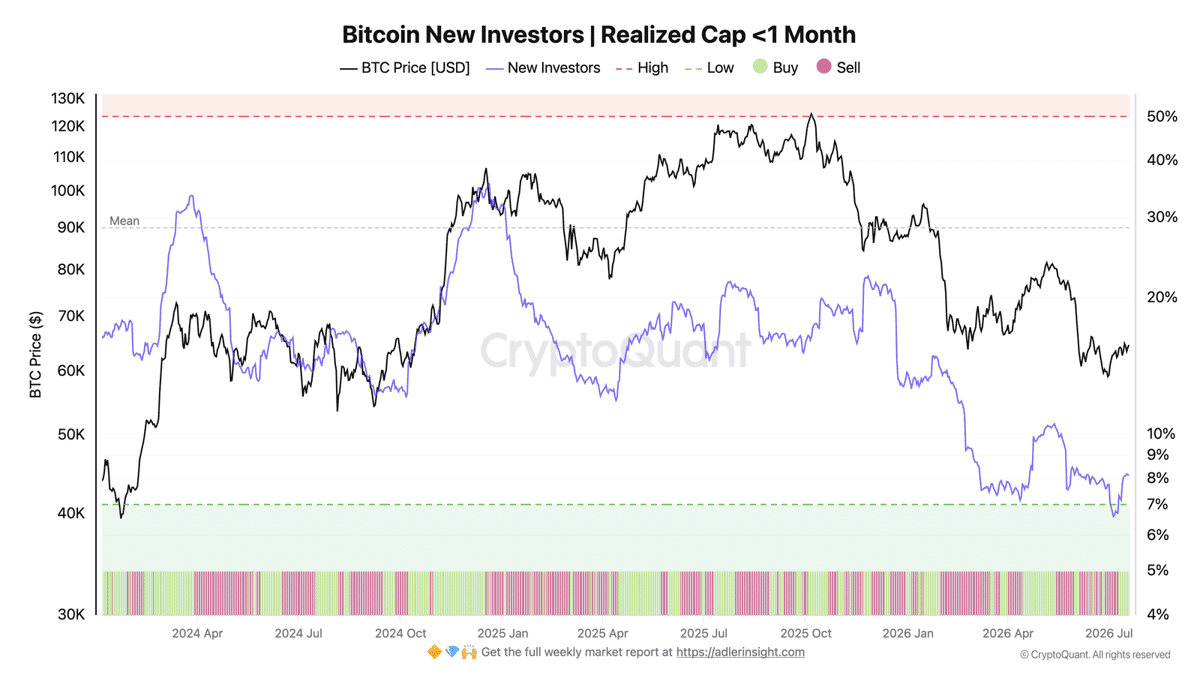
The Bitcoin New Investors metric remained near its yearly lows. It measures the share of capitalization concentrated among coins younger than 1 month [not moved in a month or less].

Crypto analyst Axel Adler Jr. used this metric to gauge new capital activity and short-term demand. The analyst observed a reading of 8.1, with the lower boundary at 7 and the upper at 50.

This meant an increase in new capital, but not in enough strength to point toward a BTC trend reversal.
Source: Axel Adler Jr.

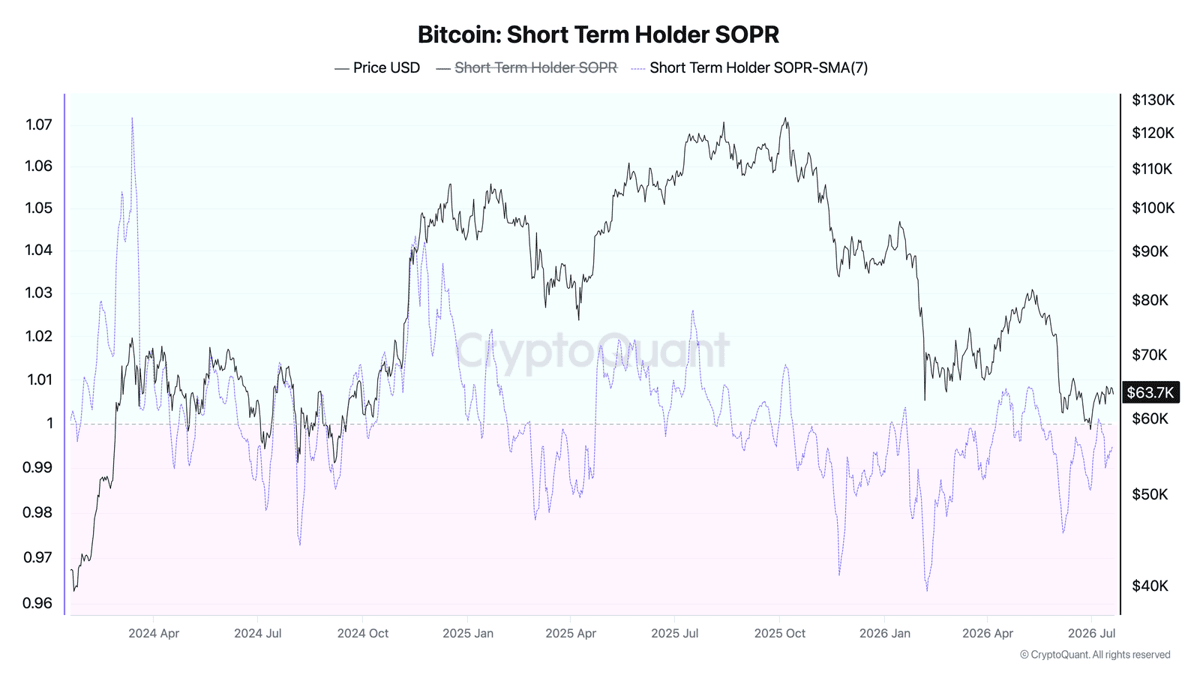
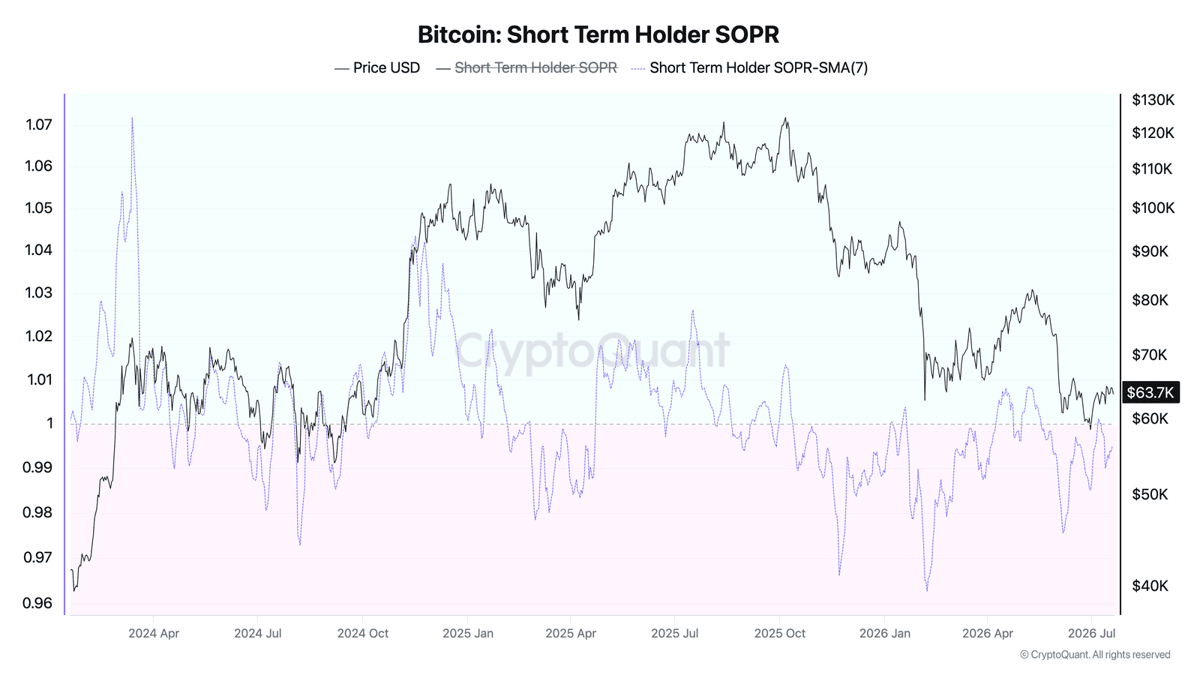
Further evidence of a local stabilization instead of a reversal came from the short-term holder spent output profit ratio [STH SOPR]. The metric measures the average profitability of short-term Bitcoin holders.

Its 7-day moving average was at 0.99, below the 1.0 mark that separates profitability from realized losses.

A sustained recovery in the metric above 1.0 would signal market sentiment has shifted. As things stand, the lack of significant participation from new capital and short-term holders realizing losses meant that bears were still in control.


Final Summary

  • Bitcoin has not yet found the momentum to take prices above the $65k-$67k local supply zone.
  • The bounce toward $65k was only a brief respite from selling, and not the beginning of a bullish recovery, the metrics showed.


Trending Cryptos

Related Questions

QWhat is the main reason Bitcoin has been unable to break above the $65k-$67k supply zone, despite positive ETF inflows?

AThe main reason is weakening spot demand and a lack of significant new capital entering the market. While ETF flows turned positive, this injection was insufficient to substantially elevate prices. Key metrics like the 30-day Bitcoin spot demand and the New Investors metric indicate hesitation from new capital.

QAccording to the analyst ScenarioX, how has the 30-day Bitcoin spot demand metric changed from early July?

AAccording to analyst ScenarioX, the 30-day Bitcoin spot demand metric recovered to -80k BTC in early July but has since deteriorated to -170k BTC, indicating a significant drop-off in demand.

QHow does the article explain Bitcoin's price stability around $65k despite decreased spot demand?

AThe article explains that price stability around $65k is maintained due to short-covering in the derivatives market and easing sell pressure from short-term holders, which are offsetting the weakness in spot demand.

QWhat does the 'Bitcoin New Investors' metric measure, and what was its recent reading according to Axel Adler Jr.?

AThe 'Bitcoin New Investors' metric measures the share of Bitcoin's market capitalization concentrated among coins that have not moved in one month or less (coins younger than 1 month). According to analyst Axel Adler Jr., its recent reading was 8.1, which is near yearly lows.

QWhat signal would indicate a shift in market sentiment according to the STH SOPR (Short-Term Holder Spent Output Profit Ratio) metric?

AAccording to the STH SOPR metric, a sustained recovery above the 1.0 mark would signal that market sentiment has shifted. This level separates profitability from realized losses for short-term holders. Currently, its 7-day moving average is at 0.99, indicating losses are still being realized.

Related Reads

Who Decides Bitcoin's Rules? BIP-110 Ignites Governance Debate

Title: Who Decides Bitcoin's Rules? BIP-110 Ignites Governance Debate A new technical proposal, BIP-110 (Reduced Data Temporary Softfork), has sparked a fundamental governance debate within the Bitcoin community. It aims to impose new consensus rules for one year to limit non-financial data (like inscriptions and Runes) on-chain, moving beyond simple node and miner policy filters to invalidate currently valid transactions. Supporters argue that default policies have failed due to workarounds, necessitating consensus-layer changes to protect Bitcoin's core monetary function from data spam. Critics, including Michael Saylor and Adam Back, contend this dangerously centralizes judgment, undermines permissionlessness, and sets a risky governance precedent. They advocate for market-based solutions like fees or Layer 2s instead. The debate exposes deeper tensions: miners are divided on activation; node operators assert their sovereignty; Bitcoin Core developers influence defaults without direct accountability; and large corporate holders like MicroStrategy now wield narrative influence. Technically, BIP-110 may not fully block data and carries a disclosed consensus bug risk. Ultimately, BIP-110 acts as a stress test, forcing the community to confront the unresolved question: who legitimately decides what Bitcoin is and how it evolves, amidst competing claims from miners, nodes, developers, and capital holders.

链捕手10m ago

Who Decides Bitcoin's Rules? BIP-110 Ignites Governance Debate

链捕手10m ago

Zcash's New Node Zakura Goes Live: Privacy Payments Can Reach 50,000 TPS, Aiming to Rival Visa and Mastercard

Zcash, a privacy-focused cryptocurrency, has launched a new full node software called Zakura version 1.0.0. Developed by Zcash co-founder Sean Bowe and Dev Ojha, with private ZEC donations, its goal is to enable Zcash to process over 50,000 transactions per second (TPS)—matching the scale of Visa and Mastercard—while maintaining full transaction privacy and verifiability. This addresses a key bottleneck, as Zcash currently handles only about 1 private transaction per second. Zakura is a fork of the Zcash Foundation's Zebra node. It features chain pruning and snapshots, reducing disk usage and allowing new nodes to sync in under two minutes. It also offers compatibility with the legacy `zcashd` client interface. The scalability challenge stems from the large data size of privacy proofs. Bowe's Tachyon project aims to use recursive proofs to reduce consensus-layer data needs from ~500 MB/s to ~100 MB/s. For wallet scalability, Valar Group is researching Private Information Retrieval (PIR) tech to allow wallets to fetch their data privately. Zakura supports fast block propagation and the upcoming "Ironwood" network upgrade (NU6.3), scheduled for activation around July 28th. Ironwood was created to contain a critical inflation bug discovered in the Orchard shielded pool in May 2024. The fix uses "turnstiles" to trap any counterfeit ZEC created during the vulnerability period within the shielded pool, preventing it from entering circulation and restoring supply integrity.

marsbit25m ago

Zcash's New Node Zakura Goes Live: Privacy Payments Can Reach 50,000 TPS, Aiming to Rival Visa and Mastercard

marsbit25m ago

Replicating the "DeepSeek Moment"? Wall Street Unanimously Says: Kimi K3 Instead Strengthens Computing Power Demand

Title: Wall Street Sees Kimi K3 as a Catalyst for Compute Demand, Not a "DeepSeek Moment 2.0" Summary: Following the release of Moonshot AI's powerful open-source model Kimi K3, initial market reaction mirrored the "DeepSeek moment" that sparked a sell-off in compute stocks earlier in 2025, fearing reduced demand for AI infrastructure. However, major Wall Street banks including UBS, Nomura, BofA, and Citi argue the opposite: K3 will accelerate, not weaken, demand for compute, memory, storage, and networking. Their analysis centers on K3's specifications—2.8 trillion parameters, 1M token context, and MoE architecture—which represent a "scale" story rather than a pure "efficiency" one like DeepSeek R1. These features increase pressure on inference, memory (especially KV cache), and storage. Analysts invoke Jevons Paradox: as high-quality models become more affordable (K3 is cheaper than top closed models but not the cheapest), usage and token volumes expand, ultimately increasing total compute consumption. The reports highlight that competition will force leading US AI labs (OpenAI, Anthropic, Google) to invest more in training and iteration to maintain their edge. Furthermore, the rise of capable open-source models like K3 is expanding the global AI developer ecosystem, with Chinese models now accounting for over 45% of developer traffic. Key beneficiaries identified across the AI infrastructure chain include memory/storage players (e.g., Micron, Samsung), compute leaders (Nvidia, TSMC), networking suppliers (due to "super-node" cluster needs for deploying K3), and cloud platforms (e.g., Alibaba) that host diverse model ecosystems. The consensus is that stronger open-source models are an entry point for the next wave of infrastructure demand diffusion, provided workload growth outpaces efficiency gains.

链捕手28m ago

Replicating the "DeepSeek Moment"? Wall Street Unanimously Says: Kimi K3 Instead Strengthens Computing Power Demand

链捕手28m ago

Prediction Markets Witness $200 Million in Suspicious Insider Trading Over Six Months, Who's Reaping the Profits?

Prediction markets are booming, with monthly trading volume exceeding $210 billion as of 2026. However, a Bloomberg investigation analyzing data from August 2025 to June 2026 reveals a parallel surge in suspicious trading, totaling roughly $200 million in the first half of 2026 on Polymarket alone. These potentially illicit trades are concentrated in geopolitical and military events, with 57% of the highest-earning wallets created less than 24 hours before trading. The analysis, using AI-driven platform Polysights, found profits are highly concentrated: the top 1% of wallets captured over half the gains. A significant portion (71%) of funds for marked trades originated from U.S.-regulated crypto exchanges, despite Polymarket's ban on U.S. users. Traders are increasingly using coordinated clusters of wallets and focusing on smaller markets to avoid detection. Two major criminal cases highlight the risks: a U.S. Army sergeant was charged for using classified information on a Venezuela operation to profit nearly $410,000, and an Israeli reservist allegedly leaked details of an Iran strike for a $128,400 gain. Regulatory scrutiny is intensifying. The CFTC is investigating Polymarket, congressional bills aim to ban insiders from trading, and major firms like Goldman Sachs have restricted employee participation. In response, Polymarket has updated its rules against insider trading and provided wallet data to authorities. The core challenge remains distinguishing between skilled research and trading on non-public information in a market designed to price such knowledge.

Foresight News38m ago

Prediction Markets Witness $200 Million in Suspicious Insider Trading Over Six Months, Who's Reaping the Profits?

Foresight News38m ago

Trading

Spot

Hot Articles

What is $BITCOIN

DIGITAL GOLD ($BITCOIN): A Comprehensive Analysis Introduction to DIGITAL GOLD ($BITCOIN) DIGITAL GOLD ($BITCOIN) is a blockchain-based project operating on the Solana network, which aims to combine the characteristics of traditional precious metals with the innovation of decentralized technologies. While it shares a name with Bitcoin, often referred to as “digital gold” due to its perception as a store of value, DIGITAL GOLD is a separate token designed to create a unique ecosystem within the Web3 landscape. Its goal is to position itself as a viable alternative digital asset, although specifics regarding its applications and functionalities are still developing. What is DIGITAL GOLD ($BITCOIN)? DIGITAL GOLD ($BITCOIN) is a cryptocurrency token explicitly designed for use on the Solana blockchain. In contrast to Bitcoin, which provides a widely recognized value storage role, this token appears to focus on broader applications and characteristics. Notable aspects include: Blockchain Infrastructure: The token is built on the Solana blockchain, known for its capacity to handle high-speed and low-cost transactions. Supply Dynamics: DIGITAL GOLD has a maximum supply capped at 100 quadrillion tokens (100P $BITCOIN), although details regarding its circulating supply are currently undisclosed. Utility: While precise functionalities are not explicitly outlined, there are indications that the token could be utilized for various applications, potentially involving decentralized applications (dApps) or asset tokenization strategies. Who is the Creator of DIGITAL GOLD ($BITCOIN)? At present, the identity of the creators and development team behind DIGITAL GOLD ($BITCOIN) remains unknown. This situation is typical among many innovative projects within the blockchain space, particularly those aligning with decentralized finance and meme coin phenomena. While such anonymity may foster a community-driven culture, it intensifies concerns about governance and accountability. Who are the Investors of DIGITAL GOLD ($BITCOIN)? The available information indicates that DIGITAL GOLD ($BITCOIN) does not have any known institutional backers or prominent venture capital investments. The project seems to operate on a peer-to-peer model focused on community support and adoption rather than traditional funding routes. Its activity and liquidity are primarily situated on decentralized exchanges (DEXs), such as PumpSwap, rather than established centralized trading platforms, further highlighting its grassroots approach. How DIGITAL GOLD ($BITCOIN) Works The operational mechanics of DIGITAL GOLD ($BITCOIN) can be elaborated on based on its blockchain design and network attributes: Consensus Mechanism: By leveraging Solana’s unique proof-of-history (PoH) combined with a proof-of-stake (PoS) model, the project ensures efficient transaction validation contributing to the network's high performance. Tokenomics: While specific deflationary mechanisms have not been extensively detailed, the vast maximum token supply implies that it may cater to microtransactions or niche use cases that are still to be defined. Interoperability: There exists the potential for integration with Solana’s broader ecosystem, including various decentralized finance (DeFi) platforms. However, the details regarding specific integrations remain unspecified. Timeline of Key Events Here is a timeline that highlights significant milestones concerning DIGITAL GOLD ($BITCOIN): 2023: The initial deployment of the token occurs on the Solana blockchain, marked by its contract address. 2024: DIGITAL GOLD gains visibility as it becomes available for trading on decentralized exchanges like PumpSwap, allowing users to trade it against SOL. 2025: The project witnesses sporadic trading activity and potential interest in community-led engagements, although no noteworthy partnerships or technical advancements have been documented as of yet. Critical Analysis Strengths Scalability: The underlying Solana infrastructure supports high transaction volumes, which could enhance the utility of $BITCOIN in various transaction scenarios. Accessibility: The potential low trading price per token could attract retail investors, facilitating wider participation due to fractional ownership opportunities. Risks Lack of Transparency: The absence of publicly known backers, developers, or an audit process may yield skepticism regarding the project's sustainability and trustworthiness. Market Volatility: The trading activity is heavily reliant on speculative behavior, which can result in significant price volatility and uncertainty for investors. Conclusion DIGITAL GOLD ($BITCOIN) emerges as an intriguing yet ambiguous project within the rapidly evolving Solana ecosystem. While it attempts to leverage the “digital gold” narrative, its departure from Bitcoin's established role as a store of value underscores the need for a clearer differentiation of its intended utility and governance structure. Future acceptance and adoption will likely depend on addressing the current opacity and defining its operational and economic strategies more explicitly. Note: This report encompasses synthesised information available as of October 2023, and developments may have transpired beyond the research period.

956 Total ViewsPublished 2025.05.13Updated 2025.05.13

What is $BITCOIN

Discussions

Welcome to the HTX Community. Here, you can stay informed about the latest platform developments and gain access to professional market insights. Users' opinions on the price of BTC (BTC) are presented below.

活动图片