Just Now, Claude Fable 5 Took First Place Again

marsbitPublished on 2026-08-04Last updated on 2026-08-04

Abstract

Claude Fable 5 has achieved a staggering 64% success rate on the MirrorCode leaderboard, significantly outperforming competitors like GPT-5.6 Sol (approx. 21%). The benchmark tests models' ability to fully reverse-engineer and reimplement 15 medium-to-large software projects (e.g., Unix tools, compilers) in an isolated environment, requiring a perfect 100% pass rate on all tests. Notably, Fable 5's performance remained remarkably consistent at 61% when using the niche language Ada, compared to 64% with Go. Given that Python training data is roughly 230x more abundant than Ada, this minimal 3-point drop suggests the model has moved beyond simple code memorization and can reason about and construct complete software projects from fundamental principles. The MirrorCode benchmark is extremely rigorous, allowing up to 100 billion tokens and 7 days of continuous runtime per task to achieve 100% correctness, with one run costing $2600 over 19 days. The results indicate that state-of-the-art AI is transitioning from a tool for writing code snippets to an agent capable of autonomously completing entire, sizable software projects when given clear specifications and automated verification. This shift will make code increasingly inexpensive while elevating the value of those who can precisely define problems and validate outcomes.

This time, Claude has truly created a gap in the AI programming rankings!

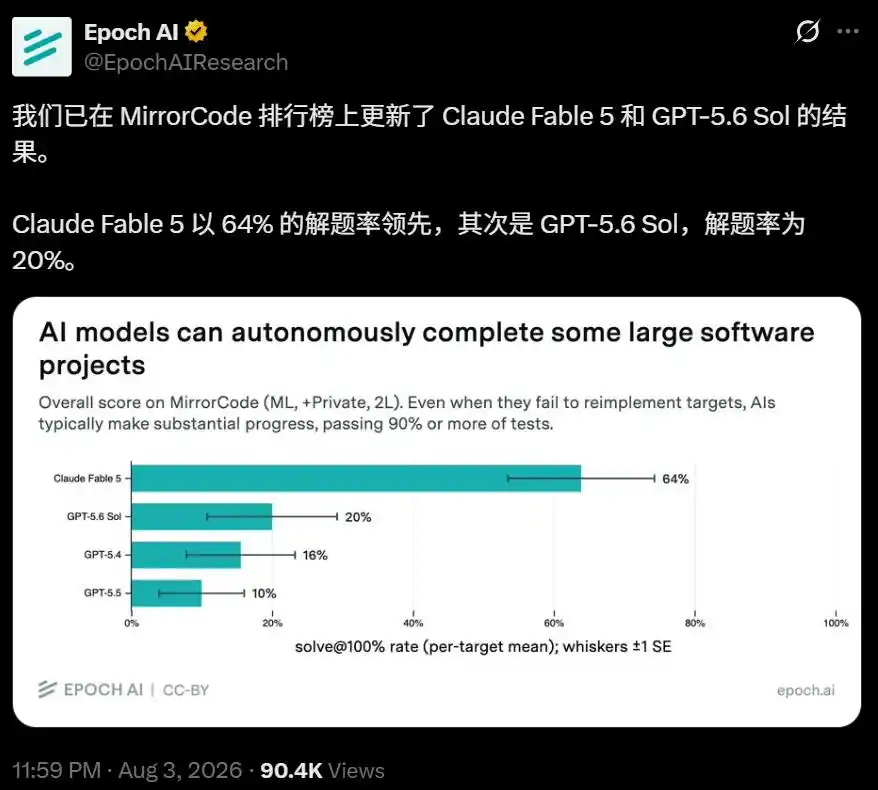
On the freshly updated MirrorCode leaderboard, Claude Fable 5 has once again topped the chart with an absolute success rate of 64%.

Closely following is GPT-5.6 Sol, with a score only one-third of Claude's!

GPT-5.5, ranked fourth, fared even worse. Not only did it achieve only 10%, but it was also beaten by its own predecessor, GPT-5.4.
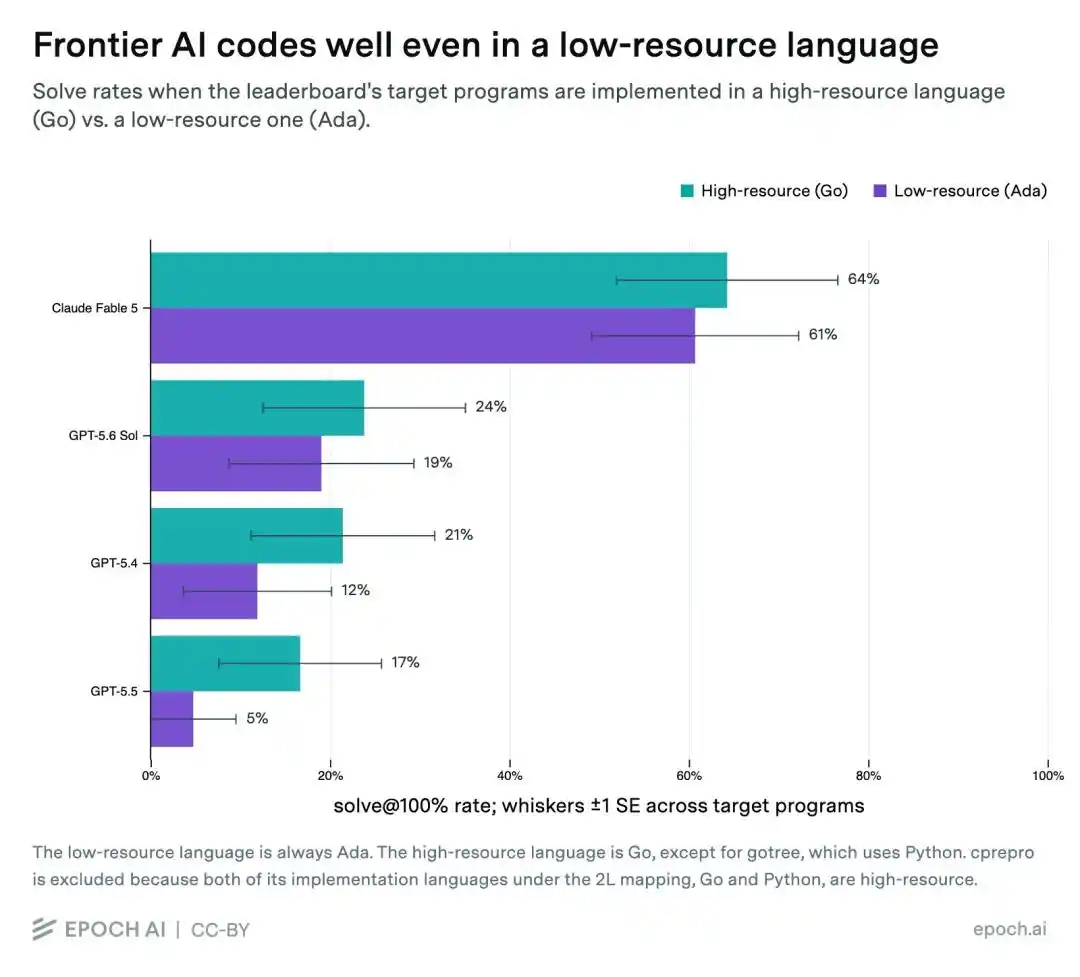
What's even more surprising is that when using high-resource languages like Go, Fable 5's solve rate is 64%; when switched to the niche language Ada, its score remains as high as 61%.

It's worth noting that in the open-source world, Python corpus is about 230 times larger than Ada's.

But with Fable 5, the score only dropped by 3 percentage points.
This is interesting.

If the model primarily relied on memorizing syntax and common patterns of popular languages, its performance should have dropped when switched to Ada.

But the current results point to another possibility——

The strongest model has broken free from the pull of specific corpora and has begun learning how to construct a complete software project from scratch.

Stuck at the 100% Pass Line, the 100 Billion Token Ultimate Test

Specifically, the complete MirrorCode contains 25 target programs, covering fields such as Unix tools, interpreters, data queries, bioinformatics, cryptography, and compression tools.

Here, the model is placed in an isolated environment—no internet, no access to the original project source code, and no ability to download third-party dependencies. All it gets is high-level documentation, a portion of visible tests, and access to call the original program repeatedly.

Next, it must continuously feed data to the original program, observe the output to guess the internal logic, and then bit by bit write a new program with consistent behavior.

The latest leaderboard selects 15 Medium and Large targets from this. Each target uses two implementation languages, and each language is run three times.

Moreover, the completion rate for both visible and hidden tests must reach 100% to pass; 99.9% is not acceptable.

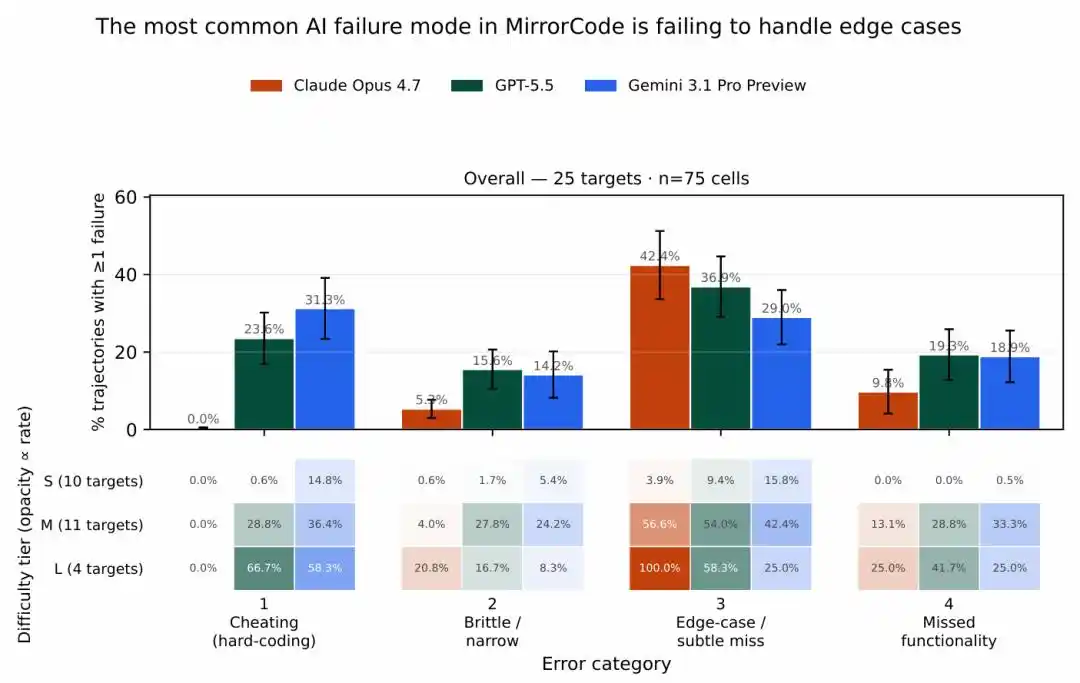
If even one edge case is missed, the entire run is still counted as a failure.
To force the model to fill the last few gaps, MirrorCode pushed the single-run budget to 100 billion tokens, allowing continuous runs for up to 7 days.

One of the most expensive tasks mentioned in the paper is even more exaggerated: the model ran continuously for 19 days, with a single-run cost reaching $2,600.

During these 19 days, the model would repeatedly run the original program, compare results, add missing features, and run the tests again. If there was an error, it would investigate the cause; if the output didn't match, it would change assumptions; once a part passed, it would move on to the next gap.

The entire process resembles debugging lasting several days more than a single generation.
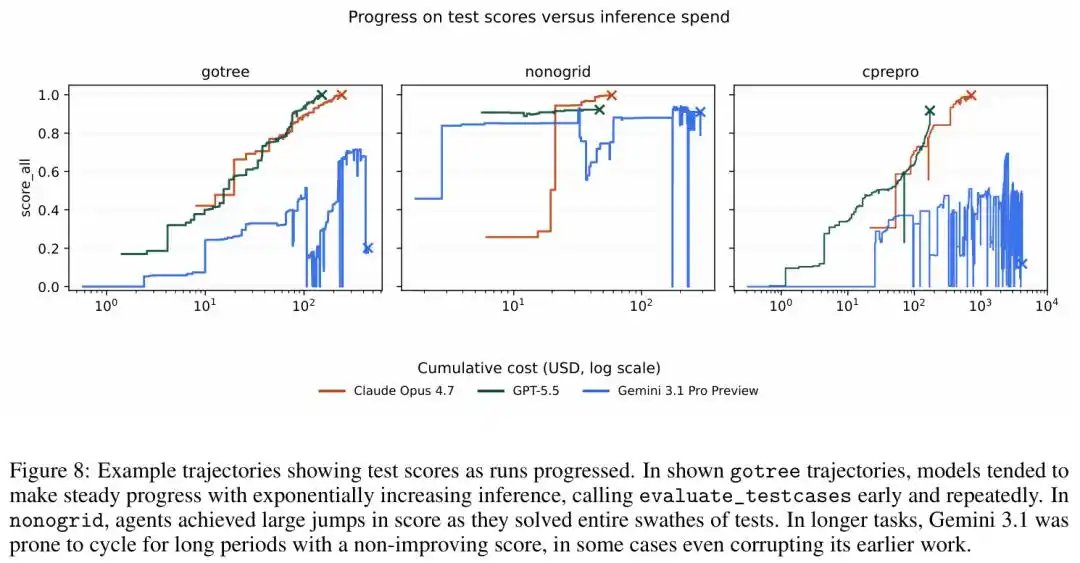
The example of 'gotree' is the most straightforward.

This bioinformatics tool originally had about 16,000 lines of Go code and over 40 commands.

Claude Opus 4.7 took 14 hours and $251, passing 2000 out of 2001 tests, achieving a completion rate of 99.95%.

Although it missed one obscure edge case handling date comments, getting blocked by MirrorCode's 100% pass line, it compressed a project estimated to take weeks into just over ten hours——

Epoch estimates that without using AI, a human engineer would need at least 2 to 17 weeks to complete the same task.

In the Corpus Desert, Fable 5 Dropped Only 3 Points

The MirrorCode paper used StarCoder's public training mix as a reference.

Python accounts for about 8%, while Ada is only 0.034%—the former is roughly 230 times larger than the latter.
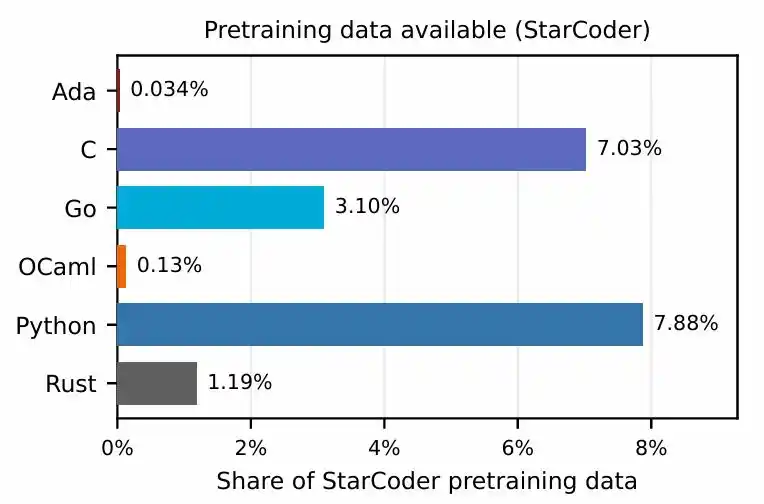
Of course, we cannot know how much Ada code closed-source models have actually seen. But using the public ecosystem as a reference, the scarcity of Ada is already clear enough.

This language primarily appears in aerospace, defense, and other safety-critical systems. Its community size, number of tutorials, and open-source projects are far from comparable to Python, JavaScript, or Go.

And Fable 5 clearly isn't translating Go code line by line into Ada.

It seems more like it first figures out how the original program works, then switches to another language to recreate the same behavior.
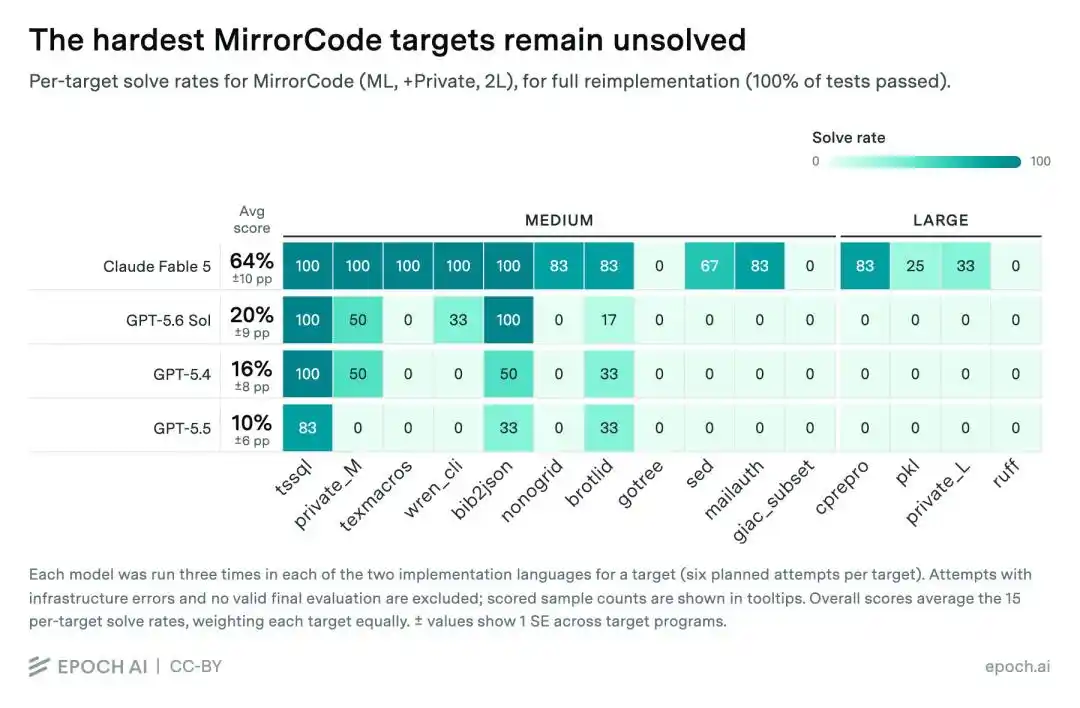
In comparison, other models aren't as stable.

GPT-5.6 Sol dropped from 24% to 19%, GPT-5.4 from 21% to 12%, and GPT-5.5 even fell from 17% to 5%. Once the language changed, the gap was immediately magnified.

Handing Over the Entire Project to AI

Nowadays, Cursor has enabled hundreds of Agents to collaborate for nearly a week, writing over 1 million lines of browser code from scratch, distributed across 1,000 files.

Anthropic had 16 Claude Agents run nearly 2,000 sessions in parallel, eventually building a C compiler with 100,000 lines capable of compiling the Linux 6.9 kernel.

In OpenAI's disclosed Codex personal user samples up to May, 70.2% had submitted at least one task estimated to require over one hour of human work; 25.6% had submitted tasks estimated to take over eight hours.

The units people are handing over to AI are shifting from a piece of code, a bug, to an afternoon's work, a week's work, or even an entire project.

The 64% from MirrorCode is precisely a quantification of this kind of "project-level delegation."

It shows that as long as the goal is clear enough and the results can be automatically validated, frontier models can already independently complete a portion of medium to large-scale software.

For everyone who is starting to hand work over to AI, the change is already imminent——

Previously, you needed to watch it write every line of code. Next, you're more likely to only check if it has gone off track at key junctures.

Code will become increasingly cheap.

And those who can articulate problems clearly and validate results effectively will become increasingly valuable.

Reference: https://epoch.ai/MirrorCode

This article is from the WeChat public account "Xinzhiyuan" (New Wisdom Source), author: ASI Apocalypse; editor: Moses


Trending Cryptos

Related Questions

QWhat is the main achievement of Claude Fable 5 mentioned in the article?

AClaude Fable 5 achieved a 64% success rate on the MirrorCode leaderboard, significantly outperforming competitors like GPT-5.6 Sol, which scored only about one-third of that.

QHow does Claude Fable 5 perform when switching from popular languages like Go to less common ones like Ada?

AWhen switching from Go to Ada, Claude Fable 5's success rate only dropped by 3 percentage points (from 64% to 61%), suggesting it can reason about and build software independently rather than relying on memorized syntax.

QWhat is unique about the MirrorCode benchmark's passing criteria?

AMirrorCode requires a 100% completion rate on both visible and hidden tests to pass a task; even a 99.9% success rate is considered a failure, making it extremely stringent.

QWhat does the article suggest about the future role of human engineers in AI-assisted programming?

AThe article suggests that human engineers will increasingly shift from writing every line of code to overseeing AI agents, focusing on defining problems clearly and verifying results at key milestones.

QAccording to the article, what broader trend in AI programming does Claude Fable 5's performance represent?

AClaude Fable 5's performance represents a trend toward AI models handling larger, project-scale software development tasks autonomously, as long as goals are well-defined and results can be automatically validated.

Related Reads

Mathematicians Refute Open AI's Claim of Proving Connes Rigidity Conjecture Within 24 Hours: 'AI Proved Every Sentence Correct, but They Are No Longer About the Original Conjecture'

Mathematician Refutes OpenAI's Claim of Disproving Connes Rigidity Conjecture in 24 Hours OpenAI claimed its next-generation AI model solved 10 world-class problems, including disproving the Connes Rigidity Conjecture. The next day, mathematician J. L. Nielsen from the University of Kansas published a paper refuting the AI's counterexample. Nielsen meticulously reviewed OpenAI's publicly released 37,000 lines of Lean 4 code, mapping each object back to its mathematical origin. He identified two independent failure paths in the AI's argument. He concluded that one of the two groups constructed by the AI does not satisfy the required conditions (specifically ICC and Kazhdan's property (T)) necessary to serve as a valid counterexample to the original conjecture. This means the AI may have successfully proven something about its constructed objects, but that statement is not equivalent to disproving the Connes Rigidity Conjecture itself. The incident highlights a crucial limitation of formal verification tools like Lean. While Lean's kernel can verify the logical correctness of a proof's steps, it cannot verify whether the formal statement being proven correctly corresponds to the intended mathematical conjecture. Human oversight remains essential to ensure the alignment between the formalized problem and the original research question. This case exemplifies what researchers call "successfully proving the wrong statement." The Connes Rigidity Conjecture, concerning the uniqueness of group von Neumann algebras under certain conditions, remains an open problem.

marsbit37m ago

Mathematicians Refute Open AI's Claim of Proving Connes Rigidity Conjecture Within 24 Hours: 'AI Proved Every Sentence Correct, but They Are No Longer About the Original Conjecture'

marsbit37m ago

When Crypto Assets Become Mortgage Collateral: The Triangular Dilemma of Regulation, Cost, and Tokenized Equity

When Crypto Assets Become Mortgage Collateral: The Trilemma of Regulation, Cost, and Tokenized Rights Better, in partnership with Coinbase, has launched a mortgage solution allowing borrowers to pledge Bitcoin or USDC as collateral. This facilitates two loans: a primary, Fannie Mae-compliant mortgage and a separate private loan for the down payment, secured by the crypto assets and a second lien on the property. The product targets asset-rich but cash-poor buyers, with high collateral requirements (250% for Bitcoin, 125% for USDC) and no margin calls. The initiative has drawn significant regulatory scrutiny. Seven U.S. Senators, led by Dick Durbin and Elizabeth Warren, sent a letter to the FHFA urging a halt, arguing the high collateral ratio itself acknowledges crypto's risk and that combined loan costs could be 1.5 percentage points higher, potentially burdening taxpayers. Despite criticism and Bitcoin's price volatility, Better's CEO Vishal Garg plans to expand support to tokenized equities (e.g., Tesla, SpaceX) and envisions using retirement accounts to help family members buy homes. A core challenge for tokenized assets is clarifying the legal rights conferred by holding such tokens. To reduce costs, Better partnered with Framework Ventures, aiming to lower capital expenses by over 100 basis points and offer sub-5% rates. While the company posted a loss in Q1 2025, it reports strong demand, with a waitlist representing ~$250M in potential loans. Garg remains committed to the model, viewing it as a key channel for integrating digital assets into the banking system.

marsbit47m ago

When Crypto Assets Become Mortgage Collateral: The Triangular Dilemma of Regulation, Cost, and Tokenized Equity

marsbit47m ago

Trading

Spot

Hot Articles

Discussions

Welcome to the HTX Community. Here, you can stay informed about the latest platform developments and gain access to professional market insights. Users' opinions on the price of AI (AI) are presented below.

活动图片