Mathematicians Refute Open AI's Claim of Proving Connes Rigidity Conjecture Within 24 Hours: 'AI Proved Every Sentence Correct, but They Are No Longer About the Original Conjecture'

marsbitPublished on 2026-08-04Last updated on 2026-08-04

Abstract

Mathematician Refutes OpenAI's Claim of Disproving Connes Rigidity Conjecture in 24 Hours OpenAI claimed its next-generation AI model solved 10 world-class problems, including disproving the Connes Rigidity Conjecture. The next day, mathematician J. L. Nielsen from the University of Kansas published a paper refuting the AI's counterexample. Nielsen meticulously reviewed OpenAI's publicly released 37,000 lines of Lean 4 code, mapping each object back to its mathematical origin. He identified two independent failure paths in the AI's argument. He concluded that one of the two groups constructed by the AI does not satisfy the required conditions (specifically ICC and Kazhdan's property (T)) necessary to serve as a valid counterexample to the original conjecture. This means the AI may have successfully proven something about its constructed objects, but that statement is not equivalent to disproving the Connes Rigidity Conjecture itself. The incident highlights a crucial limitation of formal verification tools like Lean. While Lean's kernel can verify the logical correctness of a proof's steps, it cannot verify whether the formal statement being proven correctly corresponds to the intended mathematical conjecture. Human oversight remains essential to ensure the alignment between the formalized problem and the original research question. This case exemplifies what researchers call "successfully proving the wrong statement." The Connes Rigidity Conjecture, concerning the unique...

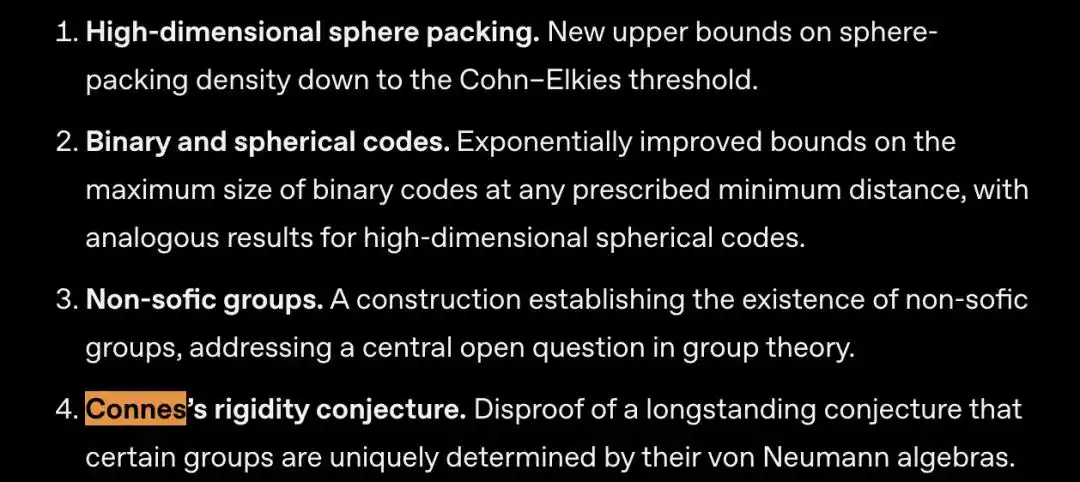
OpenAI claimed its next-generation AI model solved ten world-class problems, including overturning the Connes rigidity conjecture.

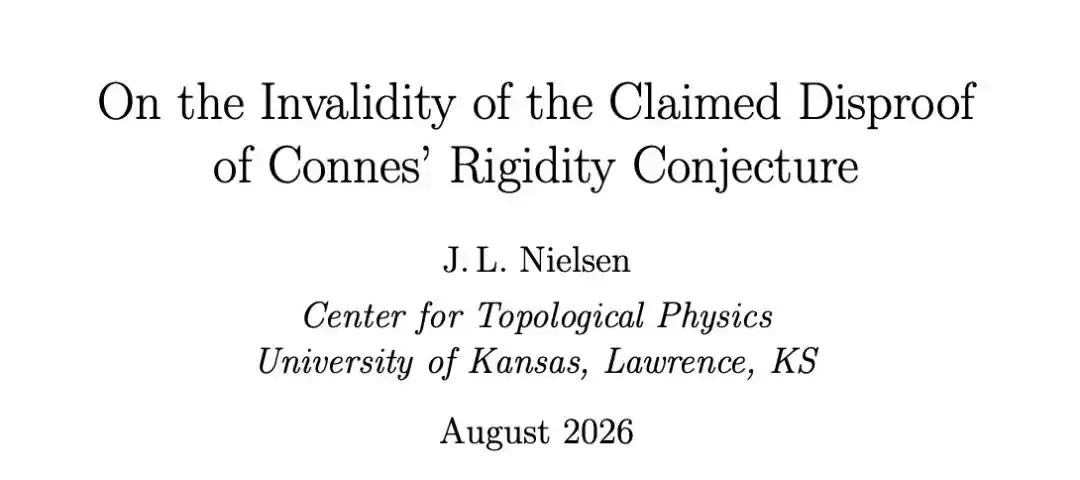
The next day, a human-authored paper responded: The counterexample proposed by the AI does not hold.
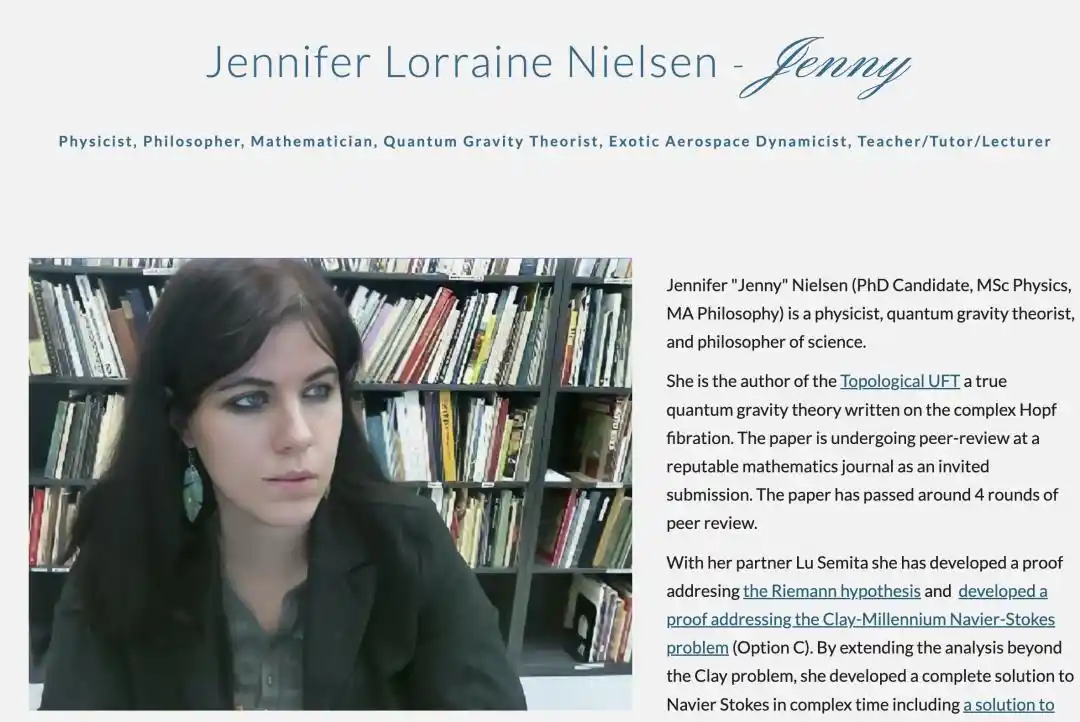
The author is J. L. Nielsen from the Topological Physics Center at the University of Kansas. He traced OpenAI's publicly released 37,000 lines of Lean 4 code from beginning to end, mapped every object back to its mathematical prototype, and finally presented two independent paths of failure.
The specific proof process isn't very comprehensible to ordinary people; let the AI and mathematicians battle it out among deities.

However, this incident illustrates that human review of AI research results remains crucial.
What is the Connes Rigidity Conjecture?

The Connes rigidity conjecture describes the following situation.

In mathematics, one can equip a group with an algebraic structure. Sometimes, two groups that look different can yield identical structures.

Connes, around 1980, conjectured that: As long as the group satisfies two additional conditions, this situation cannot occur—identical structure must imply identical groups.

These two additional conditions are called ICC and Kazhdan's Property (T).

In other words, to refute this conjecture, one needs to provide groups that satisfy both conditions but are constructed differently.

The approach of OpenAI's new model was to construct two non-isomorphic groups, have them generate the same algebra, and provide proofs that both groups satisfy ICC and Property (T).

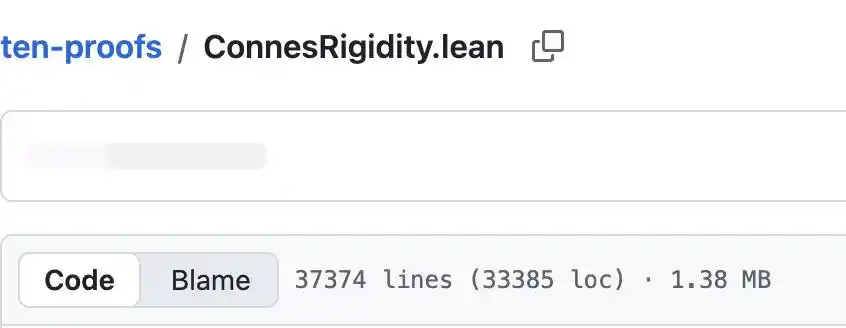
The entire argument was written as 37,000 lines of Lean 4 code, verified line by line by the Lean kernel, and accompanied by documentation explaining how these two groups were constructed.
Nielsen pointed out: One of the groups constructed by the AI does not actually satisfy the additional conditions; it is neither ICC nor does it have Property (T).
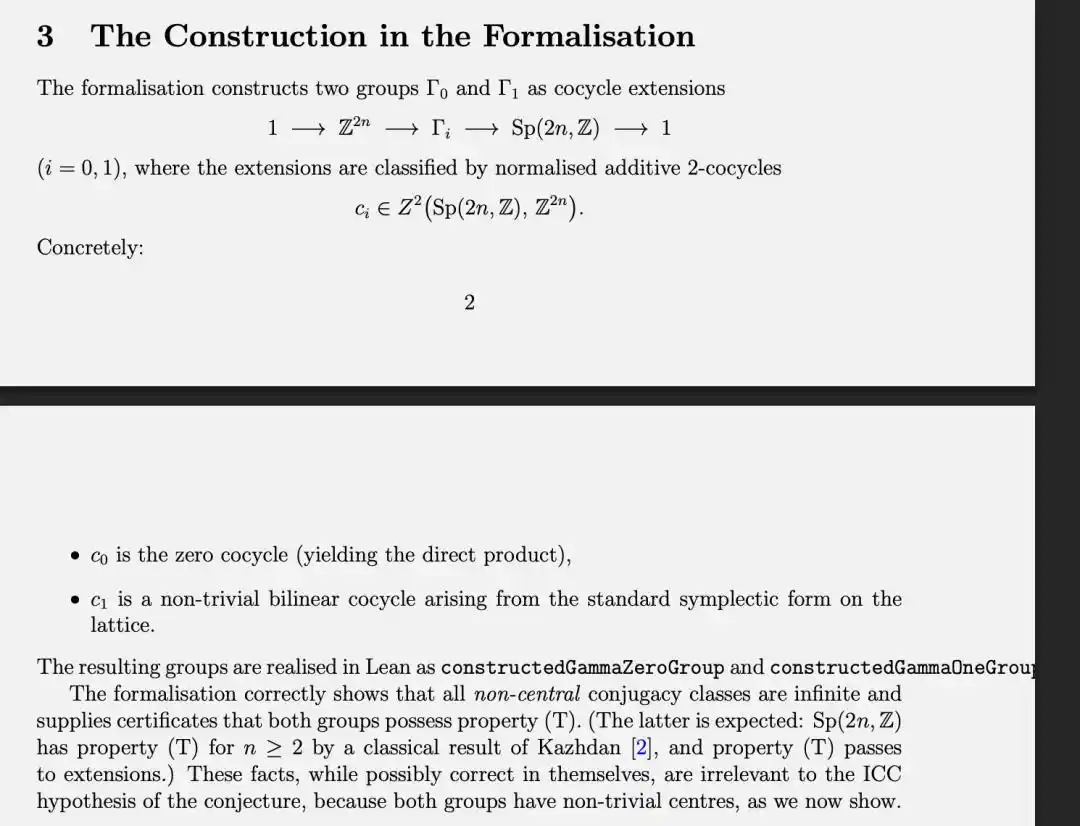
There are three possibilities for this:

The Property (T) in the code does not faithfully correspond to Kazhdan's original definition; or the proof only holds partially but was considered for the entire group; or the group in the code is not actually what is described in the documentation.

37,000 Lines, Line by Line Cross-Reference

To verify this conclusion, Nielsen did something even more laborious.

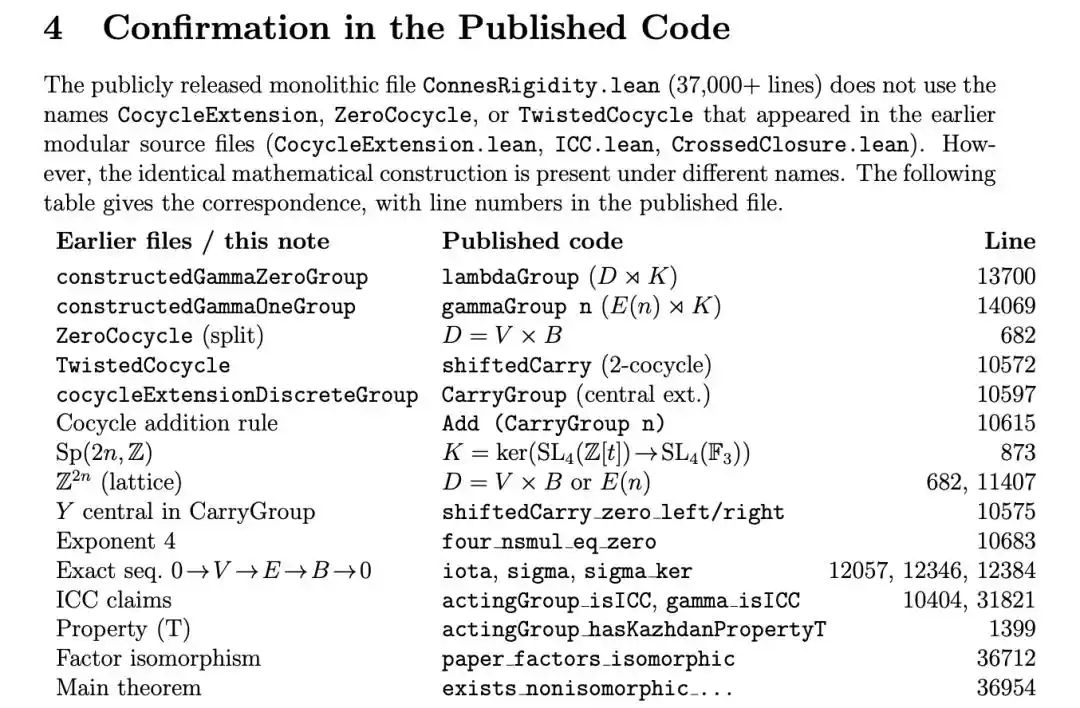
The publicly released code is a consolidated single-file version; the names from the early modular source code are all missing.

He therefore created a cross-reference table, marking the name and line number of each mathematical object in the new code:

The zero-cycle group is at line 13700, the twisted group at line 14069, the proof of isomorphism between the two algebras at line 36712, and the main theorem at line 36954.

He also traced the entire inference chain in the code that proves ICC. This chain starts at line 31430, passes upwards layer by layer, and finally synthesizes the conclusion at line 31610.
The issue Nielsen identified is that these lemmas deal with objects after a duality transformation, not the original group with central elements, and therefore do not directly cover the crucial part of the elements.

Whether they hold for every element in the specific group that ultimately enters the theorem depends on how the interface between the two construction blocks is connected.

This indicates that the problem lies in "what is to be proven," not in "whether the proof is correct." Lean is only responsible for verifying the latter.

Regarding the other twisted group, Nielsen's attitude is conservative. He said he did not independently verify from the code whether it satisfies ICC, and acknowledged that the lemmas in the code might indeed prove it does, but that does not change the conclusion since one condition is already not met.

He wrote his two refutations also as Lean code, which compiles under Lean 4.32.2.

Machines Check Form, Not Meaning

The final section of the paper places this incident into a broader context.

What the Lean kernel guarantees is only that a proof is formally flawless; it is not responsible for whether it actually proves the original claim.

Terence Tao's words can be directly quoted here: Proof verification checks the formal statement itself, not whether this statement aligns with the intention, so human review cannot be directly replaced.

There have been records of such incidents in the past.

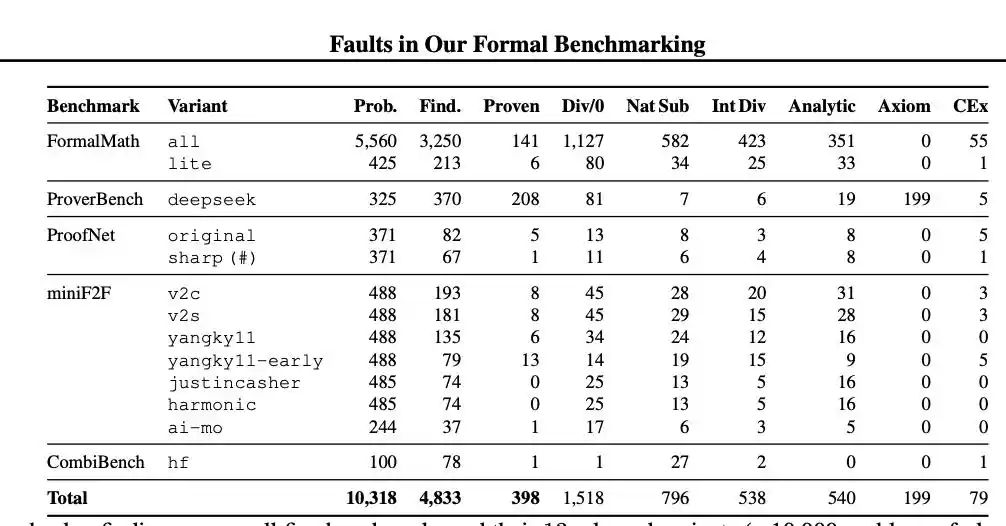
An audit of five commonly used Lean benchmarks yielded 4,833 findings, including counterexamples, vacuous theorems, and unreliable axioms, all of which had passed machine verification. It was only after humans constructed counterexamples that the statements themselves were found to be wrong.
In formalization work on statistical learning theory, the most dangerous scenario is described as "not a failed proof, but a successful proof of a wrong statement."

Research in tensor networks has also recorded similar phenomena: the system provided proofs that are formally completely correct, except the proposition being proven is weaker than expected.

Nielsen wrote that OpenAI's formalization might have correctly established every single conclusion it claimed. But what it did not establish—and what the Lean kernel cannot check—is whether these conclusions have any relation to the original wording of the conjecture.

When humans read a conjecture, they see the premises; a proof assistant, given a conclusion whose premises are not satisfied, will still verify any assertion about it.

The Connes rigidity conjecture remains open.

Paper address:

https://philarchive.org/archive/NIEWTCv17

Reference links:

[1]https://openai.com/index/ten-advances-in-mathematics/

[2]https://github.com/openai/ten-proofs/blob/main/ConnesRigidity.lean

This article is from the WeChat public account "QbitAI," author: Meng Chen

Trending Cryptos

Related Questions

QWhat was the key claim made by OpenAI's new AI model regarding the Connes Rigidity Conjecture, and how did a human mathematician respond?

AOpenAI's new AI model claimed to have found a counterexample that disproved the Connes Rigidity Conjecture. The counterexample involved constructing two non-isomorphic groups satisfying the ICC and Kazhdan's property (T) conditions, which were supposed to generate the same algebra. In response, mathematician J. L. Nielsen of the University of Kansas refuted this by analyzing the 37,000 lines of Lean 4 code and demonstrating that one of the constructed groups did not actually satisfy the required ICC and property (T) conditions, making the AI's counterexample invalid.

QAccording to Nielsen's analysis, what were the possible reasons why OpenAI's AI failed to correctly disprove the conjecture?

AJ. L. Nielsen's analysis suggested three possible failures: 1) The property (T) as defined in the code might not faithfully correspond to Kazhdan's original mathematical definition. 2) The proof might only hold for part of the group but was incorrectly applied to the entire group. 3) The group implemented in the code might not be the same as the one described in the accompanying documentation.

QWhat critical limitation of formal proof verification systems like Lean is highlighted by this incident?

AThis incident highlights that formal proof verification systems like Lean only check the logical and syntactic correctness of a proof (its form), not whether the statement being proved corresponds to the intended original mathematical conjecture (its meaning or semantic correctness). A system can successfully verify a proof for a statement that is weaker, different, or even incorrect relative to the intended theorem.

QWhat is the Connes Rigidity Conjecture, and what two conditions must a group satisfy for it to apply?

AThe Connes Rigidity Conjecture, proposed around 1980, states that for certain groups, if the von Neumann algebras they generate are isomorphic, then the groups themselves must be isomorphic. For the conjecture to apply, the groups must satisfy two specific conditions: they must have the Infinite Conjugacy Class (ICC) property and Kazhdan's property (T).

QWhat broader historical context does Nielsen's paper provide for this type of error in formalized mathematics?

ANielsen's paper places this error in a broader historical context of similar incidents in formalized mathematics. It references an audit of five common Lean benchmarks that found 4,833 issues, including counterexamples, vacuously true theorems, and unreliable axioms, all of which had passed machine verification. Similar issues have been recorded in fields like statistical learning theory and tensor network research, where formally correct proofs were generated for statements weaker than the intended ones.

Related Reads

72-Hour Countdown: Can the CLARITY Act Pass 'Miracleously' Before the Senate Recess?

"CLARITY Act Faces 72-Hour Deadline as Senate Recess Looms The U.S. Senate has released its schedule for the week, omitting the crucial CLARITY Act and instead prioritizing another resolution for a procedural vote. With the Senate set to recess on August 7th, the bill now has only about 72 hours to advance. Senate procedural hurdles are steep. First, a cloture petition requires signatures from 16 Senators. Second, a vote requires 60 votes, meaning the Republican's 53 votes need at least 7 Democratic supporters—a key sticking point that has stalled the bill for two months. If passed, a further 30 hours of debate is required before a vote to proceed to consideration. If 16 signatures are not secured by Wednesday, the bill won't even face a vote. Even if filed Wednesday, the earliest vote would be Friday, leaving no time for actual consideration before recess. The major divide remains ethical provisions. The draft bans certain senior officials from issuing or sponsoring digital assets until 2029, but Democrats argue enforcement loopholes are too large, failing to constrain existing holdings and family arrangements. The White House has not formally responded to the revised draft. The Trump family's substantial crypto profits have further eroded Democratic trust. Stablecoin rewards remain contentious. Banks liken them to deposit interest, fearing capital flight, while crypto firms see them as anti-competitive protection for banks. A current compromise bans passive interest but allows rewards for trading, staking, and platform activity. Polymarket data shows the bill's probability of passing by 2026 has fallen to 31%, down 7 points in a week. Betting volume is around $3.7 million. Analyst Bernstein warns failure to advance the bill could trigger a 'bad news' sell-off, pressuring Bitcoin and crypto valuations. Industry advocates, including Grayscale and Treasury Secretary (presumably Yellen, though 'Besant' appears in text), have urged swift action with thousands of contacts to Congress, but progress remains slow. If missed this week, the bill delays until September, where a busier schedule and approaching midterms complicate passage. Democrats suggest a procedural vote this week could keep hope alive for September, but that hope is fading hourly. Market sentiment appears resigned to delay, though a surprise passage could trigger a significant positive reaction. The bill's arduous journey underscores its potential impact on the industry."

marsbit2m ago

72-Hour Countdown: Can the CLARITY Act Pass 'Miracleously' Before the Senate Recess?

marsbit2m ago

George Santos Settles Dispute with Commodity Futures Trading Commission (CFTC) Over Trading on His Own Kalshi Market

Former U.S. Representative George Santos has settled with the Commodity Futures Trading Commission (CFTC) over allegations he manipulated a futures contract on the Kalshi prediction market related to his potential attendance at a presidential State of the Union address. According to a July 31 order, Santos must repay $17,569.98, pay a $17,500 civil penalty, and is barred from trading on any CFTC-registered exchange for three years. The CFTC found that Santos made misleading public statements about his plans to attend the event while trading on the outcome. He first built a profitable position betting he would attend, then reversed course and profited by betting against his own attendance after travel disruptions. Santos earned profits totaling over $17,000 from these trades. Santos agreed to the settlement without admitting to the findings. His attorney stated Santos initially intended to attend but changed plans due to winter weather, denying any intent to mislead traders or manipulate the market. Kalshi detected the suspicious activity, froze his account, and provided evidence to the CFTC. The exchange is considering further actions and potential restitution for affected traders. While Kalshi also referred the matter to the Justice Department, a spokesperson has denied an investigation exists. The CFTC settlement remains the only confirmed federal action regarding these trades.

cryptonews.ru8m ago

George Santos Settles Dispute with Commodity Futures Trading Commission (CFTC) Over Trading on His Own Kalshi Market

cryptonews.ru8m ago

Trading

Spot

Hot Articles

Discussions

Welcome to the HTX Community. Here, you can stay informed about the latest platform developments and gain access to professional market insights. Users' opinions on the price of AI (AI) are presented below.

活动图片