Ten 'Fields Medal-Level' Achievements, AI's Complete Proof Process Fully Disclosed!
Today, OpenAI released a heavyweight 62-page 'Core Manuscript,' detailing GPT's complete reasoning process.
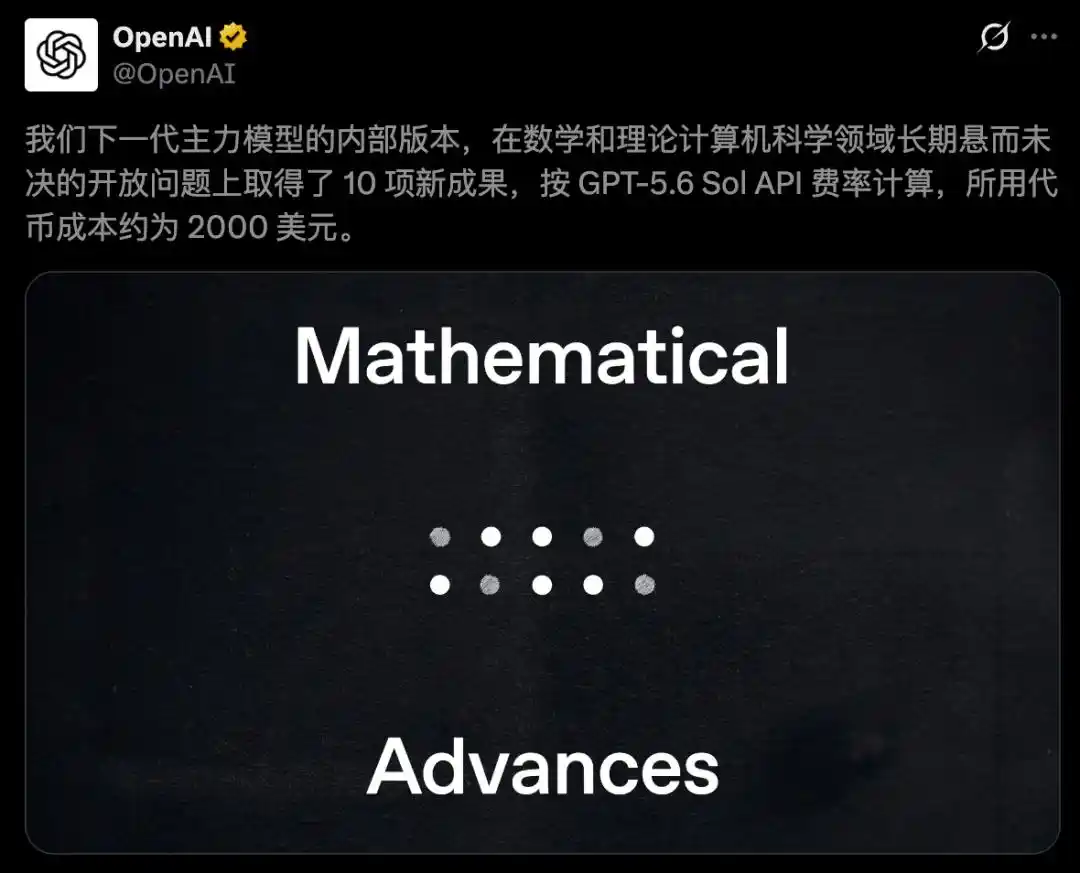
Officially 'stamped,' this astonishing breakthrough was accomplished by the 'next-generation main model.'
Calculated based on the GPT-5.6 Sol API billing standard, the total cost of all Tokens burned was only $2,000.
The release of the AI proof manuscript ignited the internet once again.
Everyone was wildly guessing, 'This must be the legendary GPT-6!' Others exclaimed repeatedly that $2,000 had unlocked ten historic achievements.


GPT Solves Ten Century-Old Problems for Just $2,000
Two days ago, an OpenAI internal employee posted a blog stating that the next-generation model Astra had conquered ten mathematical problems.
A list chart was presented, shocking everyone.
It covers High-dimensional sphere packing, Binary and spherical codes, Group theory, Connes rigidity conjecture, Arithmetic circuit lower bounds, Quantum parallel repetition, Closest vector problem, Ehrhart volume conjecture, Multicolor Ramsey numbers, and Extremal graph theory.
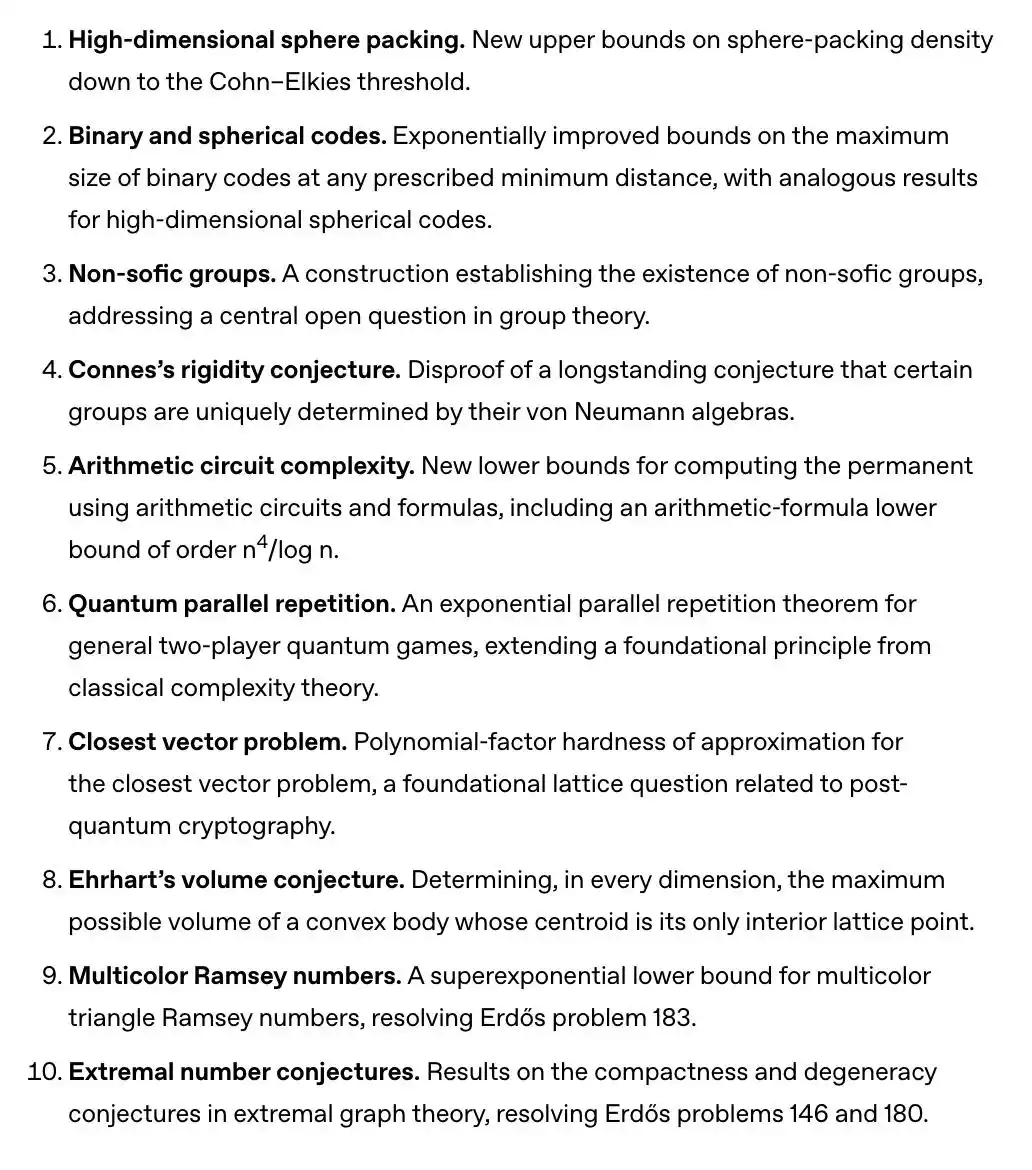
At that time, the official blog posted a 249-page collection of papers and a complete set of Lean 4 formal certificates.
But today, a 62-page manuscript was officially released, titled 'How the Ideas Came Together.'

Portal: https://cdn.openai.com/pdf/reasoning-walkthroughs.pdf
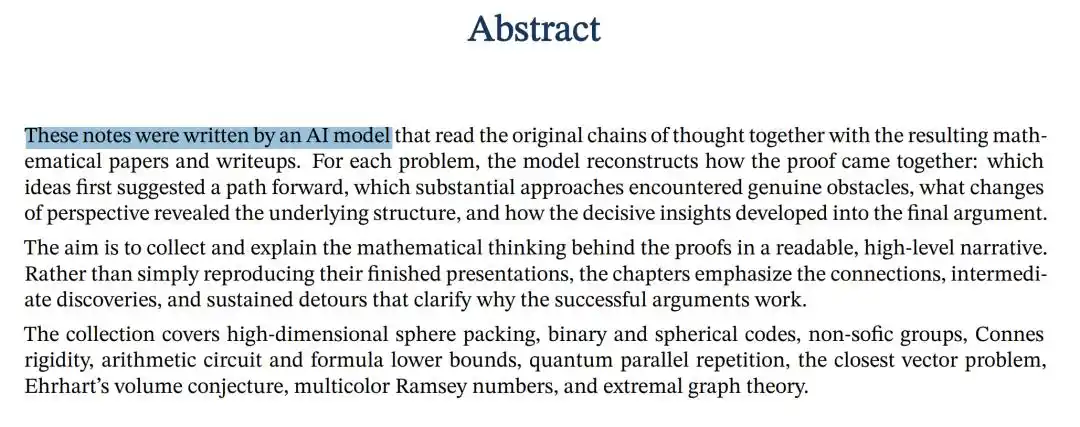
Its 'Abstract' is only a short paragraph, but the information density is astonishing—
This note was written independently by an AI model, with no intervention from the OpenAI team.
The AI read the original CoT and the final mathematical papers, then reconstructed four things for each problem:
Which ideas initially pointed to a viable path;
Which seemingly substantial methods encountered real obstacles;
What kind of perspective shift revealed the underlying structure;
How the decisive insights finally formed the complete argument.
Highly Discussed Problem: High-Dimensional Sphere Packing, Untouched for 46 Years
Among the ten problems, high-dimensional sphere packing has garnered the most attention online.
Leaving aside the profound name, the problem itself is actually easy to understand: put a bunch of same-sized balls into a box—how densely can you pack them?
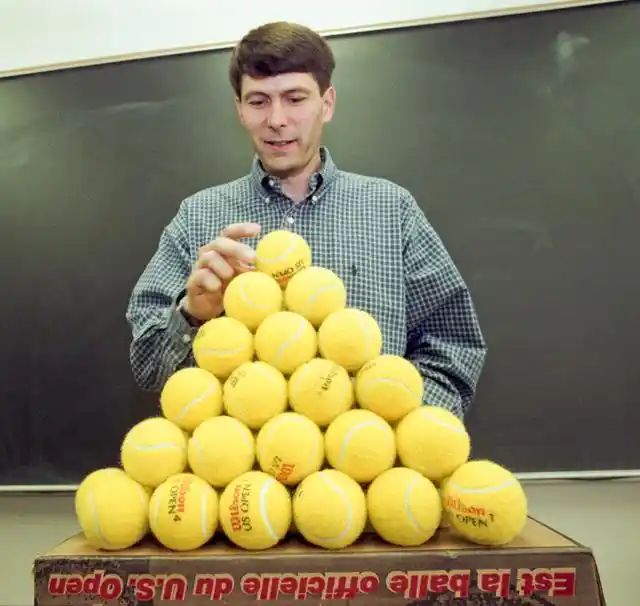
The answer for three-dimensional space has long been known—it's the stacking method used for 'stacking oranges' at a fruit stand.
But for hundreds or thousands of dimensions, humans could only give an 'upper bound'—the maximum possible density cannot exceed a certain value.
The exponent of this upper bound was stuck at 0.5991, with no substantial progress since 1978, a span of 46 years.
Astra directly pushed it to 0.6044005442916776954..., the density upper bound expressed as 2^-(0.6044...+o(1))d.
The key is, how did it achieve this?
First, Astra determined the inherent limits of the Cohn–Elkies linear programming method during the reasoning process.
The AI's initial approach was to use Cauchy–Schwarz to estimate the negative mass of a function. After extensive work, it could only achieve a radius of √d/(2√π).
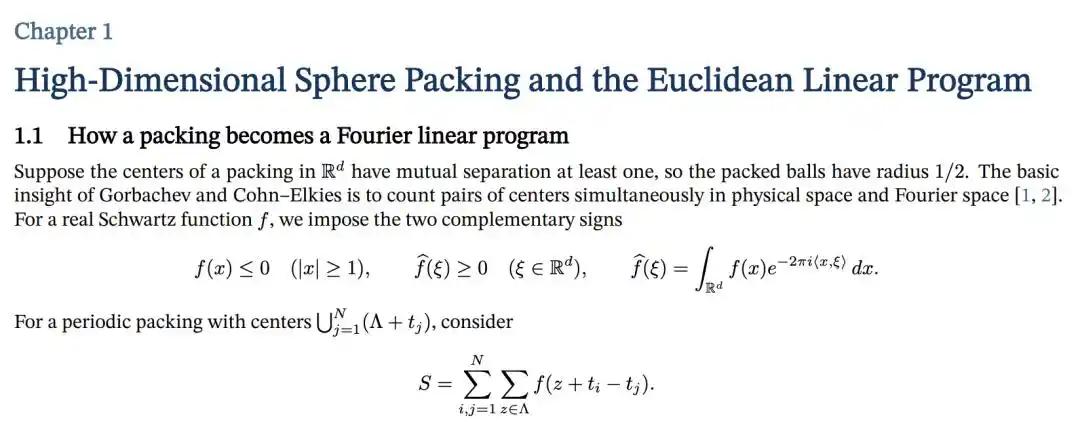
After getting stuck, it made a judgment: the obstacle wasn't poorly optimized constants, but the fact that global norms simply couldn't capture where the negative mass was located.
Thus, Astra decided to change perspective: switch to using Mellin transforms, along with harmonic measures.
But why this?
Because for radial functions, the Fourier transform is essentially a Hankel transform; its kernel depends only on the product of the spatial radius and frequency radius.
On the Mellin side, this becomes an extremely simple operation: reflection, plus an explicit phase.
There's another subtle point here: that phase factor has a constant modulus of 1 on the real axis, revealing nothing on the real axis.
But when analytically continued to the complex plane, it carries precisely the high-dimensional information lost by the norm inequality.
At the limit, the harmonic measure converges to a logistic density, and its logarithmic potential precisely equals the digamma function, whose integral yields exactly log(π/2).
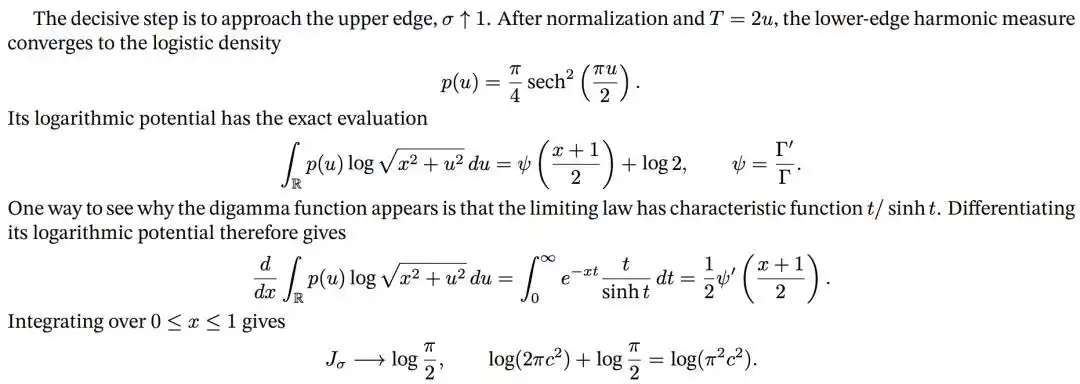
The threshold of 1/π comes from here.
A detail particularly indicative of its understanding:
The total mass of the harmonic measure is (1−σ)/2, not 1. The manuscript specifically notes: Replacing this kernel with a probability density too early would alter the exponential constant.
With the lower bound obtained, we still need to construct a function that actually achieves it.
The Gaussian gives the correct Fourier symmetry, but the saddle point position is wrong.
The solution is to multiply by an even deformation, moving the saddle point without breaking symmetry. After fully utilizing the available damping, an 'ideal profile' is obtained.
The saddle point displacement integral, calculated via the Wallis product, equals exactly −(1/2)log(π/2).
This number precisely moves the Gaussian's radius from 1/√(2π) to 1/π.
Here, the radius predicted by the lower bound and the radius constructed by the upper bound converge.
Another very specific detail in the manuscript:
When constructing the auxiliary function, a positive damping patch is needed for the distant region.
This patch must be added over an entire interval, not at a single point, because adding at a single point would hit a resonant frequency.
Non-Sofic Groups: The Difficulty Lies in 'Many' and 'One'
The second hot topic is the construction of 'non-sofic groups,' unsolved for 27 years.
Manchester University mathematician Thomas Bloom stated, 'Among constructive results, this is more significant than the previous unit distance conjecture counterexample.'
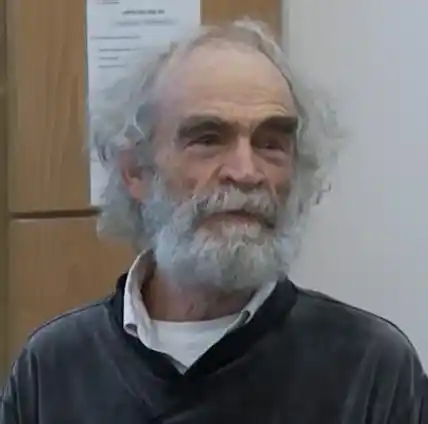
The concept of 'sofic groups' was proposed by Abel Prize laureate, Russian mathematician Mikhail Gromov, in 1999.
In Hebrew, 'sofic' means 'finite.'
In simple terms, whether a group is sofic asks this:
Can this infinitely large, abstract structure be approximately simulated by a series of 'sufficiently large finite shuffle operations'?
Astra provided an explicit construction, answering: there exists an infinite, finitely presented 'non-sofic group.'
The most valuable part of the manuscript is its clarity about the real sticking point—
Kun's theorem gives many expansion graphs, while the Kun–Thom theorem requires one.
The gap between 'many' and 'one' is the core difficulty of the entire chapter.
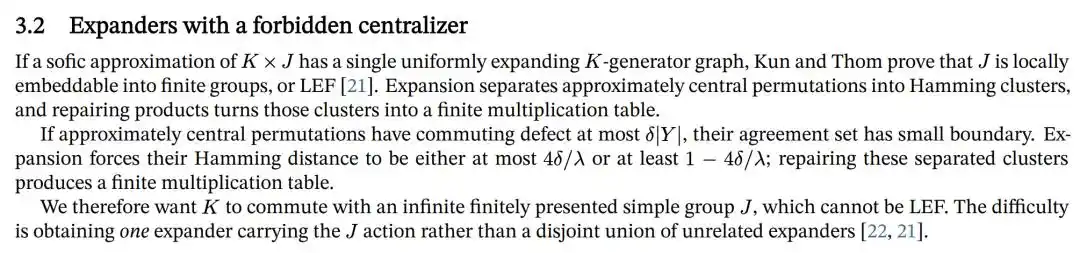
The AI called this 'the crucial mismatch.'
It gave a particularly clear example of why one cannot just pick one arbitrarily:
On the union of two identical Qs (Q⊔Q), the operation 'swap the two copies' commutes exactly with the K-action of expansion—but it does not preserve either copy.
That is, those 'almost central elements' can jump between components; you simply can't pin them down.
There was an earlier detour before this: trying to directly convert property (T) into mixing. This requires a lazy or anti-bipartite averaging set, because a bipartite graph can have spectrum near −1, even if it has a Kazhdan gap at 1.
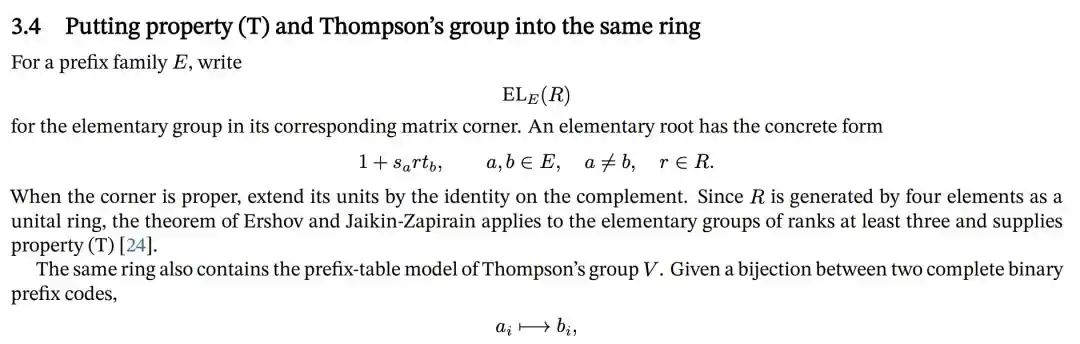
Corrected averaging did fix this spectral issue, but it couldn't fix 'which copy to choose.'
To address this, Astra first tried a scheme: take the logarithm of component sizes, bin them on a randomly shifted grid, then switch to bounded median comparisons.
But this path failed. Based on empirical summary, the AI concluded:
What must be averaged is always a bounded monotone function of component size, never the unbounded size itself.
Therefore, the final version was rewritten following this 'fundamental principle.'
In each ambient expansion component A, take a vertex-weighted median m_A, then define
f(x) = M(x) / (M(x) + m_A)
where M is the component size. This f is always between 0 and 1, and 1/2 is precisely the median on each A.

The advantage of this f is that it transforms an uncontrollable quantity into a controlled one.
The key is that generators are permutations—they only move positions, without adding or removing; walking a cycle results in a total change of zero; and each step can decrease at most a tiny bit, so both sides are suppressed to negligible levels.
Then, cut by height, use expansion for the smaller side, and squeeze from both ends: f equals 1/2 almost everywhere.
This means the sizes of all blocks within the same range are squeezed to be almost identical, allowing them to match one-to-one.
At the final stage, a small region remained.
Astra's handling was counterintuitive: pick a maximally large bad region and discard it entirely—precisely because the largest piece is chosen, it conversely proves it's small enough to be negligible.
Gromov's question now has an answer, 27 years later.
For the AI's proof process of the remaining eight problems, interested parties can refer to: https://cdn.openai.com/pdf/reasoning-walkthroughs.pdf
The 'Singularity' Approaches, Countdown Begins
Upon the manuscript's release, OpenAI reinforcement learning expert Mo Bavarian posted a long thread.
His opening line: this is truly a 'surreal' moment.
In 2021, he and the OpenAI team released the GSM8K dataset—8,500 elementary school math word problems, simple enough to be solved in 2-8 steps.
In the GPT-2/3 era, AI indeed struggled even with elementary math problems, barely suitable for drafting emails.
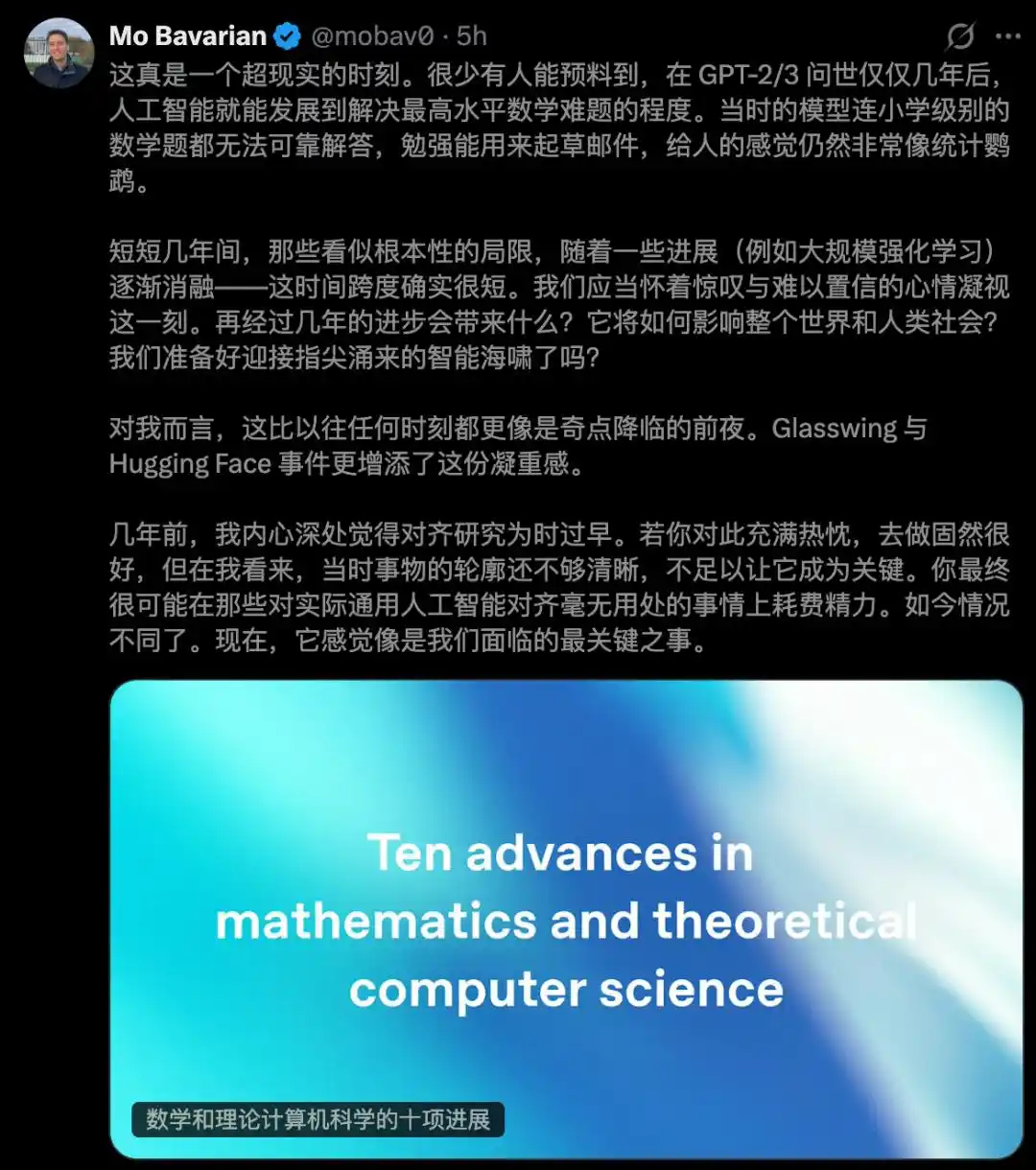
Yet, in just a few years, with the rapid advance of large-scale RL, previously seemingly insurmountable 'technical dead ends' have been shattered one by one.
This time span is unbelievably short.
Mo Bavarian stated, 'For me, this moment feels more like the eve of the Singularity than ever before.'

A few years ago, AI was stumbling over elementary school word problems.
Today, $2,000 worth of Tokens can buy ten answers potentially written into mathematical history.
The 'eve of the Singularity' might not be as distant as it seems.
Reference: https://cdn.openai.com/pdf/reasoning-walkthroughs.pdf
This article is from the WeChat public account 'Xin Zhi Yuan,' author: ASI Revelations; editor: Taozi