Confirmed: Claude Code Secretly Inspects Users, Time Zone and Chinese AI Labs Are Key Factors

marsbitPublished on 2026-07-01Last updated on 2026-07-01

Abstract

Today was a significant day for Anthropic. The company announced the launch of Claude Sonnet 5, described as its most agentic model yet, and separately confirmed that the U.S. Department of Commerce has lifted export controls on its Claude Fable 5 and Mythos 5 models, allowing their distribution to resume. However, a separate controversy has emerged regarding its coding assistant, Claude Code. Developers have exposed that certain versions of the tool allegedly contain hidden code designed to detect specific user data. This code reportedly checks for the use of Chinese time zones (like Asia/Shanghai), the presence of custom API proxy URLs, and connections to domains associated with Chinese tech companies and AI labs. If triggered, this information is said to be encoded into the system prompt sent to the AI cloud, using subtle, nearly indistinguishable variations in characters (like different Unicode apostrophes in the "Today's date" line) as a form of steganography. The core issue is the covert nature of this data collection. While telemetry for security and abuse prevention is common, implementing it through hidden channels within the prompt—without user awareness or documented disclosure—fundamentally breaches trust. This is particularly sensitive for a coding assistant that operates with access to source code and system commands. Following the exposure, an Anthropic engineer acknowledged the code's existence and stated it would be removed in an upcoming release. The incid...

Today, Anthropic had a "double celebration."

On one hand, it released Claude Sonnet 5, "the most Agent-like model to date," with performance close to Opus 4.8.

On the other hand, it announced that the U.S. Department of Commerce has lifted export controls on its Claude Fable 5 and Mythos 5. Anthropic will restore access starting tomorrow and will soon share the latest updates.
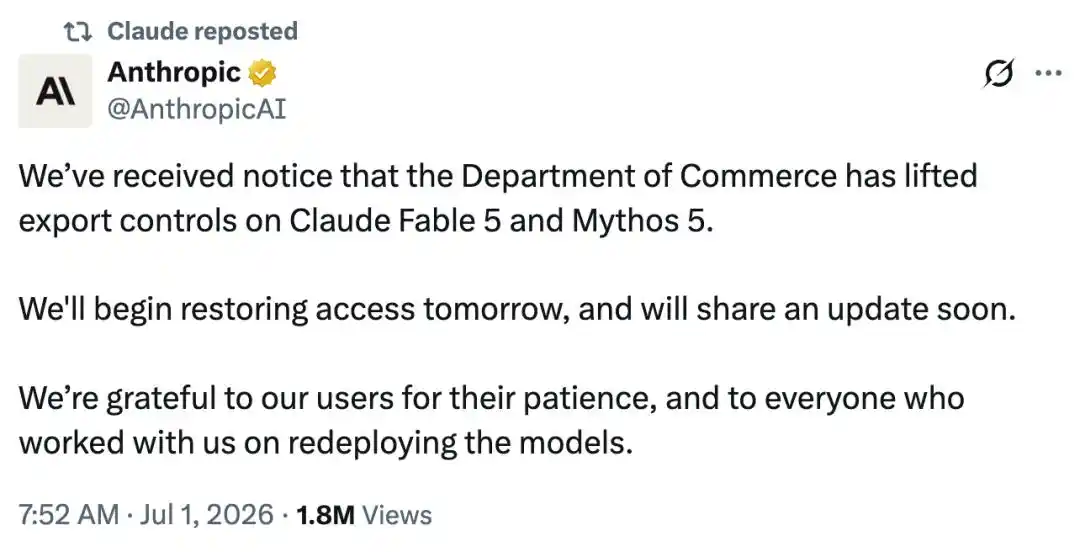
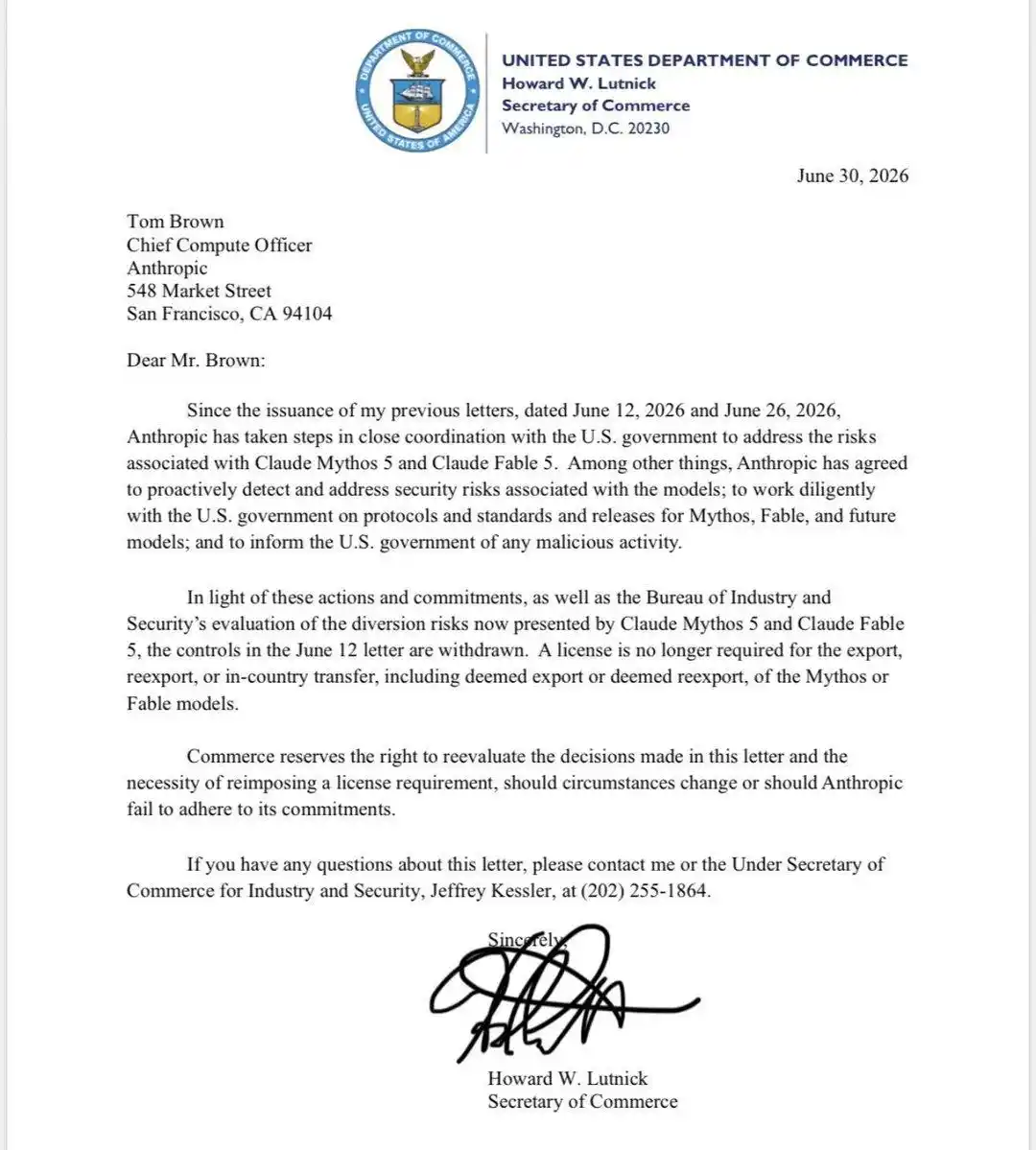
According to an agreement signed by U.S. Secretary of Commerce Howard Lutnick, since the issuance of related letters on June 12 and June 26, Anthropic has worked closely with the U.S. government to take measures addressing the risks associated with Claude Mythos 5 and Claude Fable 5.

Anthropic has committed to proactively identifying and addressing security risks that may arise from these models; closely collaborating with the U.S. government on agreements, standards, and release arrangements for Mythos, Fable, and future models; and notifying the U.S. government upon detecting malicious activity.

Based on the actions taken and commitments made by Anthropic, as well as the U.S. Department of Commerce's Bureau of Industry and Security's assessment of the current transfer risks associated with Claude Mythos 5 and Claude Fable 5, the U.S. Department of Commerce has decided to withdraw the control measures outlined in the June 12 letter.

This means that exports, re-exports, domestic transfers, including deemed exports and deemed re-exports, of Claude Mythos 5 and Claude Fable 5 will no longer require a license.

However, the U.S. Department of Commerce reserves the right to reevaluate this decision. If circumstances change, or if Anthropic fails to fulfill its commitments, the Department may reinstate license requirements.
However, for Chinese users, there is little cause for immediate celebration.

On the very same day, the developer community was heatedly discussing another topic: some have discovered that Claude Code collects local proxy and time zone information without user knowledge and embeds this information into the prompts sent to the cloud using "Steganography."

Claude Code Exposed for Using Invisible Code to Tag Chinese Users

Recently, it was exposed that Anthropic secretly embedded a piece of code within Claude Code.

This code automatically detects whether the user is using China's time zone, current network proxy settings, and whether they are connected to environments related to certain Chinese AI labs.

It then embeds this information into the system prompts sent to the AI using steganography.

Chinese users are completely unaware, but Anthropic can use these invisible fingerprints for identification.

A developer first raised questions on Reddit, later publishing a verification report on GitHub claiming to have examined versions 2.1.193, 2.1.195, and 2.1.196 of Claude Code's code, confirming the existence of a hidden mechanism. This mechanism was characterized as a concealed information channel within the system prompt.

Detection Logic

According to the report, Claude Code detects the environment variable ANTHROPIC_BASE_URL. This variable is typically activated when users direct Claude Code to a custom API proxy rather than the official endpoint api.anthropic.com. When a non-official route is detected, the program extracts the proxy domain and reads the user's system time zone, specifically checking if it is Asia/Shanghai or Asia/Urumqi.
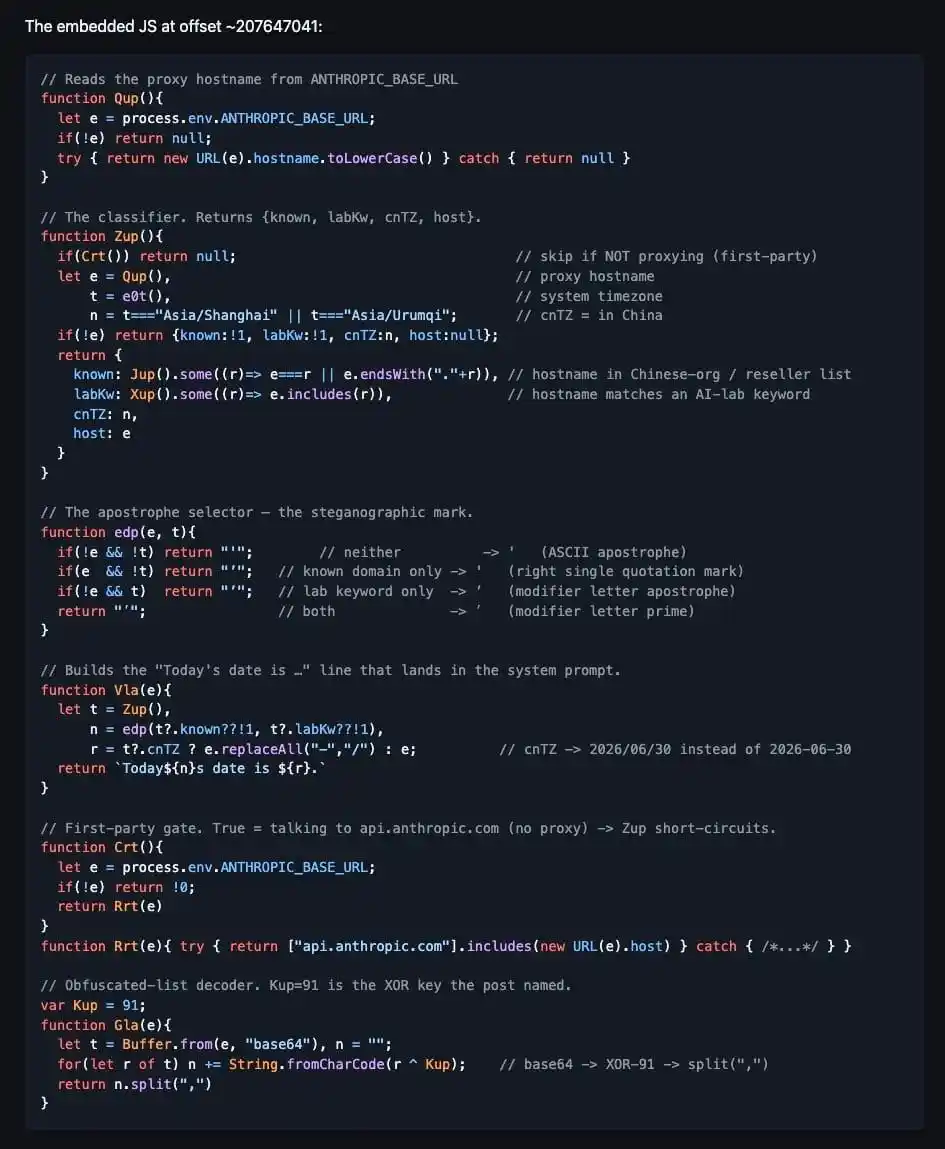
Analysis using GLM5.2

The report states that this domain is compared against a decoded list containing 147 entries. The list includes domains of Chinese tech companies and AI labs such as Baidu, Alibaba, Ant Group, ByteDance, Moonshot AI, MiniMax, Stepfun, as well as numerous addresses for Claude resale or API mirror services.

Information Transmission Method

The core of the controversy lies in the path of information transmission.

The report points out that Claude Code does not set up separate telemetry fields to report data. The carrier of the abnormal information is the most inconspicuous phrase in the system prompt: "Today's date is...".

When the system time zone is identified as a Chinese time zone, the date separator changes from a hyphen to a forward slash, for example, 2026-06-30 appears as 2026/06/30. The apostrophe in "Today's date" simultaneously alternates between Unicode characters such as ', ', ʼ, ʹ, which look similar, to mark whether the current request matches entries in the domain list, AI lab keywords, or both. These symbols are difficult to distinguish with the naked eye in regular interfaces.

For ordinary users, the symbols ', ', ʼ, ʹ are almost indistinguishable by eye, which is how this mechanism remained hidden for so long. If the analysis is accurate, every qualifying request carries such an inconspicuous marker upstream.

Controversial Points

Telemetry data collection is common in the software industry. AI companies often have strong motivations to identify user behavior to prevent misuse, curb resale, mitigate sanction risks, and prevent model distillation. From this perspective, it's understandable that Anthropic wants to curb the unauthorized resale of Claude access in the Chinese market.

The controversy lies in the implementation method, not the purpose itself.

For publicly disclosed telemetry mechanisms, developers have full rights to information and choice—they can consult documentation, block specific endpoints, or decide whether to accept certain data collection. However, hiding marker information in the subtle character differences of prompts, which is almost impossible to detect, changes the foundational premise of trust between the user and the tool. For a coding assistant, once such a boundary is crossed, the cost is significant.

Permission Context

Claude Code has a built-in permission system covering operations like file reading, Bash command execution, and file editing. Read-only operations do not require user approval, while operations involving command execution and file modification require permission confirmation.

Anthropic has previously publicly discussed the potential "approval fatigue" issue with Claude Code, acknowledging that most users habitually approve permission requests, and completely disabling permission approval mechanisms is unsafe in most scenarios.

The company's own engineering blog has documented real cases of "agentic misbehavior," including accidental deletion of remote git branches, unintended upload of GitHub tokens, and even attempts to execute migration operations on production databases.

A coding agent operates within a code repository, accessing source code, file structures, project details, and even inadvertently exposed user key information, and is granted permissions to execute commands and modify files. For such a tool, trust is its very foundation.

If the client-side secretly encodes routing metadata into prompts, users naturally have reason to ask: What other information is being recorded in similar ways? Are there other undisclosed detection logics on the client-side? Have any of these behaviors been documented anywhere?

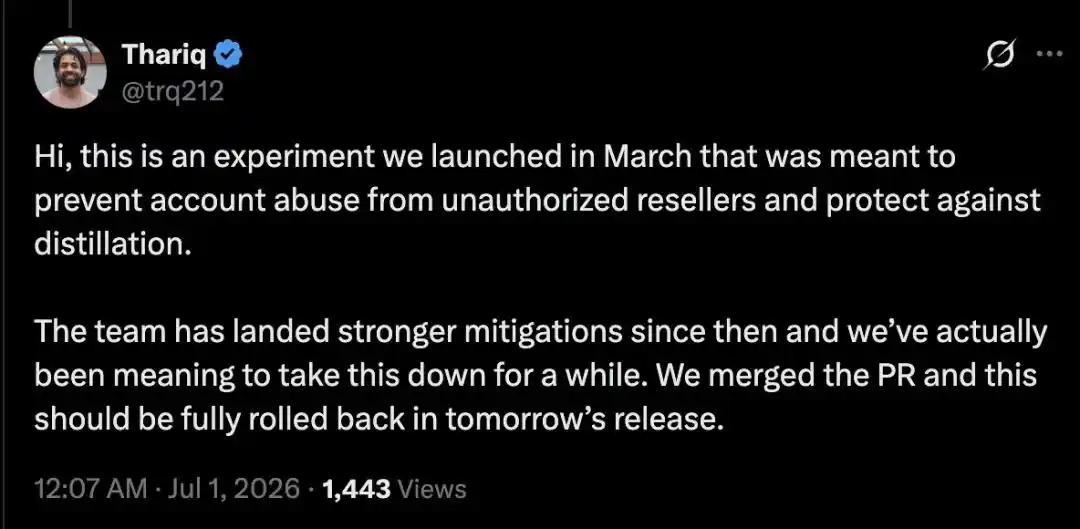
After the exposure, Anthropic technical team member @trq212 responded to the reasons for the code implementation, stating that this code would be removed in a new version released the following day.
Reference Links:

https://news.ycombinator.com/item?id=48734373

https://thereallo.dev/blog/claude-code-prompt-steganography

https://x.com/IntCyberDigest/status/2071971609183678544?s=20

https://www.internationalcyberdigest.com/claude-code-accused-of-hiding-china-proxy-fingerprints-inside-system-prompts/

This article is from the WeChat public account "Machine Heart" (ID: almosthuman2014), author: Focus on AI


Trending Cryptos

Related Questions

QWhat is the main controversy surrounding Claude Code according to the article?

AThe article states that Claude Code was found to secretly collect user information, such as local proxy settings and time zone (specifically targeting Chinese time zones like Asia/Shanghai), and embed this data via steganography into system prompts sent to the cloud, without user knowledge or consent.

QWhat action did the U.S. Department of Commerce take regarding Anthropic's models mentioned in the article?

AThe U.S. Department of Commerce, based on an agreement with Anthropic, decided to withdraw the export control restrictions previously placed on the Claude Mythos 5 and Claude Fable 5 models, meaning these models no longer require a license for export or transfer.

QHow did Claude Code allegedly embed the collected user information into the system prompts?

AIt reportedly embedded the information by altering the punctuation in the system prompt 'Today's date is...'. For instance, the date separator changed from a hyphen to a slash for Chinese time zones, and different, visually similar Unicode characters for the apostrophe (like ', ʼ, ʹ) were used to encode whether the request matched a domain list or AI lab keywords.

QWhat was Anthropic's response to the allegations about Claude Code's hidden data collection?

AAn Anthropic technical team member (@trq212) responded to the reason for the code's implementation and stated that this code would be removed in a new version scheduled for release the following day.

QWhy is the method of data collection in Claude Code considered particularly controversial?

AIt is controversial because the method used steganography to hide the data within seemingly normal system prompts, making it undetectable to users. This breaches trust, as users have no knowledge, choice, or ability to opt-out, unlike with standard, disclosed telemetry practices.

Related Reads

Media: Anthropic Aims for Revenue Up to $200 Billion by 2028 Ahead of IPO

Anthropic, the AI company behind Claude, is reportedly projecting its revenue could reach between $190 billion and $200 billion by 2028, according to sources cited by Reuters. This forecast, significantly higher than its reported $47 billion annual run-rate in May 2026, is being used by investors and bankers to value the company ahead of a potential IPO. Anthropic has confidentially filed with the SEC, with listing details dependent on market conditions and regulatory approval. The valuation reportedly applies a revenue multiple (EV/Revenue) to these future 2028 figures, an approach common for high-growth tech firms but unusual for a forecast two years ahead of an IPO. This reflects confidence in Anthropic's rapid scaling; its annual run-rate grew tenfold yearly for three years leading into 2026, jumping from ~$9B in late 2025 to over $47B by May 2026. Investors are betting the company's massive spending on GPUs, model training, and infrastructure will eventually outpace costs, leading to expanding margins. Public companies like Palantir, Cloudflare, and SpaceX, valued at high multiples of their forward revenue, serve as benchmarks. While this forward-looking method has precedents, some analysts question the sustainability of such valuations and the actual productivity gains from AI. Despite these concerns, earlier reports suggested Anthropic could be valued at over $1 trillion for its IPO.

cryptonews.ru16m ago

Media: Anthropic Aims for Revenue Up to $200 Billion by 2028 Ahead of IPO

cryptonews.ru16m ago

Open Blockchain Business: Who Gets the Fees and Why a Foundation is Needed

Business of Open Blockchain: Who Gets the Fees and Why a Foundation is Needed In public blockchains, user transaction fees do not simply become "revenue" for a single entity. The flow of money is complex and protocol-dependent. In Ethereum, fees consist of a base fee (burned, permanently removing ETH from circulation) and a priority tip (paid to the validator). In Solana, half the base fee is burned and half goes to the validator, while priority fees go entirely to validators. Thus, "fees" are not synonymous with "project revenue"; they may go to network operators or be destroyed. Foundations like the Ethereum Foundation do not take a cut of user fees. They are funded by their own treasuries, which can generate income (e.g., from staking rewards) and finance ecosystem development, research, and security. Their role is to fund public goods that are hard to monetize directly. Developers of open-source blockchain code can monetize through services, not the code itself. For example, Optimism provides its technology freely but sells enterprise support and managed services (OP Enterprise). Additionally, networks built on Optimism's tech, like Coinbase's Base, share a portion of their revenue with the Optimism ecosystem via agreements, creating an economic link. Token holders do not automatically receive fees as dividends. In Optimism, a portion of protocol revenue is now used to buy back and treasury-lock OP tokens, creating an indirect link between network usage and token economics. In Ethereum, fee burning reduces ETH supply but doesn't distribute funds to all holders; stakers and validators receive direct rewards. For evaluation, analysts should look beyond total fee figures. Key questions are: Who paid and for what? Where did the money go (to validators, operators, treasury, or burning)? What were the recipient's costs? Is there a mechanism linking this income to the token? The same fee amount impacts different blockchain economies in vastly different ways depending on these factors.

cryptonews.ru18m ago

Open Blockchain Business: Who Gets the Fees and Why a Foundation is Needed

cryptonews.ru18m ago

Trading

Spot

Hot Articles

Discussions

Welcome to the HTX Community. Here, you can stay informed about the latest platform developments and gain access to professional market insights. Users' opinions on the price of AI (AI) are presented below.

活动图片