Claude Code Growth Myth Shattered? Large Number of Users Are Canceling Subscriptions

marsbitPublished on 2026-08-20Last updated on 2026-08-20

Abstract

The myth of Claude Code's meteoric growth appears to be shattering, with a surge of users reportedly canceling subscriptions. Data from TickerTrends indicates a dramatic slowdown: after explosive ARR growth from $25B in February 2026 to over $140B by June, its monthly growth rate has plummeted to just 5.2% by August, signaling a potential shift to traditional software's slower growth pace. A key driver of user dissatisfaction is the recent global rollout of an "invisible text watermark" on all Claude-generated content, including code, which developers fear could compromise their intellectual property and create legal risks. Other complaints include restrictive usage quotas and inconsistent performance of the new Fable 5 model. As Claude Code stumbles, its rival OpenAI Codex is capitalizing, showing a 20.8% growth rate in the same period—four times higher—and attracting disgruntled Claude users. Competitors like Cursor are also offering incentives to switch. The article argues that despite Claude's technical prowess, missteps in product strategy and user experience are eroding its early advantages. The market is entering a more sober phase, moving beyond the hype of "AI self-evolution" to focus on practical, reliable tools. The piece concludes by warning Anthropic that arrogance risks alienating its core user base.

The growth myth of Claude Code is shattered!

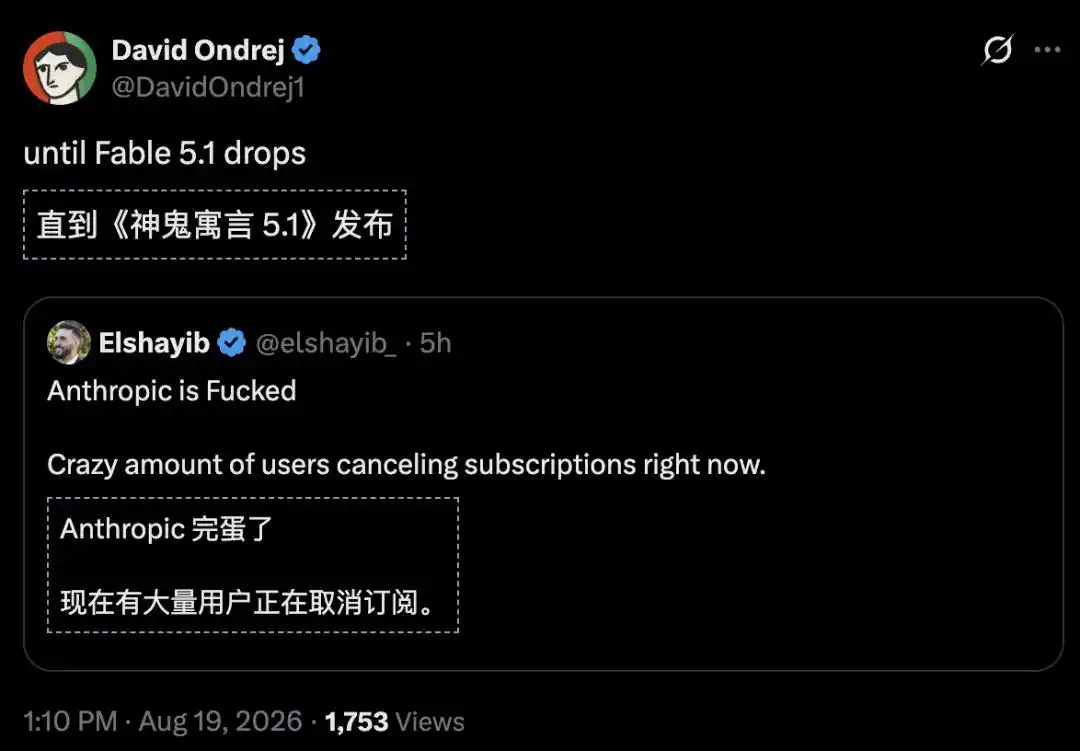
"Anthropic is done for, there's a massive wave of users frantically canceling subscriptions right now."

A developer's post on X sparked heated discussion in the community.
Latest data shows the early explosive growth phase of Claude Code has officially ended.

Now, new user growth is in the single digits, while old users are defecting in droves.

Many loyal CC users have already switched to its old rival, OpenAI's Codex.

ARR Growth Rate Plummets to 5.2%, the Frenzied Dash Halts

Today, the well-known data tracking platform TickerTrends released a new report, data shows—

Claude Code's growth engine has clearly "stalled."
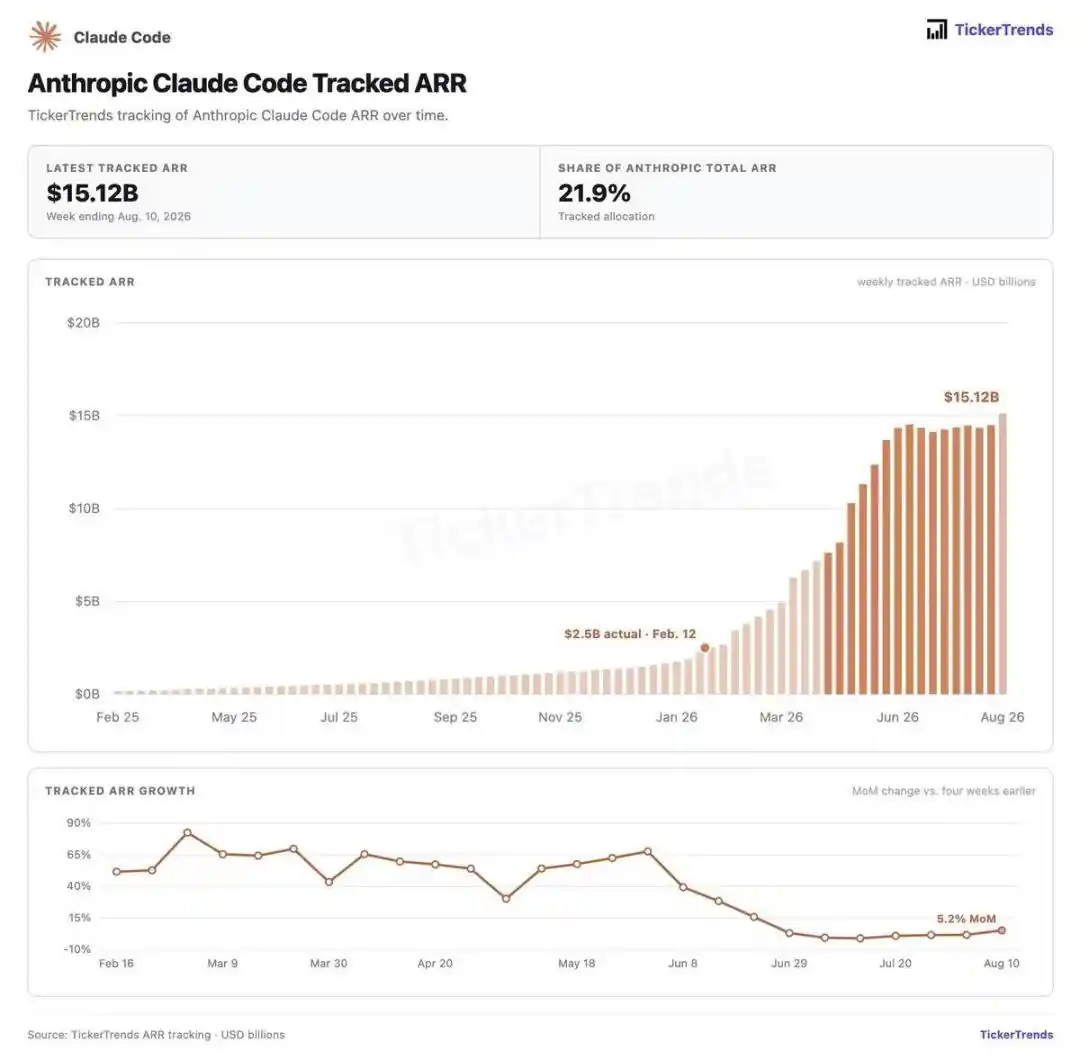
Once, Claude Code had a breathtaking growth curve.

Claude Code's ARR was around $2.5 billion on February 12, 2026; it skyrocketed to $6.3 billion by the end of March; broke through $10.3 billion by the end of April; and by June, that number had exceeded $14 billion.

Nearly a sixfold increase in just a few months!

This is not only a miracle in AI history but a myth in the entire history of the software industry. Investors were ecstatic, and the entire tech world gasped in amazement.

But Claude Code's myth ended in August 2026.

As of August 10th, Claude Code's tracked ARR stalled at $15.12 billion.

At first glance, a $15 billion plate is still massive (accounting for 21.9% of Anthropic's total tracked ARR), but if you look at the month-over-month growth rate, this number has plummeted to 5.2%!

What does 5.2% mean? For an AI unicorn at the forefront of the hype, this number indicates it has prematurely entered the low-growth period of "traditional software."

Data doesn't lie, especially for SaaS and AI subscription products. ARR is the lifeline.

As tech commentator Orange AI pointed out:

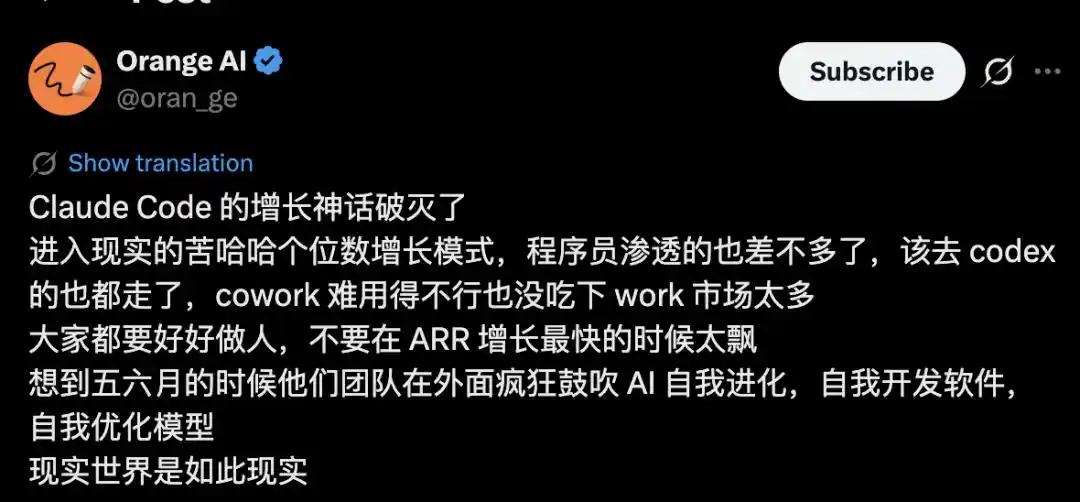
The growth myth of Claude Code is shattered.

Entering the harsh reality of single-digit growth mode, programmer penetration is almost done, those who were going to Codex have left, and Cowork is too difficult to use and hasn't captured much of the work market.
Why has growth stalled?

First, penetration among the programmer community is nearing its ceiling.

Globally, the number of core developers willing to pay for advanced AI coding tools is ultimately limited. Those who were going to buy have bought it. Where will the new growth come from?

Second, the Cowork feature, on which Anthropic had placed high hopes to change white-collar workflows, has suffered a resounding failure.

User feedback is almost universal: Cowork is terribly difficult to use, completely failing to bite into the massive Work market as expected.

The product capability didn't keep up with the ambition. The attempt to break into new markets failed, naturally leading to competition within the existing market.

Invisible Watermark Incites Public Outrage, Large-Scale "Cancel Wave" Erupts

Slowing growth is only an internal worry. A more fatal external threat is the "cancel wave" spreading across social networks.

The direct trigger for this subscription cancellation crisis is a new feature rolled out globally in early August 2026—"Invisible Text Watermarking."

It's reported that Anthropic took this step to comply with increasingly stringent EU regulations. However, this move infuriated users.

This watermark silently embeds itself into all text and code generated or processed by Claude, completely enraging programmers and writers.

For many premium users paying around $100 monthly for Claude Pro/Max subscriptions, AI is just an auxiliary tool.

They might put their core code into Claude to find bugs, or toss tens of thousands of words of confidential documents in for light polishing.

Now, anything touched by Claude gets permanently stamped with the "AI-generated" mark on these original works born from human effort.

In interviews with foreign media, several users who angrily canceled expressed their fury: "This pollutes our work!"
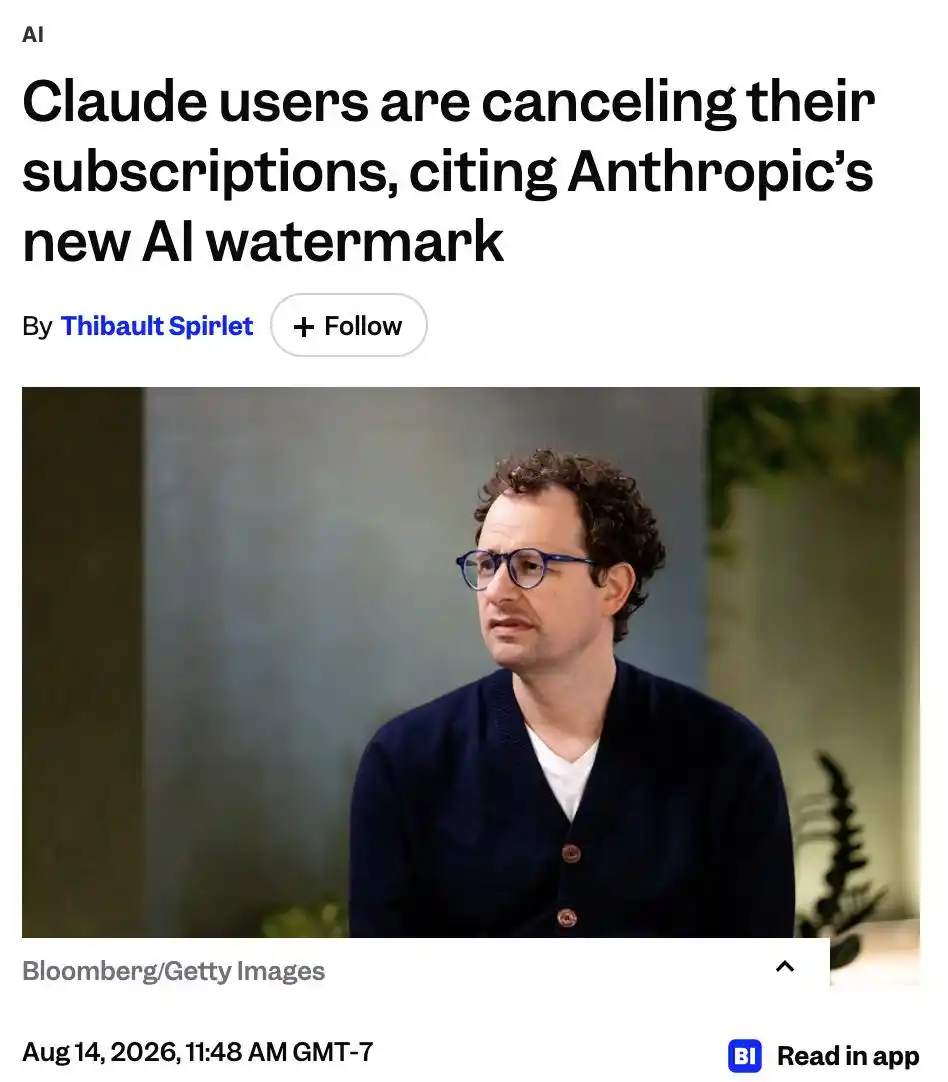
Once code is secretly watermarked, indie developers face huge trouble—they work hard to deliver to clients, only to potentially face lawsuits and breach of contract penalties.

Programmers at big companies are even more panicked. If the company's core codebase gets "contaminated" by AI watermarks, and compliance audits find out, their career prospects could be ruined.

And the watermark is just the trigger.

The subsequent official moves piled on the negative effects, thoroughly grinding everyone's patience into the ground.

For instance, the miserly token limits.

Unlike OpenAI's Thibault, who frequently resets limits, Anthropic, after being heavily criticized, reluctantly increased the weekly token limit by 50% (and only until the end of August).

But for heavy users who rely on it daily, this isn't even enough to fill the gaps! The pain of being rate-limited in the middle of coding, who understands?

Additionally, there's the Schrödinger-like model experience.

The previously hyped-up god-tier model Fable 5, after its June launch, kept causing problems.

When writing complex business logic code, its performance is like a lottery—sometimes divine, sometimes idiotic, making it impossible to fully trust.

Since it's expensive, heavily overpriced, and aggressively milking users, it's no surprise users are revolting.

OpenAI Codex's Frenzied Counterattack

Just as Claude Code is mired in trouble and losing users in droves, its arch-nemesis—OpenAI Codex—is feasting.
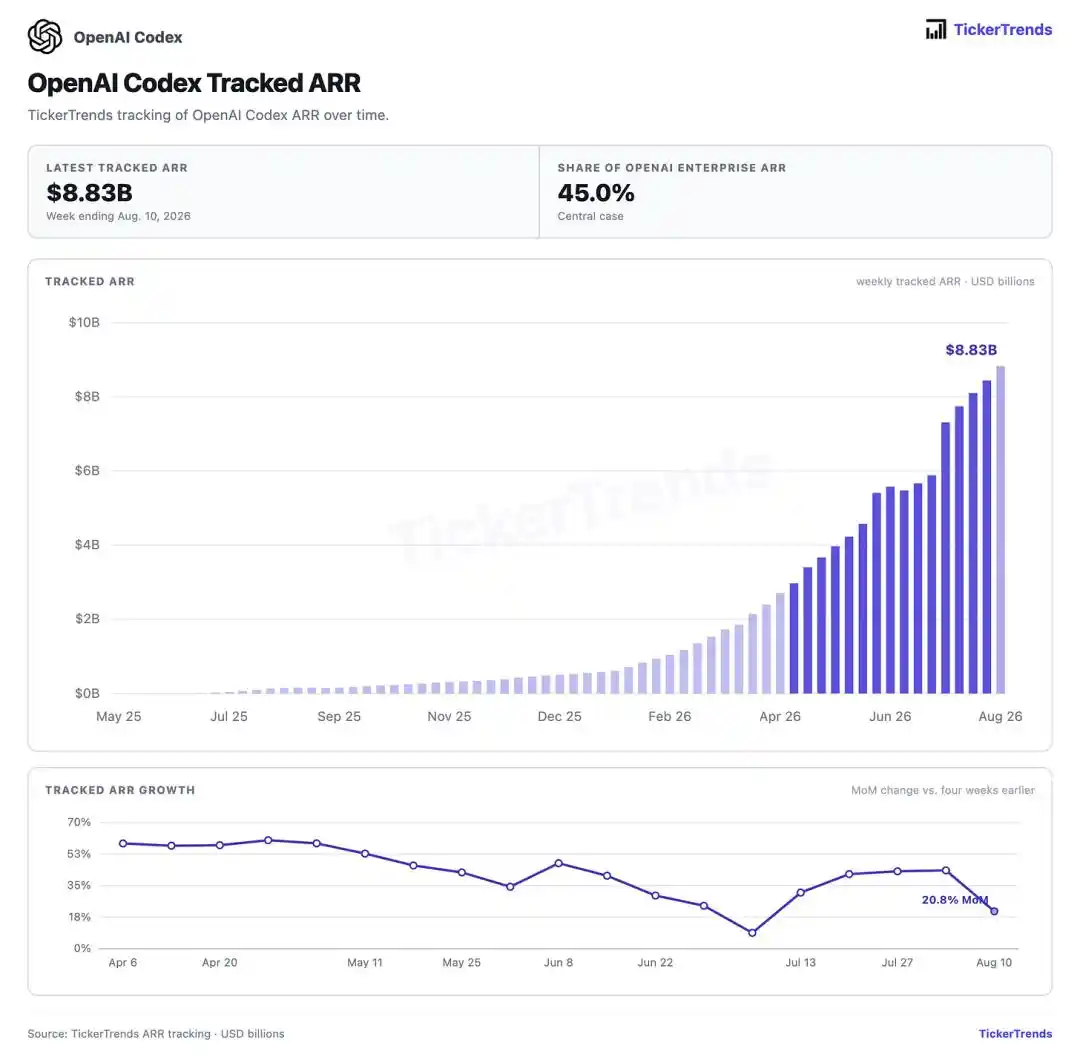
Comparative data from TickerTrends paints a picture of "fire and ice."

In the most recent four weeks ending August 10th, OpenAI Codex's month-over-month growth rate reached a staggering 20.8%, a full four times that of Claude Code (5.2%)!
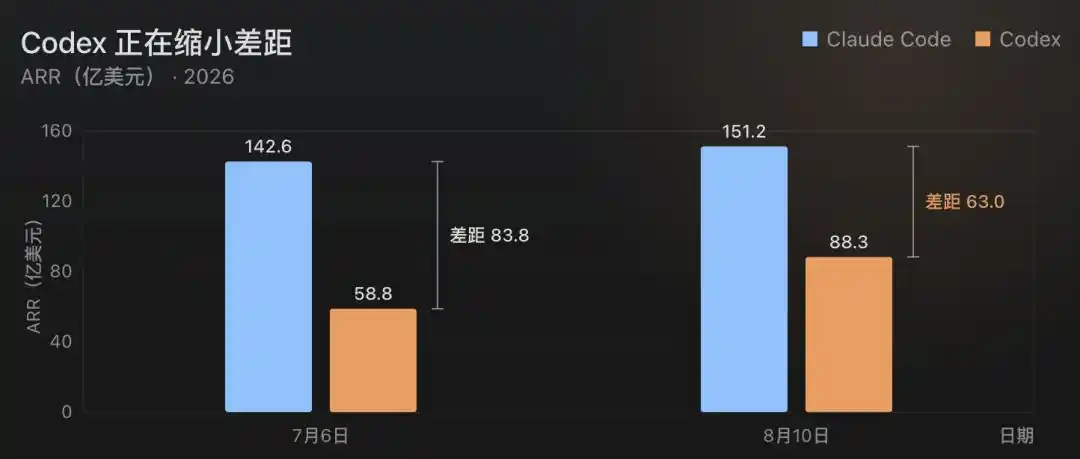
Why is Codex so strong? The answer is simple: it has absorbed a large number of "refugees" from Claude.

On platform X, numerous developers stated that due to the watermark and token limits, they have canceled their Claude subscriptions and fully switched to Codex.

Codex has looser limits, more seamless IDE integration, no disgusting invisible watermarks, and the backing of OpenAI's powerful enterprise sales network (Codex currently accounts for about 45% of OpenAI's enterprise ARR).

As one comment said: "Those who were going to Codex have left." Users are voting with their feet.

Even Cursor, recently acquired by SpaceX, has started a subsidy war, offering a $200 premium subscription directly for a "Claude cancellation screenshot."
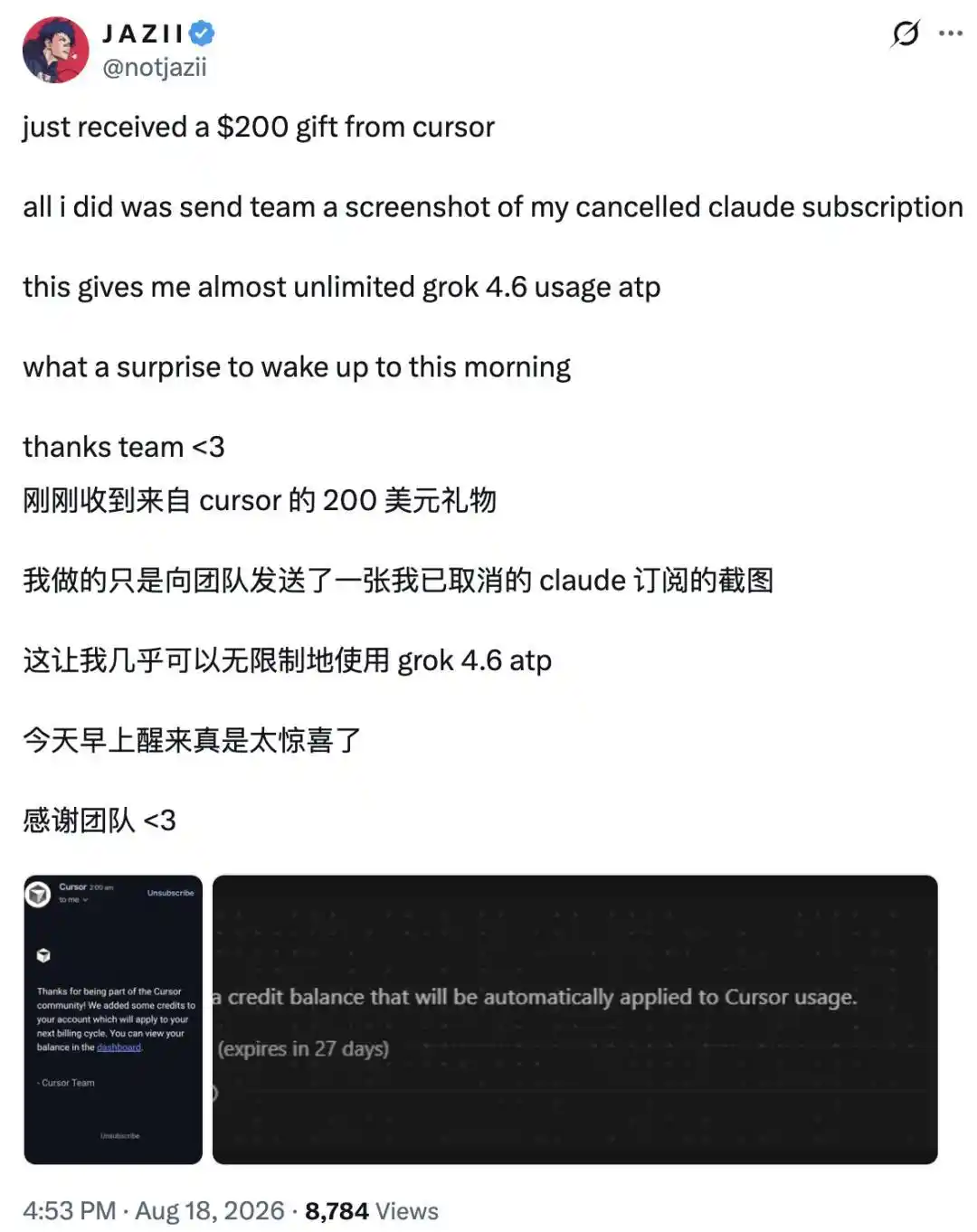

The moat Claude Code built early on with its ultra-long context and impressive zero-shot coding capabilities is being slowly filled in by OpenAI and Cursor with better product experiences and ecosystems.

The Market Enters a Cooling-Off Period, Waking from the "AI Self-Evolution" Dream

Looking back to May and June of this year, how triumphant Anthropic was then.

The Fable 5 model had just been released, team members were touting the new narrative everywhere: "AI has already gained the ability to develop software on its own." "The role of human programmers will be redefined."

At the peak of its ARR surge, all of Silicon Valley was immersed in a frenzy of "AGI is about to arrive, we are building gods."

This narrative is extremely sexy and also extremely easy to make those involved feel "high."

However, just two months later, reality harshly slapped this boastful narrative.

When the tide recedes, companies face the cold, hard business reality—

Corporate budgets are finite; compute is finite; workers' demands are quite humble (they just want the tool to be useful, not cause trouble, and have enough tokens).

What users truly care about is: "Can you stop putting watermarks in my code? Can you raise the hourly message limit a bit? Can you design your Cowork feature to be usable by humans?"

This is precisely the common dilemma facing all AI super-unicorns now.

CC's technical foundation is undoubtedly top-tier, but in product operations, commercialization strategy (like forcefully pushing watermarks), and understanding user psychology (like pricing and limits), it acts like an arrogant novice, leading to backlash.

What truly pushed the discussion to a poignant point is the critique at the capital and narrative level.

Some bluntly stated: Anthropic's roughly $2 trillion IPO valuation is absurd, even higher than SpaceX's.

Yet the reality is, it doesn't own any hardware, has no real moat, and the prospects aren't bright. Serious companies like SpaceX, whose intelligence is nearing and will soon surpass these models, will also see their revenue catch up.

As for the IPO, more people will see it as a tool to quickly offload shares and achieve a graceful exit.

Now, the market has moved from the blind rush period into a cooling-off period.

The days of feasting on hype and early-mover advantages are over.

Although Anthropic still holds a trump card—Fable 5.1—if it continues with the watermark, will users accept it?

One final piece of advice for Anthropic: Please be decent and stay humble.

Don't get too arrogant during growth, because your patrons can overturn the table and leave at any moment.

References:

https://blog.tickertrends.io/p/claude-code-vs-openai-codex-arrhttps://techcrunch.com/2026/08/17/anthropics-annualized-revenue-surges-to-65b/https://x.com/oran_ge/status/2090040293383082085

This article is from the WeChat public account "New Zhiyuan", author: Aeneas David

Trending Cryptos

Related Questions

QWhat is the main reason behind the recent surge in subscription cancellations for Claude Code?

AThe main reason is the controversial introduction of an 'invisible text watermark' on all text and code generated or processed by Claude, which users fear will taint their original work and lead to potential legal or compliance issues.

QAccording to the data from TickerTrends, how much did Claude Code's ARR growth rate drop to by August 10th?

AClaude Code's ARR growth rate plummeted to 5.2% by August 10th.

QWhich competing AI coding tool is reportedly gaining a significant number of users from Claude Code?

AOpenAI's Codex is gaining a significant number of users from Claude Code, with its recent four-week growth rate reaching 20.8%, four times that of Claude Code.

QWhat was the ambitious new narrative promoted by Anthropic's team during the peak of Claude Code's growth?

AThe team promoted a narrative that AI had achieved 'self-developing software capabilities' and that the role of human programmers would be redefined.

QWhat incentive did Cursor, recently acquired by SpaceX, offer to attract Claude Code subscribers?

ACursor offered a $200 premium subscription to users who provided screenshots proving they had cancelled their Claude subscription.

Related Reads

BTC Sees Largest Single-Day Short Liquidation in History: Overnight $1.1 Billion Short Positions Evaporate, But Calling a Bull Return is Premature

Bitcoin experienced its largest single-day short liquidation in history, with approximately $1.191 billion in short positions being forcibly closed within 24 hours as the price surged nearly 7% to approach $70,000. This event, occurring on the evening of August 19, resulted in total liquidations of about $1.345 billion across the network. The massive short squeeze was attributed to a combination of catalysts: a White House meeting between former President Trump and crypto industry executives fueling regulatory optimism, and a more substantial signal from the U.S. Treasury doubling its liquidity support for long-term bond repurchases, hinting at looser macro liquidity for risk assets. Data showed strong institutional buying, with U.S. spot Bitcoin ETFs seeing significant inflows. The liquidation process itself created a feedback loop, accelerating the price rise as forced buy-backs pushed prices higher. This event surpassed the previous record for BTC perpetual short liquidations set during the volatile "5.19" period in 2021. While such extreme short liquidations have historically signaled a potential medium-term bottom formation, analysts caution that the market often undergoes weeks of consolidation and "cooling off" afterward. Current sentiment remains mixed, with the Fear & Greed Index still in "Fear" territory, and the key test for the rally being whether it can sustain momentum to challenge higher resistance levels like $75,000. The article concludes by warning against immediate "bull market is back" assumptions, emphasizing that history provides context but not guaranteed outcomes.

marsbit12m ago

BTC Sees Largest Single-Day Short Liquidation in History: Overnight $1.1 Billion Short Positions Evaporate, But Calling a Bull Return is Premature

marsbit12m ago

Websea Global RWA Summit Successfully Held: Focusing on New Opportunities in China-Kazakhstan Digital Economy, Releasing Signals of Cross-border Collaboration

Websea Global RWA Summit Successfully Held: Focusing on China-Kazakhstan Digital Economy Opportunities, Releasing Signals for Cross-Border Synergy When traditional industries seek new channels for globalization and digital technologies reshape capital, assets, and collaboration methods, an industrial dialogue connecting China, Kazakhstan, and global markets took place in Almaty. On August 18, 2026, the "2026 Global RWA Real-World Asset Tokenization Enterprise Globalization Resource Matching & China-Kazakhstan Industrial Investment Conference," co-hosted by Websea, concluded successfully in Almaty, Kazakhstan. Centered on RWA digitization, cross-border industrial synergy, and investment promotion, the summit gathered industry representatives, investors, digital economy practitioners, creators, and media from China and Kazakhstan to explore the future of a digital economy community. The event shifted focus from mere "project showcases" to fostering deeper "industrial synergy." It featured project roadshows and panel discussions on topics like "Mining Future·Digital Empowerment," "Real Estate Renewal·Urban Evolution," "Green Energy·RWA Opportunities," and "The Globalization Logic of Real Economy." Mr. Yerbol Kharbayev, Chairman of the Kazakhstan Association of Special Economic Zones, emphasized that RWA's significance lies not only in technology but in enhancing asset transparency, collaboration efficiency, and cross-border connectivity through digitization. The discussions highlighted a move towards a deeper "Digital Economy Community" between China and Kazakhstan. Key points included the need for an open, transparent, and stable business environment to attract long-term investment and the crucial role of synergy between governments, enterprises, platforms, and communities. The summit facilitated strategic cooperation signings and targeted B2G/B2B matching, providing a direct channel for Chinese enterprises exploring the Central Asian market. As an invited digital asset platform, Websea participated in brand presentations and the launch of initiatives like a Creator Alliance and a Web3 MCN agency. Herbert Sim, Global CMO of Websea, stated that platform development is fundamentally rooted in user trust and real experience. He expressed gratitude for user and partner trust, underscoring Websea's commitment to asset security, transaction experience, risk awareness, and user rights protection. Websea aims to contribute to the global digital economy through optimized services and open collaboration. The summit also launched the Web3 Beauty Alliance - Central Asia Chapter, a China-Kazakhstan Quality Creator Alliance, and Web3 MCN agencies, expanding the dialogue beyond industry and capital to include technology, content, community, and brand building. The event concluded by signaling that the future of the digital economy will be co-created by a broad range of participants. It requires institutional and infrastructural support, long-term commitment from enterprises, and the sustained trust of users, partners, and communities. With the summit's conclusion, a new chapter in China-Kazakhstan industrial synergy and digital economy cooperation has begun. Websea will use this as a starting point to continue exploring a secure, open, and sustainable digital future alongside global users and partners.

marsbit21m ago

Websea Global RWA Summit Successfully Held: Focusing on New Opportunities in China-Kazakhstan Digital Economy, Releasing Signals of Cross-border Collaboration

marsbit21m ago

Russia's Banking Bleed and the Crypto Hunt: Citizens Have Withdrawn 24 Billion Euros from Banks This Year; Bill Limiting Total Crypto Purchases Set to Take Effect

**Title: Russia's Banking System Bleeds Cash as Citizens Turn to Crypto, But New Law Imposes Strict Limits** **Summary:** Russia is witnessing a significant outflow of cash from its banking system, with citizens withdrawing approximately €24.4 billion in the first seven months of 2026. This trend accelerated in July, marking the highest monthly increase for the year. Major banks like Gazprombank and Sberbank have reported substantial deposit losses. Simultaneously, cryptocurrency transaction volumes have surged, with an estimated daily trading volume of around $650 million. Officials note that annual crypto transactions exceed 10 trillion rubles, largely occurring outside regulated channels. Citizens are increasingly using crypto as a tool to hedge against currency depreciation and financial uncertainty. In response, President Putin signed the "Digital Currency and Digital Rights Law," with key provisions taking effect on September 1, 2026. This law severely restricts access for ordinary citizens. Non-qualified retail investors will be limited to purchasing only about $3,600 worth of cryptocurrency (initially Bitcoin, Ethereum, and USDT) per year through any single licensed intermediary. Qualified investors and businesses face no such limits for cross-border settlements. Official explanations for the cash exodus cite technical factors like tax changes and digital payment disruptions. However, analysts and media point to deeper public concerns over potential asset freezes, economic instability related to the war, and a lack of trust in the financial system. Notably, September 1 also marks the public launch of the Digital Ruble, Russia's central bank digital currency (CBDC). This creates a dual dynamic: tightening control over decentralized crypto assets while introducing a state-controlled digital currency for payments. For ordinary Russians, traditional banking is losing appeal, crypto access is being capped, and the new Digital Ruble offers a third, fully state-managed pathway.

marsbit45m ago

Russia's Banking Bleed and the Crypto Hunt: Citizens Have Withdrawn 24 Billion Euros from Banks This Year; Bill Limiting Total Crypto Purchases Set to Take Effect

marsbit45m ago

Household & Personal Care Giant Quietly Becomes the Champion in 'Chip Cleaning'

Kao, the renowned Japanese consumer goods giant known for laundry detergent and facial cleansers, has quietly become a leader in the semiconductor precision cleaning agent market, as revealed in its recent financial report. The company's chemical business, which includes semiconductor precision cleaning agents, achieved net sales of 2472 billion yen (approx. RMB 104.4 billion) in the first half of fiscal 2026, growing 9.4% year-on-year and becoming its fastest-growing segment. Notably, Kao holds about a 60% market share in cleaning agents for package substrates and is also a leader in specific chemicals for NAND flash manufacturing processes. Its products have entered the supply chains of major chipmakers like TSMC, Samsung, and Kioxia. Kao's journey into semiconductors began with its core expertise in surface science, developed from its origins in soap and detergent manufacturing. The 1987 Montreal Protocol, which phased out ozone-depleting solvents like Freon, created a demand for alternative cleaning solutions. Leveraging its deep knowledge of surfactants and purification, Kao launched its "CLEANTHROUGH" aqueous cleaning agent in 1991, entering the precision cleaning market. Over the past three decades, Kao has expanded its product line to cover both front-end (wafer fabrication) and back-end (packaging) semiconductor processes. Its "precision interface control technology" addresses key challenges like particle removal, photoresist stripping, and cleaning complex structures in advanced packaging without damaging delicate materials. Beyond cleaning, Kao's portfolio extends to adjacent processes like dry film photoresist stripping. A key to Kao's success is its customer-centric business model. The company operates "Fine Cleaning Centers" in Japan and Taiwan, where it collaborates directly with clients on process development. This deep integration, coupled with the high cost and risk of switching validated materials in semiconductor production, creates strong customer loyalty. As the AI boom drives demand for complex chip packaging like CoWoS, which requires more numerous and difficult cleaning steps, Kao is strategically positioned. The company plans to defend its back-end dominance while expanding into DRAM and logic semiconductor markets. Kao's story mirrors that of other Japanese firms like Ajinomoto (ABF film) and TOTO (electrostatic chucks), which leveraged deep-rooted core technologies from seemingly unrelated industries to achieve leadership in critical, niche segments of the semiconductor supply chain.

marsbit46m ago

Household & Personal Care Giant Quietly Becomes the Champion in 'Chip Cleaning'

marsbit46m ago

Trading

Spot

Hot Articles

What is DOGE M

Doge Matrix ($doge m): The New Breed of Community-Driven Cryptocurrency Introduction In the ever-evolving landscape of cryptocurrency, new projects constantly emerge, each aiming to capture the interest of investors and enthusiasts alike. One of the latest entrants to this domain is Doge Matrix, represented by the ticker symbol $doge m. This project has attracted attention thanks to its roots in the popular meme culture surrounding Dogecoin, establishing its place within the web3 space. This article aims to provide a comprehensive analysis of Doge Matrix, covering its overview, creator, investors, functionality, timeline, and notable aspects. What is Doge Matrix ($doge m)? Doge Matrix is a community-driven cryptocurrency project that seemingly builds upon the widespread appeal of Dogecoin, a digital currency known for its Shiba Inu mascot and its meme origins. While the overarching objectives of Doge Matrix are not extensively defined, it is characterised by a commitment to harnessing community involvement and support. Unlike traditional cryptocurrencies that often emphasise utility or intrinsic value through underlying technologies, Doge Matrix positions itself within a space that embraces the cultural phenomenon of cryptocurrencies, particularly appealing to those who resonate with the ethos of meme-based assets. Drawing on the strengths of the Dogecoin community, Doge Matrix operates as part of a broader ecosystem, inviting participation and engagement from users who share an interest in cryptocurrency and the digital landscape. Who is the Creator of Doge Matrix ($doge m)? The identity of the creator of Doge Matrix remains unknown. This lack of transparency is not an uncommon occurrence in the cryptocurrency space, where some projects are launched without revealing the identities of their founders. The absence of information regarding the founding team can raise questions among potential investors about the project’s accountability and direction. Who are the Investors of Doge Matrix ($doge m)? As it stands, there is no publicly available information detailing the investors or investment foundations that back Doge Matrix. The project appears to rely primarily on community support rather than institutional investment. This model aligns with the community-driven nature of the initiative, fostering an environment where the direction of the project is shaped by its participants rather than being dictated by a select few financial backers. How Does Doge Matrix ($doge m) Work? The specifics regarding the operational mechanisms of Doge Matrix are somewhat vague, reflecting a broader trend of projects in the meme coin space where innovative functionalities are not always clearly articulated. Nonetheless, Doge Matrix seems designed to tap into the existing cryptocurrency ecosystem by encouraging user participation while tapping into the familiar cultural references associated with Dogecoin. Its potentially unique characteristics derive from community interactions rather than technological advancements, emphasising shared experiences and collaboration among token holders. While the exact innovations have not been explicitly outlined, the project appears to create a space where community members can engage, share ideas, and propel the project's potential forward. Timeline of Doge Matrix ($doge m) Reflecting on the project’s timeline reveals notable events that have defined its journey thus far: November 25, 2024: Doge Matrix reached its all-time high value, marking a significant milestone in its early history. January 1, 2025: Conversely, Doge Matrix hit its all-time low value, illustrating the volatility often associated with cryptocurrencies, especially in the early stages of a project's lifecycle. Ongoing: The project continues to be actively traded and supported by its community, although specific future milestones or objectives have yet to be disclosed. Key Points About Doge Matrix ($doge m) Community Focus At the heart of Doge Matrix is a commitment to community engagement. The project thrives on the premise of collaboration and shared objectives among its members, emphasising the importance of collective effort. Unlike centralised projects that often have a defined leadership structure, Doge Matrix at present showcases a more fluid approach to governance, where every community member's voice matters. Volatility The cryptocurrency market is notorious for its volatility, and Doge Matrix is no exception. Its price history reflects significant fluctuations between high and low values, which is typical of many new cryptocurrencies but underscores the risks associated with investment in emerging tokens. Lack of Detailed Information One of the most striking features about Doge Matrix is the scarcity of detailed information regarding its technological underpinnings and operational mechanisms. This ambiguity necessitates that potential investors conduct thorough due diligence before engaging with the project. Conclusion In summary, Doge Matrix ($doge m) illustrates a new wave of cryptocurrency projects that lean heavily on community engagement and cultural relevance. While lacking in certain specifics—such as clear leadership, defined objectives, and detailed functionality—the project has managed to generate interest within the crypto community, leveraging the established appeal of meme culture. As with any investment in the cryptocurrency space, understanding the inherent risks and conducting comprehensive research is essential for potential participants. Doge Matrix stands as a reminder of the dynamic, sometimes unpredictable nature of the crypto industry, marked by constant evolution and enthusiasm for community-driven initiatives.

674 Total ViewsPublished 2025.02.03Updated 2025.02.03

What is DOGE M

What is $M

Understanding Mantis ($M): A New Era in Cross-Chain Interoperability In the continually evolving landscape of Web3 and cryptocurrency, new projects strive to offer innovative solutions aimed at enhancing the user experience and expanding functional possibilities within the decentralised financial ecosystem. One such project garnering attention is Mantis ($M), a pioneering protocol founded on the principles of cross-chain interoperability and intent-based settlements. This article delves into the essential aspects of Mantis, including its core functionality, creators, investment backing, innovative features, and critical milestones. What is Mantis ($M)? Mantis is described as a multi-domain intent settlement protocol that simplifies cross-chain interactions, enabling users to execute complex financial transactions across various blockchain platforms seamlessly. The protocol operates through three primary layers: Intent Expression: Users can articulate their transaction goals using natural language facilitated by the DISE LLM, an advanced AI language model. For instance, a user might express a desire to swap Ethereum (ETH) for Solana (SOL) with a specific slippage tolerance of 1%. Execution: This layer employs a network of solvers that compete to fulfil user intents. Transactions are executed using mechanisms such as Coincidence of Wants (CoWs) and Order Flow Auctions (OFAs), which ensure that user demands are met optimally. Settlement: Leveraging the Inter-Blockchain Communication (IBC) protocol, Mantis enables atomic cross-chain transactions, allowing users to operate across various supported chains, including Ethereum, Solana, and Cosmos. Mantis is engineered to introduce native yield generation for idle assets, employing cryptographic proofs to maintain the integrity of transactions throughout the entire process. Creators & Development Team Mantis was conceived by the Composable Foundation, a research-driven organisation notable for its emphasis on blockchain interoperability solutions. This foundation collaborates with esteemed academic institutions, including Harvard University and the University of Lisbon, contributing to extensive research and development efforts that inform Mantis's architecture and functionality. The Composable Foundation’s commitment to fostering innovation in the blockchain space positions Mantis as a robust solution for the growing demand for interoperability among multiple blockchain networks. Investors & Backing While specific details about individual investors have not been publicly disclosed, Mantis enjoys substantial backing from various entities, including: Ecosystem grants from IBC-enabled chains, which support the protocol's growth and integration within decentralised finance ecosystems. Strategic partnerships with infrastructure providers that enhance Mantis's network capabilities and deployment strategies. Funding through the Composable Foundation's treasury, ensuring sustained financial support for ongoing development and operational costs. These collaborative efforts reflect a consensus among stakeholders about the importance of enhancing cross-chain functionality and the potential utility of Mantis's infrastructural innovations. Key Innovations Mantis sets itself apart through several pioneering innovations that enhance its functionality and utility: Chain-Agnostic Intents: Users can initiate transactions from any supported chain while settling on another. This flexibility empowers users, driving increased interaction among different platforms. AI-Powered Interface: The integration of DISE LLM allows users to conduct complex DeFi operations using natural language, thereby simplifying interactions and making blockchain technology accessible to a broader audience. Cross-Domain MEV Capture: Mantis creates an internal market for maximal extractable value (MEV) through competitions among solvers. This innovative approach allows for greater efficiency and value extraction in complex transactions. Modular Settlement Layer: The protocol supports various verification methods, including zero-knowledge proofs and optimistic rollups, providing a versatile framework that can adapt to emerging blockchain technologies. Historical Timeline Mantis's development is marked by several critical milestones that chart its trajectory and growth: | Year | Milestone | |————|————————————————————————-| | 2022 | Initial concept development within the Composable Foundation's research division. | | Q3 2024 | Launch of the testnet with bridging capabilities between Solana and Ethereum. | | Q1 2025 | Anticipated Token Generation Event (TGE) alongside the mainnet launch. | | Q2 2025 | Expected integration of DISE LLM and expansion of cross-chain capabilities. | | 2025 H2 | Planned support for over 15 chains through further IBC upgrades. | This timeline outlines Mantis's evolution, from conceptual discussions to active implementation and future growth phases. Ecosystem Growth Strategy Mantis's strategy for ecosystem growth includes several initiatives designed to encourage user participation and developer engagement: Credits System: Users can earn protocol credits by providing liquidity and engaging in referral programmes. These credits are redeemable for incentives in the future, fostering a robust user community. Modular Software Development Kit (SDK): This toolkit empowers developers to create applications based on intent-driven models utilising Mantis's infrastructure, thus promoting innovation within its ecosystem. Governance Model: As the protocol matures, $M token holders will have a voice in protocol governance, allowing them to vote on proposed upgrades and changes, thereby enhancing community engagement and decentralisation. Mantis represents a significant advancement in the realm of cross-chain architecture. By seamlessly integrating advanced AI algorithms with a robust settlement framework, Mantis seeks to tackle the problems of fragmentation within multi-chain ecosystems. Its innovative approach prioritises improved user experiences while adhering to the foundational principles of decentralisation and security, setting a new standard for the future interoperability of blockchain technologies. As Mantis continues its journey of growth and implementation, it promises to be a project to watch closely in the competitive landscape of Web3 and decentralised finance. With its focus on crossing boundaries and elevating user engagement, Mantis is poised to be an integral part of the future developments in the cryptocurrency space.

206 Total ViewsPublished 2025.03.18Updated 2025.03.18

What is $M

Discussions

Welcome to the HTX Community. Here, you can stay informed about the latest platform developments and gain access to professional market insights. Users' opinions on the price of M (M) are presented below.

活动图片