Author: Claude, Deep Tide TechFlow
Deep Tide Guide: On August 4th, Russian President Vladimir Putin signed the "Digital Currency and Digital Rights Law," with its core provisions taking effect on September 1st. Non-qualified retail investors in Russia will be limited to purchasing no more than 300,000 rubles (approximately $3600) worth of cryptocurrency annually through any single licensed intermediary. Furthermore, a central bank draft regulation limits the purchasable assets to Bitcoin, Ethereum, and USDT. Almost simultaneously, data from the Russian Central Bank shows that in the first 7 months of 2026, citizens withdrew approximately 24.4 billion euros in cash from the banking system, with July alone seeing the highest monthly increase in cash circulation for the year. On one hand, traditional bank deposits are rapidly fleeing; on the other, the purchase of crypto assets is being tightly restricted. For ordinary Russians, both potential escape routes are narrowing.
Banks Are Bleeding: 24.4 Billion Euros in Cash Outflow Over 7 Months
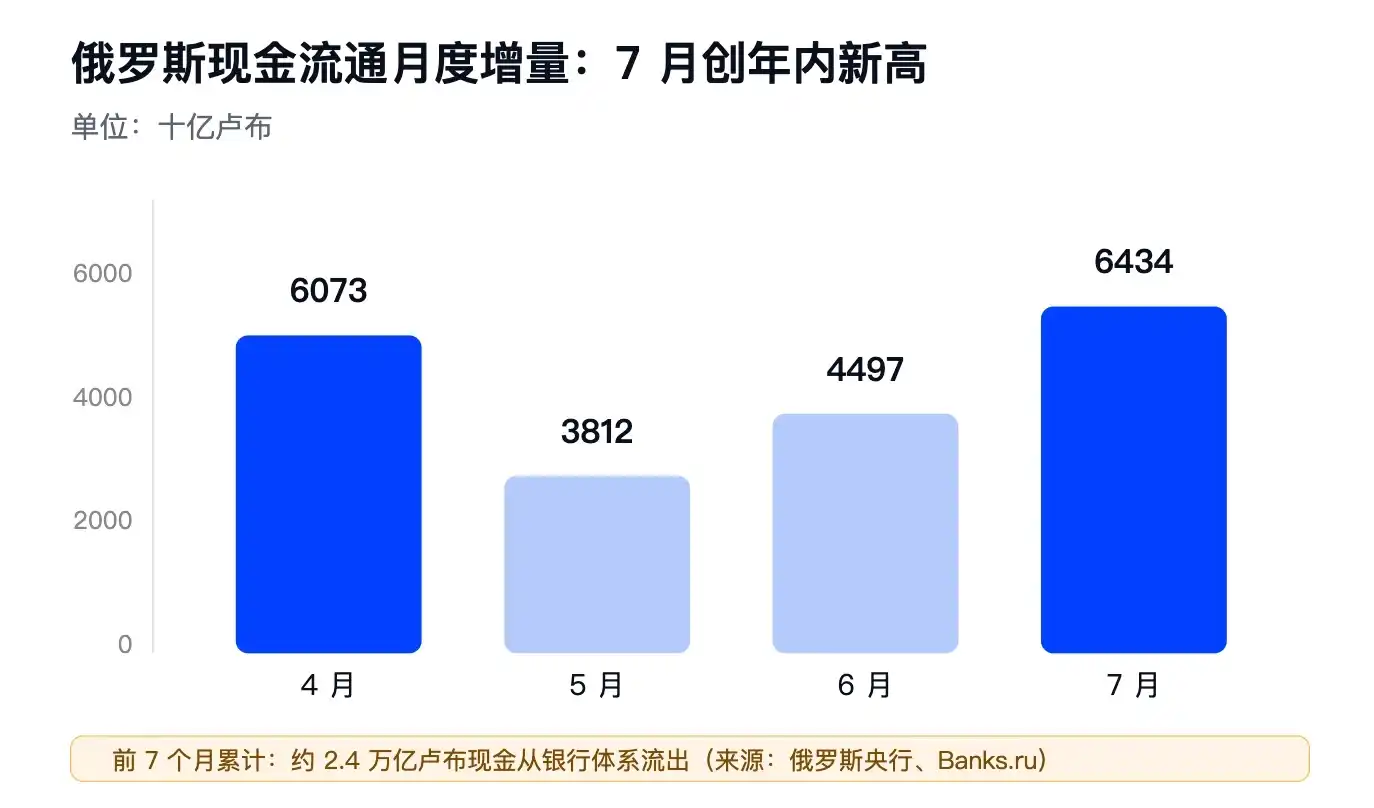
Russians are moving cash out of banks. According to reports from media outlets like the Financial Times and the Washington Post, in the first 7 months of 2026, Russians withdrew approximately 24.4 billion euros (about 2.4 trillion rubles) in cash from the banking system. Data from the Russian financial data platform Banks.ru indicates this withdrawal trend began in early March, with around 300 billion rubles leaving personal accounts each month.
The pace of outflow is accelerating. Data from the Russian Central Bank shows that cash in circulation increased by 607.3 billion rubles in April, by 381.2 billion rubles in May (a record high for May since 1995), by 449.7 billion rubles in June, and by another 643.4 billion rubles in July, marking the largest monthly increase in 2026. By July of this year, the total cash held by Russian citizens and businesses exceeded 21.9 trillion rubles.
Deposit data from specific banks paints a clearer picture. Gazprombank lost 299.5 billion rubles in personal deposits over 4 months, accounting for 10.8% of its total deposits; Rosselkhozbank lost 270.5 billion rubles, a decline exceeding 15%; Russia's largest private bank, Alfa-Bank, lost 179.4 billion rubles, a 5.6% decrease. Even the traditionally stable Sberbank was not spared, losing 211.6 billion rubles in June alone and another 31.8 billion rubles in July.
This Money Has Not Disappeared; It Has Flowed into Cryptocurrency
While cash flowed out of banks, cryptocurrency trading volume expanded rapidly. In February 2025, Russian Deputy Finance Minister Ivan Chebeskov stated at the Alfa Talk conference that daily cryptocurrency transaction volume among the Russian public reached approximately 50 billion rubles, equivalent to about $648 million at the then exchange rate, with millions of citizens participating annually.
Chebeskov's exact words were: "The annual volume of cryptocurrency transactions in our country exceeds 10 trillion rubles, all occurring outside the regulatory zone." This statement highlights the real anxiety of Russian regulators. The public is not treating cryptocurrency as a speculative toy but rather as a savings tool to hedge against ruble depreciation, circumvent capital controls, and cope with financial uncertainty.
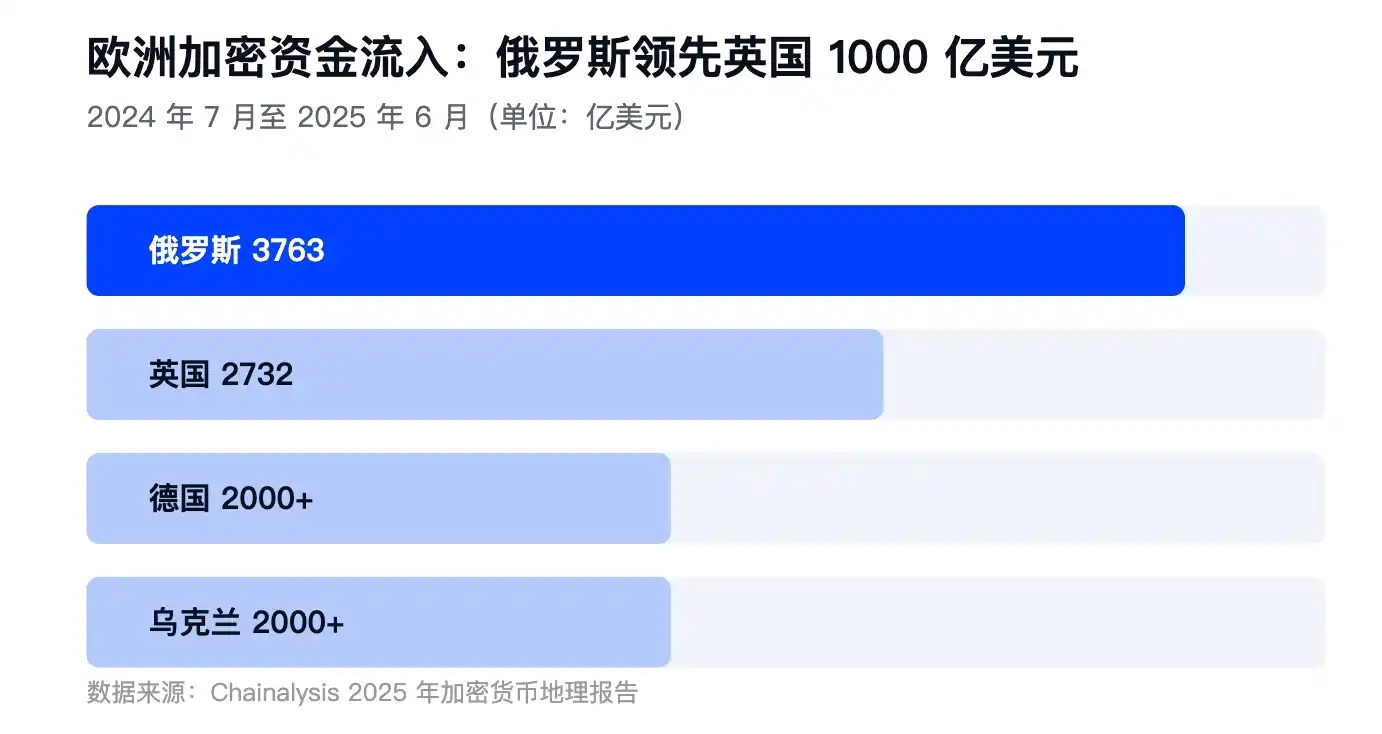
Data from Chainalysis corroborates the scale of this market. From July 2024 to June 2025, Russia received cryptocurrency inflows amounting to $376.3 billion, nearly 1.4 times the UK's $273.2 billion, ranking first in Europe. Sergei Shvetsov, Chairman of the Supervisory Board of the Moscow Exchange, estimated that Russian users pay approximately $15 billion in fees to overseas crypto platforms annually.
New Crypto Law Takes Effect September 1st, Locking Retail Investors at 300,000 Rubles Per Year

The government chose to formalize this gray channel through legislation. On July 21, 2026, the Russian State Duma passed the second and third readings of the "Digital Currency and Digital Rights Law" in a single day; Putin signed it into law on August 4th. The core provisions of this law will officially take effect on September 1, 2026.
For ordinary retail investors, the law stipulates strict entry conditions. Non-qualified investors must pass a suitability test administered by the Russian Central Bank and are limited to purchasing no more than 300,000 rubles worth of cryptocurrency annually through any single licensed intermediary, roughly equivalent to $3600 to $3800. On August 11th, the Russian Central Bank released a draft instruction initially limiting the crypto assets retail investors can purchase to Bitcoin, Ethereum, and USDT.
Qualified investors are exempt from these restrictions and can trade freely on exchanges and over-the-counter markets. Businesses and import-export firms can also use cryptocurrency for cross-border settlements, with no rigid caps for this segment. The law simultaneously maintains the ban on using cryptocurrency for domestic payments of goods and services.
In other words, ordinary people looking to preserve value with crypto assets can only buy about $3600 worth per year per platform, while businesses and high-net-worth individuals retain ample channels. This design leaves the "large outflow" valve open on the institutional side while tightening it on the retail side.
Why Are Banks Bleeding? Two Explanations Coexist
Regarding the cash outflow, Russian officials and the market offer different explanations.
Russian Central Bank and Finance Ministry officials have repeatedly emphasized that there is no plan to freeze citizens' deposits, with Finance Minister Anton Siluanov dismissing related rumors as "fake news." Central Bank Deputy Governor Alexei Zabotkin publicly stated in August 2025 that restricting withdrawals would have "destructive consequences" for the financial system.
The central bank attributes the surge in cash to several technical factors: the increase in VAT from 20% to 22% starting January 2026, coupled with bank acquiring services also being subject to VAT, pushing small and medium enterprises towards cash to avoid taxes; frequent disruptions to mobile communications and the internet since spring, causing digital payments to fail and forcing the public and businesses to hoard cash; additionally, declining deposit interest rates have made deposits less attractive.
However, the market offers a different narrative. The Financial Times and the Washington Post, citing analysts and anonymous former finance officials, suggest that the public's withdrawals stem from concerns about rising war costs, asset nationalization, and banking system instability. Last year, Russian prosecutors transferred approximately $51.5 billion in private assets to state control, and in June seized about $7.6 billion in assets related to agricultural magnate Vadim Moshkovich. These events have fueled persistent rumors that "deposits might be requisitioned by the government."
September 1st Isn't Just for the Crypto Law; The Digital Ruble is Also Launching
Notably, September 1st is also the day the Russian central bank digital currency, the "Digital Ruble," opens to the general public. Systemically important banks like Sberbank, VTB, Alfa-Bank, Gazprombank, and T-Bank, among 12 in total, must enable their clients to conduct Digital Ruble transactions, and retailers with annual turnover exceeding 120 million rubles must accept Digital Ruble payments.
This means that on the same day, Russia will undertake two simultaneous actions: on one hand, bringing民间 crypto trading under a regulatory framework through licensed intermediaries; on the other hand, pulling retail payments back into the official system via the central bank digital currency. For ordinary Russians, the attractiveness of bank deposits is waning, cryptocurrency purchase limits are being fixed, and the Digital Ruble offers a third path—one that is entirely state-controlled.
As 24.4 billion euros in cash surged out of the banking system and $650 million in daily crypto transactions flowed through the gray market, the law Putin signed on August 4th resembles a watershed moment. For ordinary Russians, the channels to autonomously manage their wealth are diminishing, with each remaining choice carrying different implications for who holds the control.