The Optimal 'AI Bubble Trade': Simultaneously Going Long on 'Arrogance' and 'Bias'

marsbitPublished on 2026-08-17Last updated on 2026-08-17

Abstract

The optimal investment strategy in the current AI bubble environment is a dual "leg" approach: going long on both "hubris" (AI tech leaders) and "humiliation" (neglected, underperforming cyclical assets). This aims to capture gains from both sides during the final surge of a nominal GDP-driven bubble, according to a Bank of America report by strategist Michael Hartnett. The bank's Bull & Bear Indicator remains in extreme bullish territory, signaling "sell", yet history shows such signals have limited immediate impact. Current fund flows show structural shifts: gold saw its largest weekly inflow since January, commodities are up 58.9% YTD, while tech stocks experienced their largest weekly outflow in seven weeks. The core thesis is that the final stage of a bubble benefits both the leading theme ("hubris" - AI) and oversold sectors ("humiliation" - like consumer stocks), similar to patterns seen in the 1999 tech bubble and 2007-2008 credit crisis. The report advises shorting "AI bonds," anticipating pressure from massive capital expenditures. Key risks include high concentration, surging bond yields, and cautious voter sentiment. The US debt burden is highlighted, with servicing costs reaching $1.4 trillion. The 10-year Treasury yield breaching 5% is seen as a red line for policymakers. For the "avoid the dollar" theme, BofA recommends gold and Hong Kong property stocks, the latter seen as deeply undervalued. The November US midterm elections, particularly the Texas govern...

The optimal investment strategy in the current AI bubble environment is to simultaneously go long on "Arrogance" (AI technology leaders) and "Bias" (neglected, underperforming assets), capturing two-way returns during the final surge phase of the nominal GDP bubble.

According to the Chasing the Wind Trading Desk, Michael Hartnett, Chief Strategist at Bank of America Securities, stated in his latest research report that the BofA Bull & Bear Indicator has slightly retreated from 9.7 to 9.3, remaining in extreme bullish territory, and continues to signal a "sell." Meanwhile, over the past week, capital flows showed structural divergence: technology stocks saw their largest weekly outflow in seven weeks, gold recorded its largest weekly inflow since January this year, commodities have delivered year-to-date returns as high as 58.9%, while Bitcoin has fallen nearly 28% year-to-date.

Bank of America points out that the core logic for major asset allocation currently remains the framework of avoiding bonds, avoiding the dollar, and fully investing in AI, further reinforced by policymakers viewing the stock market as "too big to fail." However, the strategist also warns that three potential constraints are suppressing the continuation of the bull market: surging bond yields, a shift towards caution in voter sentiment, and widespread positioning already skewed towards longs.

"Arrogance" Plus "Bias": The Optimal Two-Legged Strategy for the AI Bubble

Bank of America's core trading logic on the AI theme is derived from comparisons with historical bubble patterns.

The report points out, the optimal bubble trading strategy is to simultaneously go long on "Arrogance" (hubris)—which is AI technology itself—and go long on "Bias" (humiliation)—which are oversold cyclical assets that have been long neglected by the market and have the potential to be lifted during the final surge phase of nominal GDP.

The report cites historical examples: emerging markets during the 1999 internet frenzy, and the 2007-2008 subprime period, both played roles as "beneficiaries of spillover effects" just before the dominant bubble peaked. Bank of America believes that in the current environment, the assets most likely to replicate this path are in the consumer sector.

At the same time, Bank of America recommends shorting AI bonds—arguing that capital expenditure exceeding $1 trillion combined with negative net cash flow implies significant pressure for massive bond issuance that cannot be ignored.

Bull & Bear Indicator Remains at Extreme Levels, But Sell Signal's Impact is Limited

The BofA Bull & Bear Indicator fell slightly this week from 9.7 to 9.3, maintaining a sell signal, triggered by weaker inflows into high-yield bonds and net outflows from the technology and healthcare sectors.

The report notes that since the sell signal was issued on May 26 this year, the S&P 500 index has risen 4% cumulatively, and the MSCI World Index has gained 3%, despite experiencing a maximum drawdown of 5% during the period (from May 26 to July 30, interrupted by JPY/USD intervention and strong earnings from the "Magnificent Seven" tech stocks).
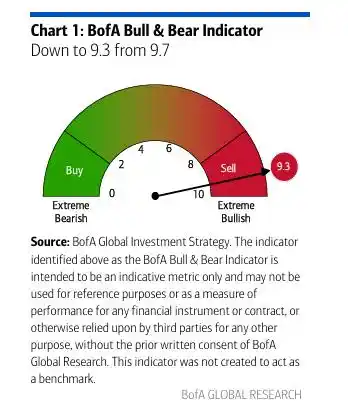
Bank of America cautions that overly concentrated positioning can disrupt the pace of a bull market, but truly ending a bull market requires the convergence of three elements: excessive positioning, overly optimistic profit expectations, and policy tightening. Currently, these three elements are not simultaneously present.

Historical data shows that since the Bull & Bear Indicator was established, it has issued 17 sell signals. Global stocks on average fell 2% to 3% within 2 to 3 months afterward, with a hit rate of about 60% and maximum drawdowns ranging between 15% and 20%.

Capital Flows: Gold and Commodities in Favor, Tech Stocks Sold

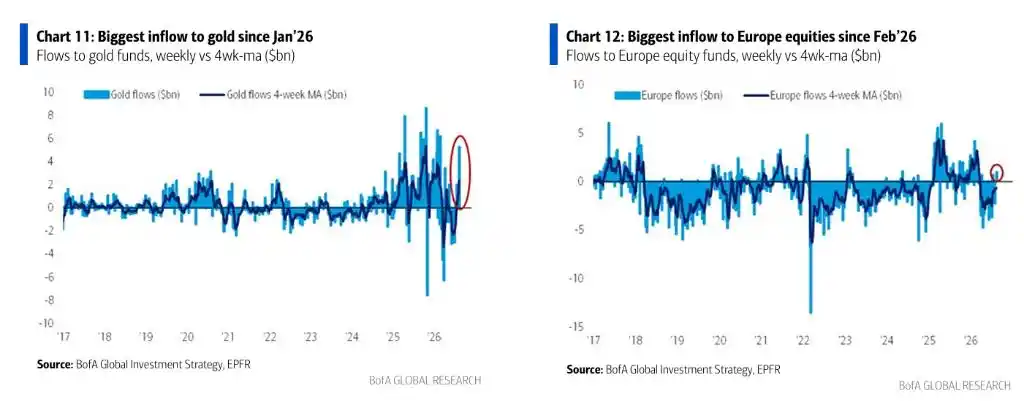
This week's capital flow data showed significant structural divergence. Gold funds recorded a net inflow of $6.3 billion, the largest weekly inflow since January this year; commodities, with a year-to-date total return rate of 58.9%, topped all asset classes, with crude oil up 43% year-to-date.

In contrast, technology funds saw a net outflow of $1.2 billion this week, the largest weekly outflow in seven weeks. European equity funds received a net inflow of $1.2 billion, the largest since February this year; South Korean equity funds recorded net inflows for the seventh consecutive week.
In fixed income, investment-grade bond funds saw inflows of $10.6 billion, the largest in five weeks; emerging market bond funds saw inflows of $1.4 billion, the largest in seven weeks. Cash-like assets attracted $25.4 billion in weekly inflows.

BofA Private Clients: Equity Allocation at Record High, Cash at Record Low

Data from BofA Private Clients shows that managed assets total $4.7 trillion, with equity allocation rising to 66.4%, a record high; bond allocation fell to 17.0%, the lowest since March 2022; cash allocation fell to 9.4%, the lowest level on record. Weekly net equity inflows were the largest since September 2022.

Within bonds, private clients are slightly extending duration, with allocations to 2-10 year U.S. Treasuries rising 15% year-to-date, while allocations to Treasury bills with maturities under one year have fallen over 30% since last November, though interest in 30-year long bonds remains lacking. Over the past four weeks, private clients have purchased ETFs in Japanese bonds, municipal bonds, and inflation-protected bonds, while reducing ETFs in emerging market debt, utilities, and the financial sector.

High Debt Pressure, U.S. Treasury Yields as the Key Variable

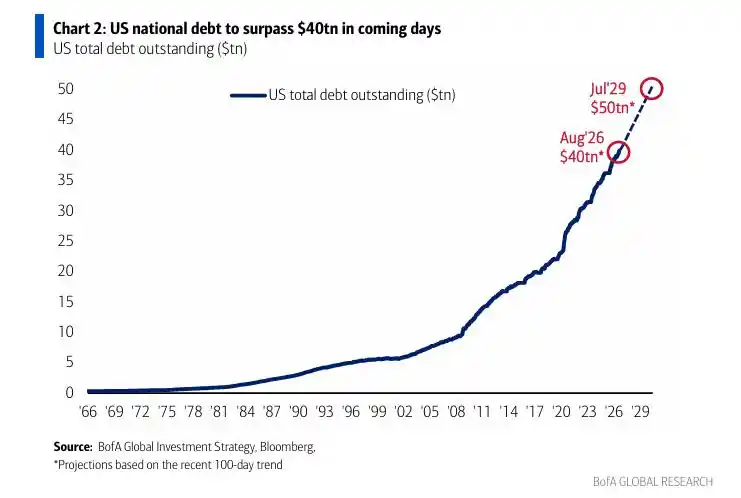
Bank of America warns that U.S. national debt is about to exceed $40 trillion and is projected to reach $50 trillion by July 2029. Federal government debt servicing costs over the past 12 months have reached $1.4 trillion and will continue to rise until the 5-year Treasury yield falls below 3.25%.

At the same time, the U.S. 30-year Treasury completed an auction at a yield of 5.126%, the highest in 25 years, while U.S. stocks hit record highs on the same day, highlighting the continued effectiveness of the "avoid bonds" allocation logic.
Bank of America points out that despite the overall upward trend in yields in 2026, long-duration, previously neglected assets such as REITs, small-cap stocks, biotech (XBI), and regional banks (KRE) are quietly outperforming the broader market, reflecting the market's advance pricing of expectations for "peak yields."

The report believes that the USD/JPY intervention has sent a clear signal that the U.S. government does not want the 10-year Treasury yield to break above 5%.

Strategists expect core CPI to fall to the 2.1%-2.6% range before the midterm elections. Hawkish Fed Chairman Warsh is then expected to use the Jackson Hole speech and the September FOMC meeting to declare "mission accomplished," working in tandem with a Bank of Japan rate hike to jointly cap the upside for yields.

Hong Kong Real Estate and Gold: Two Trades for "Avoiding the Dollar"

Under the "avoid the dollar" theme, Bank of America recommends two specific trade paths. First, go long on gold, viewing it as the best hedge against dollar depreciation, bond market collapse, and asset inflation. This week's gold inflows also confirm the market consensus in this direction.

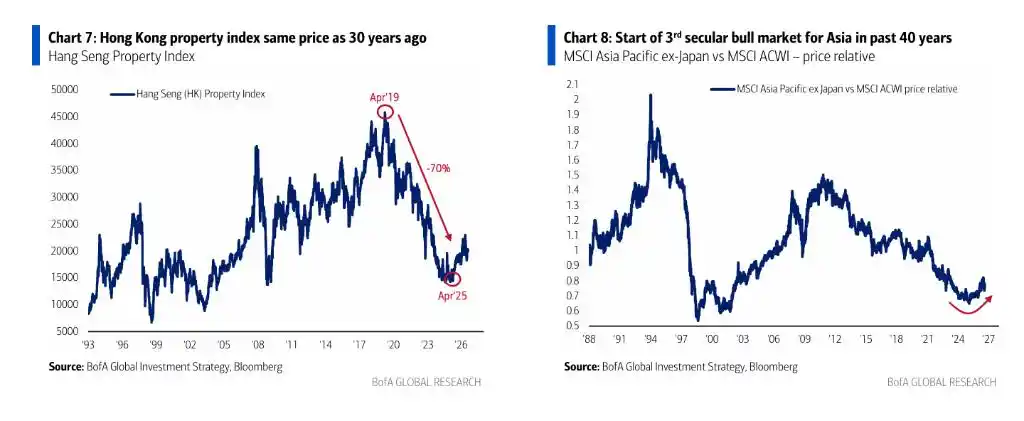
Second, go long on the Hong Kong real estate sector. BofA strategists summarize this logic as "buy humiliation, sell arrogance": the Hang Seng Properties Index is currently at the same level as 30 years ago, with a valuation of only about 12 times earnings.

The report believes Asia is entering its third long-term bull market in the past 40 years, driven by Japanese and Korean technology and Chinese AI. Hong Kong simultaneously benefits from the relative decline in attractiveness of Dubai (geopolitical conflict) and Singapore (taxes).
November Midterm Elections: The Political Variable Determining the AI Bull Market's Continuation

Bank of America lists the U.S. midterm elections on November 3 as one of the most critical events influencing market direction.

The report notes that if the Republican Party holds the Senate and Texas Governor Abbott secures re-election, AI-led risk assets are expected to accelerate towards a peak in 2027; however, if the Democratic Party wins the Senate or the Texas gubernatorial seat in November, stocks, the dollar, and bond yields could all experience sharp declines of over 10% before year-end.

The Texas gubernatorial election is seen as a referendum between "affordability" and "AI data centers": the state currently has 335 data centers, with another 247 planned. Abbott recently announced a temporary pause on data center expansion, reflecting voter concerns over grid stability and cost of living.

Additionally, key dates highlighted by Bank of America include: August 28 for Warsh's Jackson Hole speech, September 16 for the Fed FOMC meeting (current probability of a hike: 35%), and September 18 for the Bank of Japan meeting (probability of a hike: 74%).

This article is from the WeChat public account "Wall Street News," author: Zhang Yaqi

Trending Cryptos

Related Questions

QAccording to the article, what is Bank of America's optimal trading strategy in the current AI bubble environment?

AThe optimal strategy is to simultaneously go long on 'Hubris' (AI tech leaders) and 'Humiliation' (neglected, undervalued cyclical assets expected to rise during the final surge of the nominal GDP bubble). This two-legged strategy aims to capture returns from both sides.

QWhat are the three potential constraints that Bank of America warns could suppress the bull market's continued advance?

AThe three potential constraints are: 1) soaring bond yields, 2) a shift towards cautious sentiment among voters, and 3) market positioning that is already broadly skewed towards being long.

QBased on the fund flow data mentioned in the report, which asset class saw the largest weekly inflow recently and which saw a significant outflow?

AGold funds saw the largest weekly inflow of $6.3 billion, the biggest since January. In contrast, technology funds experienced a significant outflow of $1.2 billion, marking their largest weekly outflow in seven weeks.

QWhat two specific trades does Bank of America recommend under the 'Avoid the Dollar' theme?

AUnder the 'Avoid the Dollar' theme, Bank of America recommends: 1) Going long on gold as the best hedge against dollar devaluation, bond market collapse, and asset inflation. 2) Going long on the Hong Kong property sector, citing its low valuation and potential benefits from shifting dynamics in Asia.

QWhy does Bank of America consider the November U.S. midterm elections a critical political variable for the AI bull market?

AThe outcome of the midterm elections is seen as crucial. If Republicans hold the Senate and the Texas Governor is re-elected, AI-led risk assets could accelerate towards a peak in 2027. However, if Democrats win the Senate or the Texas Governor race, it could trigger a sharp correction of over 10% in stocks, the dollar, and bond yields before year-end. The Texas Governor race is framed as a referendum on 'affordability' versus 'AI data center' expansion.

Related Reads

Arthur Hayes Discusses the Sudden Surge in Bitcoin and the Reasons for Bullish Outlook on Ethereum

In a podcast interview, BitMEX co-founder Arthur Hayes discusses the recent surge in Bitcoin and his optimism for Ethereum. He attributes Bitcoin's rise to mounting concerns over the US's $40 trillion debt, unsustainable interest payments, and recent Treasury actions, including doubling its long-term bond buyback program. Hayes argues these measures signal impending "yield curve control" and will inject significant liquidity into the market, benefiting scarce assets like Bitcoin. He sees this as a replay of the 2008 financial crisis dynamics that led to Bitcoin's creation. Hayes expresses particular bullishness on Ethereum (ETH), citing its underperformance relative to its previous all-time high and other major crypto assets. He highlights Ethereum's strengths: the largest and most innovative developer community, the "Lindy effect" from its longevity since 2015, and narratives like asset tokenization (e.g., Robinhood's involvement). He believes Ethereum is well-positioned to outperform in a liquidity-driven bull market and could significantly reduce Bitcoin's current market dominance. Regarding regulation, Hayes downplays the importance of the US "CLARITY Act" for crypto's core value proposition, stating Bitcoin's primary driver is macroeconomic liquidity, not legislation. He identifies war or catastrophic infrastructure failure as the biggest risk to crypto assets. For year-end predictions, Hayes forecasts Bitcoin reaching $126,000, breaking its previous record high. His advice to new traders emphasizes patience, dedication, and continuous learning.

marsbit5m ago

Arthur Hayes Discusses the Sudden Surge in Bitcoin and the Reasons for Bullish Outlook on Ethereum

marsbit5m ago

DeFi Sector Rebounds Most Strongly, Which High-Revenue Projects Can Be a Good Opportunity to 'Get On Board'?

**Title: DeFi Sector Leads Market Rebound: High-Revenue Projects to Watch** The recent surge in Bitcoin and Ethereum has revitalized the altcoin market, with DeFi emerging as one of the most active sectors. Beyond chasing price rallies, a key fundamental metric for evaluating DeFi projects is their protocol revenue—the actual income retained after paying liquidity providers. This indicates genuine user demand and sustainable business models. **Top Revenue-Generating DeFi Projects:** * **DEX (Decentralized Exchanges):** * **Uniswap (UNI):** Leads with $7.18M in 30-day revenue. It accrues income from protocol fees, which are now active on multiple chains and used to buy back and burn UNI. * **Solana Ecosystem:** Jupiter ($4.69M), Meteora ($1.67M), and Raydium ($1.13M) are top performers, with substantial revenues driven by Solana's vibrant trading activity. Jupiter and Raydium use a portion of fees for token buybacks, while Meteora has also executed significant buybacks. * **PancakeSwap (CAKE):** Generated $5.16M recently, maintaining a strong position on BNB Chain and other networks. Its token CAKE continues a net deflationary trend through buybacks and burns. * **Aerodrome (AERO):** On Base chain, it earned $4.11M. Its revenue is directly distributed to veAERO holders instead of funding buybacks. * **Lending:** * **World Liberty Financial (WLFI):** Topped the lending sector with $10.47M in 30-day revenue. A proposal to use fees from its proprietary market making for WLFI buybacks passed, but token holders' net income remains zero currently. * **Aave (AAVE):** Earned $4.12M. It had an active buyback program until it was paused in April 2026 following a security incident. * **ETH Staking:** * **ether.fi (ETHFI):** Generated $3.03M. Revenue from eETH withdrawals is fully used to buy back ETHFI, which is then distributed to sETHFI stakers. * **Lido (LDO):** Earned $2.31M. Its recently activated NEST mechanism automatically uses 50% of annual revenue above $40M to buy back LDO. In summary, during the market rebound, several DeFi protocols across DEXs, lending, and staking are demonstrating strong revenue generation. Key models include direct fee collection, token buyback/burn programs, and revenue distribution to governance token stakers, providing fundamental strength amidst market volatility.

Odaily星球日报7m ago

DeFi Sector Rebounds Most Strongly, Which High-Revenue Projects Can Be a Good Opportunity to 'Get On Board'?

Odaily星球日报7m ago

HBM at a Crossroads

At Hot Chips 2026, Samsung and SK Hynix outlined diverging strategies for High-Bandwidth Memory (HBM) evolution. The core battlegrounds are base die architecture and advanced packaging. Samsung unveiled a three-phase roadmap for its zHBM technology. The plan transforms the base die from a passive interposer into an active partner. Phase 1 moves the memory controller from the GPU to a logic-node base die, freeing up 5-10% of GPU area for compute and offering potential 10-20% performance gains. Later phases aim to add compute-in-memory capabilities (like attention calculations) and ultimately achieve true 3D integration by stacking DRAM directly on top of the compute die. Samsung claims zHBM could reduce DRAM power by 70% and more than double bandwidth versus HBM4E, with HBM5 targeting 6TB/s bandwidth. SK Hynix is focused on advancing conventional 3D stacking while managing thermal and warpage challenges. It confirmed a 12-layer HBM4 is in production and a 16-layer version is in customer validation. The path to 20+ layers is hybrid bonding, which allows for thicker dies and finer pitches. Its iHBM concept embeds dedicated thermal conduction paths within the stack's hottest areas. However, SK Hynix noted hybrid bonding may not arrive until HBM5, as current thickness limits and manufacturing challenges (like controlling warp in 50-micron thin dies) are being addressed by its Mass Reflow-Molded Underfill (MR-MUF) process. Micron emphasized the growing "memory wall," where AI accelerator compute performance is outpacing HBM bandwidth growth. It detailed HBM's role as a bridge between compute and memory but highlighted the rising complexity and silicon cost (approximately 3x more silicon for equivalent HBM3E capacity vs. DDR5). Key challenges include thermal management, reliability (chip-package interaction, ECC), and the continued push for faster I/O and larger, more advanced system-in-package (SiP) designs. In summary, the HBM market is at a crossroads: Samsung is pursuing a radical architectural shift with active base dies and vertical stacking, SK Hynix is pushing the limits of conventional stacking with advanced thermal solutions, and all players confront significant thermal, packaging, and cost hurdles as they scale bandwidth and capacity for next-generation AI workloads.

marsbit26m ago

HBM at a Crossroads

marsbit26m ago

The Eve of the Bull Market: Undervalued/Innovative Narratives Worth Watching

Author: Haotian With a bull market approaching and many unsure where to invest, which niche or innovative narratives that emerged during the bear market—though perhaps ahead of their time—are worth watching now? (Some are already gaining momentum.) **1) Hooks:** Uniswap V4 Hooks are externally customizable smart contracts that allow custom logic to be inserted at key points in an AMM pool's lifecycle, such as initialization, liquidity actions, swaps, donations, and fee handling. (Examples: uPEG, SATO, Slonks) **2) x402:** This initiative revives the long-reserved but rarely used HTTP 402 "Payment Required" status code, proposing it as a foundational layer for AI agent payments. (Examples: PAYAI, dreams) **3) RWAFI (Real-World Assets Finance):** Extending beyond mere asset tokenization, this narrative focuses on composable DeFi applications built on TradFi assets as underlying liquidity or integrating tokenized assets into DeFi protocols. (Examples: Stonkbroker, INDEX) **4) Agentic Economy:** Based on a Google-proposed open protocol, this framework enables AI agents built on different systems to discover, communicate, delegate tasks, and collaborate, serving as a communication layer for an economy of autonomous agents. It opens possibilities for agent-based social platforms, games, and human-task automation. (Example: Moltbook) Additionally, there is a broad range of innovative narratives around AI + Crypto, including infrastructure, applications, and protocols for AI agents. Established areas like Prediction Markets, Perpetual DEXs, and Privacy narratives remain highly active. (Note: Many projects mentioned above are inactive; this is for informational purposes only, not investment advice.) What other interesting narratives are out there? Feel free to share in the comments.

marsbit26m ago

The Eve of the Bull Market: Undervalued/Innovative Narratives Worth Watching

marsbit26m ago

Trading

Spot

Hot Articles

Discussions

Welcome to the HTX Community. Here, you can stay informed about the latest platform developments and gain access to professional market insights. Users' opinions on the price of AI (AI) are presented below.

活动图片