Goldman Sachs Stakes a Clear Position: This Is the Largest Capital Demand Cycle in Human History, and the Fed Is Just an Observer

marsbitPublished on 2026-08-03Last updated on 2026-08-03

Abstract

Goldman Sachs argues that the world is entering the most capital-intensive investment cycle in history, driven by concurrent massive demands from AI infrastructure, reindustrialization, defense reinvestment, power grid rebuilding, supply chain realignment, and sovereign debt financing. This structural competition for capital is pushing its cost higher, fundamentally altering investment paradigms. Goldman's Mark Wilson states that the Federal Reserve is merely a "passenger, not the driver" in this shift, with rising yields rooted in these real economy demands rather than just monetary policy. While major indices appeared calm in July, underlying market movements were historic, featuring extreme stock dispersion and a severe momentum factor crash, leading to significant de-risking by fund managers. Wilson cautions against expecting a quick reversal in August, citing ongoing digestion of higher rates, disrupted risk models, and typically muted market performance ahead of US midterm elections. Corporate fundamentals remain robust with strong earnings, though growth rates are peaking in the US while accelerating in Europe. Notably, hyperscale cloud companies like Amazon and Microsoft are announcing staggering capital expenditure projections for 2027-2028, justified by explosive AI-related revenue growth and high returns. Amazon revealed its AI revenue run-rate exceeds $25 billion, growing triple-digits annually, and expressed confidence that AWS could become a trillion-dollar re...

Author: Long Yue, Wall Street News

When AI, reindustrialization, defense modernization, and sovereign debt vie for capital simultaneously, Goldman Sachs believes this battle for capital will rewrite the investment paradigm—with the Fed merely an observer in this grand drama.

For decades, the backdrop of the global economy was "savings glut"—abundant capital, low interest rates, with money struggling to find a home.

This era is coming to an end.

Mark Wilson, head of Goldman Sachs' European hedge fund business, states bluntly in his latest weekly note: "We are in the most capital-hungry investment cycle ever."

The driving forces are not singular. AI infrastructure construction itself is extremely capital-intensive, but that's just one strand. Concurrently, reindustrialization, reinvestment in defense, rebuilding power systems, supply chain realignment under deglobalization pressures, coupled with sovereign nations' financing needs to cover rapidly rising interest payments and ballooning welfare expenditures—multiple demand curves are rising simultaneously, naturally pushing up the price of capital.

Wilson's conclusion: this capital competition "is likely to be a persistent medium-term feature, driving capital pricing and costs structurally higher, thereby changing the investment paradigm relative to recent history."

The Fed Is a Passenger, Not the Driver

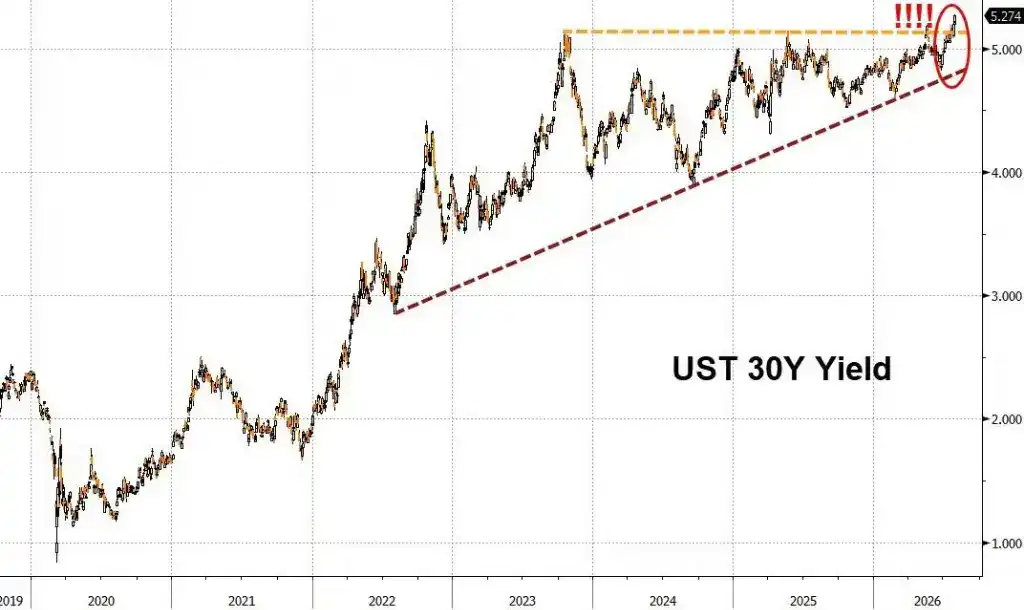
This week, the yield on the 30-year U.S. Treasury decisively broke higher, reaching levels unseen before the Global Financial Crisis (pre-GFC).

The backdrop for this breakout is newly appointed Fed Chair Wash deliberately reducing forward guidance, significantly increasing market uncertainty about the policy path. Wilson cites historical data: "Looking back at the six Fed chairs since 1970, Bernanke and Yellen each experienced a 10% pullback in their first year, while the other four saw pullbacks ranging from 20% to 36% in their first year." Markets have historically not fared well early in a new chair's tenure.

But Wilson states clearly: "I agree the Fed is more of a passenger than a driver in this conversation."

In other words, the fundamental driver of rising yields is not monetary policy, but the aforementioned structural capital demand. "Given the capital competition described at the opening, do not expect this breakout to reverse quickly."
Index Calm, Turbulence Beneath the Surface

For investors solely focused on index moves, July seemed calm. But Wilson points out, "underneath the indices, the moves have been historic."

Two themes played out simultaneously:

First, extreme stock dispersion. Just looking at last Friday: Amazon surged 15% in a single day, Apple plunged 10%—this level of divergence on the same day between the world's two largest companies by market cap is itself highly unusual.

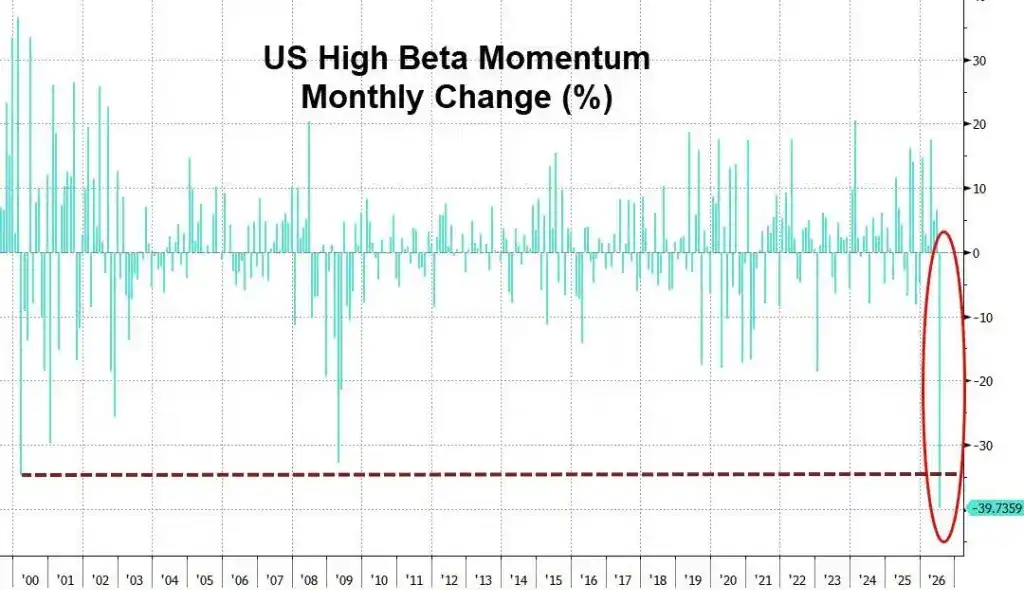
Second, momentum factor collapse. This market-neutral portfolio experienced a 40% drawdown, surpassing the extreme factor rotation records set during the tech bubble burst in March 2000, "creating significant difficulties for many in effective risk management."

The result was massive de-risking. Goldman Sachs Prime data shows fundamental managers' gross exposure falling to a one-year low, net long positioning retreating to the bottom quartile. Wilson believes the market structure is now "much cleaner" after this washout.
August: Why It's Not Time to Rush In

With de-risking complete, does that mean it's time to go long? Wilson offers several reasons why July's price action may not reverse:

  • The impact of the rate breakout hasn't been fully digested, with related recalibrations still underway;

  • Extreme volatility in July (e.g., KOSPI up 18% in a day, SK Hynix up 26% in a day) has altered risk model input parameters, making it impossible for many institutions to quickly re-leverage;

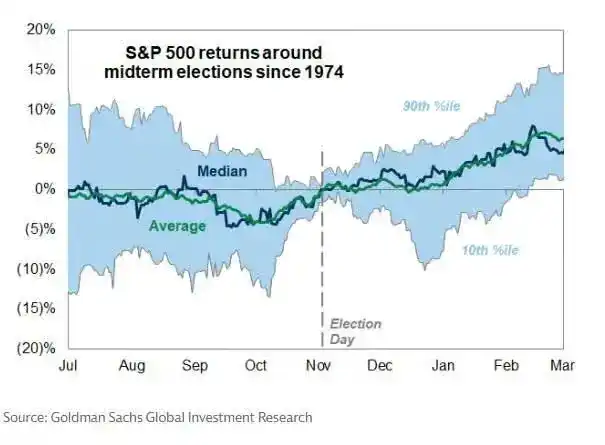
  • Looking ahead 3 to 6 months, the outlook is not straightforward—focus after summer will shift to the US midterm elections. Wilson cites data: in the 13 midterm election years since 1974, the median return for the S&P 500 from early August to Election Day is 0%.

August is likely to be a digestion period.
Fundamentals: Strong Earnings, but Internal Divergence

Despite sharp market volatility, the fundamental picture remains surprisingly robust.

Wilson notes that, unlike typical years, EPS expectations for 2026 and 2027 have been consistently revised upward throughout the year. Q2 results were generally strong, but the second derivative is starting to diverge: US quarterly EPS growth is expected to peak this quarter at around 26%; while Europe's H1 EPS growth was 13%, H2 is expected to accelerate to 19%, forming a rare pattern of H2 strength.

Memory chips are an exception. Despite being one of the best-performing sectors year-to-date, marginal sentiment signals are deteriorating: spot DRAM prices are stabilizing, progress in low-memory-consumption model technology is accelerating, and more critically—after Chinese memory chipmaker CXMT's IPO, its stock price has surged 6x from the offering price, with a market cap exceeding $550 billion, signaling a significant future supply expansion.

Hyperscalers: "Staggering" Capex, but Returns Are Equally Impressive

The most important validation question this earnings season was whether hyperscale cloud companies could signal strong enough revenue growth and ROI while raising capital expenditure.

The answer is yes—at least for Amazon and Microsoft.

Goldman Sachs' current capex forecasts for Alphabet, Amazon, and Microsoft are as follows:

  • Alphabet: $350 billion in 2027, $415 billion in 2028

  • Amazon: $325 billion in 2027, $366 billion in 2028

  • Microsoft: $262 billion in 2027, $284 billion in 2028

Wilson bluntly says this scale is "staggering."

But simultaneously, business performance is equally impressive: Google Cloud growth accelerated to 82% YoY; Microsoft confidently described enterprise customers moving from "frontier models" to "frontier ecosystems" (infrastructure that routes requests between the most suitable model capabilities); AWS revenue growth accelerated to its highest level since the pandemic.

Most impactful was the direct statement from Amazon's management on the earnings call:

"AI revenue annualized run rate increased materially sequentially and is now over $25 billion, growing triple digits year-over-year."

"We see the margin and return profile of the AI business running slightly ahead of the trajectory we saw when we built the cloud business."

"Even with 2026 capex at $220 billion, we will not have enough capacity to meet all demand in 2026, likely the same in 2027, and the scale of demand for 2028 is already staggering... We have long believed AWS could be a hundreds of billions of dollars revenue business, now we believe it will be at least double that, and will likely become a $1 trillion annual revenue business, accompanied by highly attractive free cash flow and returns on invested capital."

Private Sector vs. State Sector: A Contradictory Transition Period

Wilson concludes with a macro framework: the present is a transition period.

Private-sector hyperscalers are racing to invest, accelerating toward an AI-enabled future; while the state sector is increasingly capital-constrained, with the contradiction between the two set to become more pronounced.

"Global economic reality will, at some point, force people to confront the political choices inevitably required by the repricing of capital—but that is a discussion for another day."

For now, the AI super-cycle remains ahead, and August is likely a relatively calm window for digestion.


Trending Cryptos

Related Questions

QAccording to Goldman Sachs, what is the primary driver of the current unprecedented capital demand cycle?

AThe primary driver is not singular but a combination of multiple factors simultaneously pushing demand for capital higher. These include massive AI infrastructure investment, reindustrialization, defense reinvestment, power grid reconstruction, supply chain reconfiguration due to deglobalization, and sovereign financing needs for rising interest payments and welfare costs.

QWhat is Mark Wilson's view on the Federal Reserve's role in the current high-yield environment?

AMark Wilson from Goldman Sachs views the Federal Reserve as more of a 'passenger' rather than a 'driver' in this context. He argues that the fundamental driver of rising yields is the structural capital demand from multiple sectors, not monetary policy, and therefore expects the yield increase to be persistent and not quickly reversed.

QWhat two major market phenomena occurred beneath the seemingly calm indices in July, as described in the article?

AFirst, extreme stock dispersion: for instance, Amazon and Apple, the world's two largest companies, had divergent moves of +15% and -10% in a single day. Second, a severe momentum factor crash, where a market-neutral momentum portfolio fell 40%, surpassing the extreme factor rotation records from the 2000 dot-com bubble burst.

QWhy does Mark Wilson caution against a quick reversal of the July price action and suggest August will likely be a digestion period?

AWilson provides several reasons: 1) The market hasn't fully digested the impact of the interest rate breakout. 2) July's extreme volatility has altered risk model parameters, preventing many institutions from quickly re-leveraging. 3) Looking ahead to the US mid-term elections, historical data shows the S&P 500 has a median return of 0% from early August to Election Day in midterm election years since 1974.

QWhat are the projected capital expenditures for Alphabet, Amazon, and Microsoft in 2027 and 2028, as cited by Goldman Sachs?

AAccording to Goldman Sachs projections cited in the article: Alphabet is forecasted for $350 billion in 2027 and $415 billion in 2028; Amazon for $325 billion in 2027 and $366 billion in 2028; and Microsoft for $262 billion in 2027 and $284 billion in 2028.

Related Reads

Trump's Mining Company Reports $57 Million Loss

American Bitcoin, a cryptocurrency mining company co-founded by Eric Trump, son of Donald Trump, reported a net loss of $57.2 million for the second quarter of 2026. This loss was primarily driven by a decline in the value of Bitcoin held on its balance sheet. The company mined 932 BTC in the quarter, increasing its total reserves to 8,002 BTC, making it the 16th largest corporate Bitcoin holder. While mining revenue rose 8% to $67 million, the company's cost to mine one Bitcoin was approximately $36,500 against a market price around $63,000 in early August. Approximately 3,090 of its Bitcoins are pledged as collateral to equipment maker Bitmain. The company operates using the data centers and hardware of Hut 8, which received an 80% stake in American Bitcoin at its launch. American Bitcoin went public in September 2025, but its stock (ABTC) has since fallen over 90%. The company has faced controversy, with a Forbes investigation alleging it uses the Trump name to attract investors while primarily buying Bitcoin with raised funds rather than mining efficiently—a claim Eric Trump vehemently denied. For comparison, Michael Saylor's MicroStrategy, the world's largest corporate Bitcoin holder, reported a Q2 2026 net loss of $8.2 billion, also due to Bitcoin depreciation. Eric Trump has positioned the company as a way to give investors stock-market exposure to Bitcoin, similar to MicroStrategy, and has called himself a "Bitcoin maximalist."

cryptonews.ru26m ago

Trump's Mining Company Reports $57 Million Loss

cryptonews.ru26m ago

Forecast for August 2026 for the Crypto Market: Macroeconomics Will Determine Everything

Happy Coin News, with AI assistance from Gemini, presents a cryptocurrency market forecast for August 2026. The month is expected to solidify the market's structural transformation, where speculative narratives give way to pragmatic institutional integration. The key determinant of market dynamics will be the macroeconomic environment, with high U.S. interest rates and persistent inflation likely limiting retail capital inflow into high-risk digital assets. In this climate of limited liquidity, institutional players are predicted to gain near-total market control. Regulatory shifts will also be impactful. The EU's MiCA framework transition period officially ended on July 1, 2026, requiring full authorization for service providers. Meanwhile, the U.S. FIT21 bill will gain momentum, clarifying SEC and CFTC roles. These macro and regulatory pressures are reflected in the market structure: total capitalization is around $2.221 trillion, with Bitcoin's dominance high at 56.35%. A broad "altcoin season" is not imminent, as the Altcoin Season Index remains low. Growth in altcoins will be selective, with smart capital concentrating on AI infrastructure, next-gen DeFi, and tokenization projects. The main trend dominating August will be the tokenization of real-world assets (RWA), accelerated by the new regulatory clarity. This institutional integration will further tighten security and custodial requirements, moving the market definitively away from unregulated platforms toward hybrid models combining traditional finance tools with transparent blockchain infrastructure.

cryptonews.ru28m ago

Forecast for August 2026 for the Crypto Market: Macroeconomics Will Determine Everything

cryptonews.ru28m ago

Trading

Spot

Hot Articles

Discussions

Welcome to the HTX Community. Here, you can stay informed about the latest platform developments and gain access to professional market insights. Users' opinions on the price of AI (AI) are presented below.

活动图片