Forecast for August 2026 for the Crypto Market: Macroeconomics Will Determine Everything

cryptonews.ruPublished on 2026-08-03Last updated on 2026-08-03

Abstract

Happy Coin News, with AI assistance from Gemini, presents a cryptocurrency market forecast for August 2026. The month is expected to solidify the market's structural transformation, where speculative narratives give way to pragmatic institutional integration. The key determinant of market dynamics will be the macroeconomic environment, with high U.S. interest rates and persistent inflation likely limiting retail capital inflow into high-risk digital assets. In this climate of limited liquidity, institutional players are predicted to gain near-total market control. Regulatory shifts will also be impactful. The EU's MiCA framework transition period officially ended on July 1, 2026, requiring full authorization for service providers. Meanwhile, the U.S. FIT21 bill will gain momentum, clarifying SEC and CFTC roles. These macro and regulatory pressures are reflected in the market structure: total capitalization is around $2.221 trillion, with Bitcoin's dominance high at 56.35%. A broad "altcoin season" is not imminent, as the Altcoin Season Index remains low. Growth in altcoins will be selective, with smart capital concentrating on AI infrastructure, next-gen DeFi, and tokenization projects. The main trend dominating August will be the tokenization of real-world assets (RWA), accelerated by the new regulatory clarity. This institutional integration will further tighten security and custodial requirements, moving the market definitively away from unregulated platforms toward hybr...

The editorial team of Happy Coin News, in collaboration with the AI tool Gemini, has prepared a forecast for the crypto market for August 2026. The month has just begun, but it is already clear that it will solidify the cryptocurrency market in a phase of structural transformation, where speculative narratives of past years are giving way to pragmatic institutional integration.

The most important aspect determining market dynamics in the coming weeks will remain the macroeconomic environment. It is expected that against the backdrop of the US Federal Reserve maintaining its base rate at a high level of 3.50–3.75% and inflation persistently exceeding target levels, the inflow of retail capital into high-risk digital assets will be extremely restrained.

As macroeconomic models forecast, in conditions of limited liquidity and high yields from conservative instruments, the market in August will continue to transition to the almost complete control of institutional players.

The shift from macroeconomic challenges to regulatory changes promises to be no less sharp and fundamental. Recently, on July 1, 2026, the transition period for the Markets in Crypto-Assets (MiCA) Regulation officially ended in the European Union. According to the official requirements of the European Securities and Markets Authority (ESMA), any company providing crypto services without full authorization is obliged to cease its activities. Simultaneously, the regulatory framework of FIT21 in the United States will gain momentum, aimed at clearly delineating authority between the SEC and CFTC, which throughout the month will continue to form clear rules of the game and protect consumers in the American market.

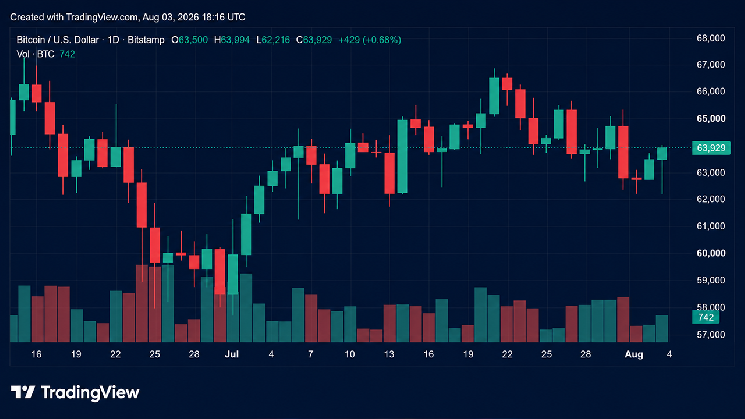
The current power balance between the main cryptocurrency and altcoins reflects these macroeconomic challenges. At the beginning of August 2026, the total market capitalization solidified around $2.221 trillion, with Bitcoin's dominance remaining high at 56.35%. The global 'altcoin season' anticipated by many retail investors is currently on hold, as the specialized Altcoin Season Index is only in the upper limits of 40 points, which does not confirm a large-scale capital rotation.

The forecast for the end of summer suggests that altcoin growth will be selective in nature, as over 10 million different tokens are now competing for liquidity, fundamentally changing the dynamics of past cycles. It is expected that in August, the main flows of smart capital will continue to concentrate around projects related to artificial intelligence infrastructure, next-generation DeFi, and tokenization.

These large-scale legislative shifts have already created the perfect legal foundation for the main trend of the current year, which will continue to dominate in August — the tokenization of real-world assets (RWA). The process of migrating traditional financial instruments to the blockchain environment is gaining avalanche-like momentum.

The logical outcome of the integration of traditional finance and blockchain this month will be the further tightening of requirements for security and custodial storage of assets. Institutional investors will continue to demand strict compliance frameworks. Precedents with exchanges like BitMEX serve as a constant reminder that the era of uncontrolled platforms is irrevocably gone. They are being confidently replaced by hybrid models where traditional financial instruments are combined with reliable and transparent blockchain infrastructure.

end-content
Related Questions

QWhat is the key factor that will determine the cryptocurrency market's dynamics in August 2026 according to the article?

AThe key determining factor is the macroeconomic environment. Specifically, the continuation of a high US Federal Reserve interest rate (3.50–3.75%) and persistently above-target inflation are expected to severely limit retail capital inflow into high-risk digital assets.

QWhat major regulatory change took effect in the European Union on July 1, 2026, as mentioned in the article?

AThe transitional period for the Markets in Crypto-Assets (MiCA) regulation officially ended. This requires any company providing crypto services without full authorization from the European Securities and Markets Authority to cease operations.

QWhat is the state of Bitcoin dominance and the overall market capitalization at the beginning of August 2026, per the article?

AThe total digital market capitalization is around $2.221 trillion, with Bitcoin dominance remaining high at 56.35%.

QWhat is the main trend expected to dominate the market in August 2026, and what regulatory change has created a foundation for it?

AThe main trend is the tokenization of real-world assets (RWA). The large-scale legislative shifts, including the full implementation of MiCA in the EU and the progression of the FIT21 framework in the US, have created an ideal legal foundation for this trend.

QWhy is a large-scale 'altcoin season' not confirmed for August 2026 according to the article?

AA large-scale altcoin season is not confirmed because the Altcoin Season Index remains only in the upper range of 40 points, which does not indicate a major capital rotation. Furthermore, the market is dominated by institutional players, and over 10 million different tokens are competing for liquidity, changing the dynamics of past cycles.

Related Reads

Trump's Mining Company Reports $57 Million Loss

American Bitcoin, a cryptocurrency mining company co-founded by Eric Trump, son of Donald Trump, reported a net loss of $57.2 million for the second quarter of 2026. This loss was primarily driven by a decline in the value of Bitcoin held on its balance sheet. The company mined 932 BTC in the quarter, increasing its total reserves to 8,002 BTC, making it the 16th largest corporate Bitcoin holder. While mining revenue rose 8% to $67 million, the company's cost to mine one Bitcoin was approximately $36,500 against a market price around $63,000 in early August. Approximately 3,090 of its Bitcoins are pledged as collateral to equipment maker Bitmain. The company operates using the data centers and hardware of Hut 8, which received an 80% stake in American Bitcoin at its launch. American Bitcoin went public in September 2025, but its stock (ABTC) has since fallen over 90%. The company has faced controversy, with a Forbes investigation alleging it uses the Trump name to attract investors while primarily buying Bitcoin with raised funds rather than mining efficiently—a claim Eric Trump vehemently denied. For comparison, Michael Saylor's MicroStrategy, the world's largest corporate Bitcoin holder, reported a Q2 2026 net loss of $8.2 billion, also due to Bitcoin depreciation. Eric Trump has positioned the company as a way to give investors stock-market exposure to Bitcoin, similar to MicroStrategy, and has called himself a "Bitcoin maximalist."

cryptonews.ru1h ago

Trump's Mining Company Reports $57 Million Loss

cryptonews.ru1h ago

Trading

Spot
活动图片