柴犬:到 2030 年 你能将 1000 美元的 SHIB 变成 100 万美元吗?

金色财经Published on 2025-01-06Last updated on 2025-01-06

原文来源公众号:钮轱辘瑶

get?code=ODZlMTE5MzlhYTgzMWIxYjFlNDUxMzZiNWQ2NjZiNDEsMTczNTU0Njc5MzYyMg==

Shiba Inu (SHIB) 的惊人成功载入史册。该资产已使许多早期投资者成为千万富翁。SHIB 的白手起家故事巩固了该项目作为“百万富翁制造者”的声誉。

虽然许多人认为 SHIB 之船已经启航,但其他人认为仍有时间利用以狗为主题的加密货币大赚一笔。让我们讨论一下你是否可以在五年内将价值 1000 美元的 SHIB 变成 100 万美元。

到 2030 年,你能将价值 1000 美元的柴犬变成 100 万美元吗?

如果您购买价值 1000 美元的 SHIB,您将获得约 46,750,818.13(4675 万)枚代币。要使 4675 万枚 SHIB 代币价值 100 万美元,每枚代币的价格必须达到 0.02139 美元。

根据 Telegaon 的数据,到 2030 年,柴犬 (SHIB) 的最高交易价格可能达到 0.000712 美元。在这种情况下,您的投资价值约为 33,286.58 美元。虽然价值上涨值得称赞,但它远低于 100 万美元大关。根据 Telegaon 的数据,SHIB 将在 2035 年至 2040 年之间的某个时候达到 0.021 美元的大关。

get?code=YzdlYTZjNTA3NjA2ZWNjYzMxNTY3YjA3NTNlODE4YWUsMTczNTU0Njc5MzYyMg==

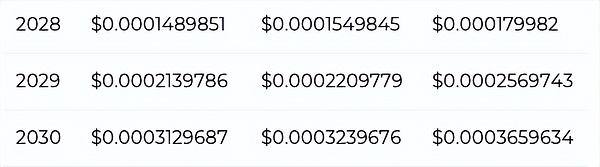
Changelly 对 SHIB 的看法比 Telegaon 更为悲观。该平台预计,到 2030 年,以狗为主题的加密货币交易价格可能达到 0.000365 美元的最高价格。在这种情况下,您的投资组合价值将升至约 17,064 美元。在这里,价值的上涨再次令人印象深刻,但仍低于 100 万美元大关。Changelly 预测 SHIB 将在 2040 年达到 0.021 美元大关。
get?code=ZjQxODI3MGQ1NDM0N2RlNTlmYmQyN2UyNGZiZjNiNTgsMTczNTU0Njc5MzYyMg==

资产价格能否更快达到 0.021 美元?

SHIB 价格上涨的最大障碍之一是其巨大的供应量。目前流通的 SHIB 代币约为 589 万亿枚。如果 Shiba Inu 团队能够进行大规模销毁,我们可能会比预期更早达到 0.021 美元的目标。

据报道,SHIB 团队正在研究一种新的销毁机制,据传每年将销毁数万亿个代币。如果成功,我们将看到许多新的 SHIB 百万富翁的诞生。

Trending Cryptos

Related Reads

Ethereum's Next Decade in the Eyes of Vitalik

"Lean Ethereum" Long-Term Roadmap Unveiled by Vitalik Buterin On July 5, 2026, Vitalik Buterin published the "Lean Ethereum" roadmap, positioning it as Ethereum's third major evolution following the Merge. This multi-year, multi-phase upgrade aims to fundamentally transform Ethereum's core protocol through staged network upgrades extending to 2029. Key goals include achieving 1 gigagas per second L1 throughput (a massive increase from the current ~32 TPS), near-instant finality, and quantum-resistant cryptography. The plan involves transitioning Ethereum's security model from full transaction re-execution by all nodes to native verification via recursive STARK proofs. A major proposed change is replacing the EVM with a proof-friendly architecture like RISC-V or leanISA, though this remains a point of contention, especially with L2s like Arbitrum favoring alternatives like WASM. Other planned upgrades include a restructured state model with a large, cheap "warehouse" storage layer to drastically reduce fees for migrated applications, multi-dimensional gas pricing, and a new focus on making privacy a first-class, native protocol feature. While the roadmap significantly raises Ethereum's long-term technical ceiling, analysts note it does not directly address ETH's mid-term token economics or value capture. The plan's multi-year timeline means near-term price impact will likely depend on observable progress milestones, such as the successful deployment of the upcoming Glamsterdam gas limit increase, growth in L2 activity and blob usage, and trends in L1 fee revenue and ETH burn.

链捕手1h ago

Ethereum's Next Decade in the Eyes of Vitalik

链捕手1h ago

In Just 11 Days, Claude Rewrote Millions of Lines of Code, an Epic AI Engineering Feat Sparks Fury

In just 11 days, Bun's founder Jarred Sumner used Anthropic's Claude AI models to rewrite its million lines of code from Zig to Rust. This move sparked significant controversy, particularly from Zig's creator, Andrew Kelley, who publicly criticized Sumner's engineering practices and the decision to use AI for such a massive rewrite. Bun, a high-performance JavaScript/TypeScript runtime and rival to Node.js, was originally written in Zig. After Anthropic acquired Bun, the team encountered persistent stability and memory safety bugs in the Zig codebase. These issues, combined with Zig's strict policy against LLM-generated code, led to the decision to rewrite in Rust. The rewrite was executed using Claude AI tools at an estimated API cost of $165,000, dramatically reducing the expected time and financial cost. Andrew Kelley's response was scathing. He blamed the original bugs on poor engineering habits, calling Bun's Zig code a collection of "hacks on top of hacks." He expressed relief that Bun was no longer associated with Zig, fearing it would misrepresent the language and attract low-quality, AI-generated contributions. The tech community is divided; some view Kelley's critique as unprofessional, while others see it as a defense of engineering integrity. A major concern about the AI-driven rewrite is the resulting code quality. The translation from Zig left approximately 27,000 lines of unsafe Rust code, raising fears about long-term maintainability and technical debt. The debate centers on whether this project is a milestone in AI-assisted development or a future maintenance nightmare.

marsbit2h ago

In Just 11 Days, Claude Rewrote Millions of Lines of Code, an Epic AI Engineering Feat Sparks Fury

marsbit2h ago

From Auto Finance to Bitcoin to AI Engines: An Analysis of Cango's 'What Not to Do' Strategy

From Auto Finance to Bitcoin and Now AI: Cango's "What Not to Do" Strategy Cango, a Chinese auto finance platform that went public on the NYSE in 2018, is undergoing its third major transformation. After selling its entire auto business in 2024, it pivoted to become a large-scale Bitcoin miner, acquiring 50 exahash of mining rigs from Bitmain. However, its true goal was never Bitcoin, but owning and controlling energy infrastructure. Now, Cango is pivoting again. While most listed Bitcoin miners are leasing power to giant hyperscalers for AI training clusters, Cango is taking the opposite path. It has launched an AI inference subsidiary called EcoHash, focusing not on training but on distributed inference. The company's strategy hinges on the insight that over 70% of mining industry power is controlled by small, independent sites (10-50 MW), which are too small for hyperscalers but ideal for low-latency AI inference. Cango aims to partner with these small operators, providing the AI technology, customers, and financing through its EcoLink software layer, which can distribute workloads across sites for reliability. Cango maintains a hybrid model, running roughly 31.7 EH/s of Bitcoin mining for cash flow while aggressively cleaning its balance sheet—slashing long-term debt by 94.5% to $30.6 million and raising $75 million for its AI venture. Its first AI deployment will be at a 50 MW site in Georgia. The strategy faces skepticism, given the high costs of converting mining sites and the potential for an AI bubble. However, Cango's leadership believes discipline around "what not to do"—avoiding direct competition with hyperscalers in training—positions it to capture the long-tail demand for distributed AI inference power.

Foresight News2h ago

From Auto Finance to Bitcoin to AI Engines: An Analysis of Cango's 'What Not to Do' Strategy

Foresight News2h ago

Strategy's Bitcoin Sales Cap Far Exceeds $1.25 Billion: A Detail the Market Overlooked

The article discusses how MicroStrategy's potential Bitcoin sales go far beyond the announced $1.25 billion "reserve-building capacity." It clarifies a key distinction in the company's "BTC Monetization Program": selling Bitcoin to *build* a new dollar reserve (the $1.25B cap) versus selling to *replenish* the existing USD Reserve after it's used for expenses like preferred share dividends. The recent $216M BTC sale for dividend payments was a "replenishment," leaving the headline $1.25B building quota untouched. The plan actually outlines three potential funding pools from BTC sales: 1) Building the reserve ($1.25B cap), 2) Covering preferred share/ debt costs (no specified cap), and 3) Funding buyback programs (up to $20B). This means the structured sales potential exceeds $30 billion, not including uncapped replenishment sales. The piece argues this marks MicroStrategy's shift from a passive "buy-and-hold" Bitcoin proxy to an actively managed entity using BTC as a balance-sheet tool to manage its complex capital structure (common stock, preferred shares, debt, reserve). This creates new dynamics and potential conflicts, as actions benefiting one part (e.g., selling BTC to pay dividends) may pressure another (e.g., undermining the "never sell" narrative). Investors must now parse the company's specific terminology ("build" vs. "replenish") to understand the true scope of future BTC sales, which is significantly larger than the market initially perceived.

marsbit2h ago

Strategy's Bitcoin Sales Cap Far Exceeds $1.25 Billion: A Detail the Market Overlooked

marsbit2h ago

Trading

Spot

Hot Articles

How to Buy SHIB

Welcome to HTX.com! We've made purchasing SHIBA INU (SHIB) simple and convenient. Follow our step-by-step guide to embark on your crypto journey.Step 1: Create Your HTX AccountUse your email or phone number to sign up for a free account on HTX. Experience a hassle-free registration journey and unlock all features.Get My AccountStep 2: Go to Buy Crypto and Choose Your Payment MethodCredit/Debit Card: Use your Visa or Mastercard to buy SHIBA INU (SHIB) instantly.Balance: Use funds from your HTX account balance to trade seamlessly.Third Parties: We've added popular payment methods such as Google Pay and Apple Pay to enhance convenience.P2P: Trade directly with other users on HTX.Over-the-Counter (OTC): We offer tailor-made services and competitive exchange rates for traders.Step 3: Store Your SHIBA INU (SHIB)After purchasing your SHIBA INU (SHIB), store it in your HTX account. Alternatively, you can send it elsewhere via blockchain transfer or use it to trade other cryptocurrencies.Step 4: Trade SHIBA INU (SHIB)Easily trade SHIBA INU (SHIB) on HTX's spot market. Simply access your account, select your trading pair, execute your trades, and monitor in real-time. We offer a user-friendly experience for both beginners and seasoned traders.

11.4k Total ViewsPublished 2024.03.29Updated 2026.06.02

How to Buy SHIB

Discussions

Welcome to the HTX Community. Here, you can stay informed about the latest platform developments and gain access to professional market insights. Users' opinions on the price of SHIB (SHIB) are presented below.

活动图片