Strategy's Bitcoin Sales Cap Far Exceeds $1.25 Billion: A Detail the Market Overlooked

marsbitPublished on 2026-07-11Last updated on 2026-07-11

Abstract

The article discusses how MicroStrategy's potential Bitcoin sales go far beyond the announced $1.25 billion "reserve-building capacity." It clarifies a key distinction in the company's "BTC Monetization Program": selling Bitcoin to *build* a new dollar reserve (the $1.25B cap) versus selling to *replenish* the existing USD Reserve after it's used for expenses like preferred share dividends. The recent $216M BTC sale for dividend payments was a "replenishment," leaving the headline $1.25B building quota untouched. The plan actually outlines three potential funding pools from BTC sales: 1) Building the reserve ($1.25B cap), 2) Covering preferred share/ debt costs (no specified cap), and 3) Funding buyback programs (up to $20B). This means the structured sales potential exceeds $30 billion, not including uncapped replenishment sales. The piece argues this marks MicroStrategy's shift from a passive "buy-and-hold" Bitcoin proxy to an actively managed entity using BTC as a balance-sheet tool to manage its complex capital structure (common stock, preferred shares, debt, reserve). This creates new dynamics and potential conflicts, as actions benefiting one part (e.g., selling BTC to pay dividends) may pressure another (e.g., undermining the "never sell" narrative). Investors must now parse the company's specific terminology ("build" vs. "replenish") to understand the true scope of future BTC sales, which is significantly larger than the market initially perceived.

This article is from: Bankless

Compiled by: Odaily Planet Daily; Translator: Azuma

On July 7th, Strategy disclosed that it had sold 3,588 BTC, worth approximately $216 million, between June 29th and July 5th.

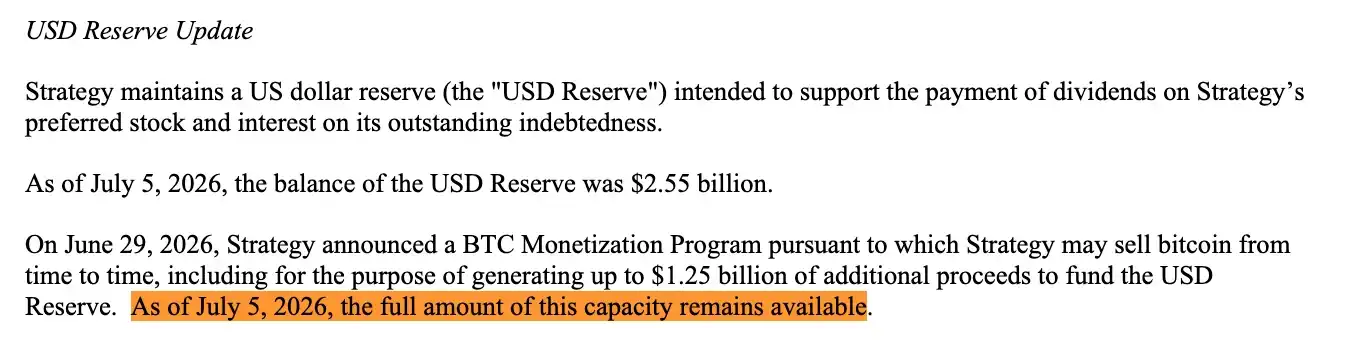
These funds were used to pay dividends on STRC and to replenish the USD Reserve previously used for dividend payments. Despite completing this sale, Strategy stated that its full $1.25 billion reserve-building capacity remains intact.

Odaily Note: In the "self-rescue plan" announced last week, Strategy had indicated it authorized the company to sell BTC to build a USD reserve of up to $1.25 billion.

That is to say, the $216 million worth of BTC sold by Strategy to replenish the reserve was not counted against the previously disclosed reserve-building capacity.

Technically, there is indeed a difference between the two: one is "replenishing" the reserve, and the other is "building" the reserve. In practice, however, both types of sales ultimately flow into the same reserve pool for the same purpose, merely categorized differently.

Looking at it another way, Strategy's previously disclosed "BTC Monetization Program" (selling BTC) never limited Strategy to selling only $1.25 billion worth of Bitcoin in total. It only limited one of the funding pools—selling BTC to "build" the USD reserve.

The program also allows Strategy to sell BTC for other purposes, which is precisely what we are seeing now.
Three Funding Pools

On June 29th, after weeks of pressure on MSTR and STRC, Strategy introduced the aforementioned BTC "Monetization Program" as part of its broader "Digital Credit Capital Framework."

This program allows Strategy to sell Bitcoin and essentially mentions three main uses:

  • First, to Build the reserve, allowing the sale of up to $1.25 billion worth of BTC to establish the USD Reserve.
  • Second, to Cover the preferreds, meaning selling BTC to pay for Strategy's fixed dividend and interest obligations on its preferred shares and debt. If management deems "selling BTC more advantageous than issuing common stock," they can also use BTC sales to replenish the reserve funds previously used for these obligations.
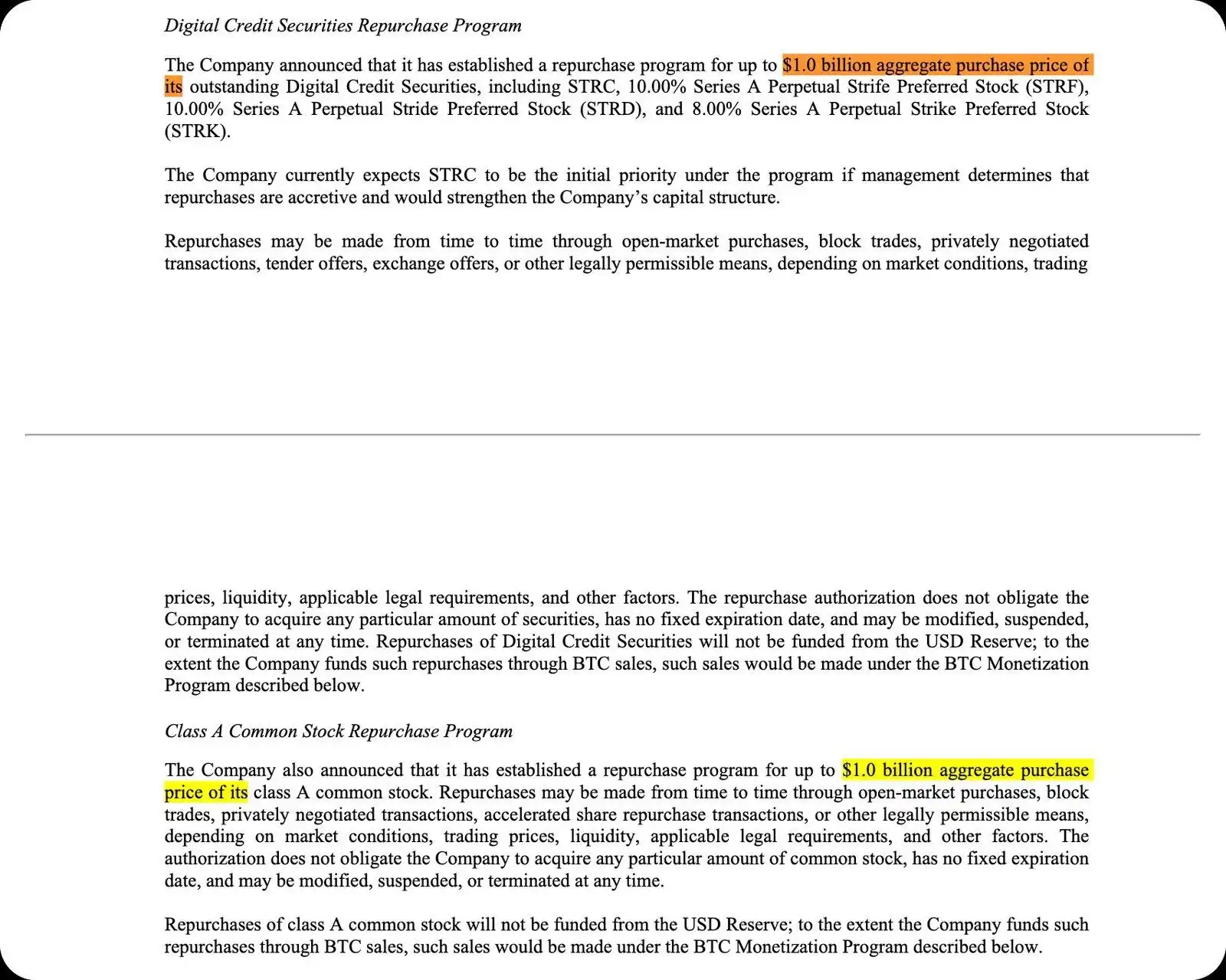
  • Third, to Fund buybacks, meaning selling BTC to repurchase up to $1 billion worth of preferred shares and up to $1 billion worth of MSTR common stock. Additionally, proceeds from BTC sales may be used to cover related taxes, fees, and other expenses.

At the time, the entire market's discussion focused on the $1.25 billion limit of the first funding pool, but the reality is far more complex.

Looking solely at the third pool, it effectively adds an extra $2 billion in sales capacity. Therefore, even calculating only the portions with explicit caps, Strategy's currently designed BTC sale scale exceeds $3 billion. And this does not include the funding pool for paying dividends, interest, and replenishing the reserve — for which no explicit upper limit has been disclosed.
Building vs. Replenishing

This is where the nuance truly lies.

The purpose of the USD Reserve is to cover these preferred share dividend and debt interest obligations. Under the current policy framework, it cannot be used for stock buybacks.

As of June 28th, Strategy's USD Reserve stood at $2.55 billion, sufficient to cover the company's annual obligations of approximately $1.76 billion for debt and preferred shares, providing about 17 months of coverage. The Strategy board has set a minimum requirement to maintain a 12-month coverage level, unless the board approves lowering this standard.

This is why the distinction between "building the reserve" and "replenishing the reserve" warrants attention.

  • Selling BTC before paying dividends and adding cash to the reserve: This is defined as "building."
  • Using the reserve to pay dividends, then selling BTC to refill the reserve: This is defined as "replenishing."

The program treats these two as different categories, but they effectively accomplish the same thing— converting BTC into cash to cover preferred share dividends and interest payments.

These details were actually disclosed in the documents all along, but the sale a few days ago made the difference in classification more apparent. Strategy sold $216 million worth of BTC, using the funds to pay dividends and replenish the reserve, while simultaneously announcing that its $1.25 billion reserve-building capacity remained fully intact.

Now, the market needs to start understanding Strategy's "specialized language": "Building" and "replenishing" are essentially accounting classifications, but they determine whether Strategy's BTC sales will count against the "publicly visible quota."

From Hoarding BTC to Active Capital Management

In the June 29th announcement, Michael Saylor stated that this framework reflects Strategy's need for "liquidity, discipline, and active capital management."

Strategy CEO Phong Le was even more direct, stating: "Strategy is shifting from a one-way capital issuance model to an active capital management model."

As Matt Walsh and Jeff Dorman of Castle Island explained on a podcast last week, Strategy has effectively evolved into an actively managed hedge fund.

The old Strategy narrative was very simple: sell MSTR stock → buy Bitcoin → provide investors with leveraged BTC exposure. But the logic is now different.

Today, Strategy is buying and selling different components within its own capital structure to manage the pressures between common stock (MSTR), preferred shares, the USD reserve, and Bitcoin assets (BTC).

This dynamic also introduces new conflicts of interest. Walsh and Dorman pointed out:

  • Selling common stock can support preferred share dividends but depress MSTR's premium relative to its BTC holdings.
  • Selling Bitcoin can extend the cash flow runway but further erodes the core "never sell" narrative.
  • Supporting the preferred share system can maintain market confidence but consumes cash reserves.
  • Cutting preferred share dividends can protect liquidity but may cause preferred share prices to crash.

The so-called "reserve loophole" is one manifestation of this shift. Today, Bitcoin is no longer just an asset for Strategy to accumulate continuously; it is becoming a balance-sheet lever used to keep the preferred share system running.

What We Will Ultimately See

Now, investors must assess Saylor's ability to operate this "machine"— every time a lever in the capital structure is adjusted, it helps one part while potentially threatening another.

This is the most noteworthy takeaway after the July 6th document disclosure. Strategy is not out of options. It likely has more room to maneuver than the market superficially sees.

Do not mistakenly believe anymore that the $1.25 billion quota represents the total cap for Strategy's Bitcoin sales.

Today, Strategy has become an institution that the market needs to re-understand. Now, every specialized term becomes more important:

  • Build;
  • Replenish;
  • Issue;
  • Repurchase;
  • Defend;

Just as Fed watchers meticulously analyze every punctuation mark in policy statements, the market must also deconstruct each term used by Strategy to judge what it implies for future BTC sales.

By introducing this plan, Strategy has granted itself greater flexibility, but the underlying contradictions remain. This is no longer a simple "leveraged Bitcoin trade"; it has now become a bet on active capital management capabilities.

Can Strategy consistently manage "selling BTC," "replenishing reserves," "issuing securities," "repurchasing stock," and "maintaining the capital structure," while ensuring that no single part disrupts the others?

Personally, I am not willing to place that bet.

Trending Cryptos

Related Questions

QWhat is the main distinction between 'building' the reserve and 'replenishing' the reserve in the context of MicroStrategy's BTC sales?

AIn MicroStrategy's framework, 'building' the reserve refers to selling BTC before a dividend payment to add cash to the USD Reserve. 'Replenishing' the reserve refers to using the reserve to pay a dividend and then selling BTC to refill the reserve. While classified differently, both actions serve the same core purpose of converting BTC into cash to cover obligations. Crucially, only sales categorized as 'building' count against the publicly disclosed $1.25 billion reserve-building capacity.

QAccording to the article, what is the potential total upper limit for BTC sales across all specified 'pools' in MicroStrategy's monetization plan, excluding replenishment?

AExcluding the unspecified limit for 'replenishing' activities, the article states that the designed upper limit for BTC sales is over $3 billion. This comprises the $1.25 billion for 'building' the USD reserve and an additional $2 billion for the third pool funding buybacks (up to $1B for preferred shares and up to $1B for MSTR common stock).

QHow does the article describe the fundamental shift in MicroStrategy's business narrative and strategy?

AThe article describes a shift from a simple 'one-way capital issuance' model of selling stock to buy and hold Bitcoin, to an 'active capital management' model. MicroStrategy is now likened to an actively managed hedge fund, using BTC as a balance-sheet tool to manage pressures between its common stock (MSTR), preferred shares, USD reserve, and Bitcoin holdings, creating complex trade-offs within its capital structure.

QWhat new conflict of interest does the article highlight as a result of MicroStrategy's strategic shift?

AThe article highlights that MicroStrategy's new active management creates conflicts where actions to support one part of its capital structure can harm another. For example: selling common stock supports preferred dividends but can lower MSTR's premium; selling BTC extends cash flow but weakens the 'never sell' narrative; supporting the preferred share system maintains confidence but drains cash; cutting preferred dividends protects liquidity but could crash their price.

QWhat key lesson does the article suggest investors must learn regarding MicroStrategy's communication about its BTC sales?

AThe article argues that investors must no longer assume the $1.25 billion reserve-building capacity is the total upper limit for BTC sales. They must become like 'Fed watchers,' carefully parsing MicroStrategy's specific terminology (e.g., build, replenish, issue, repurchase) in its disclosures, as each word has distinct implications for whether a sale counts against public limits and for the company's overall capital management strategy.

Related Reads

In Just 11 Days, Claude Rewrote Millions of Lines of Code, an Epic AI Engineering Feat Sparks Fury

In just 11 days, Bun's founder Jarred Sumner used Anthropic's Claude AI models to rewrite its million lines of code from Zig to Rust. This move sparked significant controversy, particularly from Zig's creator, Andrew Kelley, who publicly criticized Sumner's engineering practices and the decision to use AI for such a massive rewrite. Bun, a high-performance JavaScript/TypeScript runtime and rival to Node.js, was originally written in Zig. After Anthropic acquired Bun, the team encountered persistent stability and memory safety bugs in the Zig codebase. These issues, combined with Zig's strict policy against LLM-generated code, led to the decision to rewrite in Rust. The rewrite was executed using Claude AI tools at an estimated API cost of $165,000, dramatically reducing the expected time and financial cost. Andrew Kelley's response was scathing. He blamed the original bugs on poor engineering habits, calling Bun's Zig code a collection of "hacks on top of hacks." He expressed relief that Bun was no longer associated with Zig, fearing it would misrepresent the language and attract low-quality, AI-generated contributions. The tech community is divided; some view Kelley's critique as unprofessional, while others see it as a defense of engineering integrity. A major concern about the AI-driven rewrite is the resulting code quality. The translation from Zig left approximately 27,000 lines of unsafe Rust code, raising fears about long-term maintainability and technical debt. The debate centers on whether this project is a milestone in AI-assisted development or a future maintenance nightmare.

marsbit41m ago

In Just 11 Days, Claude Rewrote Millions of Lines of Code, an Epic AI Engineering Feat Sparks Fury

marsbit41m ago

From Auto Finance to Bitcoin to AI Engines: An Analysis of Cango's 'What Not to Do' Strategy

From Auto Finance to Bitcoin and Now AI: Cango's "What Not to Do" Strategy Cango, a Chinese auto finance platform that went public on the NYSE in 2018, is undergoing its third major transformation. After selling its entire auto business in 2024, it pivoted to become a large-scale Bitcoin miner, acquiring 50 exahash of mining rigs from Bitmain. However, its true goal was never Bitcoin, but owning and controlling energy infrastructure. Now, Cango is pivoting again. While most listed Bitcoin miners are leasing power to giant hyperscalers for AI training clusters, Cango is taking the opposite path. It has launched an AI inference subsidiary called EcoHash, focusing not on training but on distributed inference. The company's strategy hinges on the insight that over 70% of mining industry power is controlled by small, independent sites (10-50 MW), which are too small for hyperscalers but ideal for low-latency AI inference. Cango aims to partner with these small operators, providing the AI technology, customers, and financing through its EcoLink software layer, which can distribute workloads across sites for reliability. Cango maintains a hybrid model, running roughly 31.7 EH/s of Bitcoin mining for cash flow while aggressively cleaning its balance sheet—slashing long-term debt by 94.5% to $30.6 million and raising $75 million for its AI venture. Its first AI deployment will be at a 50 MW site in Georgia. The strategy faces skepticism, given the high costs of converting mining sites and the potential for an AI bubble. However, Cango's leadership believes discipline around "what not to do"—avoiding direct competition with hyperscalers in training—positions it to capture the long-tail demand for distributed AI inference power.

Foresight News57m ago

From Auto Finance to Bitcoin to AI Engines: An Analysis of Cango's 'What Not to Do' Strategy

Foresight News57m ago

Goldman Sachs Report Deconstructs the Competitive Landscape of China's AI Large Models: Who Will Be the Long-Term Winner?

Goldman Sachs analyzes China's AI large language model (LLM) landscape, identifying key players and a strategic shift towards efficiency and global expansion. The report highlights that Chinese open-source/open-weight models are closing the performance gap with top global proprietary models at significantly lower cost, driven by architectural innovations like MoE. This enables a "two-tier" market: a high-end segment (e.g., GLM5.2, Qwen3.7 Max) with pricing at ~$1 per million tokens, and a low-end, price-sensitive global segment. Open-source strategies aid adoption but limit monetization, as deployments via third-party platforms (e.g., AWS Bedrock, Alibaba Cloud) may not generate direct revenue for model creators. The industry is thus moving towards "open-weight + community license" models with revenue-sharing to improve unit economics. Internationally, the focus is shifting from "token maximization" to ROI-driven enterprise adoption, particularly in non-U.S. markets. Major cloud platforms are integrating Chinese models (e.g., DeepSeek, MiniMax). Using a competitive framework based on pricing power, cost advantage, and financial strength, Goldman Sachs identifies **Zhipu AI** and **DeepSeek** as leaders in foundational text models, and **ByteDance** (with Seedance) leading in multimodal/video generation. **MiniMax** and **Kuaishou** are also rated favorably. The firm forecasts China's AI model API/subscription revenue growing from ~RMB 35bn (2026E) to RMB 879bn by 2030.

marsbit1h ago

Goldman Sachs Report Deconstructs the Competitive Landscape of China's AI Large Models: Who Will Be the Long-Term Winner?

marsbit1h ago

Trading

Spot

Hot Articles

What is $BITCOIN

DIGITAL GOLD ($BITCOIN): A Comprehensive Analysis Introduction to DIGITAL GOLD ($BITCOIN) DIGITAL GOLD ($BITCOIN) is a blockchain-based project operating on the Solana network, which aims to combine the characteristics of traditional precious metals with the innovation of decentralized technologies. While it shares a name with Bitcoin, often referred to as “digital gold” due to its perception as a store of value, DIGITAL GOLD is a separate token designed to create a unique ecosystem within the Web3 landscape. Its goal is to position itself as a viable alternative digital asset, although specifics regarding its applications and functionalities are still developing. What is DIGITAL GOLD ($BITCOIN)? DIGITAL GOLD ($BITCOIN) is a cryptocurrency token explicitly designed for use on the Solana blockchain. In contrast to Bitcoin, which provides a widely recognized value storage role, this token appears to focus on broader applications and characteristics. Notable aspects include: Blockchain Infrastructure: The token is built on the Solana blockchain, known for its capacity to handle high-speed and low-cost transactions. Supply Dynamics: DIGITAL GOLD has a maximum supply capped at 100 quadrillion tokens (100P $BITCOIN), although details regarding its circulating supply are currently undisclosed. Utility: While precise functionalities are not explicitly outlined, there are indications that the token could be utilized for various applications, potentially involving decentralized applications (dApps) or asset tokenization strategies. Who is the Creator of DIGITAL GOLD ($BITCOIN)? At present, the identity of the creators and development team behind DIGITAL GOLD ($BITCOIN) remains unknown. This situation is typical among many innovative projects within the blockchain space, particularly those aligning with decentralized finance and meme coin phenomena. While such anonymity may foster a community-driven culture, it intensifies concerns about governance and accountability. Who are the Investors of DIGITAL GOLD ($BITCOIN)? The available information indicates that DIGITAL GOLD ($BITCOIN) does not have any known institutional backers or prominent venture capital investments. The project seems to operate on a peer-to-peer model focused on community support and adoption rather than traditional funding routes. Its activity and liquidity are primarily situated on decentralized exchanges (DEXs), such as PumpSwap, rather than established centralized trading platforms, further highlighting its grassroots approach. How DIGITAL GOLD ($BITCOIN) Works The operational mechanics of DIGITAL GOLD ($BITCOIN) can be elaborated on based on its blockchain design and network attributes: Consensus Mechanism: By leveraging Solana’s unique proof-of-history (PoH) combined with a proof-of-stake (PoS) model, the project ensures efficient transaction validation contributing to the network's high performance. Tokenomics: While specific deflationary mechanisms have not been extensively detailed, the vast maximum token supply implies that it may cater to microtransactions or niche use cases that are still to be defined. Interoperability: There exists the potential for integration with Solana’s broader ecosystem, including various decentralized finance (DeFi) platforms. However, the details regarding specific integrations remain unspecified. Timeline of Key Events Here is a timeline that highlights significant milestones concerning DIGITAL GOLD ($BITCOIN): 2023: The initial deployment of the token occurs on the Solana blockchain, marked by its contract address. 2024: DIGITAL GOLD gains visibility as it becomes available for trading on decentralized exchanges like PumpSwap, allowing users to trade it against SOL. 2025: The project witnesses sporadic trading activity and potential interest in community-led engagements, although no noteworthy partnerships or technical advancements have been documented as of yet. Critical Analysis Strengths Scalability: The underlying Solana infrastructure supports high transaction volumes, which could enhance the utility of $BITCOIN in various transaction scenarios. Accessibility: The potential low trading price per token could attract retail investors, facilitating wider participation due to fractional ownership opportunities. Risks Lack of Transparency: The absence of publicly known backers, developers, or an audit process may yield skepticism regarding the project's sustainability and trustworthiness. Market Volatility: The trading activity is heavily reliant on speculative behavior, which can result in significant price volatility and uncertainty for investors. Conclusion DIGITAL GOLD ($BITCOIN) emerges as an intriguing yet ambiguous project within the rapidly evolving Solana ecosystem. While it attempts to leverage the “digital gold” narrative, its departure from Bitcoin's established role as a store of value underscores the need for a clearer differentiation of its intended utility and governance structure. Future acceptance and adoption will likely depend on addressing the current opacity and defining its operational and economic strategies more explicitly. Note: This report encompasses synthesised information available as of October 2023, and developments may have transpired beyond the research period.

718 Total ViewsPublished 2025.05.13Updated 2025.05.13

What is $BITCOIN

Discussions

Welcome to the HTX Community. Here, you can stay informed about the latest platform developments and gain access to professional market insights. Users' opinions on the price of BTC (BTC) are presented below.

活动图片