Ethereum's Next Decade in the Eyes of Vitalik

链捕手Published on 2026-07-11Last updated on 2026-07-11

Abstract

"Lean Ethereum" Long-Term Roadmap Unveiled by Vitalik Buterin On July 5, 2026, Vitalik Buterin published the "Lean Ethereum" roadmap, positioning it as Ethereum's third major evolution following the Merge. This multi-year, multi-phase upgrade aims to fundamentally transform Ethereum's core protocol through staged network upgrades extending to 2029. Key goals include achieving 1 gigagas per second L1 throughput (a massive increase from the current ~32 TPS), near-instant finality, and quantum-resistant cryptography. The plan involves transitioning Ethereum's security model from full transaction re-execution by all nodes to native verification via recursive STARK proofs. A major proposed change is replacing the EVM with a proof-friendly architecture like RISC-V or leanISA, though this remains a point of contention, especially with L2s like Arbitrum favoring alternatives like WASM. Other planned upgrades include a restructured state model with a large, cheap "warehouse" storage layer to drastically reduce fees for migrated applications, multi-dimensional gas pricing, and a new focus on making privacy a first-class, native protocol feature. While the roadmap significantly raises Ethereum's long-term technical ceiling, analysts note it does not directly address ETH's mid-term token economics or value capture. The plan's multi-year timeline means near-term price impact will likely depend on observable progress milestones, such as the successful deployment of the upcoming Glamste...

Author:Chloe,ChainCatcher

On July 5, 2026, Vitalik Buterin posted a long article on X, unveiling a long-term roadmap named "Lean Ethereum." Vitalik positions this as Ethereum's third major evolution following The Merge: it's not a single upgrade, but a series of protocol improvements to be implemented in stages over the next three to four years, encompassing almost every core module of the protocol, from verification methods, cryptography, and finality to state storage—a complete overhaul.

This roadmap emerged during a period of reorganization within the Ethereum ecosystem and must be understood within a more complete historical context. To interpret this comprehensive overhaul, it's essential not only to clarify the specific content of the technical upgrades but also to see how its design reallocates trade-offs between "migration costs" and "verification thresholds," and to explore how this underlying transformation will ultimately impact ETH's price performance.

Ethereum's Three Development Stages

To position this upgrade, we can first outline Ethereum's three generations:

  • The first generation was the original architecture of "PoW + EVM," whose core was all nodes directly re-executing all transactions. While this model is secure, general-purpose, and open, its scalability is consequently limited.

  • The second generation was PoS Ethereum after the 2022 "Merge." This transition in consensus mechanism fundamentally changed Ethereum's security model, issuance model, and staking system, while also proving to the market Ethereum's remarkable engineering capability to replace its core engine without halting operations.

  • The third generation is the current "Lean Ethereum." It is no longer satisfied with the existing division of labor where "L1 handles settlement, L2 handles scaling." Instead, it integrates L1 performance, proved verification, privacy, quantum resistance, state structure, and client architecture into a single long-term refactoring framework.

The Origin of the Lean Ethereum Roadmap

The Lean Ethereum roadmap was published on strawmap.org. This is a public draft first proposed by Foundation researcher Justin Drake in February of this year, outlining seven network upgrades through 2029. The term "strawmap" comes from "straw," and the document positions itself as a draft open to modifications. The strawmap also notes that it is an ongoing coordination tool, not a locked-in schedule; any upgrade still requires research, testing, client implementation, and rough consensus.
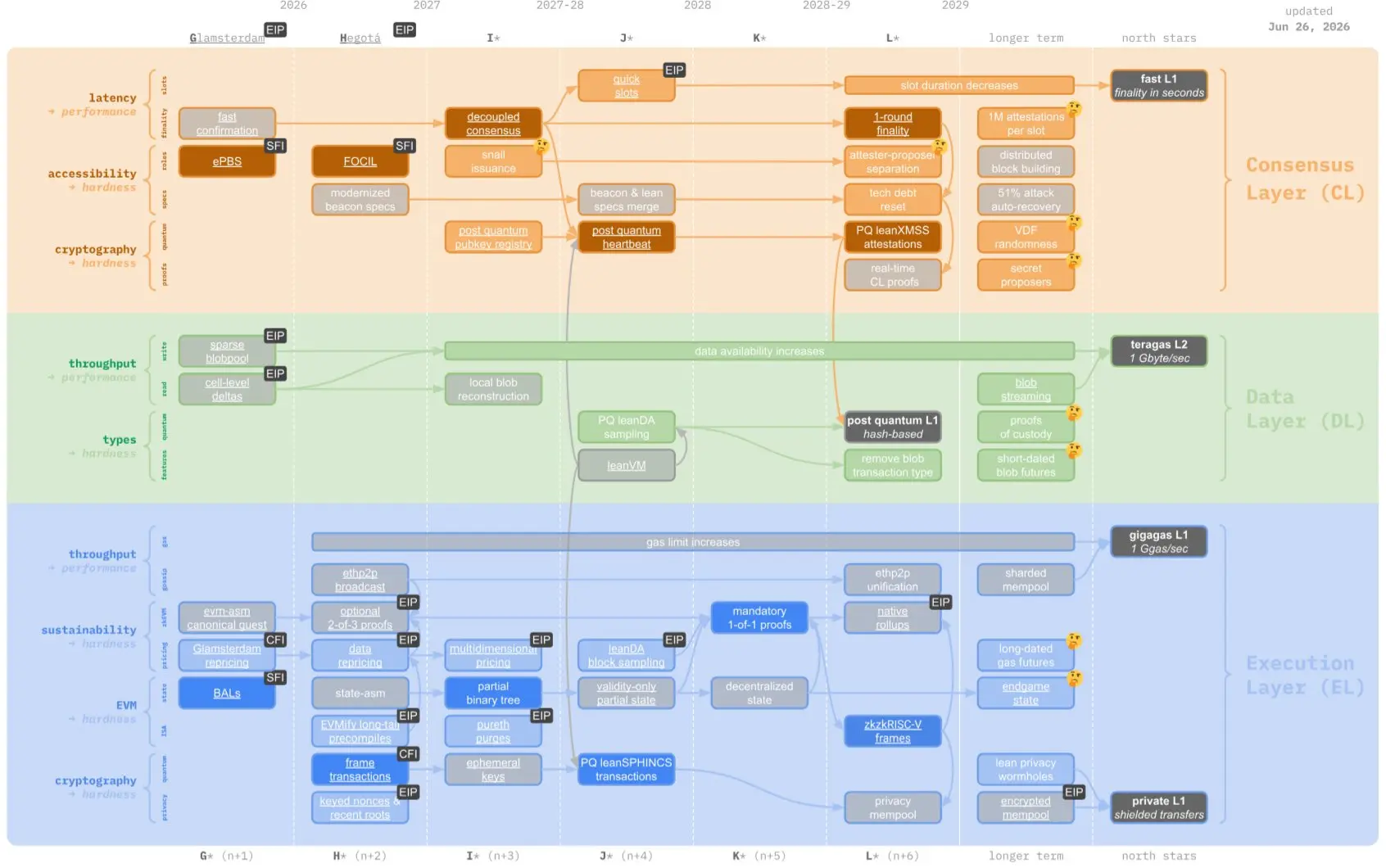
This vision clearly outlines five long-term strategic goals: faster L1 finality, achieving 1 gigagas per second L1 throughput (capable of handling tens of thousands of TPS under peak conditions), L2 scaling with a teragas-level vision for the ecosystem, comprehensively quantum-resistant cryptography, and L1-native private transactions.

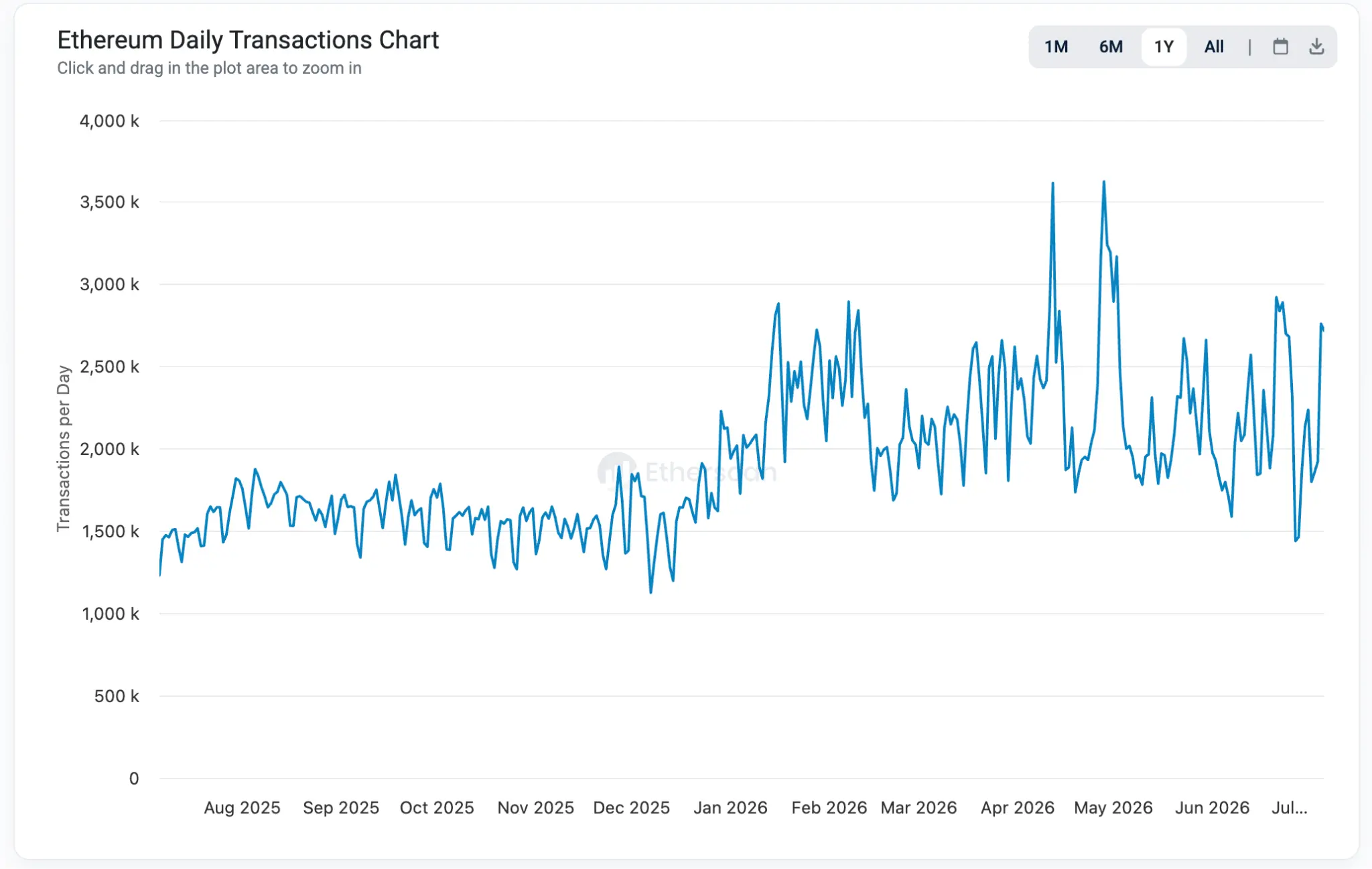
Comparing these with the current state reveals the ambitious nature of these goals. According to Etherscan data, the current Ethereum L1 processes only about 32 transactions per second on average (approximately 2.7 million per day). The 1 gigagas target implies a hundreds-fold explosion in L1's computational capacity. It's worth noting that L1's on-chain demand has actually been on a growth trend over the past year: daily transaction volume has rebounded significantly from 1.4 million in mid-2025 and has remained mostly stable between 2 million and 2.9 million in 2026, even nearing 3.6 million during market peaks in April and May. The release of this roadmap aims to address this resurging on-chain activity demand.
The timeline is also clearly marked: the Hegotá upgrade, currently scheduled as the second upgrade in 2026, is likely to be Ethereum's last "pre-Lean era" hard fork. Every subsequent upgrade, in theory, will be part of this reconstruction. The nearer-term Glamsterdam upgrade is expected to bring a substantial gas limit increase; this upgrade was originally anticipated to launch in the first half of 2026 but has not yet gone live.

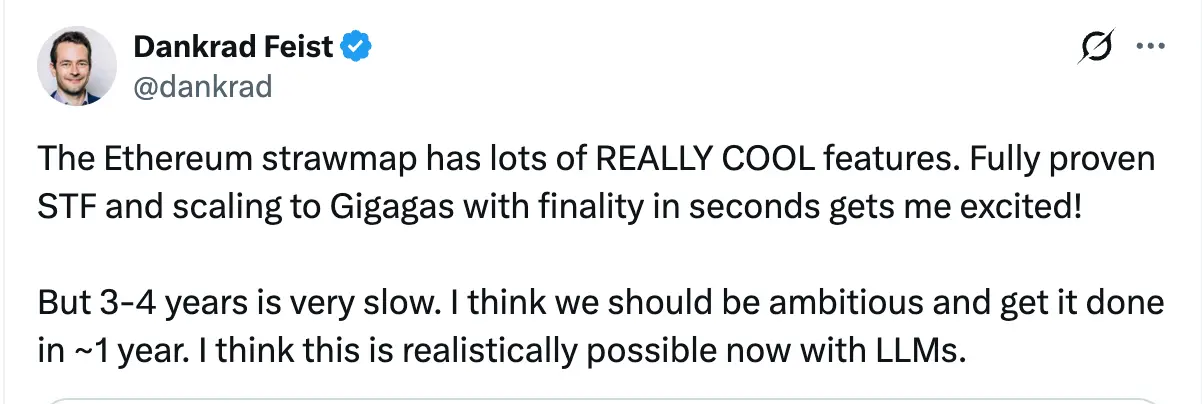
The timeline has also been a focal point of discussion since the roadmap's release. Former Ethereum Foundation core researcher and proposer of the Ethereum Danksharding solution, Dankrad Feist, posted on X, stating that while he affirms the strawmap, a three-to-four-year timeline is far too slow, suggesting that with current large language model technology, this upgrade should be completed within a year.
Major Core Technology Upgrades: Proof Verification and State Restructuring

The technical core of Lean Ethereum is to fundamentally change the verification model. Ethereum's current security model relies on every node re-executing every transaction to confirm state correctness. The new design incorporates recursive STARK proofs as a native core component of the protocol: a single prover handles the heavy computation, while all other nodes only need to verify a concise mathematical proof.

This choice also addresses another issue: STARK uses hash-based cryptography, and currently has no known quantum attack vectors, whereas Ethereum's current signature schemes carry related risks. Vitalik stated that the priority for quantum security has been "significantly raised." The roadmap plans to gradually replace all quantum-vulnerable components with Winternitz signatures, with the most urgent piece being finding a quantum-safe design for the blobs that L2s rely on to reduce fees.

The consensus layer is also within the scope of changes. In today's Ethereum, transactions are included in blocks within seconds, but it takes about fifteen minutes to reach finality. The new design separates the "chain that continuously produces blocks" and "finality" into two distinct processes. The goal is for validators to finalize within one or two voting rounds, compressing fifteen minutes down to near real-time. Additionally, there is multidimensional gas pricing, meaning different resources like computation, storage, and data transmission are priced separately—similar to how water and electricity bills are separate—instead of being lumped into a single fee.

Changes to the state architecture directly involve application developers. The state can be understood as Ethereum's real-time general ledger, recording all account balances and smart contract data. This ledger only grows thicker, and currently, full nodes must maintain a complete copy, leading to persistently high on-chain storage costs.

Vitalik's solution involves a structural layering of the storage architecture: the existing, fully-featured "Dynamic State (core essential zone)" will be strictly limited to a 2 TB hardware threshold, preventing its unlimited expansion. Simultaneously, the protocol will introduce a new, highly scalable "new state storage layer (large warehouse)" with a capacity of up to 100 TB. In Vitalik's vision for 2030, most tokens (ERC-20), NFTs, and regular DeFi applications that are willing to rewrite their contracts and migrate to this large warehouse with the new architecture could see transaction fees drop by over tenfold. The protocol layer won't force or subsidize; it will simply present the significant price differential between the two layers, leaving it to market applications to decide their migration timing.

The role of privacy has also been redefined. Ethereum's past division of labor was: everything on-chain is transparent; users wanting privacy must seek third-party privacy protocols. This time, Vitalik writes, "Privacy is no longer an afterthought, it is a first-class goal," meaning privacy transitions from something "users install themselves" to "part of the building code." In the future, during the design phase of every new protocol component, it will be evaluated for its ability to support low-cost, intermediary-free, and quantum-resistant privacy features. Whether this can be achieved remains to be seen, but the evaluation criteria itself have been written into the roadmap.

EVM Replacement Controversy: L2 Ecosystem Game

For the past decade, Ethereum has run on an engine called the EVM (Ethereum Virtual Machine). Contracts worldwide, development tools, and programming languages are all built around it. Now, Vitalik proposes replacing this engine. The reason relates to the aforementioned STARK proofs: generating mathematical proofs for transactions is expensive with the EVM; switching to an engine more friendly to proofs would be significantly cheaper.

He names two architecture candidates: RISC-V and leanISA. The ideal endgame is for the new engine to become the protocol's native component, with the EVM relegated to a translation layer: old contracts can still run, but they are first translated into instructions the new engine understands before execution. Replacing the engine is relatively more complex, which is why this proposal has been controversial since Vitalik first introduced the RISC-V idea in April 2025.

Offchain Labs, the core development firm behind the L2 Arbitrum, publicly advocated in November last year that another architecture, WebAssembly (WASM), is the better choice. However, WASM was not on the candidate list Vitalik presented this time. Why does this matter? Because Arbitrum is one of Ethereum's largest L2s, and its contract technology, Stylus, is built on WASM.

You can think of it this way: L1 changing its engine is like redefining the "plug standard" for the entire ecosystem. If your equipment happens to use the same plug, it works seamlessly; if not, you have to pay for an adapter. Whom the list favors determines which L2's past investments can seamlessly integrate with the future L1 and which ones will bear the adapter cost.

Ethereum has no voting mechanism to resolve such disagreements. Whether to replace the engine and with what ultimately depends on the rough consensus among developers in the All Core Devs meetings and whether client teams are willing to implement it. As of now, the engine replacement remains a long-term goal mentioned by Vitalik, and developer meetings have not reached any formal conclusion.

Will the Roadmap Affect ETH's Price?

Mapping the technical roadmap to ETH's price involves two temporal layers.

The first layer is the mechanism-driven transmission path. Since EIP-1559, Ethereum burns the base fee of every transaction. The scale of L1 transaction activity thus directly influences ETH's supply dynamics and settlement value. Under this mechanism, if the gigagas target is achieved and L1 transaction volume recovers alongside throughput enhancement, gas consumption and burn rates would amplify in tandem. This is the most direct transmission path between the roadmap and ETH pricing. However, it's crucial to emphasize that this path relies on the premise that "demand follows the capacity increase"—capacity itself does not automatically create demand.

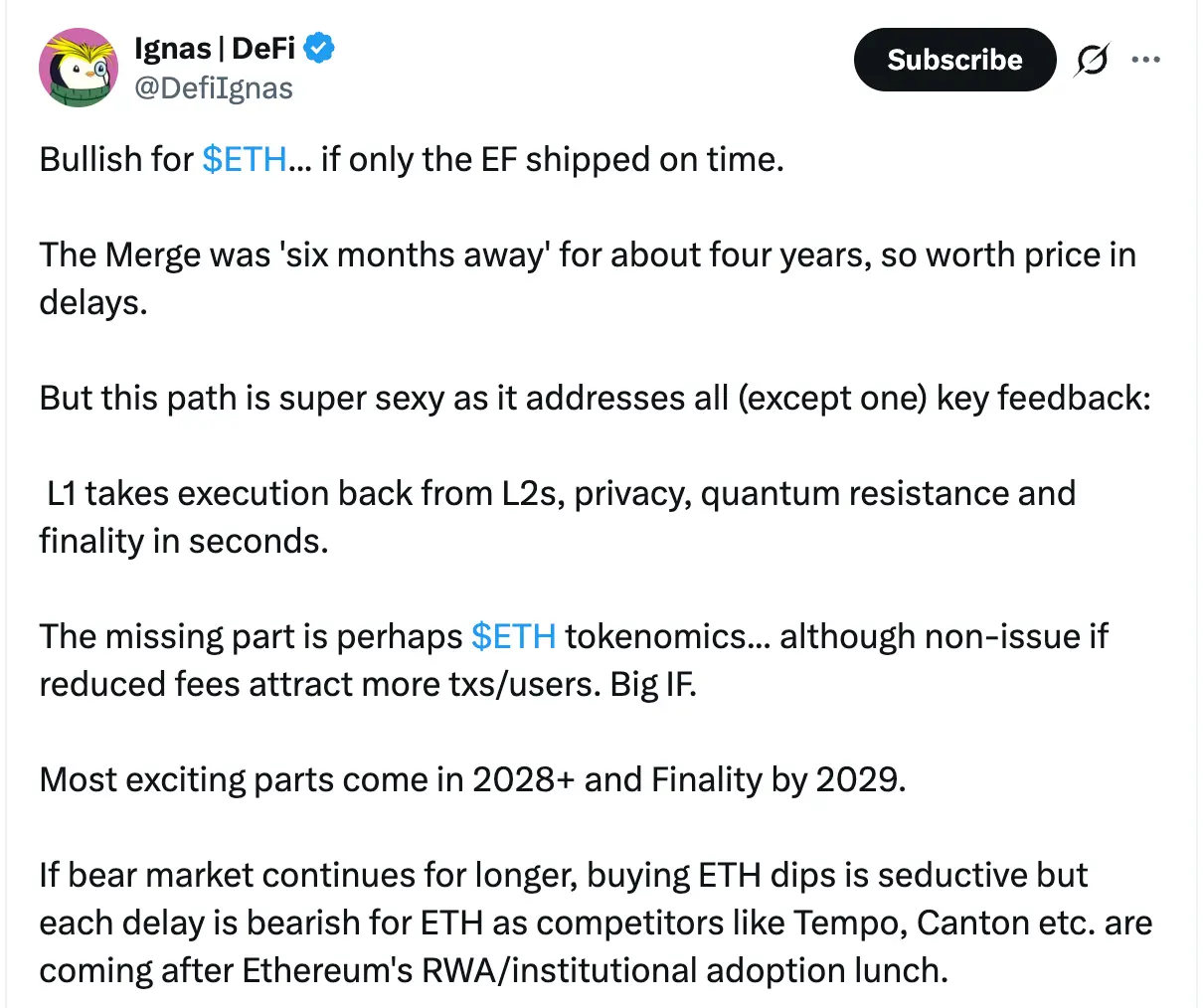
The second layer is the time lag. The roadmap announces a three-to-four-year phased engineering project. Within 2026, this roadmap will not change any aspect of Ethereum's current state. It is a directional commitment, and Ethereum's directional commitments have a history of delays in their timelines—The Merge itself was years later than early estimates. In other words, this roadmap raises Ethereum's long-term capacity ceiling but does not address ETH's medium-term value capture issues. Analyst Ignas's criticism of the roadmap points precisely to this: it does not encompass adjustments to ETH's own token economics.
Watchlist for the Next Decade

Summarizing the preceding content, the final answers all point to the same structure: this strawmap raises Ethereum's long-term ceiling but does not immediately solve ETH's medium-term value capture problem. Now is not the time to FOMO based on the roadmap alone.

Instead of pricing the roadmap itself, a more actionable approach is to track several near-term verifiable nodes:

  • Whether the Glamsterdam upgrade can launch smoothly and complete the gas limit increase.

  • Whether blob demand can continue growing with L2 activity.

  • Whether L1 fee revenue and ETH burn rates can improve.

  • Whether L2 growth can feed back to L1 through blob payments and settlement demand.

  • Whether ETH's relative performance against BTC can recover.

These indicators each correspond to elements of the roadmap and can be verified weekly on public dashboards like Etherscan's charts page and DefiLlama. Changes in any of these will provide the market with pricing signals much earlier than the roadmap document itself. Changes in any of these will tell the market sooner whether this three-to-four-year reconstruction is being delivered or delayed.

Trending Cryptos

Related Questions

QWhat is the Lean Ethereum roadmap, and how is it positioned within Ethereum's development history?

AThe Lean Ethereum roadmap is a comprehensive, long-term upgrade plan announced by Vitalik Buterin, positioned as Ethereum's third major evolution following the Merge. It is not a single upgrade but a series of protocol improvements to be rolled out in phases over the next three to four years. It aims to fundamentally restructure almost every core module of the protocol, including validation methods, cryptography, finality, and state storage.

QWhat are the five long-term strategic goals outlined in the strawmap for Lean Ethereum?

AThe five long-term strategic goals are: achieving faster L1 finality, reaching 1 gigagas per second L1 throughput (capable of handling tens of thousands of TPS in extreme cases), teragas-level scaling for L2 ecosystems, achieving comprehensive quantum cryptographic security, and enabling L1-native private transactions.

QWhat core technological shift is at the heart of Lean Ethereum's approach to transaction verification?

AThe core shift is moving away from every node re-executing every transaction for verification. Instead, Lean Ethereum will incorporate recursive STARK proofs as a native core component of the protocol. A single prover handles the heavy computational work, and all other nodes simply verify a succinct mathematical proof, drastically reducing computational overhead.

QWhat is the primary controversy surrounding the proposed EVM replacement in the Lean Ethereum roadmap, and which L2 project is notably affected?

AThe controversy centers on which new execution engine architecture should replace the EVM. Vitalik proposed candidates like RISC-V and leanISA for their proof-friendliness. However, L2 project Arbitrum, whose Stylus technology is built on WebAssembly (WASM), advocated for WASM. Since Vitalik's candidate list excludes WASM, it could impose additional 'adapter costs' on ecosystems like Arbitrum that have invested in different architectures, creating a strategic divergence.

QAccording to the article, what is the most direct mechanism through which the Lean Ethereum roadmap could potentially impact the price of ETH, and what is its key prerequisite?

AThe most direct mechanism is via the EIP-1559 fee-burn model. If the gigagas throughput target is achieved and leads to a resurgence in L1 transaction volume, the amount of gas consumed and ETH burned would increase, potentially affecting ETH's supply and value. The key prerequisite for this path is that 'demand follows back after the capacity increase,' meaning the increased capacity itself does not automatically create the necessary user demand and transaction activity.

Related Reads

In Just 11 Days, Claude Rewrote Millions of Lines of Code, an Epic AI Engineering Feat Sparks Fury

In just 11 days, Bun's founder Jarred Sumner used Anthropic's Claude AI models to rewrite its million lines of code from Zig to Rust. This move sparked significant controversy, particularly from Zig's creator, Andrew Kelley, who publicly criticized Sumner's engineering practices and the decision to use AI for such a massive rewrite. Bun, a high-performance JavaScript/TypeScript runtime and rival to Node.js, was originally written in Zig. After Anthropic acquired Bun, the team encountered persistent stability and memory safety bugs in the Zig codebase. These issues, combined with Zig's strict policy against LLM-generated code, led to the decision to rewrite in Rust. The rewrite was executed using Claude AI tools at an estimated API cost of $165,000, dramatically reducing the expected time and financial cost. Andrew Kelley's response was scathing. He blamed the original bugs on poor engineering habits, calling Bun's Zig code a collection of "hacks on top of hacks." He expressed relief that Bun was no longer associated with Zig, fearing it would misrepresent the language and attract low-quality, AI-generated contributions. The tech community is divided; some view Kelley's critique as unprofessional, while others see it as a defense of engineering integrity. A major concern about the AI-driven rewrite is the resulting code quality. The translation from Zig left approximately 27,000 lines of unsafe Rust code, raising fears about long-term maintainability and technical debt. The debate centers on whether this project is a milestone in AI-assisted development or a future maintenance nightmare.

marsbit2h ago

In Just 11 Days, Claude Rewrote Millions of Lines of Code, an Epic AI Engineering Feat Sparks Fury

marsbit2h ago

From Auto Finance to Bitcoin to AI Engines: An Analysis of Cango's 'What Not to Do' Strategy

From Auto Finance to Bitcoin and Now AI: Cango's "What Not to Do" Strategy Cango, a Chinese auto finance platform that went public on the NYSE in 2018, is undergoing its third major transformation. After selling its entire auto business in 2024, it pivoted to become a large-scale Bitcoin miner, acquiring 50 exahash of mining rigs from Bitmain. However, its true goal was never Bitcoin, but owning and controlling energy infrastructure. Now, Cango is pivoting again. While most listed Bitcoin miners are leasing power to giant hyperscalers for AI training clusters, Cango is taking the opposite path. It has launched an AI inference subsidiary called EcoHash, focusing not on training but on distributed inference. The company's strategy hinges on the insight that over 70% of mining industry power is controlled by small, independent sites (10-50 MW), which are too small for hyperscalers but ideal for low-latency AI inference. Cango aims to partner with these small operators, providing the AI technology, customers, and financing through its EcoLink software layer, which can distribute workloads across sites for reliability. Cango maintains a hybrid model, running roughly 31.7 EH/s of Bitcoin mining for cash flow while aggressively cleaning its balance sheet—slashing long-term debt by 94.5% to $30.6 million and raising $75 million for its AI venture. Its first AI deployment will be at a 50 MW site in Georgia. The strategy faces skepticism, given the high costs of converting mining sites and the potential for an AI bubble. However, Cango's leadership believes discipline around "what not to do"—avoiding direct competition with hyperscalers in training—positions it to capture the long-tail demand for distributed AI inference power.

Foresight News2h ago

From Auto Finance to Bitcoin to AI Engines: An Analysis of Cango's 'What Not to Do' Strategy

Foresight News2h ago

Strategy's Bitcoin Sales Cap Far Exceeds $1.25 Billion: A Detail the Market Overlooked

The article discusses how MicroStrategy's potential Bitcoin sales go far beyond the announced $1.25 billion "reserve-building capacity." It clarifies a key distinction in the company's "BTC Monetization Program": selling Bitcoin to *build* a new dollar reserve (the $1.25B cap) versus selling to *replenish* the existing USD Reserve after it's used for expenses like preferred share dividends. The recent $216M BTC sale for dividend payments was a "replenishment," leaving the headline $1.25B building quota untouched. The plan actually outlines three potential funding pools from BTC sales: 1) Building the reserve ($1.25B cap), 2) Covering preferred share/ debt costs (no specified cap), and 3) Funding buyback programs (up to $20B). This means the structured sales potential exceeds $30 billion, not including uncapped replenishment sales. The piece argues this marks MicroStrategy's shift from a passive "buy-and-hold" Bitcoin proxy to an actively managed entity using BTC as a balance-sheet tool to manage its complex capital structure (common stock, preferred shares, debt, reserve). This creates new dynamics and potential conflicts, as actions benefiting one part (e.g., selling BTC to pay dividends) may pressure another (e.g., undermining the "never sell" narrative). Investors must now parse the company's specific terminology ("build" vs. "replenish") to understand the true scope of future BTC sales, which is significantly larger than the market initially perceived.

marsbit2h ago

Strategy's Bitcoin Sales Cap Far Exceeds $1.25 Billion: A Detail the Market Overlooked

marsbit2h ago

Goldman Sachs Report Deconstructs the Competitive Landscape of China's AI Large Models: Who Will Be the Long-Term Winner?

Goldman Sachs analyzes China's AI large language model (LLM) landscape, identifying key players and a strategic shift towards efficiency and global expansion. The report highlights that Chinese open-source/open-weight models are closing the performance gap with top global proprietary models at significantly lower cost, driven by architectural innovations like MoE. This enables a "two-tier" market: a high-end segment (e.g., GLM5.2, Qwen3.7 Max) with pricing at ~$1 per million tokens, and a low-end, price-sensitive global segment. Open-source strategies aid adoption but limit monetization, as deployments via third-party platforms (e.g., AWS Bedrock, Alibaba Cloud) may not generate direct revenue for model creators. The industry is thus moving towards "open-weight + community license" models with revenue-sharing to improve unit economics. Internationally, the focus is shifting from "token maximization" to ROI-driven enterprise adoption, particularly in non-U.S. markets. Major cloud platforms are integrating Chinese models (e.g., DeepSeek, MiniMax). Using a competitive framework based on pricing power, cost advantage, and financial strength, Goldman Sachs identifies **Zhipu AI** and **DeepSeek** as leaders in foundational text models, and **ByteDance** (with Seedance) leading in multimodal/video generation. **MiniMax** and **Kuaishou** are also rated favorably. The firm forecasts China's AI model API/subscription revenue growing from ~RMB 35bn (2026E) to RMB 879bn by 2030.

marsbit2h ago

Goldman Sachs Report Deconstructs the Competitive Landscape of China's AI Large Models: Who Will Be the Long-Term Winner?

marsbit2h ago

Trading

Spot

Hot Articles

What is SONIC

Sonic: Pioneering the Future of Gaming in Web3 Introduction to Sonic In the ever-evolving landscape of Web3, the gaming industry stands out as one of the most dynamic and promising sectors. At the forefront of this revolution is Sonic, a project designed to amplify the gaming ecosystem on the Solana blockchain. Leveraging cutting-edge technology, Sonic aims to deliver an unparalleled gaming experience by efficiently processing millions of requests per second, ensuring that players enjoy seamless gameplay while maintaining low transaction costs. This article delves into the intricate details of Sonic, exploring its creators, funding sources, operational mechanics, and the timeline of significant events that have shaped its journey. What is Sonic? Sonic is an innovative layer-2 network that operates atop the Solana blockchain, specifically tailored to enhance the existing Solana gaming ecosystem. It accomplishes this through a customised, VM-agnostic game engine paired with a HyperGrid interpreter, facilitating sovereign game economies that roll up back to the Solana platform. The primary goals of Sonic include: Enhanced Gaming Experiences: Sonic is committed to offering lightning-fast on-chain gameplay, allowing players and developers to engage with games at previously unattainable speeds. Atomic Interoperability: This feature enables transactions to be executed within Sonic without the need to redeploy Solana programmes and accounts. This makes the process more efficient and directly benefits from Solana Layer1 services and liquidity. Seamless Deployment: Sonic allows developers to write for Ethereum Virtual Machine (EVM) based systems and execute them on Solana’s SVM infrastructure. This interoperability is crucial for attracting a broader range of dApps and decentralised applications to the platform. Support for Developers: By offering native composable gaming primitives and extensible data types - dining within the Entity-Component-System (ECS) framework - game creators can craft intricate business logic with ease. Overall, Sonic's unique approach not only caters to players but also provides an accessible and low-cost environment for developers to innovate and thrive. Creator of Sonic The information regarding the creator of Sonic is somewhat ambiguous. However, it is known that Sonic's SVM is owned by the company Mirror World. The absence of detailed information about the individuals behind Sonic reflects a common trend in several Web3 projects, where collective efforts and partnerships often overshadow individual contributions. Investors of Sonic Sonic has garnered considerable attention and support from various investors within the crypto and gaming sectors. Notably, the project raised an impressive $12 million during its Series A funding round. The round was led by BITKRAFT Ventures, with other notable investors including Galaxy, Okx Ventures, Interactive, Big Brain Holdings, and Mirana. This financial backing signifies the confidence that investment foundations have in Sonic’s potential to revolutionise the Web3 gaming landscape, further validating its innovative approaches and technologies. How Does Sonic Work? Sonic utilises the HyperGrid framework, a sophisticated parallel processing mechanism that enhances its scalability and customisability. Here are the core features that set Sonic apart: Lightning Speed at Low Costs: Sonic offers one of the fastest on-chain gaming experiences compared to other Layer-1 solutions, powered by the scalability of Solana’s virtual machine (SVM). Atomic Interoperability: Sonic enables transaction execution without redeployment of Solana programmes and accounts, effectively streamlining the interaction between users and the blockchain. EVM Compatibility: Developers can effortlessly migrate decentralised applications from EVM chains to the Solana environment using Sonic’s HyperGrid interpreter, increasing the accessibility and integration of various dApps. Ecosystem Support for Developers: By exposing native composable gaming primitives, Sonic facilitates a sandbox-like environment where developers can experiment and implement business logic, greatly enhancing the overall development experience. Monetisation Infrastructure: Sonic natively supports growth and monetisation efforts, providing frameworks for traffic generation, payments, and settlements, thereby ensuring that gaming projects are not only viable but also sustainable financially. Timeline of Sonic The evolution of Sonic has been marked by several key milestones. Below is a brief timeline highlighting critical events in the project's history: 2022: The Sonic cryptocurrency was officially launched, marking the beginning of its journey in the Web3 gaming arena. 2024: June: Sonic SVM successfully raised $12 million in a Series A funding round. This investment allowed Sonic to further develop its platform and expand its offerings. August: The launch of the Sonic Odyssey testnet provided users with the first opportunity to engage with the platform, offering interactive activities such as collecting rings—a nod to gaming nostalgia. October: SonicX, an innovative crypto game integrated with Solana, made its debut on TikTok, capturing the attention of over 120,000 users within a short span. This integration illustrated Sonic’s commitment to reaching a broader, global audience and showcased the potential of blockchain gaming. Key Points Sonic SVM is a revolutionary layer-2 network on Solana explicitly designed to enhance the GameFi landscape, demonstrating great potential for future development. HyperGrid Framework empowers Sonic by introducing horizontal scaling capabilities, ensuring that the network can handle the demands of Web3 gaming. Integration with Social Platforms: The successful launch of SonicX on TikTok displays Sonic’s strategy to leverage social media platforms to engage users, exponentially increasing the exposure and reach of its projects. Investment Confidence: The substantial funding from BITKRAFT Ventures, among others, emphasizes the robust backing Sonic has, paving the way for its ambitious future. In conclusion, Sonic encapsulates the essence of Web3 gaming innovation, striking a balance between cutting-edge technology, developer-centric tools, and community engagement. As the project continues to evolve, it is poised to redefine the gaming landscape, making it a notable entity for gamers and developers alike. As Sonic moves forward, it will undoubtedly attract greater interest and participation, solidifying its place within the broader narrative of blockchain gaming.

1.8k Total ViewsPublished 2024.04.04Updated 2024.12.03

What is SONIC

What is $S$

Understanding SPERO: A Comprehensive Overview Introduction to SPERO As the landscape of innovation continues to evolve, the emergence of web3 technologies and cryptocurrency projects plays a pivotal role in shaping the digital future. One project that has garnered attention in this dynamic field is SPERO, denoted as SPERO,$$s$. This article aims to gather and present detailed information about SPERO, to help enthusiasts and investors understand its foundations, objectives, and innovations within the web3 and crypto domains. What is SPERO,$$s$? SPERO,$$s$ is a unique project within the crypto space that seeks to leverage the principles of decentralisation and blockchain technology to create an ecosystem that promotes engagement, utility, and financial inclusion. The project is tailored to facilitate peer-to-peer interactions in new ways, providing users with innovative financial solutions and services. At its core, SPERO,$$s$ aims to empower individuals by providing tools and platforms that enhance user experience in the cryptocurrency space. This includes enabling more flexible transaction methods, fostering community-driven initiatives, and creating pathways for financial opportunities through decentralised applications (dApps). The underlying vision of SPERO,$$s$ revolves around inclusiveness, aiming to bridge gaps within traditional finance while harnessing the benefits of blockchain technology. Who is the Creator of SPERO,$$s$? The identity of the creator of SPERO,$$s$ remains somewhat obscure, as there are limited publicly available resources providing detailed background information on its founder(s). This lack of transparency can stem from the project's commitment to decentralisation—an ethos that many web3 projects share, prioritising collective contributions over individual recognition. By centring discussions around the community and its collective goals, SPERO,$$s$ embodies the essence of empowerment without singling out specific individuals. As such, understanding the ethos and mission of SPERO remains more important than identifying a singular creator. Who are the Investors of SPERO,$$s$? SPERO,$$s$ is supported by a diverse array of investors ranging from venture capitalists to angel investors dedicated to fostering innovation in the crypto sector. The focus of these investors generally aligns with SPERO's mission—prioritising projects that promise societal technological advancement, financial inclusivity, and decentralised governance. These investor foundations are typically interested in projects that not only offer innovative products but also contribute positively to the blockchain community and its ecosystems. The backing from these investors reinforces SPERO,$$s$ as a noteworthy contender in the rapidly evolving domain of crypto projects. How Does SPERO,$$s$ Work? SPERO,$$s$ employs a multi-faceted framework that distinguishes it from conventional cryptocurrency projects. Here are some of the key features that underline its uniqueness and innovation: Decentralised Governance: SPERO,$$s$ integrates decentralised governance models, empowering users to participate actively in decision-making processes regarding the project’s future. This approach fosters a sense of ownership and accountability among community members. Token Utility: SPERO,$$s$ utilises its own cryptocurrency token, designed to serve various functions within the ecosystem. These tokens enable transactions, rewards, and the facilitation of services offered on the platform, enhancing overall engagement and utility. Layered Architecture: The technical architecture of SPERO,$$s$ supports modularity and scalability, allowing for seamless integration of additional features and applications as the project evolves. This adaptability is paramount for sustaining relevance in the ever-changing crypto landscape. Community Engagement: The project emphasises community-driven initiatives, employing mechanisms that incentivise collaboration and feedback. By nurturing a strong community, SPERO,$$s$ can better address user needs and adapt to market trends. Focus on Inclusion: By offering low transaction fees and user-friendly interfaces, SPERO,$$s$ aims to attract a diverse user base, including individuals who may not previously have engaged in the crypto space. This commitment to inclusion aligns with its overarching mission of empowerment through accessibility. Timeline of SPERO,$$s$ Understanding a project's history provides crucial insights into its development trajectory and milestones. Below is a suggested timeline mapping significant events in the evolution of SPERO,$$s$: Conceptualisation and Ideation Phase: The initial ideas forming the basis of SPERO,$$s$ were conceived, aligning closely with the principles of decentralisation and community focus within the blockchain industry. Launch of Project Whitepaper: Following the conceptual phase, a comprehensive whitepaper detailing the vision, goals, and technological infrastructure of SPERO,$$s$ was released to garner community interest and feedback. Community Building and Early Engagements: Active outreach efforts were made to build a community of early adopters and potential investors, facilitating discussions around the project’s goals and garnering support. Token Generation Event: SPERO,$$s$ conducted a token generation event (TGE) to distribute its native tokens to early supporters and establish initial liquidity within the ecosystem. Launch of Initial dApp: The first decentralised application (dApp) associated with SPERO,$$s$ went live, allowing users to engage with the platform's core functionalities. Ongoing Development and Partnerships: Continuous updates and enhancements to the project's offerings, including strategic partnerships with other players in the blockchain space, have shaped SPERO,$$s$ into a competitive and evolving player in the crypto market. Conclusion SPERO,$$s$ stands as a testament to the potential of web3 and cryptocurrency to revolutionise financial systems and empower individuals. With a commitment to decentralised governance, community engagement, and innovatively designed functionalities, it paves the way toward a more inclusive financial landscape. As with any investment in the rapidly evolving crypto space, potential investors and users are encouraged to research thoroughly and engage thoughtfully with the ongoing developments within SPERO,$$s$. The project showcases the innovative spirit of the crypto industry, inviting further exploration into its myriad possibilities. While the journey of SPERO,$$s$ is still unfolding, its foundational principles may indeed influence the future of how we interact with technology, finance, and each other in interconnected digital ecosystems.

108 Total ViewsPublished 2024.12.17Updated 2024.12.17

What is $S$

What is AGENT S

Agent S: The Future of Autonomous Interaction in Web3 Introduction In the ever-evolving landscape of Web3 and cryptocurrency, innovations are constantly redefining how individuals interact with digital platforms. One such pioneering project, Agent S, promises to revolutionise human-computer interaction through its open agentic framework. By paving the way for autonomous interactions, Agent S aims to simplify complex tasks, offering transformative applications in artificial intelligence (AI). This detailed exploration will delve into the project's intricacies, its unique features, and the implications for the cryptocurrency domain. What is Agent S? Agent S stands as a groundbreaking open agentic framework, specifically designed to tackle three fundamental challenges in the automation of computer tasks: Acquiring Domain-Specific Knowledge: The framework intelligently learns from various external knowledge sources and internal experiences. This dual approach empowers it to build a rich repository of domain-specific knowledge, enhancing its performance in task execution. Planning Over Long Task Horizons: Agent S employs experience-augmented hierarchical planning, a strategic approach that facilitates efficient breakdown and execution of intricate tasks. This feature significantly enhances its ability to manage multiple subtasks efficiently and effectively. Handling Dynamic, Non-Uniform Interfaces: The project introduces the Agent-Computer Interface (ACI), an innovative solution that enhances the interaction between agents and users. Utilizing Multimodal Large Language Models (MLLMs), Agent S can navigate and manipulate diverse graphical user interfaces seamlessly. Through these pioneering features, Agent S provides a robust framework that addresses the complexities involved in automating human interaction with machines, setting the stage for myriad applications in AI and beyond. Who is the Creator of Agent S? While the concept of Agent S is fundamentally innovative, specific information about its creator remains elusive. The creator is currently unknown, which highlights either the nascent stage of the project or the strategic choice to keep founding members under wraps. Regardless of anonymity, the focus remains on the framework's capabilities and potential. Who are the Investors of Agent S? As Agent S is relatively new in the cryptographic ecosystem, detailed information regarding its investors and financial backers is not explicitly documented. The lack of publicly available insights into the investment foundations or organisations supporting the project raises questions about its funding structure and development roadmap. Understanding the backing is crucial for gauging the project's sustainability and potential market impact. How Does Agent S Work? At the core of Agent S lies cutting-edge technology that enables it to function effectively in diverse settings. Its operational model is built around several key features: Human-like Computer Interaction: The framework offers advanced AI planning, striving to make interactions with computers more intuitive. By mimicking human behaviour in tasks execution, it promises to elevate user experiences. Narrative Memory: Employed to leverage high-level experiences, Agent S utilises narrative memory to keep track of task histories, thereby enhancing its decision-making processes. Episodic Memory: This feature provides users with step-by-step guidance, allowing the framework to offer contextual support as tasks unfold. Support for OpenACI: With the ability to run locally, Agent S allows users to maintain control over their interactions and workflows, aligning with the decentralised ethos of Web3. Easy Integration with External APIs: Its versatility and compatibility with various AI platforms ensure that Agent S can fit seamlessly into existing technological ecosystems, making it an appealing choice for developers and organisations. These functionalities collectively contribute to Agent S's unique position within the crypto space, as it automates complex, multi-step tasks with minimal human intervention. As the project evolves, its potential applications in Web3 could redefine how digital interactions unfold. Timeline of Agent S The development and milestones of Agent S can be encapsulated in a timeline that highlights its significant events: September 27, 2024: The concept of Agent S was launched in a comprehensive research paper titled “An Open Agentic Framework that Uses Computers Like a Human,” showcasing the groundwork for the project. October 10, 2024: The research paper was made publicly available on arXiv, offering an in-depth exploration of the framework and its performance evaluation based on the OSWorld benchmark. October 12, 2024: A video presentation was released, providing a visual insight into the capabilities and features of Agent S, further engaging potential users and investors. These markers in the timeline not only illustrate the progress of Agent S but also indicate its commitment to transparency and community engagement. Key Points About Agent S As the Agent S framework continues to evolve, several key attributes stand out, underscoring its innovative nature and potential: Innovative Framework: Designed to provide an intuitive use of computers akin to human interaction, Agent S brings a novel approach to task automation. Autonomous Interaction: The ability to interact autonomously with computers through GUI signifies a leap towards more intelligent and efficient computing solutions. Complex Task Automation: With its robust methodology, it can automate complex, multi-step tasks, making processes faster and less error-prone. Continuous Improvement: The learning mechanisms enable Agent S to improve from past experiences, continually enhancing its performance and efficacy. Versatility: Its adaptability across different operating environments like OSWorld and WindowsAgentArena ensures that it can serve a broad range of applications. As Agent S positions itself in the Web3 and crypto landscape, its potential to enhance interaction capabilities and automate processes signifies a significant advancement in AI technologies. Through its innovative framework, Agent S exemplifies the future of digital interactions, promising a more seamless and efficient experience for users across various industries. Conclusion Agent S represents a bold leap forward in the marriage of AI and Web3, with the capacity to redefine how we interact with technology. While still in its early stages, the possibilities for its application are vast and compelling. Through its comprehensive framework addressing critical challenges, Agent S aims to bring autonomous interactions to the forefront of the digital experience. As we move deeper into the realms of cryptocurrency and decentralisation, projects like Agent S will undoubtedly play a crucial role in shaping the future of technology and human-computer collaboration.

773 Total ViewsPublished 2025.01.14Updated 2025.01.14

What is AGENT S

Discussions

Welcome to the HTX Community. Here, you can stay informed about the latest platform developments and gain access to professional market insights. Users' opinions on the price of S (S) are presented below.

活动图片