South Korea’s KB Financial Completes Stablecoin Pilot As Lawmakers Press For Regulatory Framework

bitcoinistPublished on 2026-05-19Last updated on 2026-05-19

Abstract

South Korea's KB Financial Group has completed a Proof-of-Concept (PoC) for a won-denominated stablecoin in partnership with several companies. The pilot integrated the entire financial process—from stablecoin issuance to offline payments, merchant settlements, and international remittances—into a single blockchain-based workflow. A key test involved offline payments at a coffee shop via QR code without requiring a digital wallet. For international transfers, the model converted the won stablecoin to a dollar stablecoin, completing the process within three minutes and reducing fees by approximately 87% compared to traditional methods. KB aims to launch services once digital asset regulations are established. However, South Korea's Digital Asset Act, which would establish rules for such stablecoins, faces significant delays due to a disagreement between the Financial Services Commission (FSC) and the Bank of Korea (BOK). The central bank advocates for a consortium of banks to hold a majority stake in any issuer, while the FSC worries this could stifle innovation and tech firm participation. Lawmakers and experts have urged the National Assembly to prioritize the legislation, warning that South Korea is falling behind in the global digital asset market despite accounting for 10% of global transactions. Bank of Korea Deputy Governor Chang Cheong-soo acknowledged the potential of won-pegged stablecoins as a competitive future payment method.

South Korea’s KB Financial has completed a Proof-of-Concept (PoC) for won-denominated stablecoin as lawmakers and experts push to advance the country’s digital asset framework.

KB Stablecoin Pilot Cuts Fees, Speeds Transfers

On Sunday, KB Financial Group, the parent company of South Korea’s largest bank, announced that it had completed a payment pilot for a won-denominated stablecoin, with electronic payments KG Inicis, Layer 1 blockchain platform Kaia, and digital asset solutions company OpenAsset as partners.

According to local news reports, the PoC integrated the entire financial process into a single workflow, from the issuance of a won-pegged stablecoin to offline payments, merchant settlements, and international remittances. The project allows customers to continue using financial services as before, while the internal settlement system has been migrated to blockchain.

Notably, the real-world payment model was deployed via offline kiosk transactions at a Hollys coffee shop. The system is engineered so that a consumer pays with a QR code without installing a digital wallet, and a blockchain smart contract is automatically executed at settlement.

For international money transfer verification, the model involved converting a won-pegged stablecoin into a dollar-denominated stablecoin using Kaia’s on-chain liquidity, then routing the funds through a local partner in Vietnam to the recipient’s actual bank account.

Unlike the traditional SWIFT method, the entire transfer process was completed within three minutes, and transaction fees were reduced by approximately 87% compared to previous methods, the report noted.

A KB Financial Group official affirmed that the company will work to “provide digital financial services closely integrated into daily life that customers can tangibly experience by combining financial infrastructure—based on proven stability and trust—with blockchain technology.”

The company also revealed that it plans to secure the necessary operational capabilities to launch its services immediately after South Korea’s digital asset legislation and regulations are established.

Digital Asset Act Faces Delay

Stablecoins have played a central role in the country’s digital transformation and dominated South Korea’s policy discussions over the past year. However, the long-awaited legislation set to address won-pegged token rules has been stalled for nearly six months.

For context, the second phase of the Virtual Asset User Protection Act, known as the Digital Assets Act, was initially expected to pass before the end of 2025, but a disagreement between South Korea’s Financial Services Commission (FSC) and the Bank of Korea (BOK) has delayed the framework since December.

The financial regulators have been unable to agree on the extent of banks’ role in the issuance of stablecoins, with the central bank pushing for a consortium of banks owning at least 51% of any issuer seeking approval in the country. The FSC, however, has raised concerns about the proposal, arguing that a majority stake for banks could reduce tech firms’ participation and limit market innovation.

In April, lawmakers urged the National Assembly to prioritize stablecoin legislation and approve the Digital Asset Act, warning that while politicians argue over governance structures, the global market is moving forward.

Similarly, Professor Ahn Soo-hyun of Hankuk University of Foreign Studies stated last week that while global financial leaders complete and revise crypto legislation, South Korea, which accounts for 10% of global digital asset transactions, “is falling behind.”

At a Korea Chamber of Commerce and Industry forum on digital assets, multiple lawmakers, regulators, and experts discussed the state of South Korea’s stablecoin framework, with some participants calling it a “critical juncture” for the country’s efforts to regulate the sector.

Meanwhile, Bank of Korea Deputy Governor Chang Cheong-soo stated, “I believe the won-pegged stablecoin could serve as a complementary and competitive payment method in future monetary systems, playing a role in virtual asset transactions and cross-border payments.”
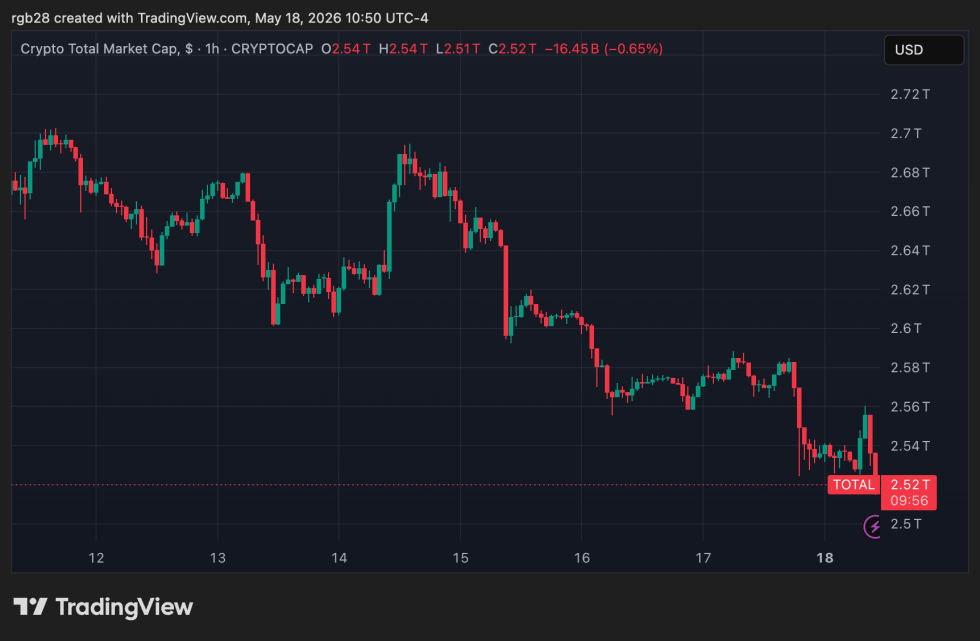
The total crypto market capitalization is at $2.52 trillion in the one-week chart. Source: TOTAL on TradingView


Related Questions

QWhat has KB Financial Group completed and with which partners?

AKB Financial Group has completed a Proof-of-Concept (PoC) for a won-denominated stablecoin. The partners for this payment pilot were electronic payments company KG Inicis, Layer 1 blockchain platform Kaia, and digital asset solutions company OpenAsset.

QWhat are the key benefits of the stablecoin model demonstrated in the pilot, especially regarding international transfers?

AFor international money transfers, the model completed the process within three minutes, compared to the traditional SWIFT method. It also reduced transaction fees by approximately 87%.

QWhat is the main point of disagreement causing the delay of South Korea's Digital Assets Act?

AThe delay stems from a disagreement between South Korea's Financial Services Commission (FSC) and the Bank of Korea (BOK). The central bank wants a consortium of banks to own at least 51% of any stablecoin issuer, while the FSC is concerned this could reduce tech firms' participation and limit market innovation.

QHow did KB Financial's pilot integrate blockchain technology for offline payments?

AThe pilot deployed a real-world payment model at a Hollys coffee shop via offline kiosk transactions. A consumer could pay with a QR code without installing a digital wallet, and a blockchain smart contract was automatically executed at settlement.

QWhat did Bank of Korea Deputy Governor Chang Cheong-soo state about the potential role of won-pegged stablecoins?

ABank of Korea Deputy Governor Chang Cheong-soo stated that he believes the won-pegged stablecoin could serve as a complementary and competitive payment method in future monetary systems, playing a role in virtual asset transactions and cross-border payments.

Related Reads

When Hyperliquid Steals Solana's 'Internet Capital Market' Script

The article "When Hyperliquid Steals Solana's 'Internet Capital Markets' Playbook" discusses Solana's struggles to maintain its "internet capital markets" narrative by 2026. Despite its initial success as a high-performance "Ethereum killer," SOL's price has underperformed, dropping significantly compared to other major cryptocurrencies. Solana's vision of a global, on-chain trading network for all assets is being challenged not primarily by Ethereum, but by Hyperliquid. Hyperliquid, evolving from a perpetual contracts platform into a dedicated financial infrastructure Layer 1, has become a major beneficiary of the shift of derivatives trading from centralized exchanges to on-chain. The article argues that for high-frequency financial trading, a specialized, performance-focused chain like Hyperliquid may be more suitable than a general-purpose ecosystem like Solana. Further compounding Solana's issues was a major $200+ million exploit on its key perpetual protocol, Drift, in April, which damaged market confidence. In response, Solana founder Anatoly Yakovenko heavily promoted the protocol Phoenix as a replacement, boosting its visibility but not its trading volume, which remains far behind leading platforms. Solana supporters have launched a public critique of Hyperliquid's decentralization, pointing to its limited validators and closed-source code. Critics, however, note Solana's own declining validator count and centralization metrics. This strategy has also caused internal friction, with developers of other Solana protocols expressing discontent over the foundation's perceived favoritism towards Phoenix. The conclusion is that Hyperliquid's rise represents a challenge to the "general-purpose blockchain" narrative, proving that the core of a capital market might be a specialized trading engine rather than a broad ecosystem. If Solana cannot regain dominance in derivatives, it risks remaining a "meme coin paradise" while its grand "internet capital markets" ambition slips away.

marsbit19m ago

When Hyperliquid Steals Solana's 'Internet Capital Market' Script

marsbit19m ago

When Hyperliquid Steals Solana's 'Internet Capital Markets' Playbook

The article discusses how Solana's grand vision of becoming an "Internet Capital Markets" platform is facing significant challenges in 2026, primarily from the unexpected rise of Hyperliquid. Solana's performance has weakened, with its token SOL experiencing the largest price decline among major cryptocurrencies. Its core narrative of building a global, chain-based marketplace for all assets is under pressure both internally and externally. Hyperliquid, originally a perpetual futures exchange, has evolved into a dedicated Layer 1 financial infrastructure network. Its focused, trading-centric approach is attracting capital and challenging the assumption that a "general-purpose" ecosystem like Solana is necessary for a capital market. Hyperliquid's success suggests that for high-frequency trading, superior performance, liquidity, and user experience may be more critical than a broad application ecosystem. Internally, Solana's strategy suffered a blow from a major hack on the Drift Protocol in April, resulting in over $200 million in losses. In response, Solana founder Anatoly Yakovenko has heavily promoted Phoenix as a new decentralized perpetual futures platform on Solana. While this boosted Phoenix's visibility, its trading volume remains far behind leading platforms. Solana's community has launched a rhetorical attack against Hyperliquid, questioning its decentralization due to its limited validator set and closed-source code. Critics, however, point out Solana's own decreasing validator count and increasing centralization of stake. This focus on "decentralization metrics" has also caused internal friction, with other Solana ecosystem developers expressing discontent over the foundation's perceived favoritism towards Phoenix. The article concludes that the rise of Hyperliquid represents a challenge to the "general-purpose blockchain" narrative, proving that an efficient trading engine might be more central to a capital market than a vast ecosystem. If Solana cannot regain dominance in the derivatives space, it risks remaining a "meme coin paradise" rather than achieving its ambition of hosting global assets.

链捕手27m ago

When Hyperliquid Steals Solana's 'Internet Capital Markets' Playbook

链捕手27m ago

Samsung Bets on Mobile HBM: AI Moves from Cloud to Palm, a New Frontier in Semiconductor Investment?

Samsung is betting on bringing high-bandwidth memory (HBM) technology from servers to mobile devices, aiming to enable powerful on-device AI features in smartphones and tablets. This move is driven by the booming AI market, where HBM demand from data centers has fueled Samsung's record profits, with HBM4 already in mass production. By integrating mobile HBM, Samsung seeks to transform user AI experiences—making tasks like image generation and real-time translation faster, seamless, and more private by processing data locally. Strategically, this allows Samsung to leverage its vertical integration in memory, advanced packaging, and Exynos processors to differentiate its Galaxy devices against competitors like Apple and Qualcomm. It also opens a new consumer growth avenue, reducing reliance on volatile server HBM demand alone. The initiative is expected to benefit the broader supply chain, boosting demand for advanced packaging materials, thermal solutions, and other components. While promising, risks include potential delays in mobile HBM mass production beyond 2027, high initial costs, and the cyclical nature of the memory market. Nonetheless, Samsung's push signals a broader industry shift toward hybrid cloud-edge AI computing, positioning it as a key player in defining the future of AI-powered devices and presenting a potential long-term investment theme in semiconductors.

marsbit37m ago

Samsung Bets on Mobile HBM: AI Moves from Cloud to Palm, a New Frontier in Semiconductor Investment?

marsbit37m ago

Trillion-Dollar Banking Giant Adjusts Portfolio: Buys XRP Heavily, Clears Out Solana

In a significant portfolio rebalancing move, Italian banking giant Intesa Sanpaolo, with $1.1 trillion in assets, has made a notable shift in its cryptocurrency holdings. According to disclosures from Q4 2025 to Q1 2026, the bank's total crypto exposure surged from $100 million to approximately $235 million. The most striking action was its first-time establishment of an XRP position, investing around $18 million through the Grayscale XRP Trust. This marks a milestone as one of the first major European banks to adopt XRP via a regulated investment vehicle. This move is part of a broader, systematic digital asset strategy. The bank also substantially increased its Bitcoin exposure via ETFs and initiated its first Ethereum investment through a staking trust. In a contrasting strategic pivot, Intesa Sanpaolo drastically reduced its Solana holdings by over 99%, nearly exiting its position in a Bitwise Solana staking ETF. This shift is interpreted as reflecting a institutional preference for assets perceived with lower regulatory and operational risk, especially following Solana's network stability issues and improved clarity for XRP after its legal settlements. The bank's actions highlight key drivers for institutional adoption: clearer regulations, the availability of compliant ETF products, and the search for portfolio diversification. This trend signifies crypto's evolving status from a niche experiment to a recognized component of mainstream asset allocation, with institutions favoring gradual, regulated entry points over direct token ownership.

marsbit1h ago

Trillion-Dollar Banking Giant Adjusts Portfolio: Buys XRP Heavily, Clears Out Solana

marsbit1h ago

Base Native Leveraged Prediction Market OmenX Officially Launches on Mainnet

Base-native leveraged prediction market platform OmenX has officially launched on mainnet. It currently supports up to 5x leverage, with plans to increase to 10x based on platform liquidity and market conditions. Unlike traditional prediction markets where users fully collateralize YES/NO positions and wait for settlement, OmenX aims to create a trading platform-like experience. Users can open leveraged positions on event outcomes, and actively trade, adjust, or hedge these positions before the event concludes for greater capital efficiency. Alongside the mainnet launch, OmenX introduced a "Hedge-to-Earn" campaign targeting existing users of other prediction markets (initially Polymarket). This initiative allows users to claim incentives or hedging benefits on OmenX based on their existing positions, aiming to introduce them to leveraged trading and active risk management. OmenX positions itself as a derivatives trading platform for prediction market assets. The team believes that as platforms like Polymarket mainstream prediction markets, event outcomes are becoming a new tradable asset class. The next phase of demand will focus on leverage, liquidity, and advanced trading tools. Post-launch, OmenX plans to expand supported market types, optimize liquidity, and develop APIs and additional trading tools. The team is also in discussions with investors and partners to secure resources for further development.

链捕手1h ago

Base Native Leveraged Prediction Market OmenX Officially Launches on Mainnet

链捕手1h ago

Trading

Spot
Futures

Hot Articles

Discussions

Welcome to the HTX Community. Here, you can stay informed about the latest platform developments and gain access to professional market insights. Users' opinions on the price of S (S) are presented below.

活动图片