South Korea’s KB Financial Completes Stablecoin Pilot As Lawmakers Press For Regulatory Framework

bitcoinistPublished on 2026-05-19Last updated on 2026-05-19

Abstract

South Korea's KB Financial Group has completed a Proof-of-Concept (PoC) for a won-denominated stablecoin in partnership with several companies. The pilot integrated the entire financial process—from stablecoin issuance to offline payments, merchant settlements, and international remittances—into a single blockchain-based workflow. A key test involved offline payments at a coffee shop via QR code without requiring a digital wallet. For international transfers, the model converted the won stablecoin to a dollar stablecoin, completing the process within three minutes and reducing fees by approximately 87% compared to traditional methods. KB aims to launch services once digital asset regulations are established. However, South Korea's Digital Asset Act, which would establish rules for such stablecoins, faces significant delays due to a disagreement between the Financial Services Commission (FSC) and the Bank of Korea (BOK). The central bank advocates for a consortium of banks to hold a majority stake in any issuer, while the FSC worries this could stifle innovation and tech firm participation. Lawmakers and experts have urged the National Assembly to prioritize the legislation, warning that South Korea is falling behind in the global digital asset market despite accounting for 10% of global transactions. Bank of Korea Deputy Governor Chang Cheong-soo acknowledged the potential of won-pegged stablecoins as a competitive future payment method.

South Korea’s KB Financial has completed a Proof-of-Concept (PoC) for won-denominated stablecoin as lawmakers and experts push to advance the country’s digital asset framework.

KB Stablecoin Pilot Cuts Fees, Speeds Transfers

On Sunday, KB Financial Group, the parent company of South Korea’s largest bank, announced that it had completed a payment pilot for a won-denominated stablecoin, with electronic payments KG Inicis, Layer 1 blockchain platform Kaia, and digital asset solutions company OpenAsset as partners.

According to local news reports, the PoC integrated the entire financial process into a single workflow, from the issuance of a won-pegged stablecoin to offline payments, merchant settlements, and international remittances. The project allows customers to continue using financial services as before, while the internal settlement system has been migrated to blockchain.

Notably, the real-world payment model was deployed via offline kiosk transactions at a Hollys coffee shop. The system is engineered so that a consumer pays with a QR code without installing a digital wallet, and a blockchain smart contract is automatically executed at settlement.

For international money transfer verification, the model involved converting a won-pegged stablecoin into a dollar-denominated stablecoin using Kaia’s on-chain liquidity, then routing the funds through a local partner in Vietnam to the recipient’s actual bank account.

Unlike the traditional SWIFT method, the entire transfer process was completed within three minutes, and transaction fees were reduced by approximately 87% compared to previous methods, the report noted.

A KB Financial Group official affirmed that the company will work to “provide digital financial services closely integrated into daily life that customers can tangibly experience by combining financial infrastructure—based on proven stability and trust—with blockchain technology.”

The company also revealed that it plans to secure the necessary operational capabilities to launch its services immediately after South Korea’s digital asset legislation and regulations are established.

Digital Asset Act Faces Delay

Stablecoins have played a central role in the country’s digital transformation and dominated South Korea’s policy discussions over the past year. However, the long-awaited legislation set to address won-pegged token rules has been stalled for nearly six months.

For context, the second phase of the Virtual Asset User Protection Act, known as the Digital Assets Act, was initially expected to pass before the end of 2025, but a disagreement between South Korea’s Financial Services Commission (FSC) and the Bank of Korea (BOK) has delayed the framework since December.

The financial regulators have been unable to agree on the extent of banks’ role in the issuance of stablecoins, with the central bank pushing for a consortium of banks owning at least 51% of any issuer seeking approval in the country. The FSC, however, has raised concerns about the proposal, arguing that a majority stake for banks could reduce tech firms’ participation and limit market innovation.

In April, lawmakers urged the National Assembly to prioritize stablecoin legislation and approve the Digital Asset Act, warning that while politicians argue over governance structures, the global market is moving forward.

Similarly, Professor Ahn Soo-hyun of Hankuk University of Foreign Studies stated last week that while global financial leaders complete and revise crypto legislation, South Korea, which accounts for 10% of global digital asset transactions, “is falling behind.”

At a Korea Chamber of Commerce and Industry forum on digital assets, multiple lawmakers, regulators, and experts discussed the state of South Korea’s stablecoin framework, with some participants calling it a “critical juncture” for the country’s efforts to regulate the sector.

Meanwhile, Bank of Korea Deputy Governor Chang Cheong-soo stated, “I believe the won-pegged stablecoin could serve as a complementary and competitive payment method in future monetary systems, playing a role in virtual asset transactions and cross-border payments.”
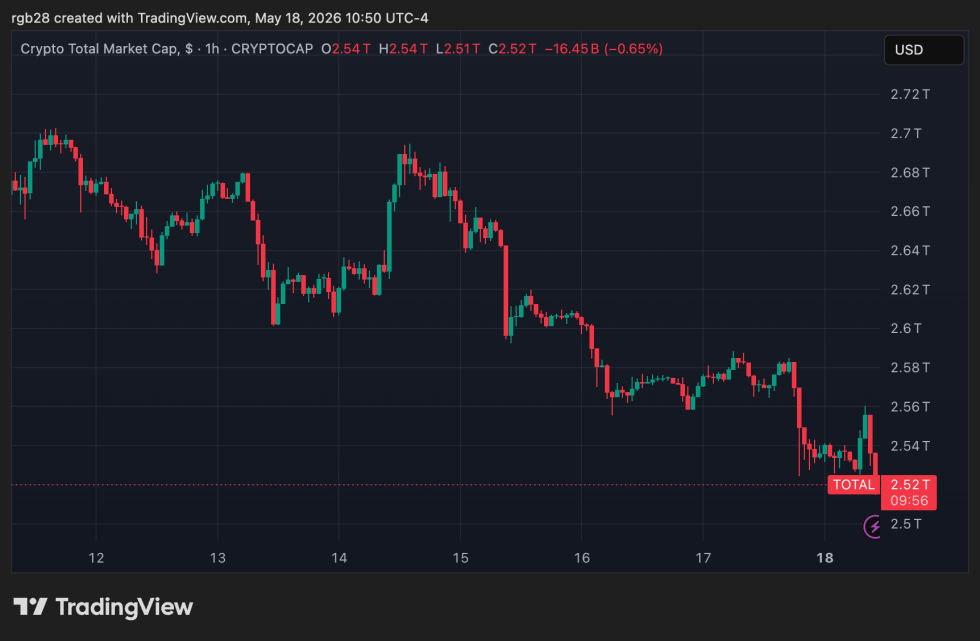
The total crypto market capitalization is at $2.52 trillion in the one-week chart. Source: TOTAL on TradingView


Trending Cryptos

Related Questions

QWhat has KB Financial Group completed and with which partners?

AKB Financial Group has completed a Proof-of-Concept (PoC) for a won-denominated stablecoin. The partners for this payment pilot were electronic payments company KG Inicis, Layer 1 blockchain platform Kaia, and digital asset solutions company OpenAsset.

QWhat are the key benefits of the stablecoin model demonstrated in the pilot, especially regarding international transfers?

AFor international money transfers, the model completed the process within three minutes, compared to the traditional SWIFT method. It also reduced transaction fees by approximately 87%.

QWhat is the main point of disagreement causing the delay of South Korea's Digital Assets Act?

AThe delay stems from a disagreement between South Korea's Financial Services Commission (FSC) and the Bank of Korea (BOK). The central bank wants a consortium of banks to own at least 51% of any stablecoin issuer, while the FSC is concerned this could reduce tech firms' participation and limit market innovation.

QHow did KB Financial's pilot integrate blockchain technology for offline payments?

AThe pilot deployed a real-world payment model at a Hollys coffee shop via offline kiosk transactions. A consumer could pay with a QR code without installing a digital wallet, and a blockchain smart contract was automatically executed at settlement.

QWhat did Bank of Korea Deputy Governor Chang Cheong-soo state about the potential role of won-pegged stablecoins?

ABank of Korea Deputy Governor Chang Cheong-soo stated that he believes the won-pegged stablecoin could serve as a complementary and competitive payment method in future monetary systems, playing a role in virtual asset transactions and cross-border payments.

Related Reads

Three Rounds in a Row, Shanghai Gives Birth to a $10 Billion Satellite Internet Unicorn

Shanghai-based semiconductor company Sixic has raised a new strategic investment round, securing backing from investors including Xinhuanet Venture Capital and Tongding Group, with continued support from existing investors. This marks the company's third disclosed financing this year, following a 1.5 billion RMB raise in February, officially cementing its status as a new Shanghai unicorn with a valuation exceeding 10 billion USD. The financing comes amid a dynamic period for China's commercial aerospace sector. Recent milestones include a successful controlled landing of a rocket first stage, signaling a path toward lower launch costs, and the establishment of a national Commercial Aerospace Innovation Consortium comprising 271 entities. Sixic stands out as the only 6G satellite internet baseband chip company within this consortium. The article highlights a market shift from a focus on rockets and satellites towards recognizing the value of the terminal and connectivity layer, essential for completing the commercial loop. Satellite internet, integral to 6G and commercial aerospace, is entering an industrial phase with clear policy support, including China's pioneering allocation of 6GHz spectrum for 6G R&D. Sixic specializes in 5G/6G satellite communication baseband chips, a highly complex segment. Unlike terrestrial communication, satellite chips must address challenges like high Doppler shift and signal loss. The company's technological validation is a key driver for investment. It has secured product certifications from leading global smartphone manufacturers, new energy vehicle makers, and communication module companies. A strategic partnership with ZTE was announced in March to collaborate on 6G NTN satellite internet. The company has achieved a full technical verification loop, from lab tests to in-orbit validation, including successfully demonstrating 5G NTN standard-based HD video calls via satellite in 2025. It maintains a 100% first-pass success rate for chip tape-outs and possesses full-stack in-house R&D capabilities. Sixic's strategy focuses on ASIC development for future commercial-scale, power-efficient consumer devices like smartphones. Its early and deep involvement in industry standards and constellation planning creates a significant competitive barrier. Looking ahead, Sixic's opportunity extends beyond chips into modules and terminal ecosystems. It has developed a full range of baseband SoC solutions and provides reference designs to help partners launch products quickly. The recent release of the CM7620 broadband satellite communication module at MWC Shanghai completes its "chip-module-terminal" portfolio. This latest funding round represents a strategic bet on the foundational communication capabilities that will underpin the next generation of 6G and satellite internet value chains.

marsbit21m ago

Three Rounds in a Row, Shanghai Gives Birth to a $10 Billion Satellite Internet Unicorn

marsbit21m ago

Is the iPhone Moment for Embodied AI Coming Soon?

Is the "iPhone moment" for embodied AI approaching? This article, based on a roundtable discussion, presents expert insights on the current state and future of embodied AI. The consensus is that the pivotal "iPhone moment" is still distant. The field is likened to the "brick phone" era, with technology paths—such as VLA and world models—not yet converging. While robotic "motor skills" (e.g., walking) have matured, the "brain" (decision-making, generalization) remains far from commercial readiness. A major bottleneck is data: an estimated tens of millions of data points are needed for a breakthrough, but only around 500,000 currently exist globally. Currently, cost remains prohibitive for widespread labor replacement, making the economic case challenging. However, experts see a three-tiered market potential: a billion-level market for emotional companionship (e.g., entertainment, basic care), a trillion-level market for commercial services (e.g., guides, receptionists), and a massive, long-term opportunity for physical labor in factories and homes. The discussion suggests that while humanoid robots face hurdles, non-humanoid embodied AI applications (like existing service robots) can be deployed sooner. The ultimate vision is for AI to operate seamlessly in the physical world, not just behind screens. Regarding AI tools, participants noted their widespread use for boosting efficiency in coding, research, and teaching. However, they warned against over-reliance due to risks of AI "deception" and the erosion of critical thinking, emphasizing that core judgment must remain with humans. In summary, embodied AI holds immense promise but requires significant progress in brain models, data collection, and cost reduction before achieving its transformative potential. Its development is expected to be gradual, advancing through specific use cases rather than a single explosive moment.

marsbit38m ago

Is the iPhone Moment for Embodied AI Coming Soon?

marsbit38m ago

Wall Street Morning Report: U.S. Stocks Suffer Collective Setback, Apple Hits New High Against the Trend, Tonight's CPI and Waller's Hearing to Determine Interest Rate Path

Wall Street Morning Report: U.S. stocks fell collectively, while Apple hit a new record high. Key events including tonight's CPI data and Fed Chair Walsh's testimony will set the direction for interest rates. Markets experienced a sharp "risk-off" move due to escalating Middle East tensions and unexpected hawkish signals from the Federal Reserve. Major indices declined, with the Nasdaq Composite leading losses, down 1.55%. The VIX fear index surged over 14%. Geopolitical tensions spiked as the U.S. conducted consecutive airstrikes on Iran and announced a maritime blockade of Iranian ports, set to begin on July 15. This triggered a panic-driven rally in oil, with WTI crude soaring over 9% to breach $80 per barrel. Safe-haven flows bolstered the U.S. dollar and Treasury yields, while gold plunged nearly 3%, losing its $4,000 level. Rate markets now price a nearly 50% chance of a Fed rate hike in July, up significantly from prior expectations, following hawkish commentary from Fed Governor Waller. The tech sector, particularly AI-related stocks, faced intense selling pressure. The Philadelphia Semiconductor Index plunged 4%. Notable decliners included SK Hynix (down 9% on its second trading day as an ADR), Nvidia, AMD, and Intel. In contrast, Apple shares rose 0.63% to a record high, viewed as a stable haven away from the costly AI data center arms race. Key events to watch include the U.S. June CPI inflation data and Fed Chair Walsh's Congressional testimony tonight, which will critically influence the Fed's policy path. Major bank earnings also begin today. The formal implementation of the U.S. maritime blockade against Iran on July 15 and upcoming events like TSMC's Q2 earnings and a SpaceX Starship test flight remain in focus.

marsbit1h ago

Wall Street Morning Report: U.S. Stocks Suffer Collective Setback, Apple Hits New High Against the Trend, Tonight's CPI and Waller's Hearing to Determine Interest Rate Path

marsbit1h ago

Crude Oil Surges 10% in Intraday Trading! US Military Restores Blockade on Iran, Trump Warns of 'Heavy Blows' Tonight and Tomorrow, Imposes 20% Fee on Strait Shipping

Crude oil prices surged up to 10% intraday as tensions between the US and Iran escalated sharply. President Trump announced the reinstatement of a maritime blockade against Iran, targeting its ships and their customers, while stating the Strait of Hormuz would remain open to all other nations. He further declared that the US, as the "guardian" of the strait, would impose a 20% fee on all cargo transiting the strategic waterway to compensate for security costs. The US Central Command confirmed the naval blockade would commence on July 14 (GMT). Following Trump's statements, reports emerged of explosions near Iran's Larak Island and the port of Bandar Abbas, though Iranian authorities did not confirm their nature. Iran's Foreign Minister criticized the proposed 20% fee as excessive, asserting Iran's role as the guardian of the strait. An Iranian military spokesperson warned of a strong response to any unauthorized US interference in the waterway. The United Nations' International Maritime Organization (IMO) expressed opposition to charging tolls for passage through international straits, stating such measures lack legal foundation. Market reactions were pronounced, with Brent crude briefly surpassing $83 and WTI above $78. The situation intensified as Trump notified Congress of renewed hostilities with Iran, following US airstrikes on Iranian targets.

marsbit1h ago

Crude Oil Surges 10% in Intraday Trading! US Military Restores Blockade on Iran, Trump Warns of 'Heavy Blows' Tonight and Tomorrow, Imposes 20% Fee on Strait Shipping

marsbit1h ago

Trading

Spot

Hot Articles

Discussions

Welcome to the HTX Community. Here, you can stay informed about the latest platform developments and gain access to professional market insights. Users' opinions on the price of S (S) are presented below.

活动图片