# Data Centers的所有文章

在 HTX 新聞中心流覽與「Data Centers」相關的最新資訊與深度分析。潘蓋市場趨勢、專案動態、技術進展及監管政策,提供權威的加密行業洞察。
"Water Scarcity": The Hidden Fatal Flaw of AI Infrastructure

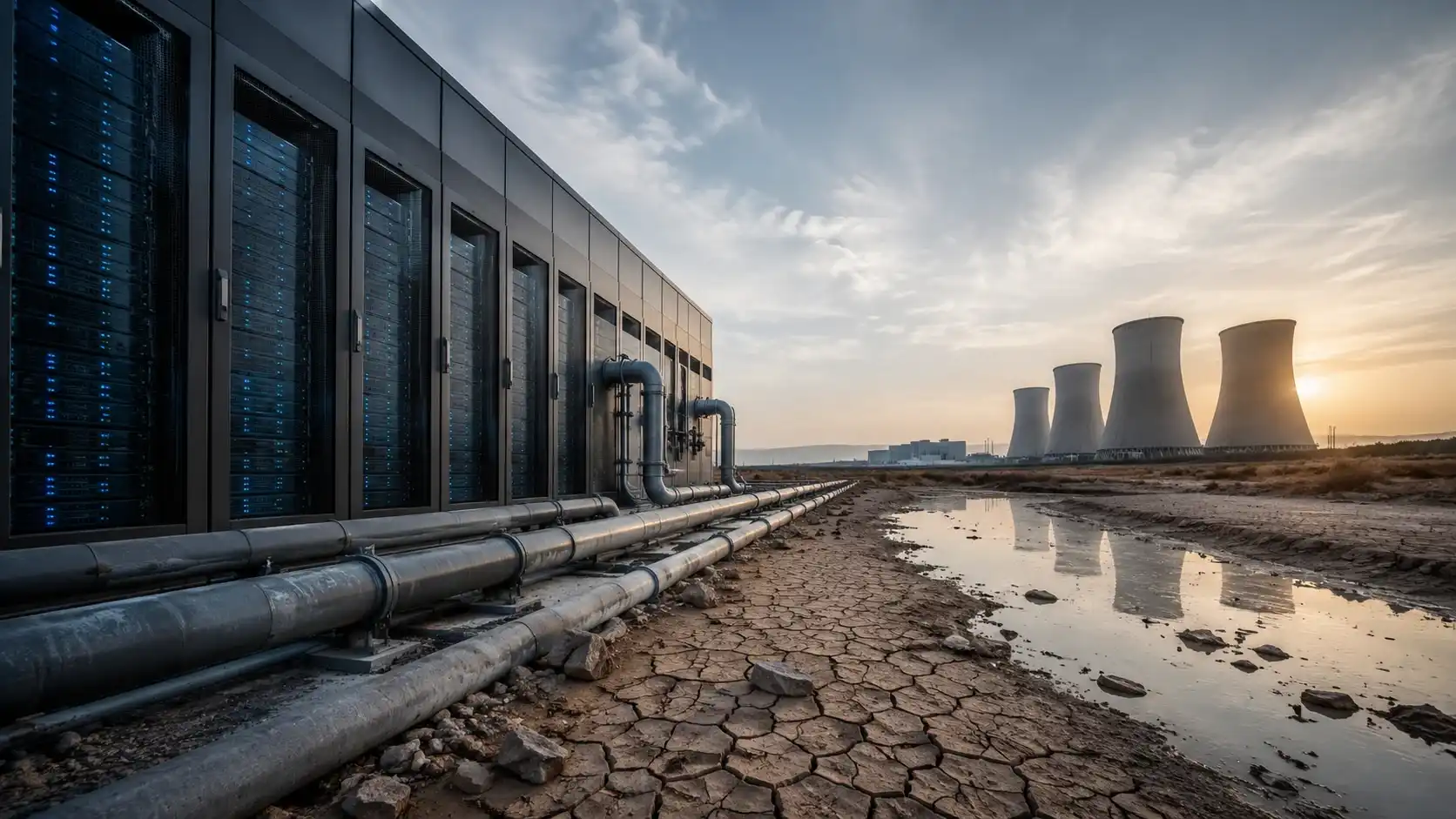
“Water Scarcity: The Hidden Vulnerability of AI Infrastructure” In June 2026, SpaceX revised its IPO prospectus to highlight a core resource constraint alongside power and processors: water. This move signals a pivotal shift where water scarcity has transformed from an operational cost to a major, uncontrollable investment risk, directly threatening AI data center expansion. The scale of the problem is immense. U.S. data centers consumed an estimated 17 billion gallons of water for direct cooling in 2023, with indirect water use for power generation exceeding 211 billion gallons. Giants like Google alone use billions of gallons annually, with single sites consuming volumes equivalent to a medium-sized city. This water is largely “consumptive,” evaporated into the atmosphere and lost. This massive demand is colliding with scarcity. Tech companies are building “water tigers” in arid regions, sparking community protests in places like Mexico and Arizona, where data centers can legally use millions of gallons daily—enough for tens of thousands of residents. These conflicts are not about illegality, but about a mismatch between historic water allocation frameworks and new, colossal demand. The consequences are real. Community opposition, largely centered on water, has reportedly stalled or canceled $64 billion in U.S. data center projects over two years. Simultaneously, investors are pressuring companies for greater water footprint transparency, viewing it as a financial risk, not just an ESG metric. Technological solutions like air or liquid cooling involve trade-offs between water and electricity use, with final choices dictated by local constraints. The irony is stark: while industry leaders envision AI as a utility “like water,” its physical infrastructure is straining real-world water supplies. The race for AI supremacy may ultimately be governed not by the fastest chip, but by the slowest water meter.

marsbit20 小時前

"Water Scarcity": The Hidden Fatal Flaw of AI Infrastructure

marsbit20 小時前

The Hottest 00s Generation on Wall Street

"Wall Street's Hottest '00s Phenom: The 25-Year-Old Fund Manager Who Bet on AI's 'Boring' Backbone" At just 25, Leopold Aschenbrenner, once fired by OpenAI, now runs a hedge fund worth $13.7 billion. His strategy? Betting against the consensus. While others chased AI chips, he invested early in the physical infrastructure powering the AI boom: electricity, data centers, and energy. Expelled from OpenAI's safety team in 2024, Aschenbrenner foresaw the coming bottleneck. He argued that AI progress would be limited not by algorithms, but by power, chip capacity, and space. Acting on this, he founded Situational Awareness LP to go long on these "old economy" assets. His bets have paid off spectacularly. His fund's assets soared from $255 million in late 2024 to $13.7 billion by Q1 2026. His portfolio is a direct reflection of his thesis: major long positions in fuel cell company Bloom Energy and data center/bitcoin mining firms like CleanSpark and Riot Platforms, which control critical land and power resources. Conversely, he holds massive put options against overheated semiconductor giants like NVIDIA and AMD. A notable exception was his bullish bet on storage company SanDisk, which surged ~160% in Q2. Aschenbrenner's vision is materializing. Tech giants like Amazon, Alphabet, and Meta are ramping up colossal capital expenditure on data centers. Global data center power consumption is projected to skyrocket, with AI accounting for over half by 2030. The demand for enabling technologies like optical fiber and modules is also exploding. His story underscores a fundamental truth of the AI era: the ethereal intelligence of algorithms rests on a very physical, heavy, and power-hungry foundation. The future is being built not just in code, but in concrete, copper, and kilowatts.

marsbit前天 07:54

The Hottest 00s Generation on Wall Street

marsbit前天 07:54

$700 Billion Poured into AI, Americans Taste the Bitter Fruit of Inflation First

A Federal Reserve analysis from the St. Louis Fed argues that AI optimism itself is a driver of inflation. The "news shock" of AI's revolutionary potential causes households and businesses to increase spending and investment in anticipation of future gains, pushing demand beyond current supply and creating inflationary pressure. This is supported by a Deutsche Bank experiment where AI models (dbLumina, Claude, ChatGPT-5.2) assessed a 20-40% probability that AI would raise inflation in the next year, citing surging demand for data centers, semiconductors, and electricity. They saw only a 5% chance of AI significantly reducing inflation. Massive capital expenditure underscores this demand. Amazon, Microsoft, Google, and Meta are projected to spend a combined ~$663B in 2026, a fourfold increase in four years. A significant portion funds power-hungry data centers. For example, OpenAI's "Stargate" project plans a 10-gigawatt capacity, equivalent to the entire electricity load of 16 Vermont states. U.S. data center electricity consumption is forecast to triple by 2030. While AI could eventually boost productivity and be disinflationary long-term, current data shows no such productivity jump. The U.S. economy now faces a cycle: massive AI investment fuels inflation, delays interest rate cuts, raises financing costs—yet the investment continues to accelerate. The outcome hinges on whether these AI models will ultimately make the economy more efficient, a question that remains unanswered.

marsbit04/02 11:03

$700 Billion Poured into AI, Americans Taste the Bitter Fruit of Inflation First

marsbit04/02 11:03

From Power to Chips: How Ordinary People Can Participate in the Wealth Opportunities of the AI Era

From Power to Chips: How Ordinary People Can Participate in the Wealth Opportunities of the AI Era This article analyzes the AI industry through a five-layer "AI stack" framework: energy, chips, cloud infrastructure, models, and applications. It argues that while public attention focuses on the top application layer (e.g., ChatGPT), the vast majority of capital investment and profits are currently concentrated in the underlying infrastructure layers. Key points include: - An estimated $700 billion in annual capital expenditure is flowing into AI infrastructure (energy, chips, data centers), not applications. - Infrastructure companies (Nvidia, TSMC, ASML) show massive profits and near-monopolies, while model companies (OpenAI, Anthropic) experience rapid revenue growth but burn enormous cash due to compute costs. - Historical parallels are drawn to the electricity revolution and internet infrastructure boom, where infrastructure builders captured most early value. - The article advises investors to focus on infrastructure layers currently generating concentrated profits, while acknowledging future value may shift to applications as the market matures. - Risks include capital misallocation, supply chain concentration, and efficiency breakthroughs (like DeepSeek's lower-cost models) that could disrupt current assumptions. The conclusion emphasizes understanding this layered structure, tracking capital flow, and participating at appropriate levels based on risk tolerance and expertise.

marsbit03/16 08:17

From Power to Chips: How Ordinary People Can Participate in the Wealth Opportunities of the AI Era

marsbit03/16 08:17

Strongest Earnings Report in 15 Years Fails to Mask Trillion-Dollar Debt; Oracle Rumored to Lay Off 30,000 in 'AI Replacement' Move—Can It Fill the Computing Power Pit?

Oracle reported its strongest financial results in 15 years, with Q3 revenue reaching $17.2 billion, a 22% year-over-year increase, and cloud revenue surging 44%. The company's remaining performance obligations (RPO) grew 325% to $553 billion. Despite these gains, Oracle faces significant financial challenges, including negative free cash flow of -$13.18 billion over the past 12 months and total debt exceeding $100 billion, with an additional $248 billion in off-balance-sheet lease commitments. To fund its aggressive data center expansion—with capital expenditures projected to reach $50 billion this year—Oracle is reportedly planning to lay off up to 30,000 employees. Analysts estimate these cuts could save the company $8–10 billion in free cash flow. The shift toward an asset-light “AI infrastructure management” model, where clients prepay or supply their own GPUs, reduces balance sheet pressure but also transforms Oracle into a lower-margin service operator. Competitive pressures are mounting: key clients like OpenAI have canceled expansion plans due to rapid chip obsolescence, as NVIDIA’s new Vera Rubin chips offer significantly better performance. This reflects a broader industry trend where tech giants are cutting jobs to fund AI investments, transferring the cost of technological advancement onto their workforce.

marsbit03/11 05:57

Strongest Earnings Report in 15 Years Fails to Mask Trillion-Dollar Debt; Oracle Rumored to Lay Off 30,000 in 'AI Replacement' Move—Can It Fill the Computing Power Pit?

marsbit03/11 05:57

活动图片