Strongest Earnings Report in 15 Years Fails to Mask Trillion-Dollar Debt; Oracle Rumored to Lay Off 30,000 in 'AI Replacement' Move—Can It Fill the Computing Power Pit?

marsbit發佈於 2026-03-11更新於 2026-03-11

文章摘要

Oracle reported its strongest financial results in 15 years, with Q3 revenue reaching $17.2 billion, a 22% year-over-year increase, and cloud revenue surging 44%. The company's remaining performance obligations (RPO) grew 325% to $553 billion. Despite these gains, Oracle faces significant financial challenges, including negative free cash flow of -$13.18 billion over the past 12 months and total debt exceeding $100 billion, with an additional $248 billion in off-balance-sheet lease commitments. To fund its aggressive data center expansion—with capital expenditures projected to reach $50 billion this year—Oracle is reportedly planning to lay off up to 30,000 employees. Analysts estimate these cuts could save the company $8–10 billion in free cash flow. The shift toward an asset-light “AI infrastructure management” model, where clients prepay or supply their own GPUs, reduces balance sheet pressure but also transforms Oracle into a lower-margin service operator. Competitive pressures are mounting: key clients like OpenAI have canceled expansion plans due to rapid chip obsolescence, as NVIDIA’s new Vera Rubin chips offer significantly better performance. This reflects a broader industry trend where tech giants are cutting jobs to fund AI investments, transferring the cost of technological advancement onto their workforce.

Author: C Labs Crypto Watch

Today (March 10), Oracle released an earnings report that drew applause from Wall Street.
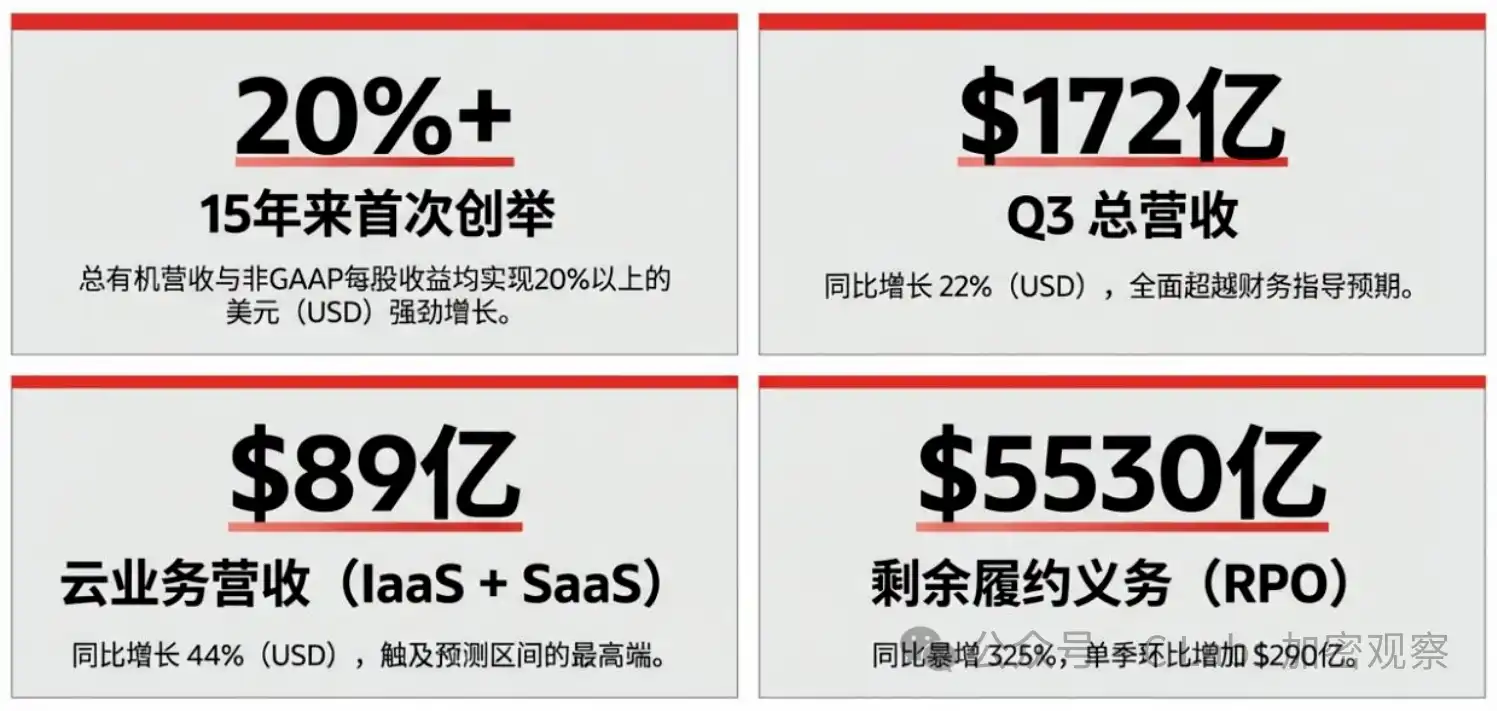
Total revenue reached $17.2 billion, a 22% year-over-year increase. Cloud business grew by 44%. The remaining performance obligation (RPO) surged to $553 billion, up 325% year-over-year. Oracle claimed this was the first time in 15 years that both revenue and profit achieved over 20% growth simultaneously. The stock price rose over 10% in after-hours trading.
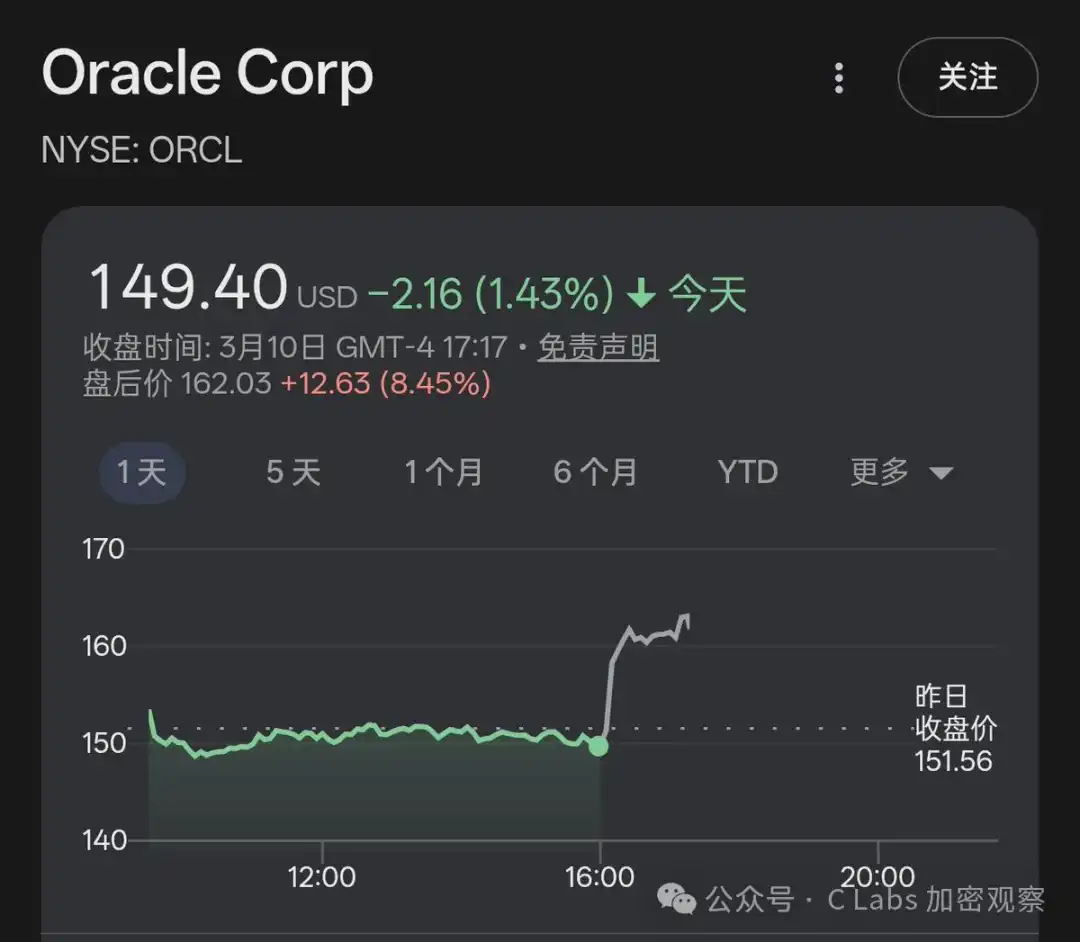
But in the same week, other news was also circulating:

  • Several banks are quietly withdrawing from Oracle's data center projects;

  • A private credit institution refused to finance Oracle's $10 billion data center;

  • Oracle is preparing to lay off tens of thousands of employees.

These two sets of news come from the same company and occurred during the same period.

01. Oracle's Financial Problems
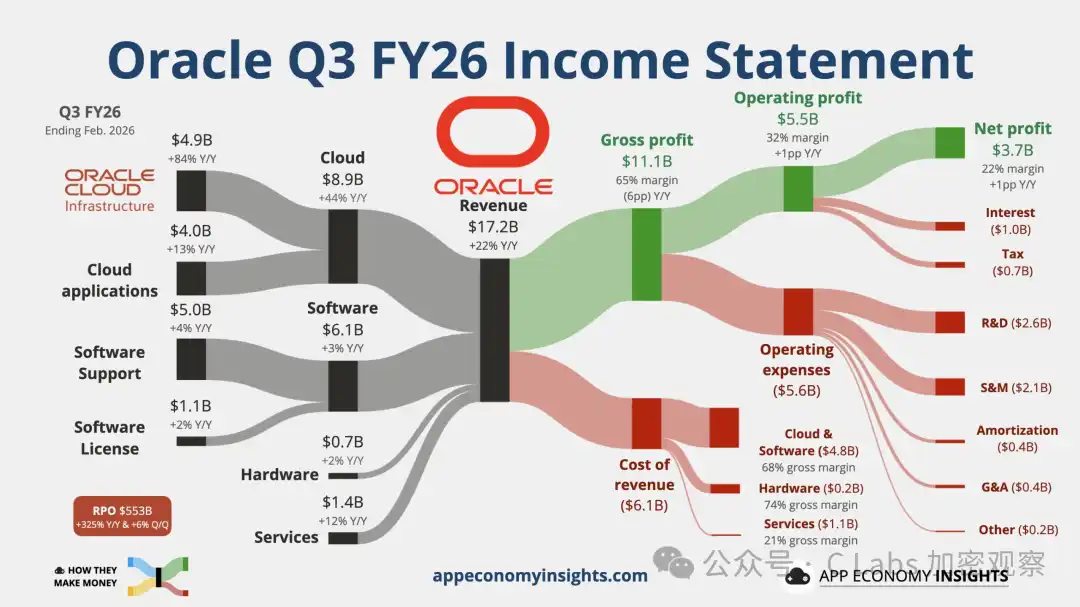
First, free cash flow is negative, and significantly so

Over the past 12 months, Oracle's free cash flow was negative $13.18 billion. Operating cash flow was positive at $23.5 billion, but capital expenditures consumed even more—the full-year capital expenditure guidance for this year is $50 billion, more than seven times that of two years ago. Revenue is growing, but so is accelerating.

Second, debt continues to expand

This quarter, Oracle raised an additional $30 billion through investment-grade bonds and convertible preferred stock, bringing total debt to over $100 billion. Hidden in the footnotes of the earnings report is an even larger number: $248 billion in off-balance-sheet lease commitments. This means Oracle currently owes over $100 billion in loans and has signed long-term leases totaling $248 billion over more than a decade—this money hasn't been paid yet, but it's already owed.
Oracle promised during the earnings call not to issue new debt in the 2026 calendar year. Publicly committing to "not borrowing new money this year"—this speaks volumes: creditors are becoming uneasy, and Oracle had to step in to reassure them.

Third, data centers become obsolete as soon as they're built!

The $553 billion RPO is the most attractive number in the entire earnings report, up 325% year-over-year. But Oracle explained the source of these contracts during the call: most of the equipment is either prepaid by customers or brought by customers themselves for Oracle to operate.
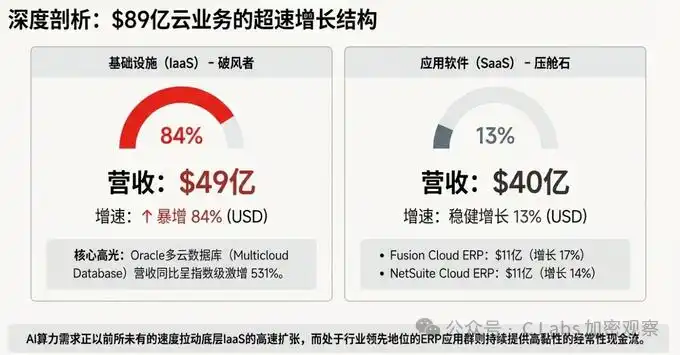
In plain terms: Oracle is increasingly playing the role of an "operator" rather than using its own money to build data centers and then leasing them out. This shift in business model reduces balance sheet pressure but also means Oracle is no longer a capital-intensive, high-margin computing power landlord; instead, it has become a computing power property management company. It's akin to the digital center version of "Wanda Commercial Management." Meanwhile, Oracle's largest customer, OpenAI, has canceled the expansion contract for its Texas data center.
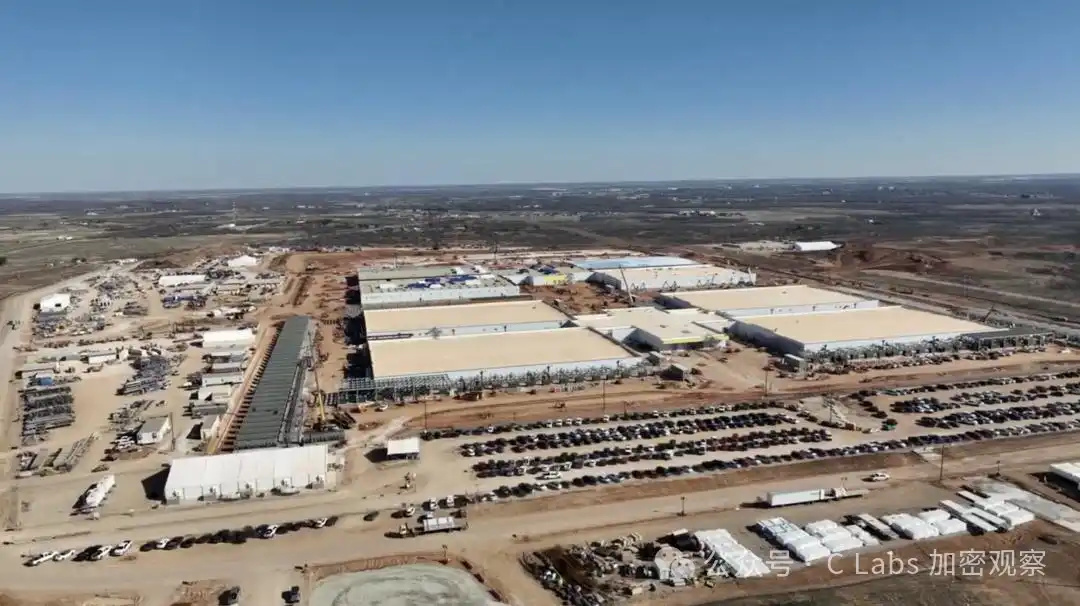
The reason is that Oracle's data centers are equipped with Blackwell chips, while Nvidia's next-generation Vera Rubin offers five times the inference performance of Blackwell. OpenAI doesn't want to be tied to an infrastructure that is about to become outdated. Data center construction cycles take 12 to 24 months, but chip update cycles have been compressed to 12 months by Jensen Huang—building a data center only for it to become obsolete upon completion is a contradiction with no simple solution. This is a significant pitfall for Oracle, which focuses on data center business but does not control chip production.

02. "Replacing Humans with AI": Oracle's Financial Self-Rescue Strategy

How to fill the financial gap? Oracle has found a politically correct answer for the current times: layoffs, justified by AI replacement.

Oracle currently has about 162,000 employees. A TD Cowen research report estimates that Oracle will lay off 30,000 employees, which could free up $8 to $10 billion in free cash flow for Oracle—specifically to fill the funding gap caused by data center expansion.

The logic is very clear: lay off workers and use the saved money to build data centers that run AI.

03. Tech Giants Rushing to Emulate Layoffs

Oracle is not an isolated case. Any tech company that has over-invested in the AI arms race and is under cash flow pressure faces the same bill. "Replacing humans with AI" provides a financially reasonable, narratively legitimate, and shareholder-acceptable way out.

Currently, North American giants like Amazon and Meta are adopting this strategy, and the capital market has welcomed it.

The bill for the AI arms race ultimately has to be paid by someone.

It's just that, once again, it's the employees who are footing the bill.

Related reading: Block Lays Off Nearly Half, Soars 24%! CEO: AI Improves Efficiency, Most Companies Will Make Similar Adjustments in the Next Year


相關問答

QWhat were the key financial highlights from Oracle's recent earnings report?

AOracle reported total revenue of $17.2 billion, a 22% year-over-year increase. Its cloud business grew by 44%, and its Remaining Performance Obligations (RPO) surged 325% to $553 billion. The company stated it was the first time in 15 years that both revenue and profit grew by over 20% simultaneously, leading to a more than 10% increase in its stock price after hours.

QWhat major financial challenges does Oracle face despite its strong revenue growth?

AOracle faces significant financial challenges, including negative free cash flow of -$13.18 billion over the past 12 months. Its total debt has exceeded $100 billion, and it has an additional $248 billion in off-balance-sheet lease commitments. Capital expenditures are projected to be $50 billion for the year, which is seven times higher than two years ago.

QWhat is the reported reason behind Oracle's potential plan to lay off 30,000 employees?

AAccording to a TD Cowen research report, Oracle plans to lay off approximately 30,000 employees to free up $8 to $10 billion in free cash flow. This financial strategy, framed as 'AI replacement,' aims to cover the funding gap created by the massive expansion of its data centers.

QHow is Oracle's business model for its data centers changing, as mentioned in the article?

AOracle's business model is shifting from building and renting out its own data centers to acting more as a 'operator' or 'property management' company for compute power. A significant portion of its $553 billion RPO comes from contracts where equipment is either pre-paid by customers or where customers provide their own GPUs for Oracle to operate, reducing pressure on its balance sheet but also transforming it into a lower-margin service provider.

QWhy did OpenAI cancel its data center expansion contract with Oracle in Texas?

AOpenAI canceled its data center expansion contract with Oracle because the facility was equipped with Blackwell chips. Nvidia's next-generation Vera Rubin chips, which offer five times the inference performance of Blackwell, made OpenAI reluctant to be locked into an infrastructure that would soon become outdated, highlighting the rapid pace of chip innovation in the AI industry.

你可能也喜歡

BingX为VIP用户推出行业首创的期货资产自动赚币功能

全球领先的加密货币交易所和Web3-AI公司BingX,于今日(2026年6月12日)正式推出了行业首创的“期货资产自动赚息”活动,该服务专为其VIP3及以上等级的用户设计。 此项目允许符合条件的交易者在进行USDT-M永续合约交易的同时,零摩擦、零影响交易地赚取被动收益,用户仅需一键激活即可参与。活动时间为2026年6月12日至8月12日。 该机制的核心优势在于,它能将闲置的合约保证金转化为每日利息收入,而用户无需锁定资金、改变交易策略或牺牲市场机会。主要特点包括: * **一键激活**:用户在活动页面点击“激活赚息”即可开始累积利息,无需复杂设置。 * **每日结算**:利息每日(UTC+8)03:00计算,并于次日08:00(UTC+8)自动发放至用户的USDT-M永续合约账户。 * **无锁定期**:符合条件的仓位始终保持完全可交易状态,且平仓不影响已结算的收益。 * **VIP分级奖励**:更高的VIP等级可获得更具吸引力的利率,最高可达4%,以此奖励用户的积极参与和长期投入。 此举进一步丰富了BingX VIP的特权体系,旨在通过行业领先的创新,帮助其核心交易社区最大化资金回报。BingX成立于2018年,是全球前五大加密衍生品交易所之一,也是加密跟单交易的先驱,目前为全球超过4000万用户提供服务。自2024年起成为切尔西足球俱乐部的主要合作伙伴,并于2026年成为Scuderia Ferrari HP的首个官方加密交易所合作伙伴。

TheNewsCrypto1 小時前

BingX为VIP用户推出行业首创的期货资产自动赚币功能

TheNewsCrypto1 小時前

不是黄仁勋要改变PC,而是PC要革自己的命

英伟达在GTC Taipei 2026上发布了面向Windows PC的全新超级芯片RTX Spark,正式进军PC核心处理器市场,并获得微软及宏碁、华硕、戴尔等主流PC厂商支持。微软在Build 2026大会上将Windows重新定义为“本地AI Agent的原生运行平台”,并推出搭载RTX Spark的Surface工作站。黄仁勋指出,AI正在重塑PC,使其从个人电脑转变为具备独立AI代理能力的“个人AI”助手。 AI PC概念虽由英特尔较早提出,但英伟达的强势入局改变了竞争态势。同时,高通、AMD、苹果等厂商也积极布局,推动AI算力向个人设备迁移。PC产业正经历从“CPU中心化”到“AI SoC中心化”的深层变革。英伟达通过集成CPU、GPU、统一内存和CUDA生态,以“平台思维”争夺硬件与生态主导权。 此次变革的核心在于,PC正从被动工具转向人与AI智能体协同工作的平台。英伟达拥有600万CUDA开发者生态,通过RTX Spark将其延伸至终端,构建从云到端的闭环。然而,新平台的普及仍受定价、Windows on ARM软件生态及杀手级应用等因素制约。 本质上,这场变革是AI技术发展的必然趋势。英特尔也推出了AI算力达180TOPS的Panther Lake处理器,顺应同一方向。各厂商的角逐关键在于谁能更快识别趋势、坚决变革。随着英伟达入局,AI PC新时代已开启,PC产业正在被重新定义。

marsbit1 小時前

不是黄仁勋要改变PC,而是PC要革自己的命

marsbit1 小時前

美 SEC 想拆掉一条 2005 年旧规,代币化股票看到了什么

美国证券交易委员会(SEC)近日提出一项拟议规则,计划撤销《国家市场体系条例》(Regulation NMS)中的第611条规则和第610(e)条规则。第611条规则(即“穿价成交规则”)旨在防止交易绕过市场上最优的报价成交;第610(e)条规则则限制“锁定报价”(买价等于另一场所卖价)和“交叉报价”(买价高于卖价)。 SEC认为,这些制定于2005年的规则已不适应如今高度自动化、互联且快速的市场环境。它们增加了市场参与者的合规成本和系统复杂性,并可能加剧交易碎片化。撤销这些规则可为交易场所、经纪商和另类交易系统(ATS)在订单路由、报价展示和交易机制上提供更大的灵活性与创新空间。 这项改革提案引起了Web3领域的关注,因为SEC在背景说明中特别提到了分布式账本技术、证券代币化以及智能合约和自动做市商(AMM)带来的新型交易方式。市场分析人士指出,此举可能为“代币化股票”的发展扫除部分结构性障碍。传统美股市场基于中心化协调和报价保护体系,而链上交易则倾向于全天候运行、智能合约撮合和跨场所流动性。现有规则可能限制了新型交易机制的设计空间。 SEC估计,撤销这两条规则后,市场参与者每年可节省约5420万至7700万美元的成本。提案目前处于公众意见征求阶段,最终能否实施尚不确定。即便规则撤销,代币化证券仍面临发行注册、托管、清算、股东权利等多重监管挑战。然而,这标志着SEC开始审视传统市场规则是否契合当前技术条件,为金融创新提供了可能的试验窗口。

Foresight News3 小時前

美 SEC 想拆掉一条 2005 年旧规,代币化股票看到了什么

Foresight News3 小時前

Ethena 的转型与华尔街的焦虑

2026年6月9日,稳定币协议Ethena宣布与全球资管巨头Janus Henderson达成深度战略合作,标志着其从DeFi原生协议正式迈入传统金融核心。Ethena将使用Janus Henderson的AAA级CLO基金作为其稳定币USDe的储备资产,而Janus Henderson则通过旗下平台收购ENA代币、将USDe纳入自身财库管理,并计划开发相关的交易所交易产品(ETP)向机构客户分销。 Ethena最初以Delta中性策略稳定币USDe闻名,其收益率高度依赖衍生品市场资金费率,在牛市中迅速扩张,但在市场转熊时暴露出脆弱性。经历2025年危机后,Ethena积极转型,大幅降低衍生品头寸占比,将储备资产扩展至包括国债、企业信贷和CLO在内的多种传统资产,使USDe转变为一种混合RWA抵押的稳定币。 此次合作展现了传统金融机构的深层焦虑。随着美国《GENIUS法案》等监管框架的明确,稳定币竞争转向合规与分发网络建设。传统资管机构面临“代币化或被代币化”的战略压力、收益率压力以及对未来资金入口控制权的担忧。Janus Henderson通过合作嵌入稳定币生态,旨在确保其在下一代金融基础设施中的地位。 这一案例揭示了传统金融与去中心化金融边界正在消融的趋势,稳定币成为双方融合的核心战场。双方通过资产互通、战略投资、财库管理和产品分销的四重合作,共同探索新的金融范式。

Foresight News3 小時前

Ethena 的转型与华尔街的焦虑

Foresight News3 小時前

交易

現貨
合約

熱門文章

如何購買MOVE

歡迎來到HTX.com!在這裡,購買Movement (MOVE)變得簡單而便捷。跟隨我們的逐步指南,放心開始您的加密貨幣之旅。第一步:創建您的HTX帳戶使用您的 Email、手機號碼在HTX註冊一個免費帳戶。體驗無憂的註冊過程並解鎖所有平台功能。立即註冊第二步:前往買幣頁面,選擇您的支付方式信用卡/金融卡購買:使用您的Visa或Mastercard即時購買Movement (MOVE)。餘額購買:使用您HTX帳戶餘額中的資金進行無縫交易。第三方購買:探索諸如Google Pay或Apple Pay等流行支付方式以增加便利性。C2C購買:在HTX平台上直接與其他用戶交易。HTX 場外交易 (OTC) 購買:為大量交易者提供個性化服務和競爭性匯率。第三步:存儲您的Movement (MOVE)購買Movement (MOVE)後,將其存儲在您的HTX帳戶中。您也可以透過區塊鏈轉帳將其發送到其他地址或者用於交易其他加密貨幣。第四步:交易Movement (MOVE)在HTX的現貨市場輕鬆交易Movement (MOVE)。前往您的帳戶,選擇交易對,執行交易,並即時監控。HTX為初學者和經驗豐富的交易者提供了友好的用戶體驗。

623 人學過發佈於 2024.12.13更新於 2026.06.02

如何購買MOVE

相關討論

歡迎來到 HTX 社群。在這裡,您可以了解最新的平台發展動態並獲得專業的市場意見。 以下是用戶對 MOVE (MOVE)幣價的意見。

活动图片












