AI, Why Does It Also Need to Sleep?

marsbit發佈於 2026-04-07更新於 2026-04-07

文章摘要

Anthropic's accidental leak of Claude Code's source code in 2026 revealed an experimental feature called "autoDream," part of the KAIROS system, which gives AI a sleep-like cycle. Unlike the prevailing AI agent paradigm of continuous, uninterrupted operation, autoDream operates offline when users are inactive. It processes and consolidates daily logs—resolving contradictions, converting vague observations into facts, and discarding redundant information—while avoiding the accumulation of noise in the limited context window, a phenomenon known as "context corruption." This mirrors human brain function: the hippocampus temporarily stores daily experiences, and during rest, the brain prioritizes and transfers important memories to the neocortex through processes like active systems consolidation. Both systems must go offline to perform memory maintenance, as simultaneous processing and consolidation compete for resources. autoDream differs in one key aspect: it labels its outputs as "hints" rather than definitive truths, requiring verification upon use—a cautious approach unlike human memory, which often constructs narratives with high confidence. The emergence of this sleep-like mechanism suggests that, beyond mere biological imitation, intelligent systems may inherently require periodic rest to maintain coherence and performance. It challenges the assumption that more power and continuous operation always lead to greater intelligence, pointing instead to the necessity of rh...

Written by: Tang Yitao

Edited by: Jing Yu

Source: GeekPark

On March 31, 2026, Anthropic accidentally leaked 510,000 lines of Claude Code's source code to the public npm registry due to a packaging error. The code was mirrored to GitHub within hours and could not be retrieved.

A lot of content was leaked, and security researchers and competitors took what they needed. But among all the unreleased features, one name sparked widespread discussion—autoDream, automatic dreaming.

autoDream is part of a background resident system called KAIROS (Ancient Greek for "the right moment").

KAIROS continuously observes and records while the user is working, maintaining a daily log (somewhat like a lobster). autoDream, on the other hand, only starts after the user turns off the computer, organizing the memories accumulated during the day, resolving contradictions, and converting vague observations into confirmed facts.

The two form a complete cycle: KAIROS is awake, autoDream is asleep—Anthropic's engineers have created a sleep-wake cycle for AI.

Over the past two years, the hottest narrative in the AI industry has been Agent: autonomous operation, never stopping, which is seen as AI's core advantage over humans.

But the company that has pushed Agent capabilities the deepest has precisely set rest times for AI in its own code.

Why?

The Cost of Never Stopping

An AI that never stops will hit a wall.

Every large language model has a "context window," a physical upper bound on the total amount of information it can process at any one moment. As an Agent runs continuously, project history, user preferences, and conversation records keep piling up. After exceeding a critical point, the model begins to forget early instructions, becomes inconsistent, and fabricates facts.

The tech community calls this "context corruption."

Many Agents adopt a crude coping strategy: shove all the history into the context window and hope the model can prioritize on its own. The result is that the more information there is, the worse the performance becomes.

The human brain hits the same wall.

Everything experienced during the day is quickly written into the "hippocampus." This is a temporary storage area with limited capacity, more like a whiteboard. True long-term memories are stored in the "neocortex," which has large capacity but is slow to write to.

A core task of human sleep is to empty this overloaded whiteboard, moving useful information to the hard drive.

The laboratory of Björn Rasch at the Neuroscience Center of the University of Zurich, Switzerland, named this process "active systems consolidation."

Continuous sleep deprivation experiments repeatedly prove: a brain that never shuts down does not become more efficient; memory fails first, followed by attention, and finally even basic judgment collapses.

Natural selection is extremely cruel to inefficient behaviors, but sleep has not been eliminated. From fruit flies to whales, almost all animals with a nervous system sleep. Dolphins evolved "unihemispheric sleep," where the two brain hemispheres rest alternately—it would rather invent a whole new way of sleeping than give up sleep itself.
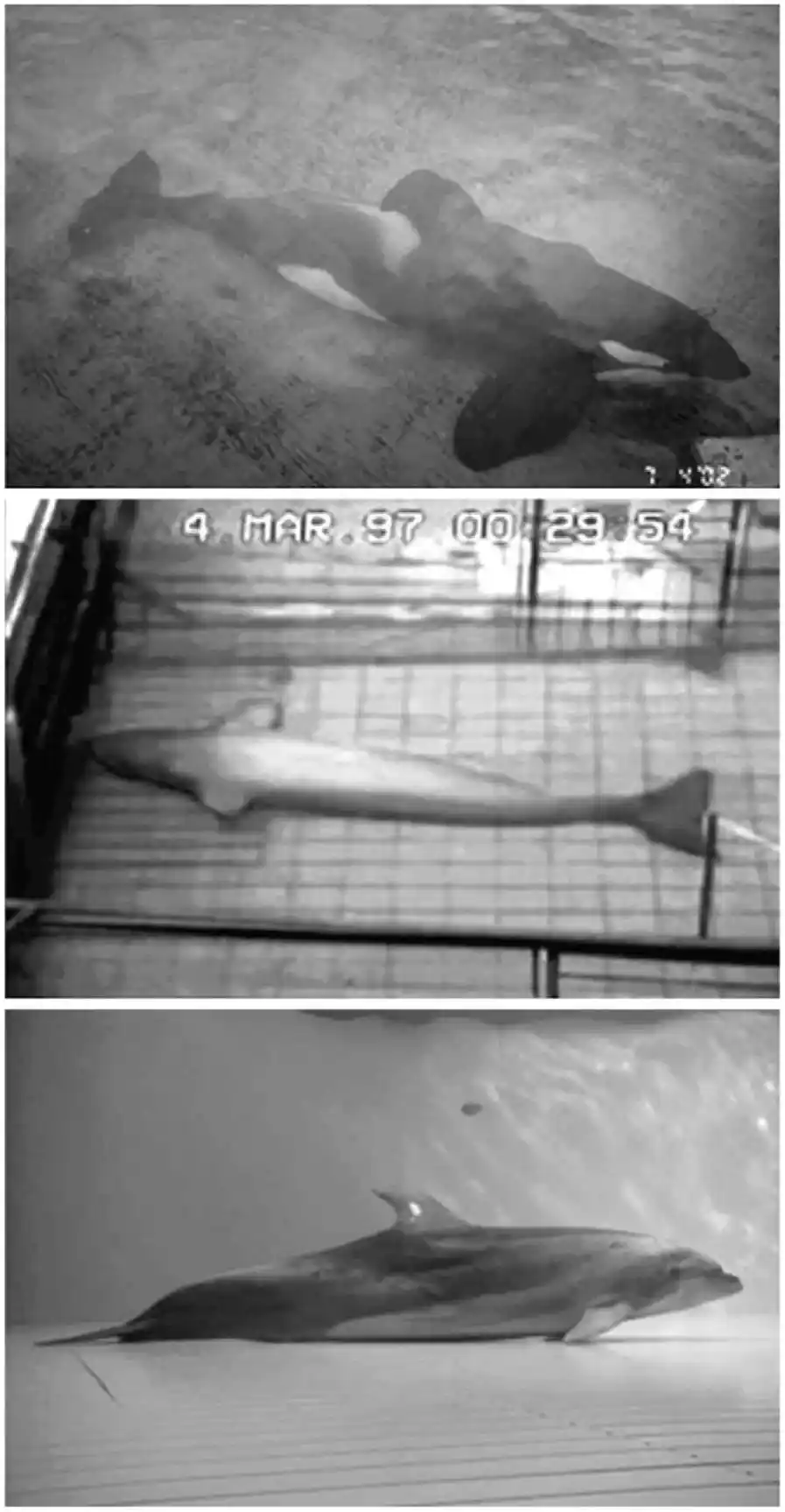
Killer whales, belugas, and bottlenose dolphins resting at the bottom of a pool | Image source: National Library of Medicine (United States)

The two systems face the same set of constraints: instant processing power is limited, but historical experience expands infinitely.

Two Answers

In biology, there is a concept called convergent evolution: species that are distantly related, because they face similar environmental pressures, independently evolve similar solutions. The classic example is the eye.

Both octopuses and humans have camera-like eyes: a adjustable lens focuses light onto a retina, and an iris controls the amount of light entering. The overall structure is almost identical.
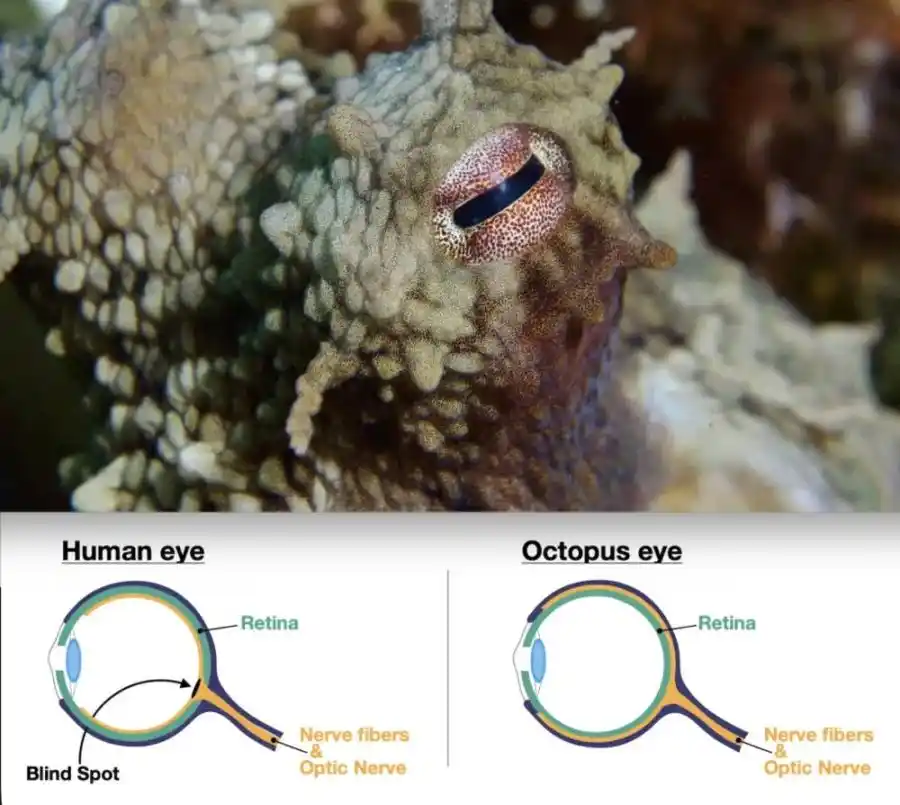
Comparison of octopus and human eye structure | Image source: OctoNation

But octopuses are mollusks, and humans are vertebrates. Their common ancestor lived over 500 million years ago, a time when there were no complex visual organs on Earth. Two completely independent evolutionary paths arrived at almost the same endpoint. Because to efficiently convert light into a clear image, the path allowed by physical laws is almost only the camera type: a lens that can focus, a light-sensitive surface to capture the image, and an aperture to regulate light intake—all indispensable.

The relationship between autoDream and human brain sleep might be of this kind—under similar constraints, the two types of systems may converge to similar structures.

The necessity to go offline is one of their most similar common points.

autoDream cannot run while the user is working. It starts independently as a forked subprocess, completely isolated from the main thread, with strictly limited tool permissions.

The human brain faces the same problem and offers a more radical solution: moving memories from the hippocampus (temporary storage) to the neocortex (long-term storage) requires a set of brainwave rhythms that only appear during sleep.

The most critical among these are the hippocampal sharp-wave ripples, responsible for packaging the day's encoded memory fragments and sending them piece by piece to the cerebral cortex; the slow oscillations of the cortex and the spindle waves from the thalamus provide precise timing coordination for the entire process.

This set of rhythms cannot form in a waking state; external stimuli disrupt it. So you don't sleep because you are tired; rather, the brain must close the front door to open the back door.

Or put another way, within the same time window, information intake and structural organization compete for resources; they are not complementary.
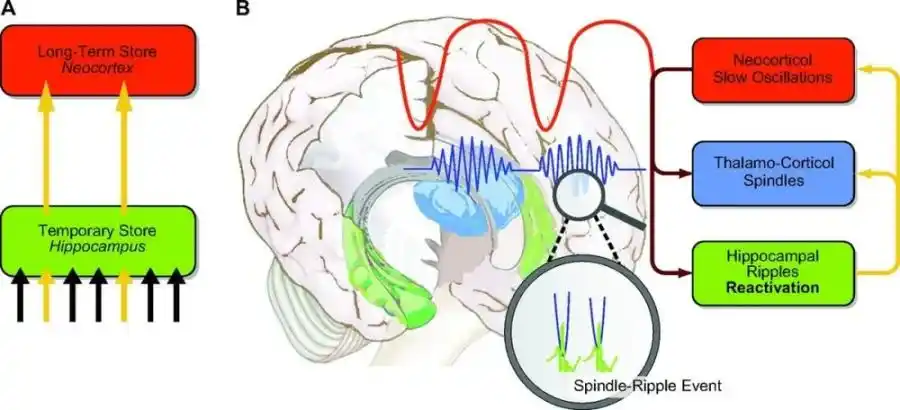
Active systems consolidation model during sleep. A (Data Migration): During deep sleep (slow-wave sleep), memories recently written to the 'hippocampus' (temporary storage) are repeatedly replayed, gradually transferred, and consolidated into the 'neocortex' (long-term storage). B (Transmission Protocol): This data transfer process relies on highly synchronized 'dialogue' between the two regions. The cerebral cortex emits slow brainwaves (red line) as the master rhythm. Driven by the wave peaks, the hippocampus packages memory fragments into high-frequency signals (green line, sharp-wave ripples), perfectly synchronized with the carrier waves (blue line, spindle waves) emitted by the thalamus. This is like embedding high-frequency memory data precisely into the gaps of the transmission channel, ensuring information is synchronously uploaded to the cerebral cortex. | Image source: National Library of Medicine (United States)

Another similarity is not making full memories, but editing them.

After starting, autoDream does not keep all logs. It first reads existing memories to confirm known information, then scans KAIROS's daily log, focusing on processing parts that deviate from previous cognition: memories that contradict what was said yesterday, or are more complex than previously thought, are prioritized for recording.

The organized memories are stored in a three-layer index: a lightweight pointer layer is always loaded, topic files are loaded on demand, and the full history is never loaded directly. Facts that can be directly looked up from the project code (like which file a function is defined in) are not written into memory at all.

The human brain does almost the same thing during sleep.

A study by Harvard Medical School lecturer Erin J. Wamsley showed that sleep preferentially consolidates unusual information, such as things that surprised you, caused emotional波动, or are related to unsolved problems. Large amounts of repetitive, featureless daily details are discarded, leaving only abstract patterns—you might not remember exactly what you saw on your way to work yesterday, but you clearly remember how to get there.

Interestingly, there is one point where the two systems made different choices. The memories produced by autoDream are explicitly labeled as "hint" rather than "truth" in the code. The agent must re-verify their validity before each use because it knows its organized content might be inaccurate.

The human brain lacks this mechanism. This is why eyewitnesses in court often give wrong testimony. They are not intentionally lying; it's because memory is temporarily pieced together from scattered fragments in the brain, and errors are the norm.

Evolution probably found no need to install an uncertainty tag for the human brain. In a primitive environment requiring quick physical reactions, believing memory enables immediate action, while doubting memory leads to hesitation—and hesitation means defeat.

But for an AI that repeatedly makes knowledge-based decisions, the cost of verification is low, while blind confidence is dangerous.

Two different contexts lead to two different answers.

Smarter Laziness

In evolutionary biology, convergent evolution means two independent lineages, without directly exchanging information, arrive at the same endpoint. There is no plagiarism in nature, but engineers can read papers.

When Anthropic designed this sleep mechanism, was it because they hit the same physical wall as the human brain, or did they reference neuroscience from the start?

The leaked code contains no citations of neuroscience literature; the name "autoDream" seems more like a programmer's joke. A stronger driver was likely the engineering constraints themselves: the context has a hard limit, long-term operation leads to noise accumulation, and online organization would pollute the main thread's reasoning. They were solving an engineering problem; biomimicry was never the goal.

What truly determined the shape of the answer was the compressive force of the constraints themselves.

Over the past two years, the AI industry's definition of "stronger intelligence" has almost always pointed in the same direction—larger models, longer context, faster reasoning, 7×24 uninterrupted operation. The direction is always "more."

The existence of autoDream suggests a different proposition: a smarter agent might be a lazier one.

An agent that never stops to organize itself will not become smarter; it will only become more chaotic.

The human brain, through hundreds of millions of years of evolution, arrived at a seemingly clumsy conclusion: intelligence must have rhythm. Wakefulness is for perceiving the world; sleep is for understanding it. When an AI company, in solving an engineering problem, independently arrives at the same conclusion, this perhaps hints at something:

Intelligence has some unavoidable basic overhead.

Perhaps, an AI that never sleeps is not a stronger AI. It is merely an AI that has not yet realized it needs to sleep.


相關問答

QWhat is the main reason AI systems like Claude Code might need a 'sleep' mechanism similar to humans?

AAI systems need a 'sleep' mechanism to prevent 'context corruption,' where continuous operation leads to information overload, causing the model to forget early instructions, become inconsistent, and generate false information, due to the physical limits of their context window.

QHow does the human brain's memory consolidation during sleep compare to the AI's autoDream system?

ABoth systems offline to transfer information from temporary storage (human hippocampus or AI's daily logs) to long-term storage (human neocortex or AI's indexed memory), prioritizing unusual or conflicting information for consolidation while discarding redundant details.

QWhat is 'convergent evolution' as mentioned in the article, and how does it relate to AI and human sleep patterns?

AConvergent evolution refers to unrelated species developing similar solutions to similar environmental pressures. Similarly, AI (like Anthropic's autoDream) and human brains independently evolved offline 'sleep' mechanisms to manage limited processing capacity and infinite historical data expansion.

QWhy does the AI's autoDream label its consolidated memories as 'hints' rather than 'truth,' and how the human brain handles memories?

AAI labels memories as 'hints' to enforce verification before use, avoiding overconfidence in potentially inaccurate consolidated data. Human brains lack this mechanism, often leading to false memories, as evolution prioritized quick action over accuracy in primitive environments.

QWhat does the existence of autoDream suggest about the future direction of AI intelligence development?

AIt suggests that smarter AI may not be about continuous operation ('more'), but about rhythmic cycles of activity and rest ('laziness'), emphasizing that intelligence has fundamental overheads like periodic consolidation to avoid chaos and improve understanding.

你可能也喜歡

黄仁勋 2026 GTC Taipei 演讲:AI 代理人时代来临,计算就是收入

在2026年GTC台北大会上,英伟达CEO黄仁勋宣布AI已进入“代理人”时代,AI从生成内容转变为能实际工作的利润与GDP创造者。其核心观点包括: 1. **AI代理人时代到来**:AI的计算模式发生根本改变,以“大语言模型+代理人框架”为核心的全新系统能理解、推理、规划并使用工具完成实际任务,每家公司都将成为运行代理人的公司。 2. **计算即收入**:在此模式下,AI生成的Token(计算单元)直接转化为收入和利润。AI工厂的经济核心是最大化每瓦电力产生的Token(收入),因此基础设施的吞吐量和能效至关重要。 3. **发布Vera Rubin系统**:英伟达推出史上最雄心勃勃的工程——Vera Rubin。它并非单一芯片,而是为运行代理人而设计的端到端完整系统,标志着英伟达从GPU公司、系统公司进一步转型为AI基础设施公司。 4. **推出Vera CPU**:首款专为AI代理人设计的CPU。代理人要求极低延迟和极高响应速度,Vera CPU强调顶级的单线程性能、每时钟指令数(IPC)和系统带宽,以满足代理人“没有耐心”的计算需求。 5. **与微软重新定义PC**:英伟达与微软合作推出新一代Windows PC产品线(桌面、笔记本、工作站),将代理式计算模式延伸至个人设备。新的PC操作系统将是传统系统与大语言模型的结合,应用程序将被“代理人运行时”取代。 6. **布局物理AI**:宣布了用于物理AI和机器人基础模型的Cosmos 3、用于自动驾驶的开放模型Alpamayo 2,以及完整的人形机器人技术栈与参考平台Isaac GR00T。这些系统遵循与云端代理人相同的“模型-框架-工具-运行时”模式。 **总结**:黄仁勋指出,过去六个月计算机行业因“有用AI”的实现而被彻底改变。未来十年,这种代理式计算模式将统一应用于云端、企业、PC、机器人及各类边缘设备。英伟达通过提供从芯片、系统到完整基础设施的全栈解决方案,旨在帮助客户建设高利润的AI工厂。对台湾供应链而言,AI工厂的交付效率、功耗控制及全栈协同能力将成为关键增长动力。

marsbit59 分鐘前

黄仁勋 2026 GTC Taipei 演讲:AI 代理人时代来临,计算就是收入

marsbit59 分鐘前

交易

現貨
合約

熱門文章

什麼是 GROK AI

Grok AI: 在 Web3 時代革命性改變對話技術 介紹 在快速演變的人工智能領域,Grok AI 作為一個值得注意的項目脫穎而出,橋接了先進技術與用戶互動的領域。Grok AI 由 xAI 開發,該公司由著名企業家 Elon Musk 領導,旨在重新定義我們與人工智能的互動方式。隨著 Web3 運動的持續蓬勃發展,Grok AI 旨在利用對話 AI 的力量回答複雜的查詢,為用戶提供不僅具資訊性而且具娛樂性的體驗。 Grok AI 是什麼? Grok AI 是一個複雜的對話 AI 聊天機器人,旨在與用戶進行動態互動。與許多傳統 AI 系統不同,Grok AI 接納更廣泛的查詢,包括那些通常被視為不恰當或超出標準回應的問題。該項目的核心目標包括: 可靠推理:Grok AI 強調常識推理,根據上下文理解提供邏輯答案。 可擴展監督:整合工具協助確保用戶互動既受到監控又優化質量。 正式驗證:安全性至關重要;Grok AI 採用正式驗證方法來增強其輸出的可靠性。 長上下文理解:該 AI 模型在保留和回憶大量對話歷史方面表現出色,促進有意義且具上下文意識的討論。 對抗魯棒性:通過專注於改善其對操控或惡意輸入的防禦,Grok AI 旨在維護用戶互動的完整性。 總之,Grok AI 不僅僅是一個信息檢索設備;它是一個沉浸式的對話夥伴,鼓勵動態對話。 Grok AI 的創建者 Grok AI 的腦力來源無疑是 Elon Musk,這個名字與各個領域的創新息息相關,包括汽車、太空旅行和技術。在專注於以有益方式推進 AI 技術的 xAI 旗下,Musk 的願景旨在重塑對 AI 互動的理解。其領導力和基礎理念深受 Musk 推動技術邊界的承諾影響。 Grok AI 的投資者 雖然有關支持 Grok AI 的投資者的具體細節仍然有限,但公開承認 xAI 作為該項目的孵化器,主要由 Elon Musk 本人創立和支持。Musk 之前的企業和持股為 Grok AI 提供了強有力的支持,進一步增強了其可信度和增長潛力。然而,目前有關支持 Grok AI 的其他投資基金或組織的信息尚不易獲得,這標誌著未來潛在探索的領域。 Grok AI 如何運作? Grok AI 的運作機制與其概念框架一樣創新。該項目整合了幾種尖端技術,以促進其獨特的功能: 強大的基礎設施:Grok AI 使用 Kubernetes 進行容器編排,Rust 提供性能和安全性,JAX 用於高性能數值計算。這三者確保了聊天機器人的高效運行、有效擴展和及時服務用戶。 實時知識訪問:Grok AI 的一個顯著特點是其通過 X 平台(以前稱為 Twitter)訪問實時數據的能力。這一能力使 AI 能夠獲取最新信息,從而提供及時的答案和建議,而其他 AI 模型可能會錯過這些信息。 兩種互動模式:Grok AI 為用戶提供“趣味模式”和“常規模式”之間的選擇。趣味模式允許更具玩樂性和幽默感的互動風格,而常規模式則專注於提供精確和準確的回應。這種多樣性確保了根據不同用戶偏好量身定制的體驗。 總之,Grok AI 將性能與互動相結合,創造出既豐富又娛樂的體驗。 Grok AI 的時間線 Grok AI 的旅程標誌著反映其發展和部署階段的關鍵里程碑: 初始開發:Grok AI 的基礎階段持續了約兩個月,在此期間進行了模型的初步訓練和微調。 Grok-2 Beta 發布:在一個重要的進展中,Grok-2 beta 被宣布。這一版本推出了兩個版本的聊天機器人——Grok-2 和 Grok-2 mini,均具備聊天、編碼和推理的能力。 公眾訪問:在其 beta 開發之後,Grok AI 向 X 平台用戶開放。那些通過手機號碼驗證並活躍至少七天的帳戶可以訪問有限版本,使這項技術能夠接觸到更廣泛的受眾。 這一時間線概括了 Grok AI 從創建到公眾參與的系統性增長,強調其對持續改進和用戶互動的承諾。 Grok AI 的主要特點 Grok AI 包含幾個關鍵特點,促成其創新身份: 實時知識整合:訪問當前和相關信息使 Grok AI 與許多靜態模型區別開來,從而提供引人入勝和準確的用戶體驗。 多樣化的互動風格:通過提供不同的互動模式,Grok AI 滿足各種用戶偏好,邀請創造力和個性化的對話。 先進的技術基礎:利用 Kubernetes、Rust 和 JAX 為該項目提供了堅實的框架,以確保可靠性和最佳性能。 倫理話語考量:包含圖像生成功能展示了該項目的創新精神。然而,它也引發了有關版權和尊重可識別人物描繪的倫理考量——這是 AI 社區內持續討論的議題。 結論 作為對話 AI 領域的先驅,Grok AI 概括了數字時代轉變用戶體驗的潛力。由 xAI 開發,並受到 Elon Musk 願景的驅動,Grok AI 將實時知識與先進的互動能力相結合。它努力推動人工智能能夠達成的界限,同時保持對倫理考量和用戶安全的關注。 Grok AI 不僅體現了技術的進步,還體現了 Web3 環境中新對話範式的出現,承諾以靈活的知識和玩樂的互動吸引用戶。隨著該項目的持續演變,它成為技術、創造力和類人互動交匯處所能實現的見證。

718 人學過發佈於 2024.12.26更新於 2024.12.26

什麼是 GROK AI

什麼是 ERC AI

Euruka Tech:$erc ai 及其在 Web3 中的雄心概述 介紹 在快速發展的區塊鏈技術和去中心化應用的環境中,新項目頻繁出現,每個項目都有其獨特的目標和方法論。其中一個項目是 Euruka Tech,該項目在加密貨幣和 Web3 的廣闊領域中運作。Euruka Tech 的主要焦點,特別是其代幣 $erc ai,是提供旨在利用去中心化技術日益增長的能力的創新解決方案。本文旨在提供 Euruka Tech 的全面概述,探索其目標、功能、創建者的身份、潛在投資者以及它在更廣泛的 Web3 背景中的重要性。 Euruka Tech, $erc ai 是什麼? Euruka Tech 被描述為一個利用 Web3 環境提供的工具和功能的項目,專注於在其運作中整合人工智能。雖然有關該項目框架的具體細節仍然有些模糊,但它旨在增強用戶參與度並自動化加密空間中的流程。該項目的目標是創建一個去中心化的生態系統,不僅促進交易,還通過人工智能整合預測功能,因此其代幣被命名為 $erc ai。其目的是提供一個直觀的平台,促進更智能的互動和高效的交易處理,並在不斷增長的 Web3 領域中發揮作用。 Euruka Tech, $erc ai 的創建者是誰? 目前,關於 Euruka Tech 背後的創建者或創始團隊的信息仍然不明確且有些模糊。這一數據的缺失引發了擔憂,因為了解團隊背景通常對於在區塊鏈行業建立信譽至關重要。因此,我們將這些信息歸類為 未知,直到具體細節在公共領域中公開。 Euruka Tech, $erc ai 的投資者是誰? 同樣,關於 Euruka Tech 項目的投資者或支持組織的識別在現有研究中並未明確提供。對於考慮參與 Euruka Tech 的潛在利益相關者或用戶來說,來自知名投資公司的財務合作或支持所帶來的保證是至關重要的。沒有關於投資關係的披露,很難對該項目的財務安全性或持久性得出全面的結論。根據所找到的信息,本節也處於 未知 的狀態。 Euruka Tech, $erc ai 如何運作? 儘管缺乏有關 Euruka Tech 的詳細技術規範,但考慮其創新雄心是至關重要的。該項目旨在利用人工智能的計算能力來自動化和增強加密貨幣環境中的用戶體驗。通過將 AI 與區塊鏈技術相結合,Euruka Tech 旨在提供自動交易、風險評估和個性化用戶界面等功能。 Euruka Tech 的創新本質在於其目標是創造用戶與去中心化網絡所提供的廣泛可能性之間的無縫連接。通過利用機器學習算法和 AI,它旨在減少首次用戶的挑戰,並簡化 Web3 框架內的交易體驗。AI 與區塊鏈之間的這種共生關係突顯了 $erc ai 代幣的重要性,成為傳統用戶界面與去中心化技術的先進能力之間的橋樑。 Euruka Tech, $erc ai 的時間線 不幸的是,由於目前有關 Euruka Tech 的信息有限,我們無法提供該項目旅程中主要發展或里程碑的詳細時間線。這條時間線通常對於描繪項目的演變和理解其增長軌跡至關重要,但目前尚不可用。隨著有關顯著事件、合作夥伴關係或功能添加的信息變得明顯,更新將無疑增強 Euruka Tech 在加密領域的可見性。 關於其他 “Eureka” 項目的澄清 值得注意的是,多個項目和公司與 “Eureka” 共享類似的名稱。研究已經識別出一些倡議,例如 NVIDIA Research 的 AI 代理,專注於使用生成方法教導機器人複雜任務,以及 Eureka Labs 和 Eureka AI,分別改善教育和客戶服務分析中的用戶體驗。然而,這些項目與 Euruka Tech 是不同的,不應與其目標或功能混淆。 結論 Euruka Tech 及其 $erc ai 代幣在 Web3 領域中代表了一個有前途但目前仍不明朗的參與者。儘管有關其創建者和投資者的細節仍未披露,但將人工智能與區塊鏈技術相結合的核心雄心仍然是關注的焦點。該項目在通過先進自動化促進用戶參與方面的獨特方法,可能會使其在 Web3 生態系統中脫穎而出。 隨著加密市場的持續演變,利益相關者應密切關注有關 Euruka Tech 的進展,因為文檔創新、合作夥伴關係或明確路線圖的發展可能在未來帶來重大機會。當前,我們期待更多實質性見解的出現,以揭示 Euruka Tech 的潛力及其在競爭激烈的加密市場中的地位。

631 人學過發佈於 2025.01.02更新於 2025.01.02

什麼是 ERC AI

什麼是 DUOLINGO AI

DUOLINGO AI:將語言學習與Web3及AI創新結合 在科技重塑教育的時代,人工智能(AI)和區塊鏈網絡的整合預示著語言學習的新前沿。進入DUOLINGO AI及其相關的加密貨幣$DUOLINGO AI。這個項目旨在將領先語言學習平台的教育優勢與去中心化的Web3技術的好處相結合。本文深入探討DUOLINGO AI的關鍵方面,探索其目標、技術框架、歷史發展和未來潛力,同時保持原始教育資源與這一獨立加密貨幣倡議之間的清晰區分。 DUOLINGO AI概述 DUOLINGO AI的核心目標是建立一個去中心化的環境,讓學習者可以通過實現語言能力的教育里程碑來獲得加密獎勵。通過應用智能合約,該項目旨在自動化技能驗證過程和代幣分配,遵循強調透明度和用戶擁有權的Web3原則。該模型與傳統的語言習得方法有所不同,重點依賴社區驅動的治理結構,讓代幣持有者能夠建議課程內容和獎勵分配的改進。 DUOLINGO AI的一些顯著目標包括: 遊戲化學習:該項目整合區塊鏈成就和非同質化代幣(NFT)來表示語言能力水平,通過引人入勝的數字獎勵來激發學習動機。 去中心化內容創建:它為教育者和語言愛好者提供了貢獻課程的途徑,促進了一個有利於所有貢獻者的收益共享模型。 AI驅動的個性化:通過採用先進的機器學習模型,DUOLINGO AI個性化課程以適應個別學習進度,類似於已建立平台中的自適應功能。 項目創建者與治理 截至2025年4月,$DUOLINGO AI背後的團隊仍然是化名的,這在去中心化的加密貨幣領域中是一種常見做法。這種匿名性旨在促進集體增長和利益相關者的參與,而不是專注於個別開發者。部署在Solana區塊鏈上的智能合約註明了開發者的錢包地址,這表明對於交易的透明度的承諾,儘管創建者的身份未知。 根據其路線圖,DUOLINGO AI旨在演變為去中心化自治組織(DAO)。這種治理結構允許代幣持有者對關鍵問題進行投票,例如功能實施和財庫分配。這一模型與各種去中心化應用中社區賦權的精神相一致,強調集體決策的重要性。 投資者與戰略夥伴關係 目前,沒有與$DUOLINGO AI相關的公開可識別的機構投資者或風險投資家。相反,該項目的流動性主要來自去中心化交易所(DEX),這與傳統教育科技公司的資金策略形成鮮明對比。這種草根模型表明了一種社區驅動的方法,反映了該項目對去中心化的承諾。 在其白皮書中,DUOLINGO AI提到與未具名的「區塊鏈教育平台」建立合作,以豐富其課程提供。雖然具體的合作夥伴尚未披露,但這些合作努力暗示了一種將區塊鏈創新與教育倡議相結合的策略,擴大了對多樣化學習途徑的訪問和用戶參與。 技術架構 AI整合 DUOLINGO AI整合了兩個主要的AI驅動組件,以增強其教育產品: 自適應學習引擎:這個複雜的引擎從用戶互動中學習,類似於主要教育平台的專有模型。它動態調整課程難度,以應對特定學習者的挑戰,通過針對性的練習加強薄弱環節。 對話代理:通過使用基於GPT-4的聊天機器人,DUOLINGO AI為用戶提供了一個參與模擬對話的平台,促進更互動和實用的語言學習體驗。 區塊鏈基礎設施 建立在Solana區塊鏈上的$DUOLINGO AI利用了一個全面的技術框架,包括: 技能驗證智能合約:此功能自動向成功通過能力測試的用戶頒發代幣,加強了對真實學習成果的激勵結構。 NFT徽章:這些數字代幣標誌著學習者達成的各種里程碑,例如完成課程的一部分或掌握特定技能,允許他們以數字方式交易或展示自己的成就。 DAO治理:持有代幣的社區成員可以通過對關鍵提案進行投票來參與治理,促進一種鼓勵課程提供和平台功能創新的參與文化。 歷史時間線 2022–2023:概念化 DUOLINGO AI的基礎工作始於白皮書的創建,強調了語言學習中的AI進步與區塊鏈技術去中心化潛力之間的協同作用。 2024:Beta發佈 限量的Beta版本推出了流行語言的課程,作為項目社區參與策略的一部分,獎勵早期用戶以代幣激勵。 2025:DAO過渡 在4月,進行了完整的主網發佈,並開始流通代幣,促使社區討論可能擴展到亞洲語言和其他課程開發的問題。 挑戰與未來方向 技術障礙 儘管有雄心勃勃的目標,DUOLINGO AI面臨著重大挑戰。可擴展性仍然是一個持續的擔憂,特別是在平衡與AI處理相關的成本和維持響應靈敏的去中心化網絡方面。此外,在去中心化的提供中確保內容創建和審核的質量,對於維持教育標準來說也帶來了複雜性。 戰略機會 展望未來,DUOLINGO AI有潛力利用與學術機構的微證書合作,提供區塊鏈驗證的語言技能認證。此外,跨鏈擴展可能使該項目能夠接觸到更廣泛的用戶基礎和其他區塊鏈生態系統,增強其互操作性和覆蓋範圍。 結論 DUOLINGO AI代表了人工智能和區塊鏈技術的創新融合,為傳統語言學習系統提供了一種以社區為中心的替代方案。儘管其化名開發和新興經濟模型帶來某些風險,但該項目對遊戲化學習、個性化教育和去中心化治理的承諾為Web3領域的教育技術指明了前進的道路。隨著AI的持續進步和區塊鏈生態系統的演變,像DUOLINGO AI這樣的倡議可能會重新定義用戶與語言教育的互動方式,賦能社區並通過創新的學習機制獎勵參與。

648 人學過發佈於 2025.04.11更新於 2025.04.11

什麼是 DUOLINGO AI

相關討論

歡迎來到 HTX 社群。在這裡,您可以了解最新的平台發展動態並獲得專業的市場意見。 以下是用戶對 AI (AI)幣價的意見。

活动图片












