A Company Once on the Verge of Collapse Now Has a Market Cap Surpassing Bitcoin

marsbit發佈於 2026-06-22更新於 2026-06-22

文章摘要

"Once nearly bankrupt, SK Hynix now surpasses Bitcoin in market cap." On June 22, SK Hynix's market value reached $1.35 trillion, exceeding Bitcoin's $1.29 trillion, driven by soaring demand for its High-Bandwidth Memory (HBM), a critical component for AI training. As NVIDIA's primary HBM supplier with over 60% market share, the company reported a 72% operating profit margin in Q1. Its remarkable turnaround stems from a 13-year bet on HBM technology, initiated in 2009 and rescued by SK Group's acquisition in 2012. The company plans a Nasdaq listing, potentially attracting more institutional capital. This milestone highlights a market preference for tangible AI infrastructure assets—like HBM with its physical scarcity and verifiable revenue—over narrative-driven crypto-AI projects, which remain in early developmental stages and lack comparable proof of scalable demand or economic models. The capital shift underscores the premium placed on real-world supply constraints and profitability in the current AI boom.

Author:Zhou,ChainCatcher

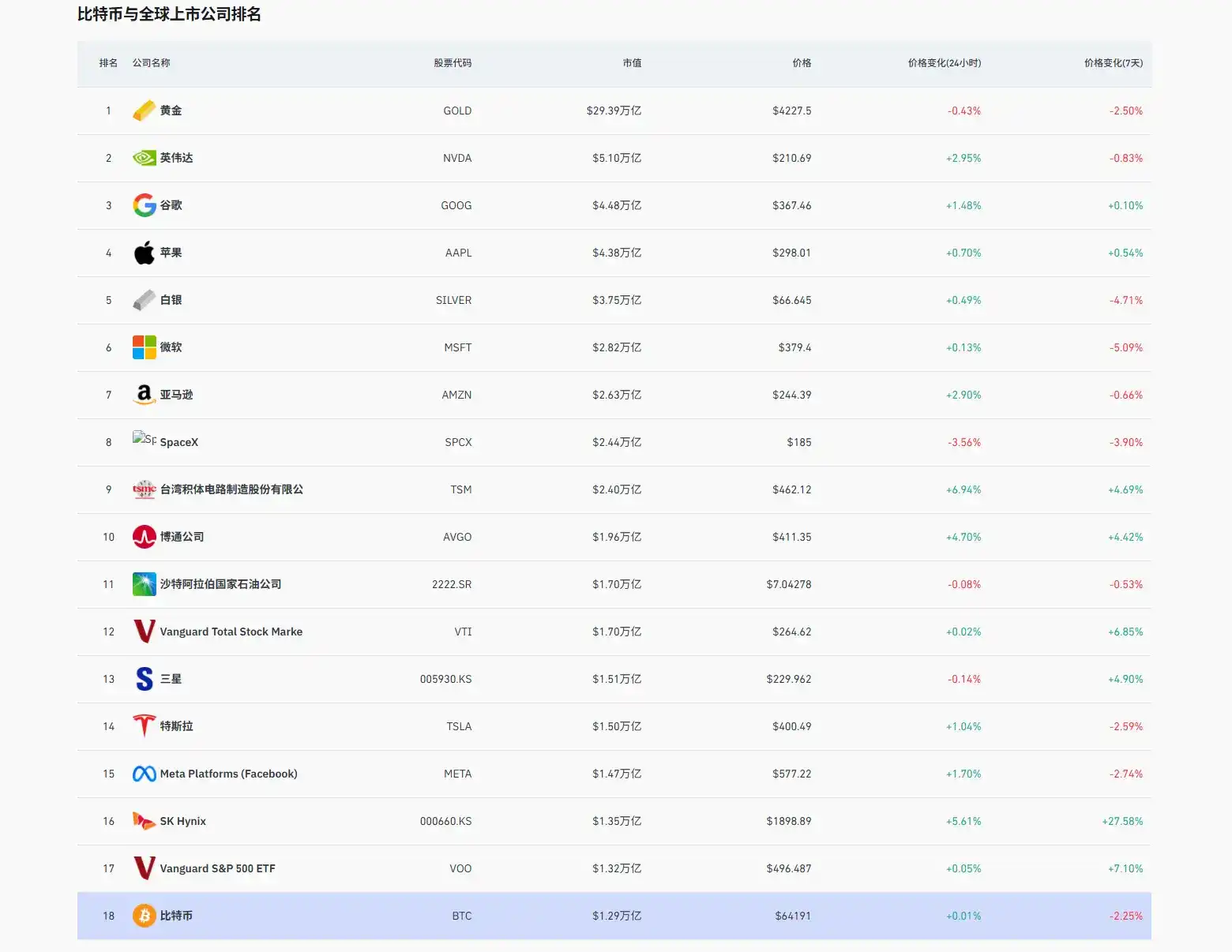
On June 22, a surge in SK Hynix's stock price propelled its market capitalization to $1.35 trillion, surpassing Bitcoin's total market cap of approximately $1.29 trillion. At one point during the trading session, it even overtook Samsung Electronics to become South Korea's highest-valued company.

According to Coinglass data, in the global asset rankings, SK Hynix rose to 16th place, while Bitcoin slid to 18th.
HBM, and a 13-Year Gamble

The core driver of SK Hynix's recent rally is HBM (High Bandwidth Memory). AI training and inference place extremely high demands on memory bandwidth, and SK Hynix is NVIDIA's primary HBM supplier, holding a market share exceeding 60%.

Financial reports show SK Hynix's Q1 revenue was 52.58 trillion won, with operating profit at 37.61 trillion won, achieving a profit margin of 72%. Analysts' current consensus for SK Hynix's Q2 operating profit is around 62~65 trillion won, with some brokerage houses' optimistic forecasts already revised upwards to over 68 trillion won.

In early April this year, most market expectations for Q2 were still in the 50 trillion won range. Since then, with persistently strong memory prices, brokerages have generally made significant upward revisions. Management stated during the earnings call that the structural memory shortage driven by artificial intelligence would last for at least several years and plans to significantly increase capital expenditure to expand advanced capacity.

Reportedly, SK Hynix began betting on HBM technology as early as 2009, a time when almost no one paid attention to this complex technology with limited initial demand. From the first generation of HBM to HBM3E, this all-or-nothing gamble lasted nearly 13 years, only reaching its coronation moment with the advent of ChatGPT.
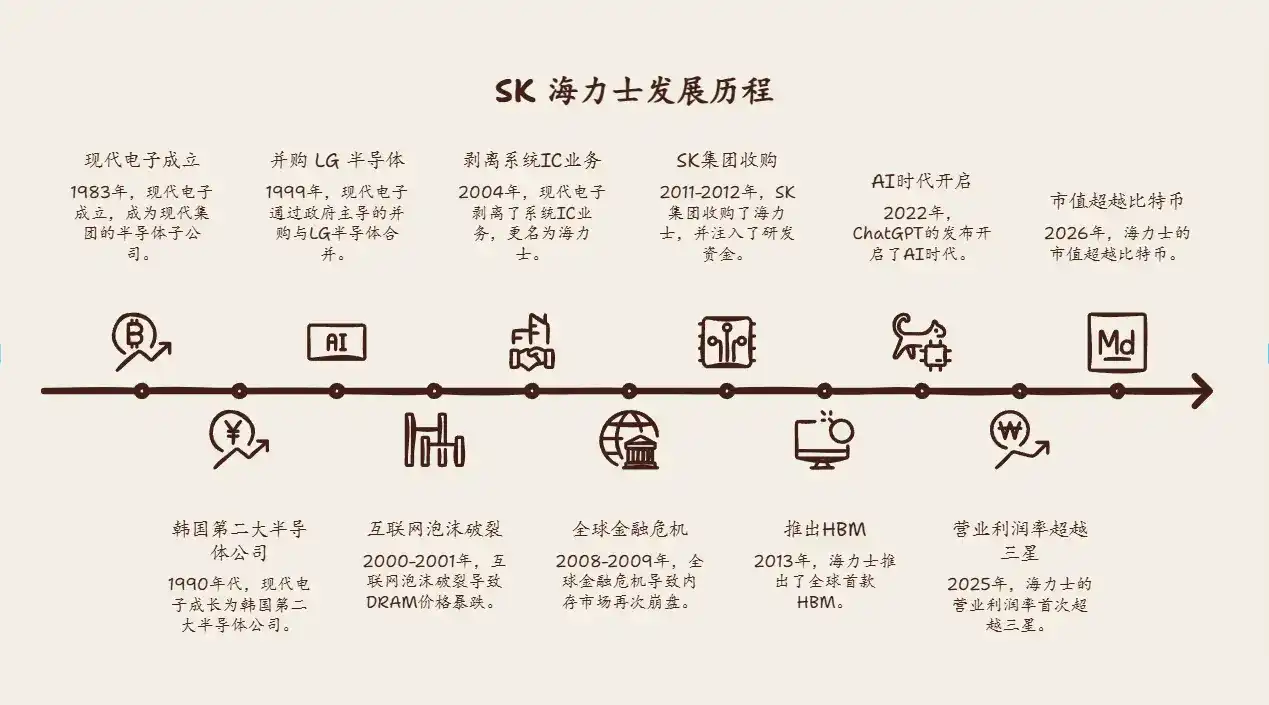
Image Source: AI Generated

SK Hynix's journey to this point cannot be separated from a critical external rescue. After the dot-com bubble burst in 2001, Hynix was deeply mired in a debt crisis, its stock price once falling to junk levels. It even negotiated a sale to Micron Technology, which ultimately failed. For the following decade, the company remained under creditor control.

In 2012, SK Group Chairman Chey Tae-won overrode board opposition and acquired the company for approximately $3 billion through its investment holding subsidiary SK Square, renaming it SK Hynix and injecting substantial R&D funding. This investment enabled the company to continue advancing the then-niche HBM technology. Currently, SK Square holds about 20% of SK Hynix shares, making it the largest single shareholder.

It is worth noting that SK Square itself once attempted to enter the crypto market. In 2021, it acquired a 35% stake in the Korean crypto exchange Korbit for about 90 billion won and planned to issue its own token, SK Coin. According to public reports, after the Terra/LUNA crash in 2022, the market cooled sharply, and the SK Coin issuance plan was subsequently shelved, with no substantial progress since.

According to a Reuters report citing informed sources, SK Hynix plans to list on NASDAQ as early as August this year, which would lower the trading threshold for U.S. institutional and passive funds and potentially attract further capital inflows. NVIDIA CEO Jensen Huang recently stated that NVIDIA's collaboration with SK Hynix is expected to bring South Korea business opportunities worth hundreds of billions of dollars in the future.

Why is Capital Buying In? Crypto AI in the Mirror

In this wave of AI, the market is more willing to pay a premium for segments that already have real orders and visible supply bottlenecks. Assets directly involved in the AI supply side—computing power, memory, and electricity—have received priority allocation due to their quantifiable revenue and verifiable barriers.

HBM production capacity is highly concentrated in the hands of SK Hynix, Samsung, and Micron, with expansion cycles taking 2 to 3 years. This physical scarcity is not built on narratives; it is locked in by production cycles and technological barriers. The valuation logic of the memory industry is also shifting from "cyclical stock" to "growth stock."

SK Hynix's market cap surpassing Bitcoin is the capital market's public statement on two types of scarcity. With such high barriers already formed at the physical layer, the situation of Crypto AI is worth re-examining.

The Crypto AI sector has been telling a story for the past two years: decentralized computing power will reshape AI infrastructure, and open networks will surpass closed enterprise data centers. The potential of this direction is real, but standing before the market cap figure of SK Hynix today, several realities are worth confronting directly.

The IC3 report jointly released by Cornell University and 12 other universities points out that the convergence of Crypto and AI is still in its early stages, and the noise surrounding this intersection has overshadowed practical progress. Decentralized computing power, data markets, and governance mostly remain at the conceptual stage.

At the project level, taking Bittensor, one of the most representative projects in the Crypto AI sector, as an example, its token TAO has fallen 20% over the past 3 months. Bittensor co-founder const posted on platform X, stating that the project's economic incentive layer is still dominated by the core team, who chose to prioritize rapid iteration at the cost of maintaining centralization, and it is estimated to take another year and a half to complete the core mechanism construction. In other words, their underlying mechanisms are still being patched.

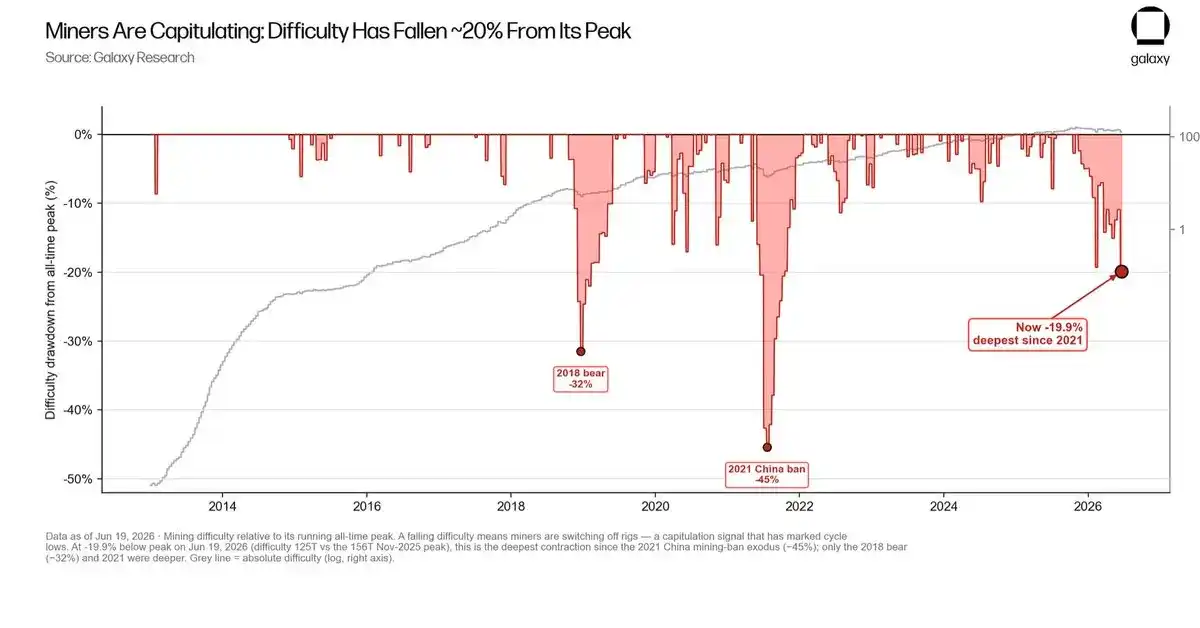
Crypto mining companies, which are closer to the hardware layer, are also facing challenges. According to Galaxy Research data, Bitcoin miners are entering a "capitulation period." The current network mining difficulty has dropped more than 20% from its historical high, marking the largest decline since China's crackdown on Bitcoin mining in 2021, with some miners continuing to exit the network or shut down equipment.
Seeking transformation, mining companies like Core Scientific, TeraWulf, and Hut 8 have announced moves into AI and high-performance computing. However, according to a VanEck report, this transformation faces a short-term funding gap of about $50 billion, with long-term capital needs around $221 billion. Furthermore, the industry has only delivered about 25% of the leased AI capacity—companies missing construction milestones already face investor downgrades.

The IC3 report jointly released by Cornell University and 12 other universities mentions that the convergence of Crypto and AI is still in its early stages, and the noise surrounding this intersection has overshadowed practical progress. Decentralized computing power, data markets, and governance mostly remain at the conceptual stage.

In terms of funding, Arthur Hayes pointed out in his recent article "Reality Test" that since the release of ChatGPT in 2022, the AI industry has cumulatively issued about $1.5 trillion in debt, roughly equivalent to the increase in U.S. M2 money supply during the same period—AI has absorbed almost all new liquidity; Bitcoin never had a chance. Hayes believes this is not a logic of "if AI falls, funds will flow back to crypto." The upcoming large-scale IPOs of Anthropic and OpenAI will further siphon market funds. Once the AI bubble bursts, bank credit contraction will simultaneously tighten liquidity, and Bitcoin will be sold off alongside AI.

Since the second half of last year, many traders previously active in the crypto market have shifted their attention to U.S. and South Korean stocks, chasing the AI hardware trend. The logic of capital flowing into AI infrastructure is also straightforward: real orders, physical barriers, quantifiable profit margins.

This certainty is the fundamental reason capital is willing to pay a high premium today, whereas the AI narrative in the crypto market lacks precisely this kind of certainty.

In other words, the dividends of AI infrastructure are currently more inclined to be captured by entities with technological barriers and real supply capabilities. In this process, crypto networks need to more clearly define their position in the value chain.


熱門幣種推薦

相關問答

QWhat is the primary driver behind SK Hynix's recent stock surge and its market capitalization surpassing that of Bitcoin?

AThe primary driver is the high demand for HBM (High Bandwidth Memory), a critical component for AI training and inference. SK Hynix is the dominant supplier (over 60% market share) of HBM to Nvidia, with strong financial results and optimistic analyst forecasts fueling the stock rise.

QHow did SK Hynix survive its financial crisis in the early 2000s and eventually thrive in the AI era?

AAfter a near-bankruptcy in the 2001 dot-com bust, SK Hynix was acquired in 2012 by SK Square, a subsidiary of SK Group, for about $3 billion. This investment provided crucial R&D funding, allowing the company to persist in developing HBM technology, which was a niche and unproven field at the time. This 13-year bet ultimately paid off with the AI boom.

QWhat are the key challenges faced by the Crypto AI sector according to the article?

AThe Crypto AI sector faces challenges including a lack of tangible progress beyond conceptual stages (e.g., decentralized compute and data markets), immature project infrastructure (e.g., Bittensor's core mechanisms still under development), significant capital shortfalls for miners trying to pivot to AI, and competition for liquidity that is being absorbed by traditional AI infrastructure with more proven, revenue-generating models.

QWhat does the article suggest is a major reason capital is favoring companies like SK Hynix over Crypto AI projects?

ACapital favors companies like SK Hynix due to their 'deterministic' value proposition: real, quantifiable orders, physical supply bottlenecks with high barriers to entry (2-3 year expansion cycles), and verifiable profit margins. This contrasts with the more speculative and narrative-driven nature of many Crypto AI projects, which lack similar immediate, proven fundamentals.

QWhat perspective does Arthur Hayes offer on the relationship between the AI funding boom and Bitcoin's market performance?

AArthur Hayes argues that the AI industry has absorbed virtually all new liquidity (issuing ~$1.5 trillion in debt since ChatGPT's launch), leaving little for Bitcoin. He contends that Bitcoin's fate is currently tied to AI's; if the AI bubble bursts, a subsequent credit contraction would likely lead to Bitcoin being sold off alongside AI assets, rather than benefiting from a capital rotation.

你可能也喜歡

博弈关键周:BTC回抽确认与HYPE支撑争夺 | 特邀分析

本周市场进入关键博弈阶段。宏观上,美联储政策预期变化主导风险资产节奏;加密市场经历震荡后,多空分歧在关键价位显现。本文对BTC和HYPE进行技术分析,制定中短线操作预案,所有内容仅为个人记录,不构成投资建议。 **BTC分析:** 4小时图显示,币价自6月5日低点反弹后呈现短期上升通道,当前已跌破通道下轨,正进行回抽确认。若无法重新站上下轨,可能回测59,100美元支撑。本周关注对通道下轨的回抽结果:站稳则可能挑战69,500~70,500美元压力区;跌破则下探59,000~60,000美元支撑区。 核心压力位:64,500~65,000美元(通道下轨附近),69,500~70,500美元。 核心支撑位:59,000~60,000美元,55,000美元附近。 操作策略:中线已按计划在64,500美元附近布局20%空单。短线利用30%仓位,依据支撑压力位寻找价差机会,并制定了A/B/C三套预案: A. 反弹至64,500~65,000美元滞涨时试空。 B. 反弹至69,500~70,500美元承压时加空。 C. 有效跌破59,000~60,000美元支撑后顺势加空。 **HYPE分析:** 4小时图显示,HYPE自6月2日高点调整后强势上涨创出新高,当前回落至64~66美元关键支撑区域。若在此获得支撑,上涨趋势可能延续;若失守,可能测试52~54美元支撑带。 核心压力位:77美元附近,80~82美元区域。 核心支撑位:64~66美元区域,52~54美元区域。 本周核心观点:观察64~66美元区域的多空争夺结果。 操作策略:短线遵循“逢低布局”,当价格回测64~66美元或52~54美元支撑区域出现企稳信号时,可轻仓试多,仓位控制在30%以下,并严守止损纪律。 **特别提示:** 开仓立即设止损;盈利1%时止损移至成本价;盈利2%时止损移至盈利1%处;此后每盈利1%,止损同步上移1%,动态锁定利润。 市场瞬息万变,本文所有内容仅为个人技术分析记录,不构成任何投资建议。市场有风险,投资需谨慎。

Odaily星球日报2 小時前

博弈关键周:BTC回抽确认与HYPE支撑争夺 | 特邀分析

Odaily星球日报2 小時前

交易

現貨
合約

熱門文章

什麼是 BITCOIN

理解 HarryPotterObamaSonic10Inu (ERC-20) 及其在加密空間中的地位 近年來,加密貨幣市場見證了迷因幣的流行激增,吸引了不僅是交易者的注意,還有尋求社區參與和娛樂價值的人士。在這些獨特的代幣中,有一個有趣的項目 HarryPotterObamaSonic10Inu (ERC-20),它將文化參考融入加密貨幣的織造中。本文深入探討 HarryPotterObamaSonic10Inu 的關鍵方面,探索其機制、以社區為驅動的精神,以及其與更廣泛的加密生態的互動。 HarryPotterObamaSonic10Inu (ERC-20) 是什麼? 正如其名所示,HarryPotterObamaSonic10Inu 是一種建立在以太坊區塊鏈上的迷因幣,按照 ERC-20 標準分類。與強調實用性或投資潛力的傳統加密貨幣不同,這項代幣依賴於娛樂價值和其社區的力量。該項目旨在促進一個讓互動用戶可以聚在一起、分享想法和參與受不同文化現象啟發的活動的環境。 HarryPotterObamaSonic10Inu 的一個顯著特點是其 交易零稅。這一引人注目的元素旨在鼓勵交易和社區參與,無需擔心可能會阻礙小型交易者的額外費用。該幣的總供應量定為十億個代幣,這一數字標示其意圖在社區內保持較大的流通量。 HarryPotterObamaSonic10Inu (ERC-20) 的創建者 HarryPotterObamaSonic10Inu 的起源有些神秘;對創建者的具體資訊尚不清楚。這個代幣的開發缺乏可識別的團隊或明確的藍圖,這在迷因幣領域並不罕見。相反,該項目是自然產生的,其進展主要依賴於社區的熱情和參與。 HarryPotterObamaSonic10Inu (ERC-20) 的投資者 關於外部投資和支持,HarryPotterObamaSonic10Inu 亦保持模稜兩可。該代幣並未列出任何已知的投資基金或顯著的組織支持。相反,該項目的生命力來自其草根社區,通過集體行動和參與在加密空間促進其增長和可持續性。 HarryPotterObamaSonic10Inu (ERC-20) 如何運作? 作為一種迷因幣,HarryPotterObamaSonic10Inu 主要在傳統的資產價值框架之外運作。以下是幾個定義該項目運作方式的獨特方面: 零稅交易:由於交易沒有稅費,使用者可以自由地買賣該代幣,而不必擔心隱藏成本。 社區參與:該項目依賴於社區互動,利用社交媒體平台創造話題並促進參與。討論、內容分享及互動是幫助擴展其影響力和加強支持者忠誠度的重要元素。 無實用性:需要指出的是,HarryPotterObamaSonic10Inu 在金融生態中並不提供具體的實用性。相反,它被定義為主要用於娛樂和社區活動的代幣。 文化參考:該代幣巧妙地融入了流行文化中的元素,以吸引興趣,與迷因愛好者和加密追隨者建立聯繫。 HarryPotterObamaSonic10Inu 範例展示了迷因幣如何與更傳統的加密貨幣項目運作不同,作為創新的社會構造進入市場,而非實用資產。 HarryPotterObamaSonic10Inu (ERC-20) 的時間線 HarryPotterObamaSonic10Inu 的歷史標誌著幾個值得注意的里程碑: 創建:這個代幣源於一個病毒式的迷因,捕捉了許多加密愛好者的想像力。具體的創建日期目前並不清楚,凸顯其自然興起。 上架交易所:HarryPotterObamaSonic10Inu 已經在多個交易所上架,使社區更容易存取和交易。 社區互動倡議:持續進行旨在增進社區互動的活動,包括比賽、社交媒體活動和來自粉絲和支持者的內容創作。 未來擴展計劃:該項目的路線圖包括推出 NFT 收藏品、周邊商品及相關電子商務網站,進一步與社區互動並嘗試為其生態系統增添更多維度。 關於 HarryPotterObamaSonic10Inu (ERC-20) 的關鍵點 以社區為驅動的特質:該項目優先考慮集體意見和創意,確保用戶參與在其發展過程中居於核心地位。 迷因幣分類:它代表了以娛樂為基礎的加密貨幣的典範,與傳統投資工具大相徑庭。 與比特幣無直接關聯:儘管在代碼名稱上有相似之處,HarryPotterObamaSonic10Inu 是獨特的,並不與比特幣或其他已建立的加密貨幣存在關係。 協作焦點:HarryPotterObamaSonic10Inu 旨在為持有者創造一個共享故事和協作的空間,提供創意和社區聯結的途徑。 未來前景:向超越其初步主題擴展至 NFT 和周邊商品的雄心,描繪了該項目潛在進入數字文化的更主流途徑。 隨著迷因幣繼續吸引加密貨幣社區的想像力,HarryPotterObamaSonic10Inu (ERC-20) 由於其文化聯繫和以社區為中心的方式而脫穎而出。儘管它可能不符合以實用性為導向的代幣的典型模式,其本質在於支持者間培育的快樂和友誼,突顯了在日益數字化的時代中,加密貨幣的演變特性。隨著該項目的持續發展,觀察社區動態如何影響其在不斷變化的區塊鏈技術格局中的軌跡將是重要的。

2.3k 人學過發佈於 2024.04.01更新於 2024.12.03

什麼是 BITCOIN

如何購買BTC

歡迎來到HTX.com!在這裡,購買Bitcoin (BTC)變得簡單而便捷。跟隨我們的逐步指南,放心開始您的加密貨幣之旅。第一步:創建您的HTX帳戶使用您的 Email、手機號碼在HTX註冊一個免費帳戶。體驗無憂的註冊過程並解鎖所有平台功能。立即註冊第二步:前往買幣頁面,選擇您的支付方式信用卡/金融卡購買:使用您的Visa或Mastercard即時購買Bitcoin (BTC)。餘額購買:使用您HTX帳戶餘額中的資金進行無縫交易。第三方購買:探索諸如Google Pay或Apple Pay等流行支付方式以增加便利性。C2C購買:在HTX平台上直接與其他用戶交易。HTX 場外交易 (OTC) 購買:為大量交易者提供個性化服務和競爭性匯率。第三步:存儲您的Bitcoin (BTC)購買Bitcoin (BTC)後,將其存儲在您的HTX帳戶中。您也可以透過區塊鏈轉帳將其發送到其他地址或者用於交易其他加密貨幣。第四步:交易Bitcoin (BTC)在HTX的現貨市場輕鬆交易Bitcoin (BTC)。前往您的帳戶,選擇交易對,執行交易,並即時監控。HTX為初學者和經驗豐富的交易者提供了友好的用戶體驗。

5.6k 人學過發佈於 2024.12.12更新於 2026.06.02

如何購買BTC

什麼是 $BITCOIN

數字黃金 ($BITCOIN):全面分析 數字黃金 ($BITCOIN) 介紹 數字黃金 ($BITCOIN) 是一個基於區塊鏈的項目,運行於 Solana 網絡,旨在將傳統貴金屬的特徵與去中心化技術的創新相結合。雖然它與比特幣同名,常被稱為「數字黃金」,因其被視為價值儲存工具,但數字黃金是一個獨立的代幣,旨在於 Web3 生態系統中創造一個獨特的生態系。其目標是將自己定位為一個可行的替代數字資產,儘管有關其應用和功能的具體細節仍在發展中。 什麼是數字黃金 ($BITCOIN)? 數字黃金 ($BITCOIN) 是一個專門為 Solana 區塊鏈設計的加密貨幣代幣。與比特幣提供廣泛認可的價值儲存角色不同,這個代幣似乎更專注於更廣泛的應用和特徵。值得注意的方面包括: 區塊鏈基礎設施:該代幣建立在 Solana 區塊鏈上,以其處理高速和低成本交易的能力而聞名。 供應動態:數字黃金的最大供應量上限為 100 萬兆代幣(100P $BITCOIN),儘管有關其流通供應的詳細信息目前尚未披露。 實用性:雖然具體功能尚未明確說明,但有跡象表明該代幣可能被用於各種應用,可能涉及去中心化應用(dApps)或資產代幣化策略。 誰是數字黃金 ($BITCOIN) 的創建者? 目前,數字黃金 ($BITCOIN) 的創建者和開發團隊的身份仍然是 未知 的。這種情況在許多創新項目中是典型的,特別是那些與去中心化金融和迷因幣現象相關的項目。雖然這種匿名性可能促進社區驅動的文化,但也加劇了對治理和問責制的擔憂。 誰是數字黃金 ($BITCOIN) 的投資者? 可用的信息顯示,數字黃金 ($BITCOIN) 沒有任何已知的機構支持者或知名的風險投資。該項目似乎運行在一個以社區支持和採用為重點的點對點模型上,而不是傳統的資金籌集途徑。其活動和流動性主要位於去中心化交易所(DEXs),如 PumpSwap,而不是已建立的集中交易平台,進一步突顯其草根方法。 數字黃金 ($BITCOIN) 如何運作 數字黃金 ($BITCOIN) 的運作機制可以根據其區塊鏈設計和網絡特徵進行詳細說明: 共識機制:通過利用 Solana 的獨特歷史證明(PoH)結合權益證明(PoS)模型,該項目確保高效的交易驗證,促進網絡的高性能。 代幣經濟學:雖然具體的通縮機制尚未詳細說明,但巨大的最大代幣供應量暗示它可能適合微交易或尚待定義的利基用例。 互操作性:存在與 Solana 更廣泛生態系統的整合潛力,包括各種去中心化金融(DeFi)平台。然而,關於具體整合的詳細信息仍未明確。 重要事件時間表 以下是關於數字黃金 ($BITCOIN) 的重要里程碑時間表: 2023:該代幣首次在 Solana 區塊鏈上部署,並以其合約地址為標誌。 2024:數字黃金獲得曝光,因其在去中心化交易所如 PumpSwap 上可供交易,允許用戶以 SOL 進行交易。 2025:該項目見證了零星的交易活動和社區主導參與的潛在興趣,儘管截至目前尚未記錄到任何顯著的合作夥伴關係或技術進展。 關鍵分析 優勢 可擴展性:基於 Solana 的基礎設施支持高交易量,這可能增強 $BITCOIN 在各種交易場景中的實用性。 可及性:每個代幣潛在的低交易價格可能吸引零售投資者,促進更廣泛的參與,因為存在分割所有權的機會。 風險 缺乏透明度:缺乏公眾已知的支持者、開發者或審計過程可能引發對該項目可持續性和可信度的懷疑。 市場波動性:交易活動在很大程度上依賴於投機行為,這可能導致價格波動和投資者的不確定性。 結論 數字黃金 ($BITCOIN) 在快速發展的 Solana 生態系統中,作為一個引人入勝但模糊的項目出現。雖然它試圖利用「數字黃金」的敘事,但其與比特幣作為價值儲存工具的既定角色的脫離,突顯了對其預期實用性和治理結構更清晰區分的需求。未來的接受度和採用率可能取決於解決當前的不透明性,並更明確地定義其運營和經濟策略。 注意:本報告涵蓋截至 2023 年 10 月的綜合信息,並且在研究期間可能發生了進展。

98 人學過發佈於 2025.05.13更新於 2025.05.13

什麼是 $BITCOIN

相關討論

歡迎來到 HTX 社群。在這裡,您可以了解最新的平台發展動態並獲得專業的市場意見。 以下是用戶對 BTC (BTC)幣價的意見。

活动图片