The Year's Most Expensive New Stock Hits the Market: Pinson Laser, Bright Prospects Amid Concerns

marsbit發佈於 2026-08-18更新於 2026-08-18

文章摘要

Annual Most Expensive IPO Debuts: Pinsun Laser's Bright Prospects Shadowed by Concerns Pinsun Laser, dubbed "A-share's first precision laser stock", has made its debut on the STAR Market with a record-high issue price of 186.88 yuan per share this year. Despite the hype, its journey is marked by challenges. The company's allure lies in its "small and beautiful" profile. It issued a small float of only 10 million new shares, boosting its price elasticity and retail investor appeal. Financially, it has shown strong performance with revenue growing at a 68.2% CAGR from 2023 to 2025 and gross margins consistently above 67%. As the domestic leader in precision lasers for quantum technology, it holds a 9.21% global and 16.85% domestic market share in 2024, offering a scarce A-share investment opportunity. Its P/E ratio of 49.42x at issuance was below the industry average, suggesting room for valuation growth. However, Pinsun's path is fraught with hurdles. Its core market—lasers for quantum tech (computing, sensing, communication)—remains a niche, research-driven sector. Global demand is projected to grow at a modest sub-8% CAGR through 2030, constrained by the distant commercialization timeline of quantum computing, which heavily relies on research funding cycles. The company's prestigious clientele, including top global universities, exposes it to funding volatility. It faces intense competition from entrenched giants like Germany's Toptica and the US's Coherent. While Pinsun ...

By | Alpha Factory

The year's most expensive new stock has been listed.

Upon opening, Pinson Laser will officially debut on the STAR Market. As "the first stock in the A-share market for precision lasers," Pinson Laser's issue price per share reached 186.88 yuan, making it the most expensive new stock of the year. In comparison, the most discussed stock on the STAR Market currently, Yushu, has an issue price of 150.8 yuan per share.

Over the past three years, the company's revenue has grown at a compound annual growth rate of 68.2%, with gross margin consistently above 67%. The company is engaged in the R&D, production, and sales of precision lasers, primarily serving fields with grand prospects like quantum technology.

However, before reaching that future, Pinson Laser still faces a series of real-world challenges, including fluctuations in downstream demand and competition from overseas giants.

01 How Did Pinson Laser Become the 'Year's Most Expensive New Stock'?

"Small yet beautiful" is an important reason why Pinson Laser became the most expensive new stock.

"Small" refers to its small float.

In this IPO, Pinson Laser issued only 10 million new shares, making it one of the new stocks with the smallest number of shares issued this year. Calculated at the issue price, the company is expected to raise a total of 1.869 billion yuan.
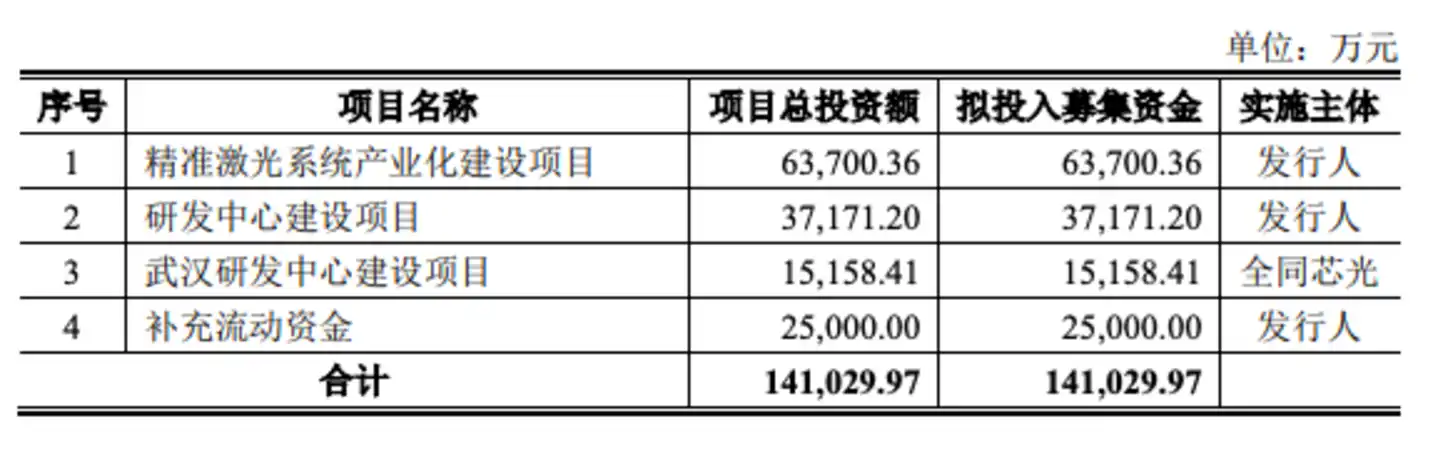
Pinson Laser's proposed fundraising projects are expected to use 1.41 billion yuan of the raised funds; Data source: Prospectus

The small share capital not only pushed up the issue price but also increased the post-listing stock price volatility. Pinson Laser's unrestricted float is only 7.6178 million shares, accounting for 19.04% of the total share capital, corresponding to a float market value of approximately 1.42 billion yuan—this size is also not large within the STAR Market.

At the same time, this makes the subscription threshold quite friendly. The upper limit for online subscription is 2,000 shares, requiring a Shanghai market value of only 20,000 yuan for a full subscription, allowing many retail investors to participate. Consequently, Pinson Laser's lottery winning rate is quite low at only 0.02%.

Pinson Laser's "beauty" refers to its impressive performance.

Pinson Laser's main business is precision lasers, with its core application scenario being the quantum technology field.

In terms of performance, from 2023 to 2025, the company's revenue was 148 million yuan, 292 million yuan, and 418 million yuan respectively, achieving a three-year compound growth rate of 68.2%. During the same period, net profit attributable to shareholders grew from 60.46 million yuan to 159 million yuan, with profit growth largely matching revenue expansion.

Performance growth has also strengthened the company's position in the industry. According to QY Research data, in 2024, Pinson Laser held a 9.21% market share in the global quantum technology laser market and a 16.85% share in the domestic market. In the niche field of precision lasers, Pinson Laser is already the domestic leader.

Furthermore, the company's gross margin has remained stable at a high level between 67% and 70%, indicating that Pinson Laser's growth is driven by genuine demand rather than price competition.

Besides being "small yet beautiful," the valuation premium brought by scarcity is another significant reason why Pinson Laser became the "year's most expensive new stock."

For investors looking to buy into a core hardware player in the quantum technology sector, Pinson Laser is currently almost the only choice in the A-share market. This "one-of-a-kind" scarcity supports the market's acceptance of its high pricing, a logic that has been repeatedly validated on the STAR Market this year.

It's worth noting that Pinson Laser's price-to-earnings (P/E) ratio at issuance is 49.42 times, lower than the industry average P/E ratio (68.04 times). This largely implies that the company's high gross margin has not been fully "priced in."

02 The Road to the Stars and Beyond is Paved with Thorns

Quantum technology is often imbued with "star-reaching" imagination. Whether it's quantum computing, quantum precision measurement, or quantum communication, each direction points toward disruptive technological revolutions. And lasers are indispensable core hardware for these cutting-edge technologies.

But stripping away the conceptual halo, the quantum information laser track where Pinson Laser operates is currently still a niche market dominated by scientific research procurement.

Data from QY Research shows that the global scientific research laser market size in 2024 was approximately $2.147 billion, expected to reach $3.331 billion by 2030, with a compound annual growth rate of less than 8%.

An 8% growth rate might be respectable in the manufacturing sector, but this growth rate clearly cannot support excessively high imaginations.

The reason for the limited market size is straightforward: quantum computing and quantum precision measurement are still mainly in the laboratory stage, with true industrial applications still far off.

Pinson Laser's customer list is quite impressive, covering top-tier quantum research institutions in Europe and America such as Harvard University, University of Colorado, California Institute of Technology, and ETH Zurich.

This client list certainly testifies to the company's technical strength from the side. However, the demand from research institutions is significantly influenced by funding cycles. Orders surge when funding is ample and contract sharply when budgets tighten—a challenge faced by all scientific instrument and equipment manufacturers.

Pinson Laser also frankly admits in its prospectus that if downstream market demand declines or competition increases significantly in downstream application segments, the company may face risks of declining gross margin and operating performance.

Competition from overseas giants is another layer of pressure. The high-end narrow-linewidth precision laser market has long been dominated by overseas manufacturers, with Germany's Toptica and America's Coherent being the traditional powerhouses in this field.

Pinson Laser's technical approach has its own characteristics, adopting a "seed source + fiber amplification + nonlinear frequency conversion + frequency stabilization" architecture, which differs from the traditional schemes of overseas manufacturers. It can achieve narrow linewidth, low-noise laser output across the full spectrum from 177nm to 5000nm. While this route offers advantages in cost and spectral coverage, it still needs time to catch up in terms of brand recognition.

A greater variable lies in the significant uncertainty surrounding the industrialization pace of quantum computing. The industry generally believes that commercial applications for general-purpose quantum computers are at least a decade or more away.

Before that, the primary customers for quantum technology lasers will remain research institutions, with a clearly visible market ceiling. If the industrialization process of quantum computing is slower than expected, Pinson Laser's growth story will need to find new support.

The semiconductor business has been entrusted with high hopes as a second growth curve. Pinson Laser's products have already penetrated semiconductor fields such as wafer fabrication, wafer measurement and inspection, and wafer stealth dicing. From 2023 to 2025, the company's revenue in this field increased from 25.15 million yuan to 104 million yuan.

The semiconductor equipment market is far larger than the scientific research laser market. If Pinson Laser can gain a foothold in the semiconductor field, it would undoubtedly significantly raise the company's business ceiling.

But competition in the semiconductor market is equally fierce. International giants like Coherent and II-VI have deep layouts in the semiconductor laser field. For Pinson Laser to increase its share from 1.98% in the semiconductor sector will be no easy task.

R&D is another test for Pinson Laser. During the reporting period, the company's R&D expenses were 22.12 million yuan, 41.71 million yuan, and 61 million yuan respectively, accounting for 14% to 15% of revenue. This proportion is not low, but the absolute amount pales in comparison to the hundreds of millions of dollars in R&D investment by overseas giants.

It's not hard to see that between the "star-reaching" prospects and revenue lies a long path of industrialization.

For Pinson Laser, focusing on the present is more likely to lead to the shores of the future.

熱門幣種推薦

相關問答

QWhat are the main factors that made Pinzhun Laser the most expensive IPO of the year?

AThe main factors are its 'small but beautiful' characteristics. 'Small' refers to its small float share, which increases price volatility and makes it accessible to retail investors. 'Beautiful' refers to its impressive financial performance, with revenue CAGR of 68.2% over three years and consistently high gross margins above 67%. Additionally, its scarcity as a core hardware player in the quantum technology sector creates valuation premiums, and its P/E ratio was lower than the industry average, suggesting its high profitability wasn't fully priced in.

QWhat are the primary risks or challenges facing Pinzhun Laser's business in the quantum technology sector?

AThe primary risks include: 1) A limited, niche market dominated by research institutions whose demand is volatile and dependent on research funding cycles. 2) Fierce competition from established international giants like Germany's Toptica and America's Coherent. 3) Significant uncertainty around the industrialization timeline for quantum computing, which is likely more than a decade away, keeping the market's growth ceiling relatively low in the near term.

QHow does Pinzhun Laser plan to expand its business beyond the quantum technology research market?

APinzhun Laser is focusing on the semiconductor sector as its second growth curve. The company has already begun supplying products for wafer manufacturing, measurement/inspection, and stealth dicing. Revenue from this segment grew significantly from 25.15 million yuan in 2023 to 104 million yuan in 2025. The semiconductor equipment market is much larger than the research laser market, offering a substantial opportunity to raise the company's business ceiling.

QWhat is the structure of the global market for quantum technology lasers, and what is Pinzhun Laser's position within it?

AThe global quantum technology laser market is currently a small, research-driven market. According to QY Research data, the global market size was approximately $2.147 billion in 2024. In this niche, Pinzhun Laser has established itself as a domestic leader. In 2024, it held a 9.21% market share in the global market for lasers used in quantum technology and a 16.85% share in the domestic Chinese market.

QWhat is unique about Pinzhun Laser's technical approach compared to its overseas competitors?

APinzhun Laser employs a unique technical architecture consisting of 'seed source + fiber amplification + nonlinear frequency conversion + frequency stabilization.' This differs from the traditional solutions used by overseas competitors like Toptica and Coherent. Pinzhun's approach offers advantages in cost and wavelength coverage, enabling narrow-linewidth, low-noise laser output across the full spectrum from 177nm to 5000nm.

你可能也喜歡

宇树投资人,联手重仓一个具身团队

中国具身智能迎来里程碑——8月19日,宇树科技登陆科创板,成为A股“人形机器人第一股”。其创始人王兴兴白手起家,十年间将宇树做到人形机器人出货量全球第一。 引人注目的是,宇树三大外部投资方美团、红杉中国与经纬创投,又共同投资了一家低调的具身智能公司——妙动科技。妙动两位联合创始人高建荣和杨硕均有大疆背景,其中杨硕曾任职于特斯拉Optimus核心团队,是团队中职位最高的华人工程师之一。 妙动与宇树相似,坚持自研电机与软硬件全栈能力,但产品路径不同:宇树聚焦“四足机器狗+人形机器人”,妙动则选择“双轮足机器人+小人形机器人”。 近期,妙动在众筹平台Kickstarter推出全球首款消费级轮足跟拍机器人Beni,支持低视角自动跟拍、跳跃、避障等功能,众筹金额创下机器人品类纪录,并获得顶级科技博主满分评价。该产品计划于10月全球发售,内部目标三年售出百万台。 通过Beni,妙动积累了电机设计、量产一致性及用户体验闭环能力,并计划将技术延伸至人形机器人。团队坚持“第一性原理”与全栈研发,已在人形机器人的全身智能协同、复杂地形步态等关键技术取得突破。妙动强调从真实场景出发定义产品,不追逐短期估值,致力于通过持续产品迭代,稳健推进家用具身智能落地。

marsbit16 分鐘前

宇树投资人,联手重仓一个具身团队

marsbit16 分鐘前

俄罗斯的非法挖矿:为何家庭矿场极易被发现

俄罗斯非法挖矿活动日益风险加大,尤其是在加密货币开采被禁止的地区。能源供应公司发现住宅用电量异常增长后,通常会启动检查程序:监测异常用电量、将数据转交税务部门,并上报检察院。 投资顾问指出,家庭挖矿设施的用电特征明显:用电量持续且几乎全天稳定,这种异常模式在统计数据中很容易被识别。目前,针对挖矿的专门行政和刑事责任法规尚未完全生效,但当局仍可依据现行规定对违法者进行处理,如按非法接入电网、无记录用电、损害能源公司利益及逃税等条款追究责任。 非法挖矿的主要危害包括:给能源公司造成损失、导致电网过载,以及造成税收流失。后果可能涉及罚款、赔偿损失、设备没收,甚至刑事责任。 目前,莫斯科、莫斯科州及库尔斯克州部分市辖区已自8月15日起禁止挖矿。此外,达吉斯坦、北奥塞梯等多个地区,以及卢甘斯克、顿涅茨克等地,均实行了持续至2031年3月15日的全年禁令。 家庭挖矿之所以容易被发现,关键在于其用电模式异常:设备持续运行,电网负载稳定,与日常家庭用电波动明显不同。因此,试图在住宅区隐藏非法挖矿行为很可能迅速引发检查,并面临能源公司追责及税务问题。

cryptonews.ru36 分鐘前

俄罗斯的非法挖矿:为何家庭矿场极易被发现

cryptonews.ru36 分鐘前

交易

現貨

熱門文章

什麼是 ₿O₿

比特幣鮑勃 ($₿o₿):透過混合層-2創新開創以比特幣為中心的去中心化金融 在數字經濟快速演變的時代,比特幣鮑勃 ($₿o₿) 作為一個革命性項目出現,旨在提升比特幣在去中心化金融 (DeFi) 領域的實用性。比特幣鮑勃於2024年5月正式推出,也被稱為「基於比特幣的建設」(Build on Bitcoin, BOB),代表了一種混合層-2區塊鏈解決方案,將比特幣著名的安全性和不可變性與以太坊的可編程性相結合。這一倡議旨在填補比特幣生態系統中的一個關鍵空白,通過促進智能合約和去中心化應用的整合,同時保持比特幣固有的信任和安全核心原則。在著名風險投資家的大力支持下,比特幣鮑勃有望重新定義比特幣在DeFi領域的角色,使其成為全球去中心化金融運作的基石。 比特幣鮑勃是什麼,$₿o₿? 比特幣鮑勃的核心是一種混合區塊鏈解決方案,旨在增強比特幣的功能。該項目的主要目標是使比特幣上的去中心化金融成為可能,促進快速和無縫的交易,同時確保高水平的安全性。 比特幣鮑勃採用了先進技術,特別是一種混合層-2架構,將比特幣的安全屬性與以太坊虛擬機 (EVM) 的可編程性和靈活性相結合。這一務實的做法使項目能夠有效運行,而不妥協比特幣的基本價值,這使其成為彌合傳統比特幣持有者與新興DeFi生態系統之間差距的重大步驟。 比特幣鮑勃的一個突出特點是其通過創新機制提供信任最小化環境的角色,例如最初依賴以太坊的樂觀滾動,最終過渡到完全的比特幣整合。這一混合系統旨在確保比特幣中存在的龐大流動性不僅得以保留,還能有效地在各種DeFi協議中利用。 比特幣鮑勃的創始人是誰,$₿o₿? 比特幣鮑勃的創意力量是聯合創始人兼首席執行官 Alexei Zamyatin,他在加密貨幣領域擁有豐富的經驗和知識。Zamyatin 擁有計算機科學博士學位,自2015年以來一直積極參與比特幣的開發。他對比特幣和以太坊生態系統的深刻理解在塑造比特幣鮑勃的願景和技術基礎方面發揮了關鍵作用。 與Zamyatin一起的是聯合創始人 Dominik Harz,他擔任首席技術官 (CTO)。這對搭檔培養了一支充滿才華的團隊,大家共同熱衷於推動區塊鏈技術的邊界,確保比特幣鮑勃在市場上的創新地位。 比特幣鮑勃的投資者是誰,$₿o₿? 比特幣鮑勃成功獲得了一系列知名投資者和風險投資公司的支持,他們認識到該項目改變比特幣格局的潛力。在2024年3月,該項目完成了一輪強勁的 1000萬美元種子融資,由Castle Island Ventures主導,Coinbase Ventures和Bankless Ventures等公司也有顯著參與。 不久之後,在2024年7月,比特幣鮑勃獲得了額外的 160萬美元戰略資金。這一輪融資由Ledger Ventures共同主導,並有來自BlackRock、Aave和Curve等多家知名公司的天使投資者參與。強大的財務支持反映了整個行業對比特幣鮑勃在解鎖比特幣在DeFi領域潛力的創新方法的認可。 這筆資金對於項目的持續發展至關重要,同時也用於建立一個孵化器,以促進專門滿足不斷增長的用戶基礎需求的比特幣原生去中心化應用 (dApps)。 比特幣鮑勃是如何運作的,$₿o₿? 比特幣鮑勃的運作機制根植於其 混合滾動架構,旨在結合比特幣的安全性和以太坊EVM的多樣性。該項目採用分階段的安全模型,概述其與用戶和開發者的互動方式如下: 第一階段 – 初始階段作為以太坊上的樂觀滾動運行,其中交易以有效性的樂觀預期進行處理,為未來在比特幣上的發展鋪平道路。 第二階段 – 隨著項目的過渡,將通過比特幣質押整合 比特幣最終性,利用巴比倫網絡增強安全性。這一機制要求驗證者鎖定比特幣,從而驗證BOB交易,這不僅增強了安全性,還為參與者創造了收益機會。 第三階段 – 比特幣鮑勃的前瞻性願景是完全整合比特幣,使用創新技術如BitVM和零知識證明來促進鏈下計算,同時保持比特幣的安全完整性。 關鍵創新如 BitVM2,這是一種由Zamyatin共同編寫的信任最小化橋接協議,對項目的功能至關重要,允許比特幣存款和取款而無需依賴廣泛的網絡。這使生態系統能夠有效地與以太坊和其他兼容鏈連接,為用戶和開發者創造一個流暢而有效的互動模型。 比特幣鮑勃的時間表,$₿o₿ 了解比特幣鮑勃的演變需要追蹤其重要里程碑: 2019年:Alexei Zamyatin和Dominik Harz成立了一家專注於區塊鏈解決方案的研究公司,為未來項目奠定基礎。 2024年3月:比特幣鮑勃成功籌集 1000萬美元 的種子融資,標誌著其進入競爭激烈的區塊鏈市場。 2024年5月1日:官方主網啟動,展示項目的能力,並獲得顯著的用戶採用和總鎖倉價值 (TVL)。 2024年7月:該項目吸引了額外的 160萬美元 戰略資金,用於建立其孵化器,旨在促進比特幣驅動的創新。 2024年10月:比特幣鮑勃發布了「願景文件」,詳細說明其混合層-2設計和前瞻性策略。 2025年:預計推出第二階段功能,重點是比特幣最終性和BitVM橋接,旨在增強整體功能性。 結論:重新定義比特幣在去中心化金融中的角色 比特幣鮑勃 ($₿o₿) 不僅僅是另一個區塊鏈項目;它代表了比特幣與更廣泛金融應用互動方式的範式轉變。通過精心結合比特幣的安全性和以太坊的靈活性,比特幣鮑勃旨在重塑DeFi格局,彌合數字貨幣與去中心化應用之間的差距。 憑藉強大的技術框架、卓越的領導力和戰略資金,比特幣鮑勃有望在加密貨幣生態系統中建立起基礎性角色,為比特幣解鎖新的流動性和實用性維度。隨著項目的持續演變和擴展,它承諾將迎來創新的新時代,證明比特幣的潛力遠不止於作為一種單純的價值儲存,而是作為未來金融格局的基石。 隨著項目在預期階段中的推進,所有目光都將集中在比特幣鮑勃身上,特別是關於其致力於融入去中心化原則,確保用戶能夠享受基於比特幣的DeFi的全部好處。

192 人學過發佈於 2025.06.30更新於 2025.06.30

什麼是 ₿O₿

如何購買O

歡迎來到HTX.com!在這裡,購買O1 exchange (O)變得簡單而便捷。跟隨我們的逐步指南,放心開始您的加密貨幣之旅。第一步:創建您的HTX帳戶使用您的 Email、手機號碼在HTX註冊一個免費帳戶。體驗無憂的註冊過程並解鎖所有平台功能。立即註冊第二步:前往買幣頁面,選擇您的支付方式信用卡/金融卡購買:使用您的Visa或Mastercard即時購買O1 exchange (O)。餘額購買:使用您HTX帳戶餘額中的資金進行無縫交易。第三方購買:探索諸如Google Pay或Apple Pay等流行支付方式以增加便利性。C2C購買:在HTX平台上直接與其他用戶交易。HTX 場外交易 (OTC) 購買:為大量交易者提供個性化服務和競爭性匯率。第三步:存儲您的O1 exchange (O)購買O1 exchange (O)後,將其存儲在您的HTX帳戶中。您也可以透過區塊鏈轉帳將其發送到其他地址或者用於交易其他加密貨幣。第四步:交易O1 exchange (O)在HTX的現貨市場輕鬆交易O1 exchange (O)。前往您的帳戶,選擇交易對,執行交易,並即時監控。HTX為初學者和經驗豐富的交易者提供了友好的用戶體驗。

762 人學過發佈於 2026.06.19更新於 2026.06.29

如何購買O

相關討論

歡迎來到 HTX 社群。在這裡,您可以了解最新的平台發展動態並獲得專業的市場意見。 以下是用戶對 O (O)幣價的意見。

活动图片