On the afternoon of July 31st, Phoenix Net Technology discovered upon checking the DeepSeek official website that the DeepSeek-V4-Flash official version API has been launched for public beta testing. Unlike the previous hierarchical logic of “Pro strong, Flash weak”, this update signals a noteworthy shift—the performance of the Flash official version in multiple Agent benchmark tests has approached or even surpassed the level of the V4-Pro preview version from three months ago.
The official update log shows that the V4-Flash official version scored 82.7 points on Terminal Bench 2.1, 54.2 points on NL2Repo, 76.7 points on Cybergym, and 70.3 points on Toolathlon verified. In contrast, the V4-Pro preview version scored 67.9 points on Terminal Bench 2.0.
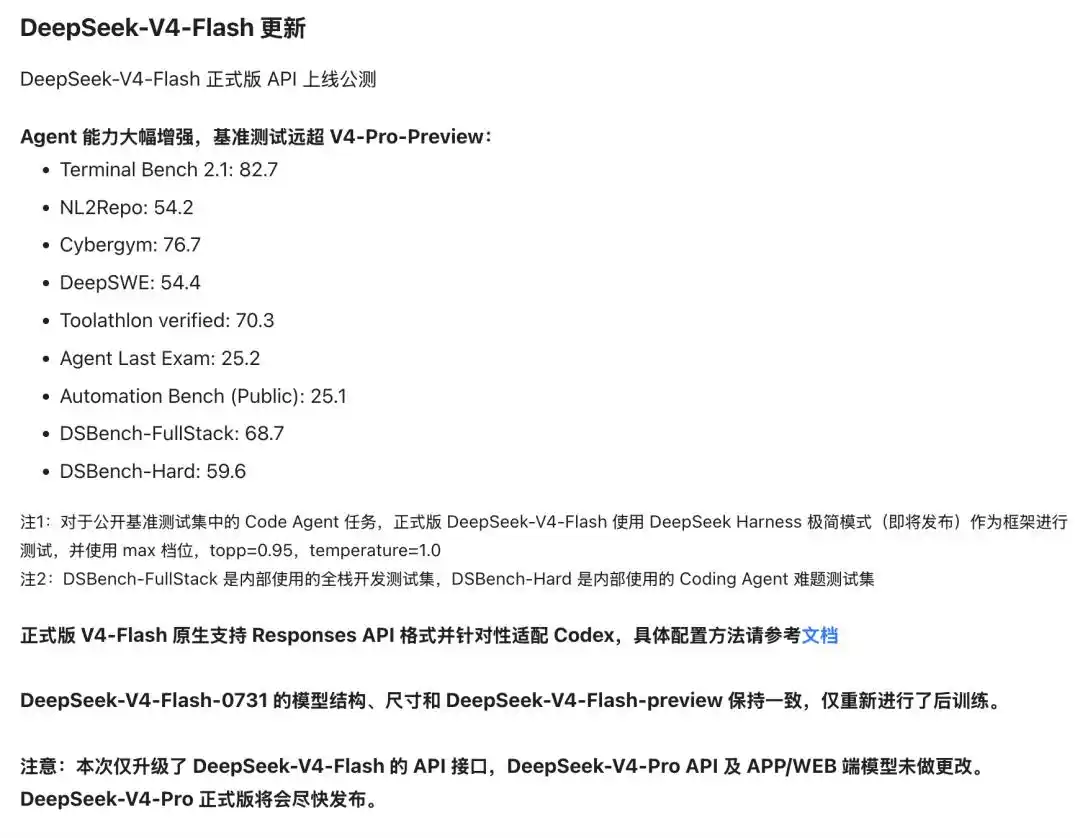
It is important to note that Terminal Bench 2.0 and 2.1 are not the same version of the test suite, so a direct comparison is not entirely fair. However, for a lightweight version with only 13 billion activation parameters to achieve such scores in Agent capabilities suggests that the optimization space in the post-training phase might offer greater leverage than simply scaling up parameters.
Additionally, DeepSeek also specifically noted that the current public beta is limited to the API, and the latest capabilities are not yet available on the App and web interface. The DeepSeek-V4-Pro official version will be released as soon as possible.
“Only Underwent Post-Training Again”
The DeepSeek official statement in the update log indicates, “The model architecture, size, and parameters of DeepSeek-V4-Flash-0731 remain consistent with DeepSeek-V4-Flash-preview; only post-training was conducted again.”
According to DeepSeek's official technical report, V4-Flash has 284 billion total parameters and 13 billion activation parameters; V4-Pro has 1.6 trillion total parameters and 49 billion activation parameters. The two differ by an order of magnitude in model scale. If Flash can bring its Agent capabilities close to Pro's level through post-training, it implies that for specific tasks, model scale is not the decisive factor—the weight of training methods and data quality is rising.
The official also specially noted that for the Code Agent tasks in the public benchmark tests, the DeepSeek Harness minimal mode was used as the framework for testing, with max setting, topp=0.95, temperature=1.0. This detail suggests that DeepSeek may have made targeted optimizations at the Agent framework level, not just improvements in the model itself.
This is also the first time DeepSeek's self-developed Harness has appeared under an official name. Previously, Liang Wenfeng compared the path to AGI to climbing stairs: language models are the first step, CoT (Chain-of-Thought) was addressed last year, this year's step is Agent, and the problem that must be solved after Agent is continuous learning—enabling models to accumulate experience over time like humans, rather than requiring the full context to be fed in every time to work. Beyond that lies the “singularity” of self-iteration and embodied intelligence. “AI currently lacks not taste or intuition, but the ability for continuous learning,” he said. “Investors look at Agent; we look at how to solve learning.”
Continuous learning sounds like a model-level proposition, but its engineering focal point lies precisely in the Harness. DeepSeek's Agent Harness team was formed in March this year. Leading it is Cui Tianyi, born in the 1990s, a Zhejiang University computer science graduate, holder of six ACM Asia Regional Competition gold medals, who previously worked for nine years at top quantitative firm Jane Street, joined DeepSeek in March this year, and subsequently aggressively recruited in May.
It is reported that DeepSeek plans to launch the Harness concurrently with the V4 official version release. Furthermore, as DeepSeek stated at the end of the log, “The DeepSeek-V4-Pro official version will be released as soon as possible.”
A Direct Confrontation at the Ecosystem Level
If large model competition in 2023 was about “competing on general capabilities” and 2024 was about “competing on long context,” then the keyword for 2026 is undoubtedly Agent.
Agent capability—the model's ability to autonomously plan, call tools, and execute complex tasks—is becoming the new yardstick for measuring large model strength. From Terminal Bench (terminal operations) and NL2Repo (code repository generation) to Cybergym (cybersecurity tasks) and SWE-bench (software engineering), a series of Agent benchmark tests are redefining what makes a good model.
Globally, the first tier of Agent capability is still dominated by closed-source giants. According to data from third-party evaluation platforms like benchlm.ai, GPT-5.6 Sol and the Claude Opus series rank at the top in most Agent benchmark tests. Among domestic players, GLM, Qwen, and others are also catching up quickly.
DeepSeek's significant boost to Flash's Agent capabilities this time has a clear strategic intent: to enter the vast market of Agent applications with a high-value, lightweight model.
After all, Agent scenarios are far more sensitive to inference speed and cost than pure dialogue scenarios. An Agent task requiring repeated tool calls and multi-step reasoning could cost several times or even tens of times more to run on a flagship model compared to Flash. If Flash's Agent capability reaches a level that is “sufficient or even good,” its cost-performance advantage will be highly disruptive.
The two internal test sets officially released also have clear targets. DSBench-FullStack (internal full-stack development test set) scored 68.7, and DSBench-Hard (internal Coding Agent difficult problem test set) scored 59.6. This indirectly confirms DeepSeek's positioning—to build Flash as the preferred foundation for developers and Agent applications.
A quiet ecosystem battle is also brewing. The official V4-Flash natively supports the Responses API format and is specifically adapted for Codex.
The Responses API is a new-generation API format strongly promoted by OpenAI. Compared to the traditional Chat Completions, it is more suitable for Agent scenarios—supporting more flexible tool calls, more complex multi-turn interactions, and finer-grained output control.
DeepSeek's native support for this format means developers can migrate Agent applications developed based on the OpenAI ecosystem to DeepSeek at a lower cost. This will be a direct confrontation between the two at the ecosystem level.
The adaptation for Codex targets the vertical scenario of code generation and software development. Codex is OpenAI's model for the code domain. DeepSeek's targeted adaptation is a direct challenge in OpenAI's traditional area of strength.
Viewed together, these moves indicate that DeepSeek's ambition is not just to be a “cheap alternative” but to establish its own niche in the Agent era.
After the 50 Billion RMB Financing: Time Window Under High Valuation
This update comes less than two months after DeepSeek completed its first round of external financing.
A little over a month ago, DeepSeek completed its first external financing round since its founding nearly three years ago, raising over 50 billion RMB, setting a single-round financing record in China's AI industry, with a post-money valuation of approximately $52 billion (about 350 billion RMB). Investors included industry giants like Tencent, CATL, JD.com, as well as several state-owned industrial funds.
In mid-July, DeepSeek intended to advance a new round of private financing with a pre-money valuation of about $71 billion (approximately 480 billion RMB), a roughly 37% increase from the $52 billion valuation after the first round. The interval from $52 billion to $71 billion was less than six weeks.
Behind the high valuation lies market recognition of DeepSeek's technical strength and bets on its commercialization prospects. However, high valuation also means high expectations and high pressure.
According to multiple media reports, DeepSeek founder Liang Wenfeng personally contributed approximately 20 billion RMB in the first financing round, maintaining firm control of the company through a special structure. This founder, who emerged from the quantitative firm Phantom, had insisted on self-funding for nearly three years previously. The shift from “no financing, no IPO” to actively embracing capital is itself a strong signal—DeepSeek is accelerating toward commercialization and an IPO.
The launch of the Flash official version can perhaps be seen as a technological realization by DeepSeek under the support of capital. But the real test lies ahead: Can the Pro official version arrive on schedule? Can the improvement in Agent capability translate into solid revenue? Under the pressure from giants like OpenAI and Anthropic, how will DeepSeek leverage its high-value route?
The curtain on the Agent war has just risen. DeepSeek, with a significant evolution of a lightweight model, poses a new question to the industry—when the dividends of post-training are fully exploited, when efficiency gains begin to offset the parameter gap, the competitive logic of large models may need to be rewritten.
This article is from the WeChat public account “Phoenix Net Technology,” author: Phoenix Net Technology