Weekly Data Recap: S&P Pantera Index Launches, Robinhood Chain Volume Climbs to Top 4

marsbit發佈於 2026-07-27更新於 2026-07-27

文章摘要

Weekly Data Recap: S&P Pantera Index Launches, Robinhood Chain Volume Ranks Fourth This week saw a mixed performance for risk assets amidst internal reshuffling. Bitcoin closed slightly down at $64,444, while Ethereum gained 0.6%. A key development was the launch of the S&P Pantera Digital Assets Index (SPPDA), co-created by S&P Dow Jones Indices and Pantera Capital. This 18-token benchmark index, powered by Artemis's revenue and supply data, filters for protocols with actual revenue and weights constituents by market cap. Notably, Bitcoin and XRP were excluded due to the revenue requirement. Meanwhile, Robinhood Chain, an Arbitrum Orbit L2 launched on July 1st, surged to become the fourth-largest chain by DEX volume with $4.7B weekly trading. However, analysis reveals a gap between its intended purpose and current reality. While marketed for tokenizing real-world assets (RWAs) like stocks, the chain is currently dominated by memecoin trading, accounting for ~75% of DEX volume. Robinhood's own stock tokens represent only 4.2% of the chain's $595M TVL, with 70% locked in third-party protocols like Morpho and Ethena. Uniswap commands a near-monopoly (98%) on the DEX layer. The launchpad pons.family captured most activity, generating fees roughly five times the chain's total gas fees. Robinhood currently earns basic transaction fees, while third-party applications capture significant economic value, illustrating a "fat app, skinny chain" dynamic. Other notable developments in...

Author: Artemis Analytics

Compiled by: Deep Tide TechFlow

Deep Tide Intro:S&P and Pantera launched the first crypto index screened based on protocol revenue, with Artemis providing data support. While Robinhood Chain's DEX trading volume has climbed into the industry's top four, the reality is: 70% of its TVL comes from Morpho and Ethena, stock tokens account for only 4.2%, and the memecoin casino still contributes 75% of the trading volume. This chain, which was meant for RWA tokenization, is currently being monetized by third-party protocols, with Robinhood only earning basic fees.

Market Overview

Risk assets traded sideways, but internal structure adjusted sharply. Bitcoin closed at $64,444, down 0.7%. Ethereum rose 0.6%.

The six-week outflow streak for ETFs finally stopped:

  • Spot Bitcoin ETFs: Net inflow of $75.5 million from July 13–17, net inflow of $33.9 million from July 20–24
  • Total Bitcoin ETF AUM: $78.9 billion
  • Ethereum ETFs: Net inflow of about $104 million per week over the past two weeks

The real repricing happened in the interest rate market. The probability of a Fed rate hike on July 28–29 surged from 10.7% on July 15 to nearly 35% by July 22, almost entirely due to Brent crude approaching $100 driven by Iran conflict.
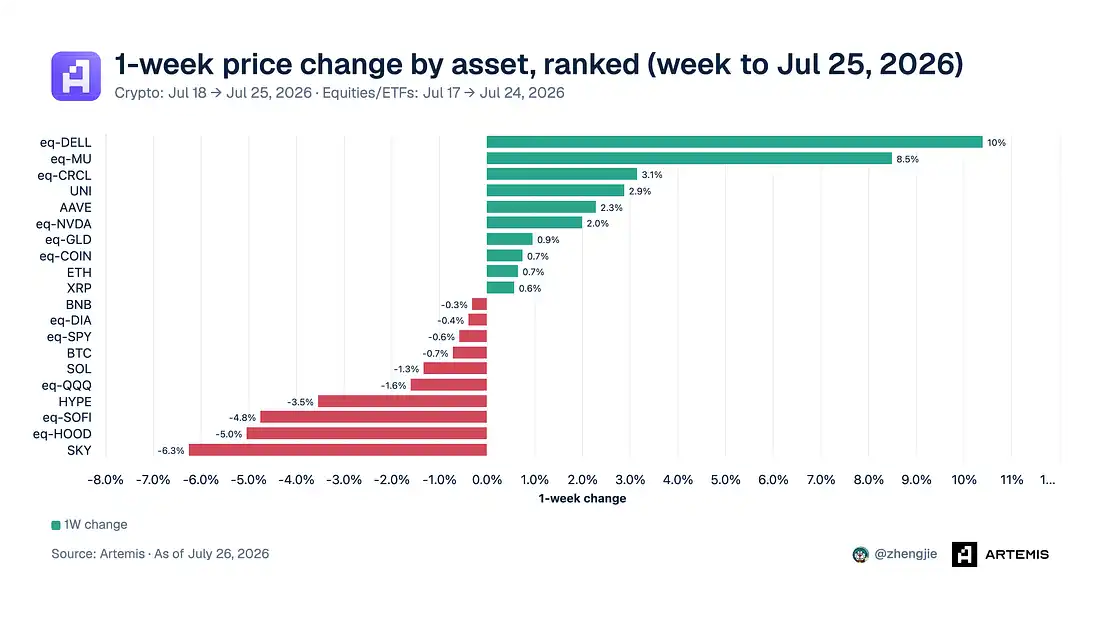
Chart: Weekly asset price performance, cryptocurrencies mixed vs. stocks/ETFs, eq-DELL leads gains at ~10%. Source: Artemis

Unlike last week, semiconductor stocks rebounded. Dell (+10.4%) and Micron (+8.5%) led gains, a sharp reversal for memory chips after Micron plunged 28% from its June high. Nvidia (+2.0%) outperformed its anchor index, the Nasdaq 100 (-1.5%). DeFi continued its rise, with UNI (+2.9%) and AAVE (+2.3%).

Crypto stocks were mixed. Circle (+3.2%) was the only stock with material gains. Coinbase (+0.75%) gave back all of its 9.6% gain from July 21 driven by the CLARITY Act.

The hardest hit were retail fintech stocks: SKY (-6.2%), HOOD (-5.0%) and SOFI (-4.8%), with HYPE (-3.5%) following closely. Bitcoin (-0.7%) and major indices barely moved (SPY -0.5%, Dow -0.3%).

A basket of stocks averaged a gain of 0.41%, median +0.18%.

S&P Pantera Digital Asset Index Launches, Powered by Artemis Data

S&P Dow Jones Indices and Pantera Capital launched the S&P Pantera Digital Asset Index (SPPDA) on July 20th.

This is an 18-token benchmark index that screens for projects with protocol revenue from the S&P Crypto Broad Digital Asset Index, then weights them by market cap.

Artemis provides revenue classification, circulating supply, and total supply data. Lukka provides pricing.

The top five component tokens by weight are ETH, BNB, SOL, TRX, and HYPE.
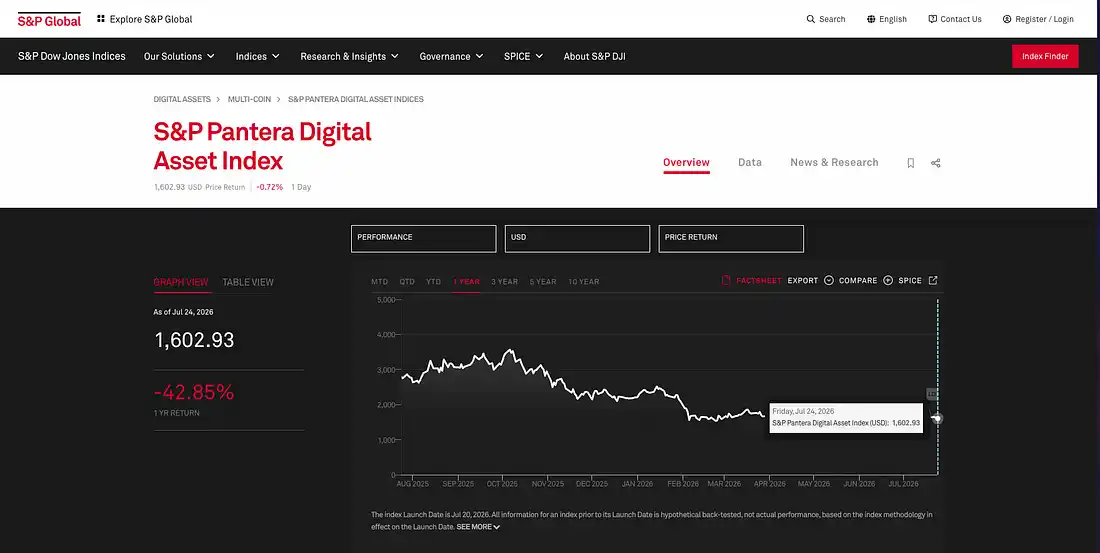
Chart: S&P Pantera Digital Asset Index (SPPDA), powered by Artemis revenue data, screened by protocol revenue, weighted by market cap. Source: Artemis

Both Bitcoin and XRP fail the revenue test outright. For scale: XRP's entire 14-year history of burned fees totals about $16 million, while the 18 selected tokens generate over $3 billion in revenue annually.

S&P is positioning this index carefully. The methodology calls protocol revenue an "objective, rules-based indicator of economic activity" and explicitly states it does not imply investment return or cash flow.

Simply put, revenue determines which tokens make the cut, market cap determines how much you hold. So if you read the headlines and thought this was a way to hold the biggest earners in crypto, you'd be wrong.

Additionally, tokens need at least 30% of supply actually circulating to qualify, quietly weeding out projects whose valuations are built on locked-up tokens.

This rule runs on Artemis's circulating supply data and hasn't been reported on yet. The first component rebalance will be determined on the third Friday of August, effective September 18th.

Robinhood Chain: What's Actually Happening

Let's be clear on what Robinhood Chain is, because most people skipped that part.

Robinhood Chain is an Arbitrum Orbit L2, meaning Robinhood rents Ethereum's security and runs its own cheap, fast transaction layer on top of it. It launched on July 1st.

The pitch was tokenizing real-world assets: putting stocks, ETFs, and private equity on-chain. Robinhood's customers could trade them 24/7, including in places where they can't open a US brokerage account. What actually launched was a memecoin casino, and what's happening now is that casino slowly turning into what it was supposed to be (RWA tokenization).

Just last week, we showed Robinhood Chain becoming a leading chain for DEX volume on a peak day. For the full week of July 18–25, it ranked fourth at $4.7 billion, behind BSC, Ethereum, and Base, ahead of Solana.
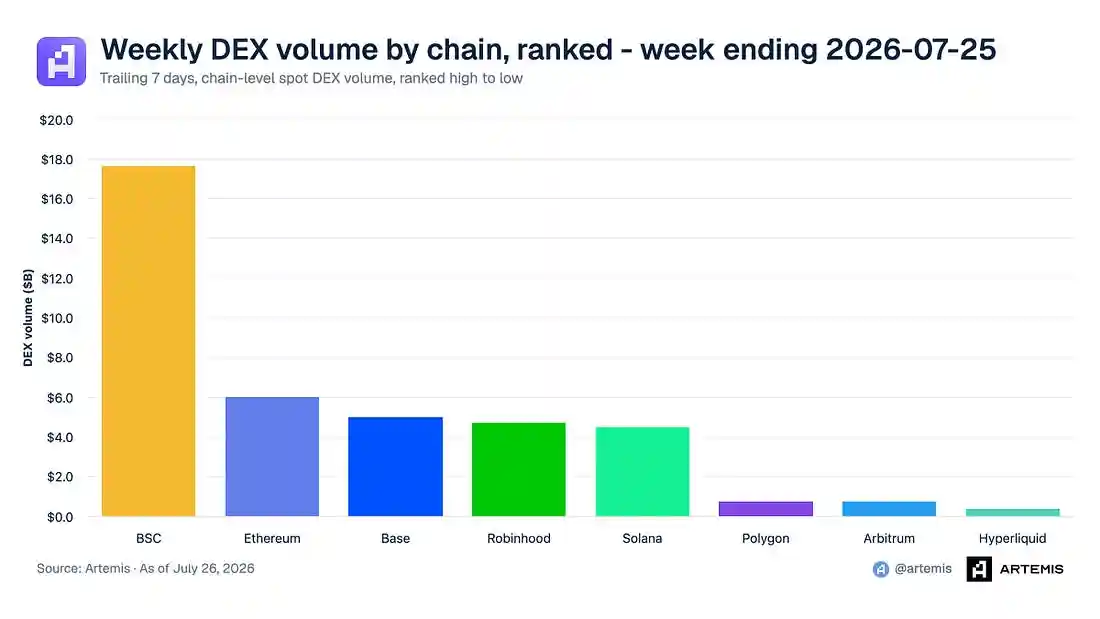
Chart: DEX Volume Ranking by Chain for July 18–25, Robinhood Chain ranks fourth at $4.7B, behind BSC, Ethereum, Base. Source: Artemis

Activity on Robinhood Chain:
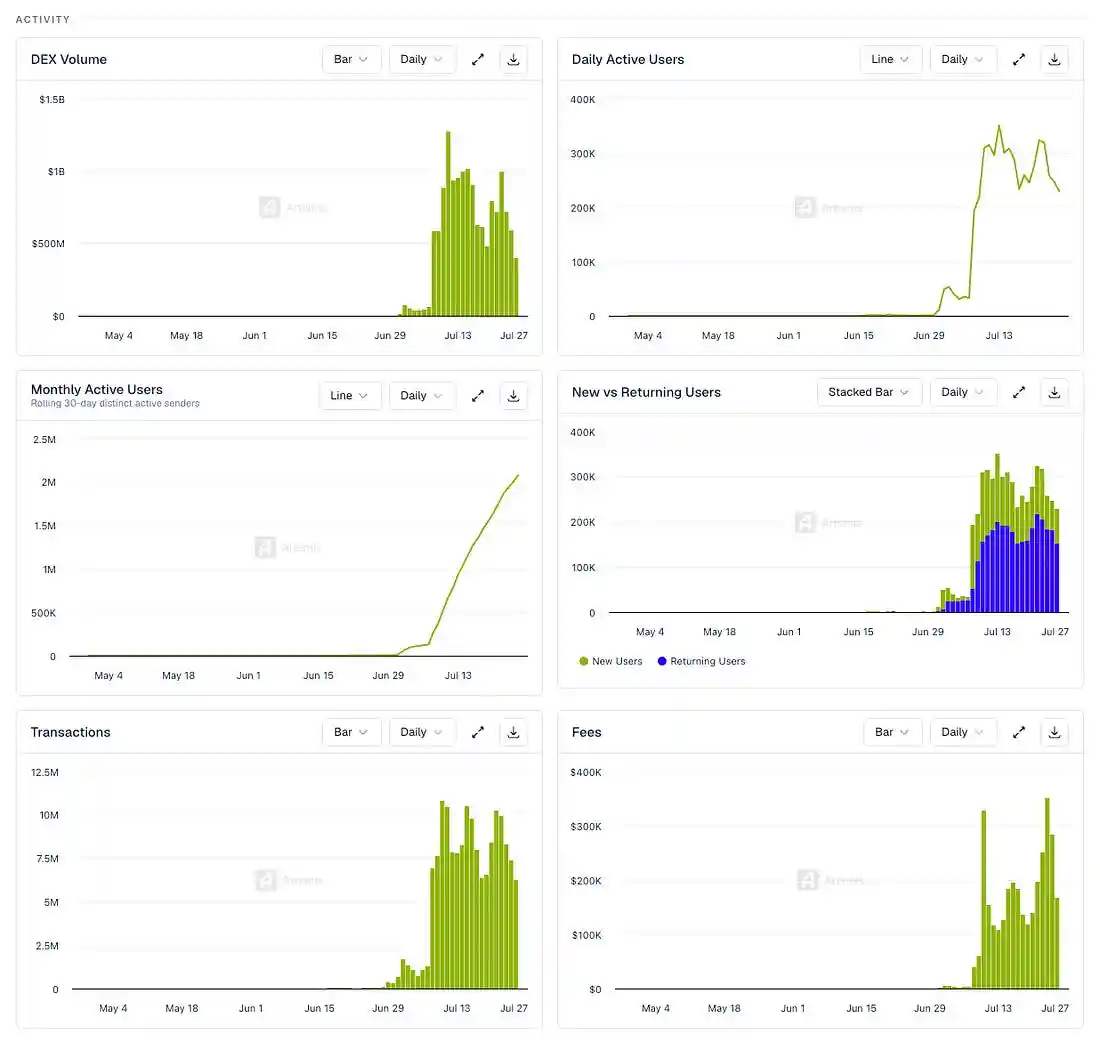
Chart: Robinhood Chain Activity Metrics – DEX daily volume ~$500M, daily active users ~250K, monthly active users 2.1M. Source: Artemis

  • DEX volume averaging ~$500 million daily
  • Daily Active Users averaging ~250,000
  • Monthly Active Users hit a new ATH of 2.1 million
  • About two-thirds of DAUs are returning users
  • Transaction count averaging ~6 million daily
  • Fees averaging ~$200,000 daily

Most of the Money on Robinhood Chain Isn't Robinhood's

As of July 25th, TVL was $595.1 million, a massive jump from almost zero in mid-June. The composition is key:

  • Morpho: $236.2 million
  • Ethena: $177 million
  • Uniswap: $48.3 million
  • Maple: $48.1 million
  • Lighter: $25 million
  • Robinhood Stock Tokens: $24.7 million

Morpho and Ethena together account for 70% of the on-chain money. Robinhood stock tokens make up only 4.2%.
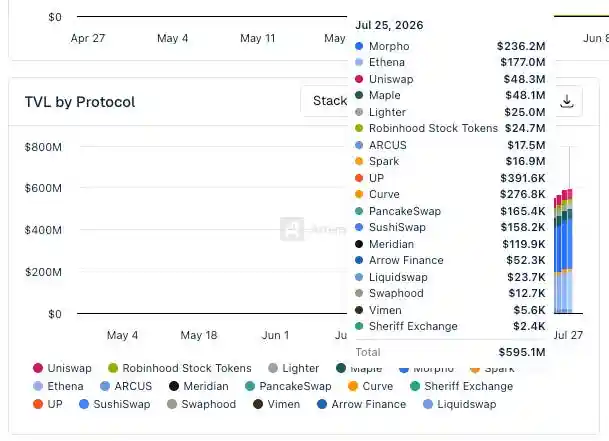
Chart: Robinhood Chain TVL Composition as of July 25, Morpho + Ethena account for 70%, Robinhood stock tokens only 4.2%. Source: Artemis

Uniswap Has a Complete Monopoly on the Trading Layer

Of the $397.4 million in DEX volume on July 25th:

  • Uniswap V3: $251.9 million
  • Uniswap V4: $80.1 million
  • Uniswap V2: $58.4 million
  • All other protocols combined: less than $7 million

That's 98% Uniswap. Arcus, PancakeSwap, and all forks on-chain share the remainder.
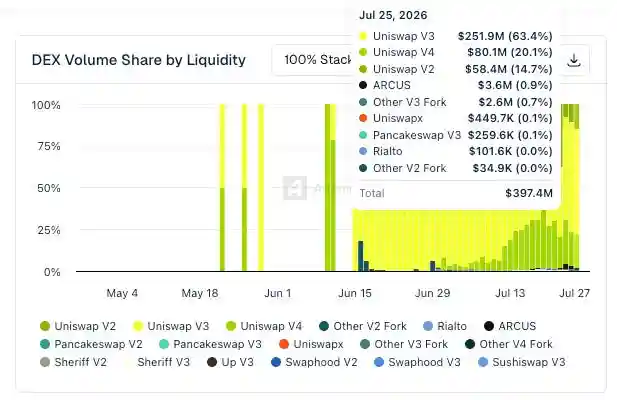
Chart: DEX Volume by Liquidity Share on July 25, Uniswap V3 63.4%, V4 20.1%, total 98%. Source: Artemis

Memecoins still account for the majority of all DEX volume:

  • Memecoin pairs: $297 million (74.7%)
  • Ethereum: $64.2 million (16.1%)
  • Robinhood stock token pairs: $36 million (9.1%)
  • Protocol token pairs: $219.6K (0.1%)

One Launchpad Accounts for Most of the On-Chain Activity

On July 25th, pons.family accounted for:

  • $99.7 million out of $155.8 million in launchpad volume (64%)
  • 1.3 million out of 1.6 million launchpad transactions (81%)
  • 11,200 out of 17,600 tokens deployed (64%)

The second-largest platform, Bankr, did $13.1 million.

Over seven days, pons.family generated $7.86 million in total fees on $826 million in volume. Total gas fees for the chain in the same period were about $1.51 million.

The application layer revenue was about five times that of the L2.
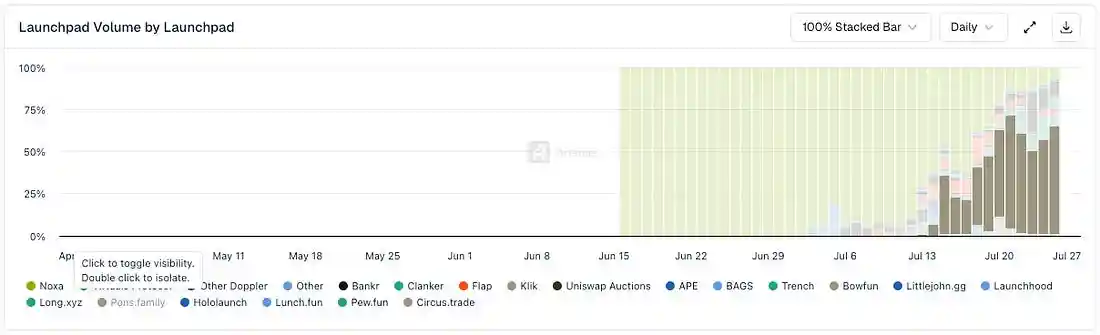
Chart: Launchpad Volume Distribution, pons.family accounts for 64% of launchpad volume and 81% of transactions. Source: Artemis

What It Was Built For: Small, Growing Fast, Broader Than Stocks

Total on-chain tokenized market cap is $24.8 million:

  • Stocks: $19.1 million
  • Private Equity: $1.9 million
  • ETFs: $1.5 million
  • Commodities: $1.2 million
  • US Treasuries: $800,100

That's up about 4.5x from about $5.5 million on June 29th, in less than a month. Tokenized equity holders grew from 29,407 to 48,470 in five days. Stock token pairs now account for 9.1% of DEX volume, averaging $36 million daily, compared to 74.7% for memecoins.
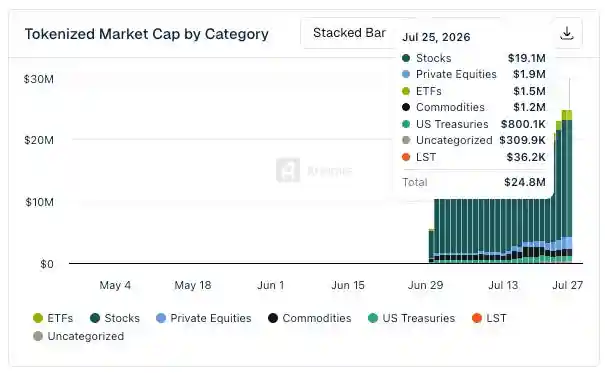
Chart: Total On-Chain Tokenized Market Cap by Category, Stocks lead at $19.1M, total $24.8M. Source: Artemis

Robinhood built the distribution channel. Third parties capture the economic upside. Morpho and Ethena hold deposits. Uniswap clears trades. Pons.family takes fees. Robinhood earns the base fee, annualized to about $78 million.

This is the fat application, thin chain theory with a public company P&L attached.

Chart of the Week

Hyperliquid open interest reached a new all-time high of $11.4 billion on July 24, 2026.
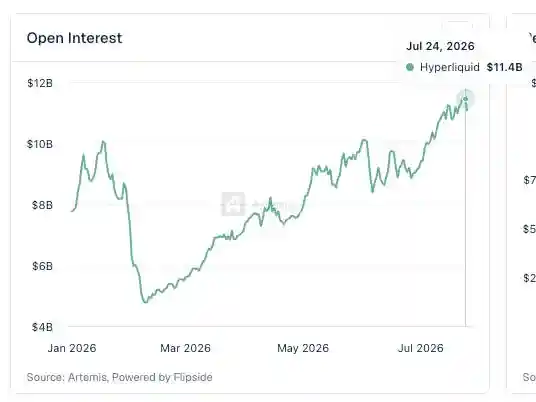
Chart: Hyperliquid Open Interest hits new ATH of $11.4B on July 24. Source: Artemis / Flipside

Ethereum ETFs saw net inflows of about $104 million over the past two weeks, while Bitcoin flows were more volatile.
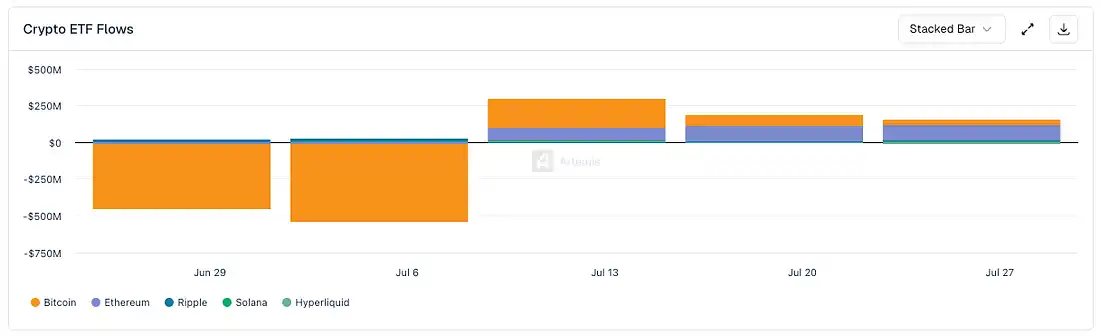
Chart: Crypto ETF Flows, Ethereum net inflow ~$104M over past two weeks, Bitcoin more volatile. Source: Artemis

Other Notable News

  • The London Stock Exchange announced LSE 24 on July 21, a 24/5 trading venue with native access for AI agents and on-chain settlement; two days later the SEC announced a September 17th roundtable on 24-hour US equity trading.
  • Strategy sold $263.5 million of MSTR stock between July 13–19, marking a fourth consecutive week without buying Bitcoin, boosting its dollar reserves to $3.225 billion against ~$1.76 billion in annual preferred stock and interest obligations.
  • Nine companies including Strategy, BlackRock, Coinbase, and Galaxy pledged $15 million over three years for Bitcoin post-quantum research, with over 7 million BTC in outputs with exposed public keys.
  • Regulators missed the July 18th rulemaking deadline for the GENIUS Act, with no final rules from any of the six agencies, pushing full implementation to January 18, 2027, while stablecoin supply still grew 18.6% to $308.1 billion.
  • PayPal's board formally rejected Stripe and Advent's $60.50 per share acquisition offer, hired Goldman Sachs and Evercore, and is seeking a price near $70 ahead of July 28th earnings.
  • The CLARITY Act still hasn't had a cloture motion filed, with the August 7th recess being the key deadline.

熱門幣種推薦

相關問答

QWhat are the key criteria used to screen tokens for inclusion in the S&P Pantera Digital Asset Index (SPPDA), and why are Bitcoin and XRP excluded?

AThe S&P Pantera Digital Asset Index screens tokens based on their ability to generate protocol revenue. Tokens are selected from the S&P Cryptocurrency Broad Digital Assets Index and must have at least 30% of their supply in circulation. The weights are then determined by market capitalization. Bitcoin and XRP are excluded because they failed the protocol revenue test. For example, the article notes that XRP's total burned value over its entire 14-year history is only about $16 million, whereas the 18 selected tokens generate over $3 billion in annual revenue.

QAccording to the data, what is the current composition of Total Value Locked (TVL) on the Robinhood Chain, and what does this reveal about the chain's actual use versus its intended purpose?

AAs of July 25th, the TVL on Robinhood Chain was $595.1 million. Its composition reveals a significant divergence from its intended purpose of RWA tokenization. Morpho ($236.2M) and Ethena ($177M) together account for approximately 70% of the TVL. In contrast, Robinhood's tokenized stocks only represent $24.7 million, or 4.2% of the total. This shows that most of the capital on the chain is from third-party DeFi protocols, not from the RWA assets it was primarily built to host.

QWhat is the dominant DEX on the Robinhood Chain in terms of trading volume, and what types of assets constitute the majority of its DEX trading activity?

AUniswap is the dominant DEX on the Robinhood Chain, accounting for approximately 98% of its total DEX volume as of July 25th. This breakdown includes Uniswap V3 (63.4%), V4 (20.1%), and V2. The vast majority of DEX trading activity, about 74.7%, is in memecoin trading pairs. Tokenized stocks represent 9.1% of the volume, and Ethereum trading pairs make up 16.1%.

QWhat major event triggered a significant repricing in the interest rate market during the week discussed in the article, and how did this affect crypto and stock assets?

AThe significant repricing in the interest rate market was triggered by escalating tensions between the US and Iran, which pushed Brent crude oil prices toward $100 per barrel. This caused the probability of a Federal Reserve rate hike to surge from 10.7% on July 15th to nearly 35% by July 22nd. In response, crypto and stock assets showed mixed performance. Semiconductors like Dell and Micron rebounded strongly, while retail fintech stocks (e.g., Robinhood, SoFi) were the hardest hit, declining significantly. Bitcoin and major stock indices like the S&P 500 saw only minor movements.

QWhat is the 'fat app, thin chain' theory, and how does the current economic activity on the Robinhood Chain serve as an example of it?

AThe 'fat app, thin chain' theory suggests that the majority of value and economic activity (the 'fat' part) occurs at the application layer (dApps, protocols), while the underlying blockchain (the 'thin' chain) primarily provides basic security and settlement, earning relatively minimal fees. Robinhood Chain is a prime example. Third-party applications like Morpho, Ethena, Uniswap, and pons.family capture most of the economic value through TVL, trading fees, and launchpad fees. In contrast, the Robinhood Chain itself only earns the foundational gas fees, estimated at an annualized rate of about $78 million, while the application layer's revenue is roughly five times higher.

你可能也喜歡

Core Scientific支付4190万美元以加速退出比特币挖矿业务

比特币矿企Core Scientific在季度报告中披露,为终止与Block及其子公司Proto的比特币挖矿芯片供应合同支付了4190万美元违约金。公司正彻底放弃提升算力的计划,并将业务转向人工智能托管服务。 除了已确认的4190万美元损失外,协议未披露其他额外赔偿条款。该协议最初于2024年7月宣布,涉及供应总算力约15 EH/s的3纳米芯片,并包含额外采购期权。取消订单后,Core Scientific表示将不再投资新的挖矿设备以维持或扩大加密货币挖矿产能。 公司计划通过现有设备产生现金流,同时着手改造其数据中心设施,必要时将出售或淘汰ASIC矿机。2026年第二季度,其AI托管收入飙升至1.367亿美元,较上年同期的1060万美元大幅增长,占总营收的83%。同期,自主挖矿收入下降66%至2150万美元,第三方矿机托管收入为600万美元。 公司季度比特币产量同比下降53%,平均实现价格下跌27%。截至2026年6月30日,其AI托管容量为395兆瓦,到7月中旬增至437兆瓦。客户租赁的总功率达到约1.1吉瓦。目前所有托管收入均来自CoreWeave,该公司在2026年上半年贡献了Core Scientific约77%的总收入。 此外,Core Scientific在7月底宣布与AMD达成合作,潜在数据中心容量达2.5吉瓦。初始为期15年的协议覆盖约530兆瓦和五个站点,预计可带来超过140亿美元的合同收入。2026年第二季度,公司总收入增长至1.642亿美元,资本支出跃升至7.975亿美元。截至6月30日,其采购和建设承诺约为10亿美元,长期债务为43亿美元,自由流动性为18.2亿美元。 2026年,随着比特币挖矿盈利压力加剧,多家大型矿企加速向AI领域转型,斯坦福大学数据也证实了这一趋势。

cryptonews.ru8 分鐘前

Core Scientific支付4190万美元以加速退出比特币挖矿业务

cryptonews.ru8 分鐘前

交易

現貨

熱門文章

什麼是 $S$

理解 SPERO:全面概述 SPERO 簡介 隨著創新領域的不斷演變,web3 技術和加密貨幣項目的出現在塑造數字未來中扮演著關鍵角色。在這個動態領域中,SPERO(標記為 SPERO,$$s$)是一個引起關注的項目。本文旨在收集並呈現有關 SPERO 的詳細信息,以幫助愛好者和投資者理解其基礎、目標和在 web3 和加密領域內的創新。 SPERO,$$s$ 是什麼? SPERO,$$s$ 是加密空間中的一個獨特項目,旨在利用去中心化和區塊鏈技術的原則,創建一個促進參與、實用性和金融包容性的生態系統。該項目旨在以新的方式促進點對點互動,為用戶提供創新的金融解決方案和服務。 SPERO,$$s$ 的核心目標是通過提供增強用戶體驗的工具和平台來賦能個人。這包括使交易方式更加靈活、促進社區驅動的倡議,以及通過去中心化應用程序(dApps)創造金融機會的途徑。SPERO,$$s$ 的基本願景圍繞包容性展開,旨在彌合傳統金融中的差距,同時利用區塊鏈技術的優勢。 誰是 SPERO,$$s$ 的創建者? SPERO,$$s$ 的創建者身份仍然有些模糊,因為公開可用的資源對其創始人提供的詳細背景信息有限。這種缺乏透明度可能源於該項目對去中心化的承諾——這是一種許多 web3 項目所共享的精神,優先考慮集體貢獻而非個人認可。 通過將討論重心放在社區及其共同目標上,SPERO,$$s$ 體現了賦能的本質,而不特別突出某些個體。因此,理解 SPERO 的精神和使命比識別單一創建者更為重要。 誰是 SPERO,$$s$ 的投資者? SPERO,$$s$ 得到了來自風險投資家到天使投資者的多樣化投資者的支持,他們致力於促進加密領域的創新。這些投資者的關注點通常與 SPERO 的使命一致——優先考慮那些承諾社會技術進步、金融包容性和去中心化治理的項目。 這些投資者通常對不僅提供創新產品,還對區塊鏈社區及其生態系統做出積極貢獻的項目感興趣。這些投資者的支持強化了 SPERO,$$s$ 作為快速發展的加密項目領域中的一個重要競爭者。 SPERO,$$s$ 如何運作? SPERO,$$s$ 採用多面向的框架,使其與傳統的加密貨幣項目區別開來。以下是一些突顯其獨特性和創新的關鍵特徵: 去中心化治理:SPERO,$$s$ 整合了去中心化治理模型,賦予用戶積極參與決策過程的權力,關於項目的未來。這種方法促進了社區成員之間的擁有感和責任感。 代幣實用性:SPERO,$$s$ 使用其自己的加密貨幣代幣,旨在在生態系統內部提供多種功能。這些代幣使交易、獎勵和平台上提供的服務得以促進,增強了整體參與度和實用性。 分層架構:SPERO,$$s$ 的技術架構支持模塊化和可擴展性,允許在項目發展過程中無縫整合額外的功能和應用。這種適應性對於在不斷變化的加密環境中保持相關性至關重要。 社區參與:該項目強調社區驅動的倡議,採用激勵合作和反饋的機制。通過培養強大的社區,SPERO,$$s$ 能夠更好地滿足用戶需求並適應市場趨勢。 專注於包容性:通過提供低交易費用和用戶友好的界面,SPERO,$$s$ 旨在吸引多樣化的用戶群體,包括那些以前可能未曾參與加密領域的個體。這種對包容性的承諾與其通過可及性賦能的總體使命相一致。 SPERO,$$s$ 的時間線 理解一個項目的歷史提供了對其發展軌跡和里程碑的關鍵見解。以下是建議的時間線,映射 SPERO,$$s$ 演變中的重要事件: 概念化和構思階段:形成 SPERO,$$s$ 基礎的初步想法被提出,與區塊鏈行業內的去中心化和社區聚焦原則密切相關。 項目白皮書的發布:在概念階段之後,發布了一份全面的白皮書,詳細說明了 SPERO,$$s$ 的願景、目標和技術基礎設施,以吸引社區的興趣和反饋。 社區建設和早期參與:積極進行外展工作,建立早期採用者和潛在投資者的社區,促進圍繞項目目標的討論並獲得支持。 代幣生成事件:SPERO,$$s$ 進行了一次代幣生成事件(TGE),向早期支持者分發其原生代幣,並在生態系統內建立初步流動性。 首次 dApp 上線:與 SPERO,$$s$ 相關的第一個去中心化應用程序(dApp)上線,允許用戶參與平台的核心功能。 持續發展和夥伴關係:對項目產品的持續更新和增強,包括與區塊鏈領域其他參與者的戰略夥伴關係,使 SPERO,$$s$ 成為加密市場中一個具有競爭力和不斷演變的參與者。 結論 SPERO,$$s$ 是 web3 和加密貨幣潛力的見證,能夠徹底改變金融系統並賦能個人。憑藉對去中心化治理、社區參與和創新設計功能的承諾,它為更具包容性的金融環境鋪平了道路。 與任何在快速發展的加密領域中的投資一樣,潛在的投資者和用戶都被鼓勵進行徹底研究,並對 SPERO,$$s$ 的持續發展進行深思熟慮的參與。該項目展示了加密行業的創新精神,邀請人們進一步探索其無數可能性。儘管 SPERO,$$s$ 的旅程仍在展開,但其基礎原則確實可能影響我們在互聯網數字生態系統中如何與技術、金融和彼此互動的未來。

315 人學過發佈於 2024.12.17更新於 2024.12.17

什麼是 $S$

什麼是 AGENT S

Agent S:Web3中自主互動的未來 介紹 在不斷演變的Web3和加密貨幣領域,創新不斷重新定義個人如何與數字平台互動。Agent S是一個開創性的項目,承諾通過其開放的代理框架徹底改變人機互動。Agent S旨在簡化複雜任務,為人工智能(AI)提供變革性的應用,鋪平自主互動的道路。本詳細探索將深入研究該項目的複雜性、其獨特特徵以及對加密貨幣領域的影響。 什麼是Agent S? Agent S是一個突破性的開放代理框架,專門設計用來解決計算機任務自動化中的三個基本挑戰: 獲取特定領域知識:該框架智能地從各種外部知識來源和內部經驗中學習。這種雙重方法使其能夠建立豐富的特定領域知識庫,提升其在任務執行中的表現。 長期任務規劃:Agent S採用經驗增強的分層規劃,這是一種戰略方法,可以有效地分解和執行複雜任務。此特徵顯著提升了其高效和有效地管理多個子任務的能力。 處理動態、不均勻的界面:該項目引入了代理-計算機界面(ACI),這是一種創新的解決方案,增強了代理和用戶之間的互動。利用多模態大型語言模型(MLLMs),Agent S能夠無縫導航和操作各種圖形用戶界面。 通過這些開創性特徵,Agent S提供了一個強大的框架,解決了自動化人機互動中涉及的複雜性,為AI及其他領域的無數應用奠定了基礎。 誰是Agent S的創建者? 儘管Agent S的概念根本上是創新的,但有關其創建者的具體信息仍然難以捉摸。創建者目前尚不清楚,這突顯了該項目的初期階段或戰略選擇將創始成員保密。無論是否匿名,重點仍然在於框架的能力和潛力。 誰是Agent S的投資者? 由於Agent S在加密生態系統中相對較新,關於其投資者和財務支持者的詳細信息並未明確記錄。缺乏對支持該項目的投資基礎或組織的公開見解,引發了對其資金結構和發展路線圖的質疑。了解其支持背景對於評估該項目的可持續性和潛在市場影響至關重要。 Agent S如何運作? Agent S的核心是尖端技術,使其能夠在多種環境中有效運作。其運營模型圍繞幾個關鍵特徵構建: 類人計算機互動:該框架提供先進的AI規劃,力求使與計算機的互動更加直觀。通過模仿人類在任務執行中的行為,承諾提升用戶體驗。 敘事記憶:用於利用高級經驗,Agent S利用敘事記憶來跟蹤任務歷史,從而增強其決策過程。 情節記憶:此特徵為用戶提供逐步指導,使框架能夠在任務展開時提供上下文支持。 支持OpenACI:Agent S能夠在本地運行,使用戶能夠控制其互動和工作流程,與Web3的去中心化理念相一致。 與外部API的輕鬆集成:其多功能性和與各種AI平台的兼容性確保了Agent S能夠無縫融入現有技術生態系統,成為開發者和組織的理想選擇。 這些功能共同促成了Agent S在加密領域的獨特地位,因為它以最小的人類干預自動化複雜的多步任務。隨著項目的發展,其在Web3中的潛在應用可能重新定義數字互動的展開方式。 Agent S的時間線 Agent S的發展和里程碑可以用一個時間線來概括,突顯其重要事件: 2024年9月27日:Agent S的概念在一篇名為《一個像人類一樣使用計算機的開放代理框架》的綜合研究論文中推出,展示了該項目的基礎工作。 2024年10月10日:該研究論文在arXiv上公開,提供了對框架及其基於OSWorld基準的性能評估的深入探索。 2024年10月12日:發布了一個視頻演示,提供了對Agent S能力和特徵的視覺洞察,進一步吸引潛在用戶和投資者。 這些時間線上的標記不僅展示了Agent S的進展,還表明了其對透明度和社區參與的承諾。 有關Agent S的要點 隨著Agent S框架的持續演變,幾個關鍵特徵脫穎而出,強調其創新性和潛力: 創新框架:旨在提供類似人類互動的直觀計算機使用,Agent S為任務自動化帶來了新穎的方法。 自主互動:通過GUI自主與計算機互動的能力標誌著向更智能和高效的計算解決方案邁進了一步。 複雜任務自動化:憑藉其強大的方法論,能夠自動化複雜的多步任務,使過程更快且更少出錯。 持續改進:學習機制使Agent S能夠從過去的經驗中改進,不斷提升其性能和效率。 多功能性:其在OSWorld和WindowsAgentArena等不同操作環境中的適應性確保了它能夠服務於廣泛的應用。 隨著Agent S在Web3和加密領域中的定位,其增強互動能力和自動化過程的潛力標誌著AI技術的一次重大進步。通過其創新框架,Agent S展現了數字互動的未來,為各行各業的用戶承諾提供更無縫和高效的體驗。 結論 Agent S代表了AI與Web3結合的一次大膽飛躍,具有重新定義我們與技術互動方式的能力。儘管仍處於早期階段,但其應用的可能性廣泛且引人入勝。通過其全面的框架解決關鍵挑戰,Agent S旨在將自主互動帶到數字體驗的最前沿。隨著我們深入加密貨幣和去中心化的領域,像Agent S這樣的項目無疑將在塑造技術和人機協作的未來中發揮關鍵作用。

1.1k 人學過發佈於 2025.01.14更新於 2025.01.14

什麼是 AGENT S

如何購買S

歡迎來到HTX.com!在這裡,購買Sonic (S)變得簡單而便捷。跟隨我們的逐步指南,放心開始您的加密貨幣之旅。第一步:創建您的HTX帳戶使用您的 Email、手機號碼在HTX註冊一個免費帳戶。體驗無憂的註冊過程並解鎖所有平台功能。立即註冊第二步:前往買幣頁面,選擇您的支付方式信用卡/金融卡購買:使用您的Visa或Mastercard即時購買Sonic (S)。餘額購買:使用您HTX帳戶餘額中的資金進行無縫交易。第三方購買:探索諸如Google Pay或Apple Pay等流行支付方式以增加便利性。C2C購買:在HTX平台上直接與其他用戶交易。HTX 場外交易 (OTC) 購買:為大量交易者提供個性化服務和競爭性匯率。第三步:存儲您的Sonic (S)購買Sonic (S)後,將其存儲在您的HTX帳戶中。您也可以透過區塊鏈轉帳將其發送到其他地址或者用於交易其他加密貨幣。第四步:交易Sonic (S)在HTX的現貨市場輕鬆交易Sonic (S)。前往您的帳戶,選擇交易對,執行交易,並即時監控。HTX為初學者和經驗豐富的交易者提供了友好的用戶體驗。

2.3k 人學過發佈於 2025.01.15更新於 2026.06.02

如何購買S

相關討論

歡迎來到 HTX 社群。在這裡,您可以了解最新的平台發展動態並獲得專業的市場意見。 以下是用戶對 S (S)幣價的意見。

活动图片