Author: CryptoSlate
Compilation: Deep Tide TechFlow
Deep Tide Introduction: The Bank for International Settlements warns that the five tech giants will invest $1 trillion in AI infrastructure from 2025 to 2026. If the return on investment falls short of expectations, a funding squeeze could first impact risky assets like Bitcoin. While loose monetary policy may benefit Bitcoin in the long run, traders must first survive this round of sell-offs.
Over the past year, AI trading has become one of the main pillars supporting global risk appetite.
However, the Bank for International Settlements (BIS) is now warning: if expected returns fail to materialize, this spending frenzy could become a source of financial stress.
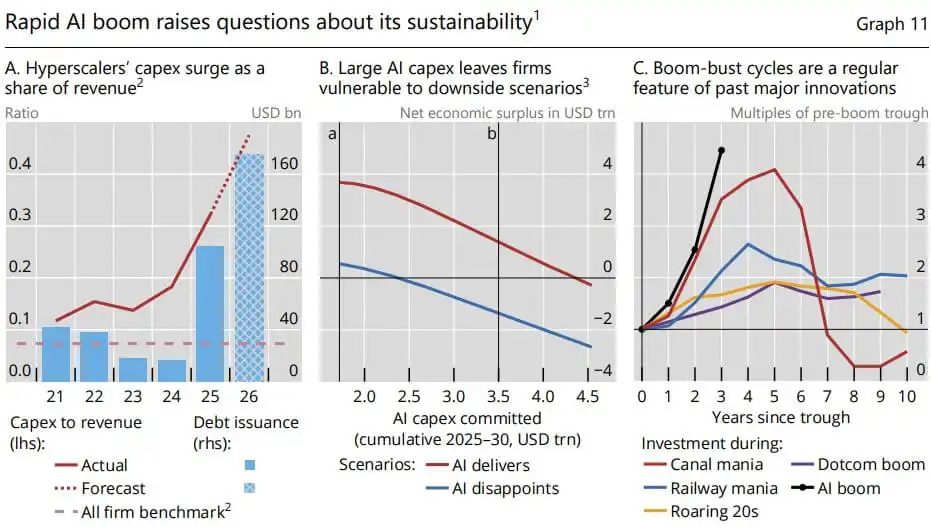
In its annual economic report, the Basel-based institution that advises central banks noted that the five largest cloud computing giants will have AI-related capital expenditures exceeding $1 trillion in 2025 and 2026.
The BIS stated that such massive investment raises the question of whether companies are committing too much capital before their business models are fully validated.
The BIS said:
"Disappointing returns could trigger a sudden withdrawal of financing, turning the capital expenditure boom into a prolonged investment slump, with knock-on effects on financial conditions."
For Bitcoin traders, the implications of this warning extend far beyond the chip and data center race in Silicon Valley.
A sharp reversal in AI spending could tighten liquidity in equity and credit markets, forcing cryptocurrencies to face a tough test: in a sell-off, will Bitcoin initially behave like another risky asset, or will its long-term monetary narrative regain strength after the shock?
AI Spending Boom Draws Central Bank Attention
The Bank for International Settlements (BIS), a forum for central banks, warned in its annual economic report that the race for AI dominance may be pushing investment to levels that future returns cannot sustain.
The BIS stated:
"If supply bottlenecks limit production, the current capital expenditure surge may not be sustainable. Fierce competition for market leadership could further fuel overinvestment, as seen in previous innovation waves, increasing the risk of a sharp reversal if AI returns disappoint."
The issue is not a lack of economic potential for AI. The BIS indicated that this technology could ultimately boost productivity in ways different from earlier waves of automation and software development. If AI systems can self-improve and help generate new ideas, the long-term macroeconomic impact could be significant.
But the near-term financial risks are different. Companies like Google, OpenAI, and Anthropic are pouring huge sums of money without clarity on how much revenue the spending will generate, how long that revenue will last, or how quickly the infrastructure behind AI will become obsolete.
In practice, the largest tech companies are splurging on chips, cloud capacity, data centers, power supplies, and networking equipment, competing for users and market share.
The scale of this race has helped solidify investor confidence in tech stocks while boosting demand for suppliers and infrastructure companies linked to AI construction.
However, the BIS warned that intense competition itself creates fragility. If every major player spends heavily to avoid falling behind, the entire industry could end up with overcapacity, lower returns, and financing structures difficult to maintain once optimism fades.
This dynamic has occurred before. The BIS pointed to earlier investment booms associated with canals, railways, electrification, and the internet.
While each technology later transformed the economy, they also produced periods where investors financed too much, too fast, ultimately leading to painful reversals.
With this in mind, the BIS concluded:
"The scale and speed of the current AI investment boom, coupled with expectations of a significant productivity boost, resemble these precedents and highlight the potential near-term downside risks."
Compounding the issue are severe physical bottlenecks. The insatiable demand for computing power is straining supplies of advanced semiconductors, grid equipment, and raw electricity.
According to the BIS, this surging demand is already pushing up electricity prices, potentially feeding into broader inflation measures—at a time when geopolitical conflicts in the Middle East are independently straining global supply chains.
Credit Risks Build Beneath Equity Rally
Meanwhile, the BIS's concerns extend far beyond a simple stock market correction to how an AI shock could affect the broader financial system.
While the early stages of AI development were funded largely by the massive cash reserves of Silicon Valley giants, the current trillion-dollar scale of investment relies more on debt and increasingly opaque financing structures.
The BIS noted that AI infrastructure now spans corporate debt markets, private credit, lease financing, data center construction, energy contracts, and supplier agreements.
Chipmakers, cloud providers, AI labs, and data center operators are becoming increasingly interconnected through equity investments, procurement commitments, and long-term capacity trades.
Indeed, Bitcoin-focused financial services firm Onramp Bitcoin recently pointed out:
"A web of overlapping commitments now binds AI construction into roughly a $1 trillion loop: Nvidia invests in AI labs like OpenAI, the labs lease cloud capacity from Oracle and CoreWeave, and those cloud services buy Nvidia chips. The same dollar can be booked simultaneously as investment, funding, revenue, and sales, so headline numbers are no longer as meaningful as they appear."

The BIS warned that these arrangements can make risks harder to see, noting that this network of claims is built on expectations of future demand. If AI adoption continues to accelerate, this structure can be self-reinforcing.
But if demand disappoints, stress could reverberate back through the chain.
This could lead to a scenario where suppliers might lose orders, and data center developers might struggle to fill capacity.
Meanwhile, private credit funds could face stress on loans linked to software, infrastructure, or tech borrowers. Banks might find their exposure to private credit and non-bank finance more complex than surface numbers suggest.
This is why the BIS's warning extends beyond tech stocks. A decline in AI-related stocks directly hurts investors. A broader reassessment of AI financing could tighten credit conditions for companies relying on the same funding environment.
Credit spreads have remained relatively narrow, reflecting investor belief that borrowers can continue servicing debt.
A sharp repricing of equity risk could quickly change that. Once lenders demand more risk compensation, weaker borrowers face higher refinancing costs, reduced access to capital, and pressure to cut investment.
This is the path through which AI disappointment could evolve into a macro event.
Bitcoin's Initial Reaction May Be Defensive
In such an economic shock, Bitcoin's role would be complex. Proponents of the asset often describe it as a hedge against currency debasement, fiscal stress, and financial system fragility. Its supply is fixed, it has no corporate issuer, and it does not rely on corporate profits or debt repayment schedules.
These properties could become more attractive if an AI credit crunch ultimately forces policymakers to ease financial conditions. But in the early stages of a broad sell-off, Bitcoin would likely face the same pressure as other risk assets.
When liquidity tightens, investors typically sell liquid positions first. Bitcoin trades continuously, can be sold quickly, and is held by many investors who also own stocks, exchange-traded products, derivatives, and other high-beta assets. This makes it vulnerable during portfolio de-risking.
Recent market behavior supports this concern. CryptoSlate recently reported that Bitcoin fell below $63,000 after South Korea's benchmark KOSPI stock index plunged nearly 10% last week.
This decline suggests that liquidity conditions, leverage, and risk appetite can overwhelm the scarcity narrative for extended periods.
A market shock triggered by AI could follow a similar sequence. Tech stocks linked to construction might fall first. As investors reassess debt linked to data centers, suppliers, and private financing vehicles, credit spreads could widen. Funds facing losses or margin pressure might subsequently cut positions in cryptocurrencies and other liquid assets.
At that stage, Bitcoin wouldn't need a direct link to AI infrastructure to be affected. It just needs to be part of the same risk budget.
Liquidity Questions Follow
But the second stage depends on the government's response to the ensuing market distress.
If a reversal in AI investment remains confined to a small group of tech companies, the damage could be limited. Stocks would reprice, suppliers would adjust, investors would reassess valuations, without forcing a major shift in monetary policy.
But the risk flagged by the BIS is that the spending boom is already large enough to affect the broader financial system.
This suggests that a significant pullback in AI capital expenditure could simultaneously hit corporate investment, employment, household wealth, and credit availability. If inflation remains high and central banks feel unable to cut rates quickly, these pressures could become more severe.
This creates a difficult scenario for risk assets. Higher inflation could keep policy tight even as investment weakens. Tighter credit could expose leverage in private markets. Falling stock prices could reduce household wealth and slow consumption. Each channel could reinforce the others.
For Bitcoin, the policy path is crucial. This asset typically performs best when liquidity is expanding, real rates are falling, and investors anticipate central bank support for markets. A credit shock that ultimately brings looser money could restart that trade.
BitMEX co-founder Arthur Hayes believes that an AI crash could help propel Bitcoin significantly higher if authorities respond by re-creating liquidity, and investors shift away from debt-laden financial structures.
This view remains speculative, but it captures why some crypto traders see AI capital expenditure and credit markets as potential drivers for the next Bitcoin cycle.
But the timing is uncertain. Therefore, traders betting on an eventual liquidity response may still have to endure the preceding drawdown.
Bitcoin rose 2.28% in the past 24 hours and is currently ranked first by market capitalization.
Broader Market Status
Currently, the total cryptocurrency market capitalization is $2.09 trillion, with a 24-hour trading volume of $81.45 billion. Bitcoin's dominance is 57.97%.
For two years, buying more Bitcoin was enough to push up treasury stock prices. Strategy's BTC Yield is now declining, Metaplanet's market capitalization is below the value of its Bitcoin holdings, and new entrants in Europe are asking investors to fund them at terms no one is pricing.